2018 Seat Alhambra bonnet
[x] Cancel search: bonnetPage 275 of 324

Checking and refilling levels
●
If it i
s necessary to work on the fuel system
or the electrical system, please follow the in-
structions below:
–Always disconnect the vehicle battery.
When disconnecting the battery, ensure
that the vehicle is unlocked otherwise
the anti-theft alarm will be triggered.
– Never work close to heaters, heat sources
or places exposed to flames or sparks.
● Always keep a recently serviced and per-
fectly w
orking fire extinguisher close by.
● Never cover the engine with additional in-
sul
ating materials such as a blanket. Risk of
fire! CAUTION
When refilling or changing service liquids,
ens ur
e that you put the liquids into the right
tank. Making a mistake when refilling could
cause serious malfunctions and damage the
engine! For the sake of the environment
Service fluids leaks are harmful to the envi-
ronment . F
or this reason you should make
regular checks on the ground underneath
your vehicle. Take the vehicle to a specialised
workshop to be checked if you see stains, oil
or other fluids on the ground. Collect any
spilt service fluids and allow a professional to
dispose of them. Opening and closing the bonnet
Fig. 239
In the footwell on the driver side:
L ev
er f
or unlocking the bonnet Fig. 240
Release lever to open the bonnet in
the r a
di
ator grille Opening the bonnet
The l
ev
er t
o open the bonnet can only be
used if the driver door is open. ●
Befor
e opening the bonnet, make sure that
the windscreen wiper arms are in place
against the windscreen ››› .
● Open the driver door.
● Pull the release lever ››
›
Fig. 239 in the di-
rection of the arrow. The bonnet is released
from the lock carrier by a spring mechanism
››› .
● Lift the bonnet using the release lever
› ›
›
Fig. 240 (arrow) and open the bonnet fully.
The bonnet is held open thanks to the gas
strut.
Closing the bonnet
● To close the bonnet, pull it down to over-
come the ga
s strut pressure ››› .
● Allow the bonnet to fall into the lock carrier.
Do not pr
e
ss down.
If the bonnet is not correctly closed, open it
once again and close it correctly.
The bonnet is correctly closed when it is flush
with the corresponding parts on the body-
work. WARNING
If the bonnet is not correctly closed, it could
sud den
ly open while driving leaving the driv-
er without visibility. This could result in a se-
rious accident. » 273
Technical data
Advice
Operation
Emergencies
Safety
Page 276 of 324

Advice
●
Aft er c
losing the bonnet, always check that
it is properly secured by the locking mecha-
nism in the lock carrier. The bonnet must be
flush with the surrounding body panels.
● While driving, if you notice that the bonnet
is not
correctly closed then stop immediately
and close it correctly.
● Only open and close the bonnet when there
is no
body within its range. CAUTION
● To av oid d
amage to the bonnet and to the
windscreen wiper arms, only open it when
the windscreen wipers are in place against
the windscreen.
● Before driving, always lower the wiper
arms. Checking fluid levels
Fig. 241
Diagram for the location of the vari-
ou s
el
ements. From time to time, the levels of the different
fluid
s
in the
vehicle must be checked. Never
fill with incorrect fluids, otherwise serious
damage to the engine may be caused.
Coolant fluid deposit
Engine oil dipstick
Oil filler neck
Brake fluid reservoir
Vehicle battery (underneath a cover)
Windscreen washer fluid reservoir
The checking and refilling of service fluids
are carried out on the components men- 1 2
3
4
5
6 tioned above. These operations are descri-
bed in
››
›
page 271.
Overview
Further explanations, instructions and restric-
tions on the technical data are contained as
of ››› page 297
Engine oil Introduction WARNING
Incorrectly handling engine oil can cause in-
jury and seriou
s burns.
● Always protect your eyes when handling
engine oil
.
● Oil is toxic and must be kept out of the
reac
h of children.
● Engine oil should only be kept in its origi-
nal
packaging; the same goes for used oil un-
til it is disposed of.
● Never store engine oil in empty food con-
tainers
or bottles as other people may acci-
dentally drink it.
● Regular contact with engine oil can be bad
for the skin. If
you come into contact with en-
gine oil, wash your skin with soap and water.
● With the engine running, the engine oil
gets
extremely hot and can cause severe skin 274
Page 278 of 324

Advice
Checking engine oil level Fig. 242
Marked engine oil dipstick Fig. 243
In the engine compartment: Engine
oi l
fi
ller cap. Read the additional information carefully
› ›
›
page 40
Preparations ● Park the vehicle on flat ground so that the
engine oil
reading is correct. ●
Stop the engine and w
ait a few minutes for
the oil to drain back into the sump. When the
engine has cooled down, immediately check
the oil level and top up if necessary.
● Open the bonnet ›››
page 271.
● The engine oil filler neck can be recognised
by the symbo
l on the cap ››› Fig. 243 and
the dipstick by its coloured handle.
Checking the engine oil level
● Pull out the dipstick and wipe it on a clean
cloth.
● Rep
lace the dipstick, pushing it in as far as
it wi
ll go. If the dipstick has a mark, when you
reintroduce it this mark should slot into the
corresponding groove located on the upper
end of the tube.
● Remove the oil dipstick again and check
the engine oil
level.
● After reading the oil level, replace the dip-
stick
in the tube completely.
Adding oil after checking the level
Only add engine oil in small quantities and in
steps:
● Unscrew the cap from engine oil filler neck
on the cylinder head ›
›› Fig. 243. If you are
not sure where the cap is, request help from
a specialist. ●
Only r
efill using approved SEAT engine oil
in small quantities (no more than 0.5 l)
››› page 275.
● To avoid adding too much oil, each time
you ad
d a quantity, wait until the oil has flow-
ed into the crankcase so that it can be meas-
ured with the dipstick.
● Check the oil level before adding any more
oil. Do not
top up with too much engine oil
››› .
● When the oil level is at least in the
› ›
›
Fig. 242 B zone, insert the dipstick into
the t ube f
u
lly to avoid engine oil escaping
when the engine is running.
● After topping up the oil, ensure that the
cap is
screwed on to the filler neck correctly. WARNING
Oil could catch fire if it comes into contact
with hot en
gine components. This could lead
to a fire, explosion and severe injuries.
● Always ensure that after topping of oil, the
engine oil
filler cap is correctly tightened.
This will avoid engine oil spilling onto hot en-
gine parts when the engine is running. CAUTION
● If the en gine oi
l level is above the area
››› Fig. 242 A do not start the engine. Seek
spec i
alist assistance. Otherwise catalytic
converter and engine damage may occur. 276
Page 282 of 324

Advice
Checking the coolant level and top-
pin g up Fig. 245
In the engine compartment: Marking
on c oo
l
ant expansion tank Fig. 246
In the engine compartment: Coolant
e xp
an
sion tank cap If the coolant level is low, the coolant warn-
in
g indic
at
or will light. Preparations
● Park the vehicle on even, flat and firm
ground.
● A
llow the engine to cool ›››
.
● Open the bonnet › ›
›
page 271.
● The coolant expansion tank is easily recog-
nisab
le because of the symbol on the cap
››› Fig. 246.
Checking the engine coolant level
● When the engine is cold, check the coolant
level
using the side marking on the expan-
sion tank ››› Fig. 245.
● If the level is below the minimum mark,
top up w
ith coolant. When the engine is hot it
may be slightly above the marked area.
Topping up the engine coolant level
● Always protect your face, hands and arms
from hot c
oolant and steam using a large,
thick cloth over the coolant expansion tank
cap.
● Remove the cap very carefully ›››
.
● Only refill using new engine c
oo
lant ac-
cording to SEAT specifications ( ››› page 279)
››› .
● The engine coolant level should be be-
tw een the m
ark
s on the coolant expansion
tank ››› Fig. 245. Do not exceed the top level
of the marked area ››› .
● Screw on the cap tightly. ●
If, in the ev
ent
of an emergency, you have
no coolant that is compliant to the required
specifications ( ››› page 279), do not use an-
other type of additive. Instead, top up with
distilled water only ››› . Then re-establish
the c orr
ect
proportion of the mixture with the
correct additive as soon as possible
››› page 279. WARNING
Hot vapours and coolant can cause serious
burn s.
● Nev
er open the coolant expansion tank if
ste
am or coolant is coming from the engine
compartment. Wait until you cannot see or
hear any steam or coolant escaping.
● Always wait until the engine has complete-
ly coo
led before very carefully opening the
expansion tank cap. Contact with hot ele-
ments of the engine can cause skin burns.
● When the engine is warm or hot, the cool-
ing sys
tem is pressurised. Do not unscrew
the cap on the expansion tank when the en-
gine is hot. Otherwise, coolant may spray out
under pressure causing burns and serious in-
jury.
– Carefully and slowly unscrew the cap an-
ti-clockwise, gently pressing down on it.
– Always protect your face, hands and arms
from hot coolant and steam using a large,
thick cloth. 280
Page 285 of 324

Checking and refilling levels
Windscreen washer reservoir Chec k
in
g and topping up the wind-
screen washer reservoir Fig. 248
In the engine compartment: wind-
s c
r
een washer reservoir top Read the additional information carefully
› ›
›
page 42
Check the level in the windscreen washer
tank regularly and top up as required.
● Open the bonnet ›››
page 271.
● The washer reservoir is marked with the
symbol on the c
ap ››› Fig. 248.
● Check there is enough water in the reser-
voir.
● T
o top up, mix water with a window cleaner
recommended b
y SEAT ››› . Please follow
the in struction
s for use found on the packag-
ing. ●
In col
d weather, a special antifreeze should
also be added to prevent the water from
freezing ››› .
Fi l
lin
g amounts
The capacity of the tank is approximately 3 li-
tres; in vehicles with a headlight washer sys-
tem, it is approximately 7 litres. WARNING
Never mix an unsuitable antifreeze or other
simi l
ar additives with the windscreen washer
water. A greasy layer may be formed on the
windscreen which will impair visibility.
● Use clean water with a window cleaner rec-
ommended by
SEAT.
● If necessary, add a suitable antifreeze to
the water in the r
eservoir. CAUTION
● Do not mi x
cleaning products recommen-
ded by SEAT with other products. This could
lead to flocculation and may block the wind-
screen washer jets.
● When topping up service fluids, make abso-
lutely c
ertain that you fill the fluids into the
correct reservoirs. Using the wrong fluids
could cause serious malfunctions and engine
damage! Vehicle battery
Intr oduction The battery is a component of the vehicle's
electric
al
system.
Never work on the electrical system without
fully understanding the operations required,
the applicable safety standards and without
the correct tools ››› ! If required, have any
work c
arried out by a specialised workshop.
SEAT recommends taking your car in for tech-
nical service. Negligent work can cause seri-
ous injury.
Location and number of batteries in the vehi-
cle
The battery is located in the engine compart-
ment.
Explanation of the warning indications on
the vehicle's battery
Wear eye protection!
Battery acid is extremely corrosive. Al-
ways wear protective gloves and eye pro-
tection!
Fires, sparks, open flames and smoking
are prohibited.
A highly explosive mixture of gases is re-
leased when the battery is under charge.»
283
Technical data
Advice
Operation
Emergencies
Safety
Page 287 of 324

Checking and refilling levels
Checking the electrolyte level of the
v ehic
l
e battery Fig. 249
In the engine compartment: remove
the lid fr om the
v
ehicle's battery. Fig. 250
In the engine compartment: lift off
the c o
v
er from the vehicle's battery. Read the additional information carefully
› ›
›
page 42
The battery's electrolyte level should be
checked regularly in high-mileage vehicles, in hot countries and in older batteries. Other
batterie
s do not require maintenance.
Vehicles with a Start-Stop system
( ››› page 209) are equipped with a special
battery marked with the letters “AGM”. For
technical reasons, it is not possible to check
the electrolyte level of these batteries
Preparations
● Prepare the vehicle for work in the engine
compar
tment ››› page 271
● Open the bonnet ›››
page 271.
Opening the battery cover
The battery covers are different depending on
the engine size of the vehicle:
● In the case of a lid: pres
s the tab ››› Fig. 249
A in the direction of the arrow and pull the
c o
v
er upwards.
● In the case of a cover: fol
d the cover to one
side to remove ››› Fig. 250.
Checking the battery electrolyte level
● Make sure there is sufficient lighting to
cle
arly recognise the colours. Never use
flames or flashing objects as a light source.
● Depending on the level of acid, the Magic
eye on the top of
the battery will change col-
our.
Colour indi-
catorNecessary operations
Light yellow or
ColourlessThe electrolyte level of the vehicle's
battery is too low. Have the battery
checked and, where applicable, re-
placed by a specialised workshop.
BlackThe electrolyte level of the vehicle's
battery is correct. WARNING
Working with the vehicle battery involves a
risk of
corrosion, explosions or electric
shock.
● Never tilt the vehicle battery. Battery acid
coul
d spill out of the openings for the release
of gases and cause corrosion damage.
● Never open the vehicle battery.
● If battery acid splashes on you, immediate-
ly rinse
your eyes and skin abundantly with
water for several minutes. Then seek medical
care immediately.
● If acid is swallowed by mistake, consult a
doctor immediat
ely. Charging, replacing and connecting or
di
s
c
onnecting the battery Charging the battery
The
vehic
le battery should be charged by a
specialised workshop only, as batteries us-
ing special technology have been installed »
285
Technical data
Advice
Operation
Emergencies
Safety
Page 310 of 324

Index
electronic drive torque management (XDS) . . 206
l ane As
s
ist . . . . . . . . . . . . . . . . . . . . . . . . . . . . . 222
lane assist system . . . . . . . . . . . . . . . . . . . . . . 222
Launch-Control programme . . . . . . . . . . . . . . . 197
optical parking system . . . . . . . . . . . . . . . . . . . 213
park Assist . . . . . . . . . . . . . . . . . . . . . . . . . . . . 214
park assist system . . . . . . . . . . . . . . . . . . . . . . 214
parking assistance . . . . . . . . . . . . . . . . . . . . . . 212
parking distance warning system . . . . . . . . . . 212
rear assist . . . . . . . . . . . . . . . . . . . . . . . . . . . . . 217
rear cross traffic alert (RCTA) . . . . . . . . . . . . . . 225
rear View Camera . . . . . . . . . . . . . . . . . . . . . . . 217
sign Assist . . . . . . . . . . . . . . . . . . . . . . . . . . . . . 230
start-Stop . . . . . . . . . . . . . . . . . . . . . . . . . . . . . 209
start assistance . . . . . . . . . . . . . . . . . . . . . . . . 208
tiredness detection . . . . . . . . . . . . . . . . . . . . . 232
traction control when accelerating (ASR) . . .206, 207
traffic signal detection . . . . . . . . . . . . . . . . . . . 230
tyre monitoring indicator . . . . . . . . . . . . . . . . . 236
Assisted starting . . . . . . . . . . . . . . . . . . . . . . . . . . 52
Auto Hold . . . . . . . . . . . . . . . . . . . . . . . . . . . . . . . 208
Automatic belt retractor . . . . . . . . . . . . . . . . . . . . . 68
Automatic car wash switching Auto Hold off . . . . . . . . . . . . . . . . . . 209
switching the start assist off . . . . . . . . . . . . . . 209
Automatic dipped beam control . . . . . . . . . . . . . 132
Automatic gearbox . . . . . . . . . . . . . . . . . . . . . . . . 194 driving tips . . . . . . . . . . . . . . . . . . . . . . . . . . . . 196
emergency release . . . . . . . . . . . . . . . . . . . . . . . 36
ignition key removal lock . . . . . . . . . . . . . . . . . 185
kick-down . . . . . . . . . . . . . . . . . . . . . . . . . . . . . 196
malfunction . . . . . . . . . . . . . . . . . . . . . . . 196, 197
AUX-IN . . . . . . . . . . . . . . . . . . . . . . . . . . . . . . . . . . 110
Auxiliary heater . . . . . . . . . . . . . . . . . . . . . . . . . . 180 automatic off . . . . . . . . . . . . . . . . . . . . . . . . . . . 266
operating instructions . . . . . . . . . . . . . . . . . . . 183
programming . . . . . . . . . . . . . . . . . . . . . . . . . . 182 remote control . . . . . . . . . . . . . . . . . . . . . . . . . 181
remote c
ontrol range . . . . . . . . . . . . . . . . . . . . 181
remote control: replacing the battery . . . . . . . 181
special features . . . . . . . . . . . . . . . . . . . . . . . . 180
switching off . . . . . . . . . . . . . . . . . . . . . . . . . . . 180
switching on . . . . . . . . . . . . . . . . . . . . . . . . . . . 180
things to note . . . . . . . . . . . . . . . . . . . . . . . . . . 183
Auxiliary heater remote control auxiliary heater . . . . . . . . . . . . . . . . . . . . . . . . . 181
replacing the battery . . . . . . . . . . . . . . . . . . . . 181
B BAS see Brake assist system . . . . . . . . . . . . . . . . . . 206
Battery changing in the vehicle key . . . . . . . . . . . . . . . 113
Before setting off . . . . . . . . . . . . . . . . . . . . . . . . . . 57
Belt height adjustment . . . . . . . . . . . . . . . . . . . . . 68
Belt tension device service and disposal . . . . . . . . . . . . . . . . . . . . . 69
Belt tensioner . . . . . . . . . . . . . . . . . . . . . . . . . . . . . 68
Belt tension limiter . . . . . . . . . . . . . . . . . . . . . . . . . 68
Belt tightening . . . . . . . . . . . . . . . . . . . . . . . . . . . . 68
Bicycle carrier fitting on the tow hitch ball . . . . . . . . . . . . . . . 240
maximum load . . . . . . . . . . . . . . . . . . . . . . . . . 240
Biodiesel . . . . . . . . . . . . . . . . . . . . . . . . . . . . . . . . 268
Blind spot detector (BSD) . . . . . . . . . . . . . . . . . . 225 control lamps . . . . . . . . . . . . . . . . . . . . . . . . . . 225
driving situations . . . . . . . . . . . . . . . . . . . . . . . 228
indication in the external rear view mirror . . . 226
malfunction . . . . . . . . . . . . . . . . . . . . . . . . . . . . 225
operating . . . . . . . . . . . . . . . . . . . . . . . . . . . . . . 226
towing . . . . . . . . . . . . . . . . . . . . . . . . . . . . . . . . 230
Bonnet . . . . . . . . . . . . . . . . . . . . . . . . . . . . . . . . . . 13 opening and closing . . . . . . . . . . . . . . . . . . . . 273
Bottle holders . . . . . . . . . . . . . . . . . . . . . . . . . . . . 171 Brake
brake ser vo . . . . . . . . . . . . . . . . . . . . . . . . . . . . 192
emergency braking function . . . . . . . . . . . . . . 190
Brake assist system . . . . . . . . . . . . . . . . . . . . . . . 205
Brake fluid . . . . . . . . . . . . . . . . . . . . . . . . . . . . . . . 42 specification . . . . . . . . . . . . . . . . . . . . . . . . . . . 281
Brakes . . . . . . . . . . . . . . . . . . . . . . . . . . . . . . . . . . 188 brake assist system . . . . . . . . . . . . . . . . . . . . . 205
brake fluid . . . . . . . . . . . . . . . . . . . . . . . . . . . . . 281
brake fluid level . . . . . . . . . . . . . . . . . . . . . . . . 282
brake pads . . . . . . . . . . . . . . . . . . . . . . . . . . . . 191changing the brake fluid . . . . . . . . . . . . . . . . . 282
control and warning lamps . . . . . . . . . . . . . . . 188
electronic parking brake . . . . . . . . . . . . . . . . . 190
running in new brake pads . . . . . . . . . . . . . . . 191
Brake servo . . . . . . . . . . . . . . . . . . . . . . . . . 192, 205
Brake system . . . . . . . . . . . . . . . . . . . . . . . . . . . . 205 fault . . . . . . . . . . . . . . . . . . . . . . . . . . . . . . . . . . 192
Braking brake assist system . . . . . . . . . . . . . . . . . . . . . 205
BSD see Blind spot detector . . . . . . . . . . . . . . . . . . 225
Bulb malfunction see Changing bulbs . . . . . . . . . . . . . . . . . . . . . . 92
C
Capacities . . . . . . . . . . . . . . . . . . . . . . . . . . . . . . . . 40 windshield wiper fluid tank . . . . . . . . . . . . . . . 283
Card compartment . . . . . . . . . . . . . . . . . . . . . . . . 168
Caring for paintwork . . . . . . . . . . . . . . . . . . . . . . . 256
Caring for the vehicle exterior . . . . . . . . . . . . . . . . . . . . . . . . . . . . . . . 253
Catalytic converter . . . . . . . . . . . . . . . . . . . . . . . . 203 control and warning lamps . . . . . . . . . . . . . . . 202
malfunction . . . . . . . . . . . . . . . . . . . . . . . . . . . . 203
CCS . . . . . . . . . . . . . . . . . . . . . . . . . . . . . . . . . . . . 221 see cruise control . . . . . . . . . . . . . . . . . . . . . . . . 33
308
Page 311 of 324
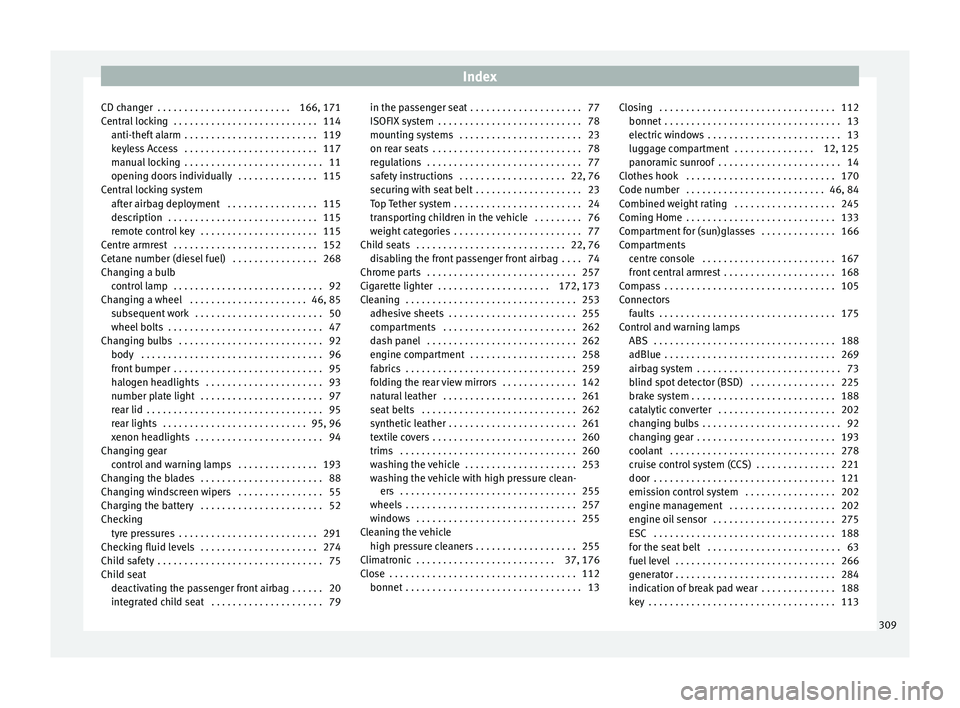
Index
CD changer . . . . . . . . . . . . . . . . . . . . . . . . . 166, 171
C entr
al
locking . . . . . . . . . . . . . . . . . . . . . . . . . . . 114
anti-theft alarm . . . . . . . . . . . . . . . . . . . . . . . . . 119
keyless Access . . . . . . . . . . . . . . . . . . . . . . . . . 117
manual locking . . . . . . . . . . . . . . . . . . . . . . . . . . 11
opening doors individually . . . . . . . . . . . . . . . 115
Central locking system after airbag deployment . . . . . . . . . . . . . . . . . 115
description . . . . . . . . . . . . . . . . . . . . . . . . . . . . 115
remote control key . . . . . . . . . . . . . . . . . . . . . . 115
Centre armrest . . . . . . . . . . . . . . . . . . . . . . . . . . . 152
Cetane number (diesel fuel) . . . . . . . . . . . . . . . . 268
Changing a bulb control lamp . . . . . . . . . . . . . . . . . . . . . . . . . . . . 92
Changing a wheel . . . . . . . . . . . . . . . . . . . . . . 46, 85 subsequent work . . . . . . . . . . . . . . . . . . . . . . . . 50
wheel bolts . . . . . . . . . . . . . . . . . . . . . . . . . . . . . 47
Changing bulbs . . . . . . . . . . . . . . . . . . . . . . . . . . . 92 body . . . . . . . . . . . . . . . . . . . . . . . . . . . . . . . . . . 96
front bumper . . . . . . . . . . . . . . . . . . . . . . . . . . . . 95
halogen headlights . . . . . . . . . . . . . . . . . . . . . . 93
number plate light . . . . . . . . . . . . . . . . . . . . . . . 97
rear lid . . . . . . . . . . . . . . . . . . . . . . . . . . . . . . . . . 95
rear lights . . . . . . . . . . . . . . . . . . . . . . . . . . . 95, 96
xenon headlights . . . . . . . . . . . . . . . . . . . . . . . . 94
Changing gear control and warning lamps . . . . . . . . . . . . . . . 193
Changing the blades . . . . . . . . . . . . . . . . . . . . . . . 88
Changing windscreen wipers . . . . . . . . . . . . . . . . 55
Charging the battery . . . . . . . . . . . . . . . . . . . . . . . 52
Checking tyre pressures . . . . . . . . . . . . . . . . . . . . . . . . . . 291
Checking fluid levels . . . . . . . . . . . . . . . . . . . . . . 274
Child safety . . . . . . . . . . . . . . . . . . . . . . . . . . . . . . . 75
Child seat deactivating the passenger front airbag . . . . . . 20
integrated child seat . . . . . . . . . . . . . . . . . . . . . 79 in the passenger seat . . . . . . . . . . . . . . . . . . . . . 77
ISOFIX sys
tem . . . . . . . . . . . . . . . . . . . . . . . . . . . 78
mounting systems . . . . . . . . . . . . . . . . . . . . . . . 23
on rear seats . . . . . . . . . . . . . . . . . . . . . . . . . . . . 78
regulations . . . . . . . . . . . . . . . . . . . . . . . . . . . . . 77
safety instructions . . . . . . . . . . . . . . . . . . . . 22, 76
securing with seat belt . . . . . . . . . . . . . . . . . . . . 23
Top Tether system . . . . . . . . . . . . . . . . . . . . . . . . 24
transporting children in the vehicle . . . . . . . . . 76
weight categories . . . . . . . . . . . . . . . . . . . . . . . . 77
Child seats . . . . . . . . . . . . . . . . . . . . . . . . . . . . 22, 76 disabling the front passenger front airbag . . . . 74
Chrome parts . . . . . . . . . . . . . . . . . . . . . . . . . . . . 257
Cigarette lighter . . . . . . . . . . . . . . . . . . . . . 172, 173
Cleaning . . . . . . . . . . . . . . . . . . . . . . . . . . . . . . . . 253 adhesive sheets . . . . . . . . . . . . . . . . . . . . . . . . 255
compartments . . . . . . . . . . . . . . . . . . . . . . . . . 262
dash panel . . . . . . . . . . . . . . . . . . . . . . . . . . . . 262
engine compartment . . . . . . . . . . . . . . . . . . . . 258
fabrics . . . . . . . . . . . . . . . . . . . . . . . . . . . . . . . . 259
folding the rear view mirrors . . . . . . . . . . . . . . 142
natural leather . . . . . . . . . . . . . . . . . . . . . . . . . 261
seat belts . . . . . . . . . . . . . . . . . . . . . . . . . . . . . 262
synthetic leather . . . . . . . . . . . . . . . . . . . . . . . . 261
textile covers . . . . . . . . . . . . . . . . . . . . . . . . . . . 260
trims . . . . . . . . . . . . . . . . . . . . . . . . . . . . . . . . . 260
washing the vehicle . . . . . . . . . . . . . . . . . . . . . 253
washing the vehicle with high pressure clean-ers . . . . . . . . . . . . . . . . . . . . . . . . . . . . . . . . . 255
wheels . . . . . . . . . . . . . . . . . . . . . . . . . . . . . . . . 257
windows . . . . . . . . . . . . . . . . . . . . . . . . . . . . . . 255
Cleaning the vehicle high pressure cleaners . . . . . . . . . . . . . . . . . . . 255
Climatronic . . . . . . . . . . . . . . . . . . . . . . . . . . 37, 176
Close . . . . . . . . . . . . . . . . . . . . . . . . . . . . . . . . . . . 112 bonnet . . . . . . . . . . . . . . . . . . . . . . . . . . . . . . . . . 13 Closing . . . . . . . . . . . . . . . . . . . . . . . . . . . . . . . . . 112
bonnet . . . . . . . . . . . . . . . . . . . . . . . . . . . . . . . . . 13
electric
windows . . . . . . . . . . . . . . . . . . . . . . . . . 13
luggage compartment . . . . . . . . . . . . . . . 12, 125
panoramic sunroof . . . . . . . . . . . . . . . . . . . . . . . 14
Clothes hook . . . . . . . . . . . . . . . . . . . . . . . . . . . . 170
Code number . . . . . . . . . . . . . . . . . . . . . . . . . . 46, 84
Combined weight rating . . . . . . . . . . . . . . . . . . . 245
Coming Home . . . . . . . . . . . . . . . . . . . . . . . . . . . . 133
Compartment for (sun)glasses . . . . . . . . . . . . . . 166
Compartments centre console . . . . . . . . . . . . . . . . . . . . . . . . . 167
front central armrest . . . . . . . . . . . . . . . . . . . . . 168
Compass . . . . . . . . . . . . . . . . . . . . . . . . . . . . . . . . 105
Connectors faults . . . . . . . . . . . . . . . . . . . . . . . . . . . . . . . . . 175
Control and warning lamps ABS . . . . . . . . . . . . . . . . . . . . . . . . . . . . . . . . . . 188
adBlue . . . . . . . . . . . . . . . . . . . . . . . . . . . . . . . . 269
airbag system . . . . . . . . . . . . . . . . . . . . . . . . . . . 73
blind spot detector (BSD) . . . . . . . . . . . . . . . . 225
brake system . . . . . . . . . . . . . . . . . . . . . . . . . . . 188
catalytic converter . . . . . . . . . . . . . . . . . . . . . . 202
changing bulbs . . . . . . . . . . . . . . . . . . . . . . . . . . 92
changing gear . . . . . . . . . . . . . . . . . . . . . . . . . . 193
coolant . . . . . . . . . . . . . . . . . . . . . . . . . . . . . . . 278
cruise control system (CCS) . . . . . . . . . . . . . . . 221
door . . . . . . . . . . . . . . . . . . . . . . . . . . . . . . . . . . 121
emission control system . . . . . . . . . . . . . . . . . 202
engine management . . . . . . . . . . . . . . . . . . . . 202
engine oil sensor . . . . . . . . . . . . . . . . . . . . . . . 275
ESC . . . . . . . . . . . . . . . . . . . . . . . . . . . . . . . . . . 188
for the seat belt . . . . . . . . . . . . . . . . . . . . . . . . . 63
fuel level . . . . . . . . . . . . . . . . . . . . . . . . . . . . . . 266
generator . . . . . . . . . . . . . . . . . . . . . . . . . . . . . . 284
indication of break pad wear . . . . . . . . . . . . . . 188
key . . . . . . . . . . . . . . . . . . . . . . . . . . . . . . . . . . . 113
309