2018 Seat Alhambra ECU
[x] Cancel search: ECUPage 79 of 324

Transporting children safely
The physical principles and the forces acting
on the v
ehic
le in the event of a collision or
other type of accidents also apply to children
››› page 65. However, unlike adults and
youngsters, children do not have fully devel-
oped muscle and bone structures. In the
event of an accident, children are subject to a
greater risk than adults of sustaining severe
injuries.
Given that children's bodies are not yet fully
developed, child restraint systems must be
used that are especially adapted to their
height, weight and constitution. There are
laws in force in many countries that indicate
the use of approved seat systems for trans-
porting babies and children.
Only used authorised, approved child seats
that are suitable for the vehicle. Always con-
sult with a technical service centre or a speci-
alised workshop should you have any
doubts.
Specific child seat regulations for each coun-
try (selection)
RegulationFurther information
ECE-R 44 a)technical service centre
a)
ECE-R: Economic Comission for Europe Regulation.
Categorisation of child seats according to
ECE-R44
Weight
categoryWeight of the childInstallation of the child seat
Group 0up to 10 kgRear-facing. On rear seats,optionally using the ISO- FIX system.
Group 0+up to 13 kg
Group 19 to 18 kgForward-facing. On rear
seats, optionally using the ISOFIX system.
Group 215 to 25 kg
Forward-facing. On the
outer rear seats or in the
centre seat of the second row of seats and on all
seats in the third row. Op- tionally with ISOFIX sys- tem.
Group 322 to 36 kgForward-facing. Not all children fit in the seat of their weight
gr
oup
. Nor do al
l seats adapt to the vehicle.
Therefore, always check whether the child fits
properly in the child seat and whether the
seat can be installed safely in the vehicle.
The rear seats are suitable for child seats
with the ISOFIX system specially designed
for this type of vehicle in accordance with
regulation ECE-R 44. Child seats approved under the ECE-R 44 reg-
ulation ar
e fitted with the corresponding ap-
proval symbol. The sign is an upper-case E in
a circle with the identification number below
it.
Use of the child seat on the front pas-
senger se
at1) Transporting children on the front passenger
seat
i
s not permitted in all countries. Further-
more, not all child seats are approved for use
on the front passenger seat. Your technical
service centre has an updated list of all ap-
proved child seats. Only used child seats that
are approved for each vehicle.
The front airbag on the front passenger side
is highly dangerous for a child. The front pas-
senger seat is life-threatening to a child if he
or she is transported in a rear-facing child
seat.
If a rear-facing child seat is secured to the
front passenger seat, an inflating front airbag
can strike it with such great force that severe
or fatal injuries may result ››› . Therefore,
r e
ar
-facing child seats must never be placed
on the front passenger seat when the front
passenger front airbag is enabled. »1)
Compliance with current national legislation and
the manuf act
urer's instructions is required when us-
ing or installing child seats. 77
Technical data
Advice
Operation
Emergencies
Safety
Page 80 of 324

Safety
Only use a rear-facing child seat on the front
p a
s
senger seat if the front passenger front
airbag is disabled. When it is disabled, the
yellow control lamp on the dash panel
will be lit up ››› page 73.
If you cannot disable the front passenger
front airbag and it remains activated, it is
forbidden to transport children on the front
passenger seat ››› .
Thin g
s
to note if using a child seat on the
front passenger seat:
● The front passenger front airbag must
be
disabled when using a rear-facing child
seat ››› page 74.
● The seat backrest of the front passenger
seat mu
st be upright.
● The front passenger seat must be moved as
far bac
k as possible.
● A height-adjustable front passenger seat
must
be raised to its highest point.
● The seat belt height adjustment must be as
high as po
ssible.
Suitable child seats
The child seat must be authorised by the
manufacturer especially for use on a front
passenger seat with a front or side airbag.
If the front passenger seat is equipped with
retaining rings, the child seat can be secured
using an approved retaining system provided
it is approved for this type of vehicle in ac- cordance with current regulations of the
countr
y in question.
Universal seats for children of groups 0, 0+,
1, 2 or 3 according to the standard ECE-R 44
can be mounted on the front passenger seat
and the rear seats. WARNING
If a child seat is mounted on the front passen-
ger se at, the ri
sk of the child sustaining se-
vere or fatal injuries in the event of an acci-
dent increases. Rear-facing child seats must
never be mounted on the front passenger
seat when the front passenger front airbag is
enabled. This is life-threatening to the child
should the front airbag deploy, as the child
seat would be struck by the inflated airbag
and thrown against the seat backrest. WARNING
If, in exceptional circumstances, a child must
be tran s
ported in a rear-facing child seat on
the front passenger seat, strictly observe the
following:
● Always disable the front passenger front
airbag and le
ave it disabled.
● The child seat must be approved by the
manufact
urer for use on a front passenger
seat with front and side airbag.
● Follow the installation instructions of the
chil
d seat manufacturer and observe the
warnings. ●
Mov e the fr
ont passenger seat as far back
as possible and adjust it to its highest posi-
tion to keep as far away as possible from the
front airbag.
● Move the seat backrest to the upright posi-
tion.
● The seat belt height adjustment must be as
high as po
ssible.
● Children must always be protected with an
appro
ved child restraint system suited to
their height and weight. Use of the child seat on the rear seat
If a child seat is mounted on the rear seat,
a
d
apt
the position of the front passenger
seat so that the child has enough space.
Therefore, adapt the front passenger seat to
the size of the child seat and the height of
the child. Ensure the passenger is in the cor-
rect position ››› page 58.
Move the second and third rows of seats fully
back and lock them. Place the seat backs in a
vertical position and fold the head restraints
down.
ISOFIX child seats approved for rear seats
The rear seats are suitable for child seats
with the ISOFIX system specially designed
for this type of vehicle in accordance with
regulation ECE-R 44.
78
Page 83 of 324

Transporting children safely
Seat belt routing on the integrated
c hi
l
d seat Fig. 94
Integrated child seats. adjusting the
se at
belt
. Fig. 95
Integrated child seats. seat belt rout-
in g w
ith guide h
andle Using the guide handle
››
›
Fig. 95, position
the seat belt so that the shoulder part of the
belt lies on the centre of the child's shoulder.
Seat belt guide handle
● Secure the seat belt guide handle to the
side hea
d restraint on the window side. The
guide handle is secured by a button.
● Open the upper button on the seat belt
guide handle and p
ass the belt webbing be-
low the side head restraint and through the
guide handle.
● Close the button again.
Adjustin
g the seat belt
● Guide the automatic three-point seat belt
below the side he
ad restraint.
● Pull the latch plate and slowly place the
belt we
bbing across the child's chest and
lap.
● Insert the latch plate into the buckle for the
appropri
ate seat and push it down until it is
securely locked with an audible click.
● Pull the belt to ensure that the latch plate is
securely
engaged in the buckle. WARNING
The seat belt only offers maximum protection
from sev er
e or fatal injuries when it is cor-
rectly positioned. ●
Chil dr
en must assume the proper sitting
position and be properly belted in while trav-
elling.
● The shoulder belt must be positioned
agains
t the middle of the shoulder.
● The seat belt must lie flat and fit comforta-
bly.
● A
llow the belt to retract until it fits tightly
over the c
hild's seat.
● The lap part of the seat belt must lie across
the pelvis, nev
er across the stomach.
● Only one child may occupy a child seat. Removing the child seat
Fig. 96
Integrated child seats. lowering the
c u
shion Lowering the cushion
● Pull the unlock lever ››
›
Fig. 96 A on the
c u
shion in the dir
ection of the arrow 1 .
»
81
Technical data
Advice
Operation
Emergencies
Safety
Page 85 of 324

Self-help
Emergencies
Self -help
In c a
se of emergency
First aid kit, warning triangle, reflec-
tive vests and fire extinguishers* Fig. 97
On the rear lid: Warning triangle
br ac
k
et Reflective vests
Some
v
ehic
les will have a driver door com-
partment to store a reflective vest
››› page 100.
Warning triangle
With the rear lid open, rotate the lock 90°
››› Fig. 97. Lower the bracket and remove the
warning triangle. First-aid kit
There is
a first aid kit ››› page 166 in the rear
left-hand side storage compartment of the
luggage compartment.
The first aid kit must comply with legal re-
quirements. Check the expiry date of the con-
tents of the first aid kit.
Fire extinguisher
There is a Fire extinguisher underneath the
front passenger seat.
The fire extinguisher must conform to legal
requirements, be ready for use and be
checked regularly. Check the certification
seal on the extinguisher. WARNING
Loose objects in the vehicle interior can be vi-
ol ently
thrown in case of a sudden manoeu-
vre or braking and especially in accidents
causing serious injury.
● Secure fire extinguishers, first aid kit, re-
flective
vests and warning triangle securely
to their respective supports. Vehicle tool kit*
Loc
ation Fig. 98
In the luggage compartment, viewed
fr om in
s
ide the vehicle: the vehicle tool kit lo-
cated in a cavity close to the lock carrier. When securing the vehicle in case of a break-
do
wn, p
l
ease note the legal requirements for
each country.
Depending on the model, the vehicle tools
may be kept in the luggage compartment, in
a cavity close to the lock carrier ››› Fig. 98.
Loosen the safety straps and remove the ve-
hicle tool kit. For vehicles factory-fitted with
winter tyres, you will find additional tools in a
toolbox located in the luggage compartment. WARNING
Loose objects in the vehicle interior can be vi-
ol ently
fired through the compartment in
case of a sudden manoeuvre or braking and » 83
Technical data
Advice
Operation
Emergencies
Safety
Page 86 of 324

Emergencies
especially in accidents causing serious in-
jury
.
● M
ake sure that the vehicle tools are stored
safely
in the luggage compartment. WARNING
Unsuitable or damaged vehicle tools can
c au se injur
y or accidents.
● Never work with inappropriate or damaged
tool
s. Note
After use, return the jack to its initial position
us in
g the handle in order to securely store it
in the vehicle. Components
Fig. 99
Components of the vehicle tool kit The vehicle tool kit depends on the vehicle
equipment
.
The f
ollowing is a description for
a vehicle with all options.
The individual elements of the vehicle tool
kit ››› Fig. 99
Adapter for anti-theft bolt. SEAT recom-
mend you carry the wheel bolt adapter in
the vehicle tool kit at all times. The code
number of the anti-theft wheel bolt is
stamped on the front of the adapter. In
case it is lost, another adapter can be or-
dered using this number. Note the anti-
theft bolt code for the wheels and keep it
in a place other than the vehicle.
Towline anchorage, removable.
Wheel spanner.
Jack crank handle. The crank handle
needs to be folded away before returning
it to the tool kit.
Jack. Before storing the jack in the tool
kit, fold its hook.
Screwdriver with hexagon socket in the
handle for screwing and unscrewing the
wheel bolts. The screwdriver bit is inter-
changeable. The screwdriver may be
found underneath the wheel spanner.
Wire hook for pulling off the wheel cover,
integral hubcaps and the wheel bolt
caps.
1
2
3
4
5
6
7 Note
The jack does not generally require any main-
ten anc
e. If required, it should be greased us-
ing universal type grease. Folding wheel chocks*
Fig. 100
To unfold the foldable wedges. The folding chocks are in the tool kit
› ›
›
Fig. 99.
Assemble the folding chocks
● Lift the base plate ›››
Fig. 100 1 .
● Insert the two “tabs” of the mounting plate
int o the lon
g openin
gs on the base plate 2 .
C orr
ect
use
The folding chocks may be used to block the
wheel diagonally opposite to the wheel being
changed.
84
Page 99 of 324
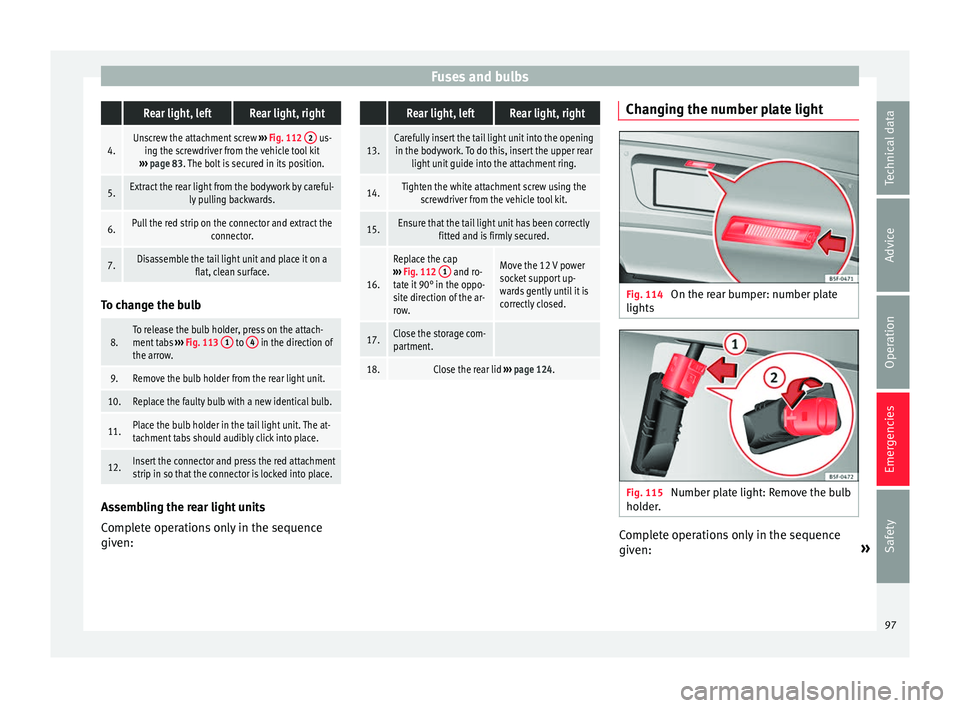
Fuses and bulbs Rear light, leftRear light, right
4.Unscrew the attachment screw
››› Fig. 112 2 us-
ing the screwdriver from the vehicle tool kit
››› page 83. The bolt is secured in its position.
5.Extract the rear light from the bodywork by careful-
ly pulling backwards.
6.Pull the red strip on the connector and extract the connector.
7.Disassemble the tail light unit and place it on aflat, clean surface.To change the bulb
8.To release the bulb holder, press on the attach-
ment tabs
››› Fig. 113 1 to 4 in the direction of
the arrow.
9.Remove the bulb holder from the rear light unit.
10.Replace the faulty bulb with a new identical bulb.
11.Place the bulb holder in the tail light unit. The at-
tachment tabs should audibly click into place.
12.Insert the connector and press the red attachment
strip in so that the connector is locked into place. Assembling the rear light units
C
omp
l
ete operations only in the sequence
given:
Rear light, leftRear light, right
13.Carefully insert the tail light unit into the opening in the bodywork. To do this, insert the upper rear light unit guide into the attachment ring.
14.Tighten the white attachment screw using the screwdriver from the vehicle tool kit.
15.Ensure that the tail light unit has been correctly fitted and is firmly secured.
16.
Replace the cap
››› Fig. 112 1 and ro-
tate it 90° in the oppo-
site direction of the ar-
row.Move the 12 V power
socket support up-
wards gently until it is
correctly closed.
17.Close the storage com-
partment.
18.Close the rear lid ››› page 124. Changing the number plate light
Fig. 114
On the rear bumper: number plate
lights Fig. 115
Number plate light: Remove the bulb
ho l
der
. Complete operations only in the sequence
giv
en: »
97
Technical data
Advice
Operation
Emergencies
Safety
Page 118 of 324

OperationFunctionHandling the buttons on
the vehicle
Unlocking the rear lid.Press the button.
Open the sliding door.›››
page 122. Please note: depending on the c
entr
al lock-
ing function selected in the Convenience submenu, you may have to push the but-
ton twice ›››
page 27 to unlock all doors
and the rear lid.
The vehicle key only locks and unlocks the
vehicle if it is within range of the vehicle and
if the batteries have enough power. When
locking, the vehicle's turn signals will blink.
If the driver door is open, the vehicle cannot
be locked with the key. If you unlock the vehi-
cle without opening any doors or the rear lid,
it will lock again automatically after a few
seconds. This function prevents the vehicle
from remaining unlocked if the unlocking
button is pressed by mistake.
Convenience open/close function
● See ››
›
page 127, Controls for the win-
dows: functions.
● See ›››
page 129, Panoramic sliding sun-
roof: operating. Unlocking and locking the vehicle
from ins
ide Fig. 129
In the driver door: central locking
b utt
on
Push the button ››› Fig. 129:
Unlocking the vehicle.
Locking the vehicle.
The central locking button is still operative
when the ignition i
s
sw
itched off.
The central locking button is only deactivated
if the Safe security system is activated
››› page 119.
Please note the following when you use the
central locking button to lock your vehicle:
● Do not turn on the Safe security system
› ›
› page 119.
● Do not turn on the anti-theft alarm. ●
It w i
ll not be possible to open the doors or
the rear lid from the outside. This may offer
extra safety, for example when stopped at
traffic lights.
● The doors can be opened and unlocked in-
dividually
from the inside by pulling the door
handle. If necessary, pull the door release
lever twice.
● The driver door cannot be locked when
open. This
avoids locking the vehicle key in-
side the vehicle when there is nobody inside.
116
Page 119 of 324

Opening and closing
Locking and unlocking the vehicle
w ith K
eyl
ess Access Fig. 130
Keyless Access locking and ignition
sy s
t
em: in the proximity of the car. Fig. 131
Keyless Access locking and ignition
sy s
t
em: sensor surface A for unlocking in-
s ide the door h
andl
e and sensor surface Bfor locking on the exterior of the handle.
Keyless Access is a key-free locking and igni-
tion sy
s
t
em to unlock and lock the vehicle
without actively using its key. For this, only a valid vehicle key is required to be in an area
near
››
› Fig. 130 the vehicle and one of the
sensor surfaces to be touched on the door
handles ››› Fig. 131.
General information
If a valid key is located in the proximity of the
car ››› Fig. 130, the Keyless Access lock and
ignition system gives the key entry as soon
as one of the sensor surfaces on the door
handles is touched or the push button on the
boot hatch is operated. The following fea-
tures are then available without having to
use the vehicle key actively:
● Keyless-Entry: unlocking of the vehicle with
the handle
s on the four doors or the button
located on the boot hatch.
● Keyless-Go: engine ignition and driving. For
this t
o occur, there has to be a valid key in-
side the vehicle and the ignition push button
needs to be pressed ››› page 183.
● Keyless-Exit: unlocking of the vehicle with
one of the four door h
andle.
The central locking and locking systems oper-
ate in the same way as a normal locking and
unlocking system. Only the controls change.
Unlocking the vehicle is confirmed with a
double flash of the indicator lights; locking
by a single flash. The vehicle will lock again after a few sec-
onds if
you unlock the vehicle but fail to open
any door or boot hatch.
Unlocking and opening the doors (Keyless-
Entry)
● Grip the door handle. In doing this, the
sensor sur
face ››› Fig. 131 A (arrow) is
t ouc
hed on the h
andle and the vehicle un-
locks.
● Open the door.
On vehic
les without the Safe security sys-
tem: shutting and locking doors (Keyless-Ex-
it)
● Switch the ignition off.
● Close the driver's door.
● Touch the surface sensor B onc
e (arrow)
on the door h andl
e. The door being operated
must be closed.
On vehicles with the Safe security system:
shutting and locking doors (Keyless-Exit)
● Switch the ignition off.
● Close the driver's door.
● Touch the surface sensor B onc
e (arrow)
on the door h andl
e. The vehicle locks with
the Safe security system ››› page 119. The
door being operated must be closed. »
117
Technical data
Advice
Operation
Emergencies
Safety