Page 269 of 364
3.53
3
LUGGAGE NET (1/3)
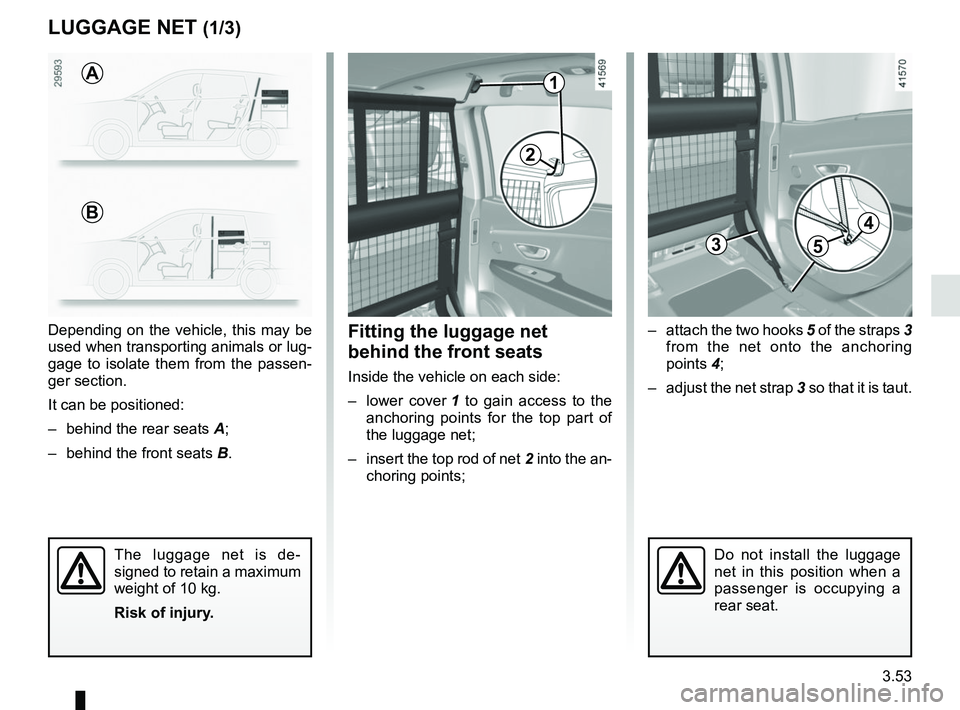
– attach the two hooks 5 of the straps 3 from the net onto the anchoring
points 4;
– adjust the net strap 3 so that it is taut.Fitting the luggage net
behind the front seats
Inside the vehicle on each side:
– lower cover 1 to gain access to the
anchoring points for the top part of
the luggage net;
– insert the top rod of net 2 into the an-
choring points;
Depending on the vehicle, this may be
used when transporting animals or lug-
gage to isolate them from the passen-
ger section.
It can be positioned:
– behind the rear seats
A;
– behind the front seats B.
The luggage net is de-
signed to retain a maximum
weight of 10 kg.
Risk of injury.Do not install the luggage
net in this position when a
passenger is occupying a
rear seat.
A
B
1
2
5
4
Page 271 of 364
3.55
8
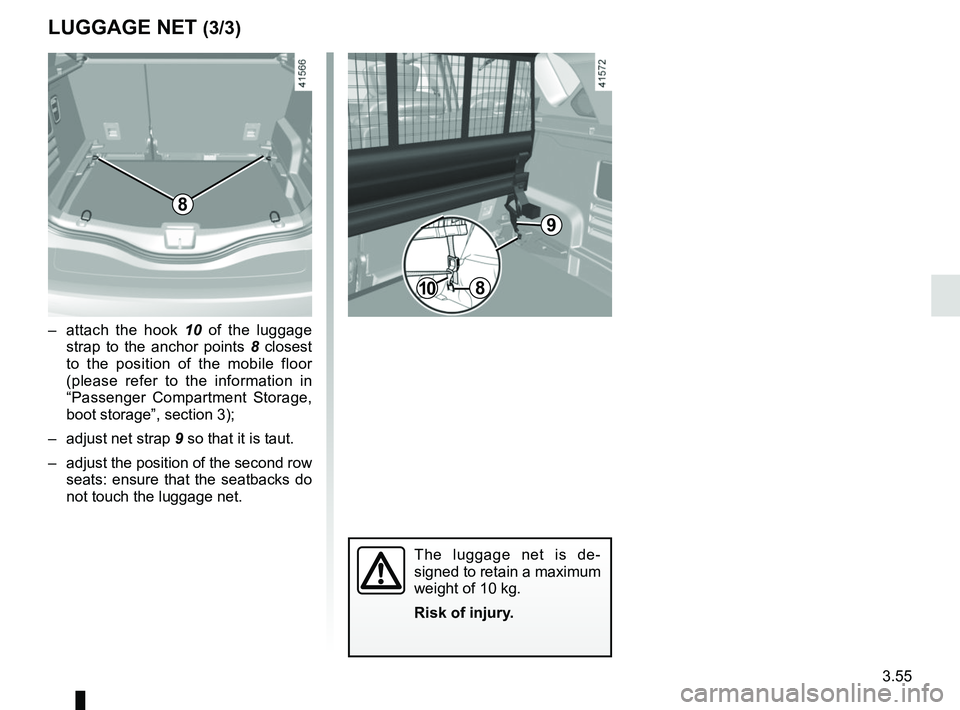
– attach the hook 10 of the luggage strap to the anchor points 8 closest
to the position of the mobile floor
(please refer to the information in
“Passenger Compartment Storage,
boot storage”, section 3);
– adjust net strap 9 so that it is taut.
– adjust the position of the second row seats: ensure that the seatbacks do
not touch the luggage net.
10
9
LUGGAGE NET (3/3)
8
The luggage net is de-
signed to retain a maximum
weight of 10 kg.
Risk of injury.
Page 272 of 364
3.56
ROOF BARS
For information on the range of
equipment adapted to your vehi-
cle, we advise you to consult an ap-
proved Dealer.
Refer to the fitting instructions for in-
formation on how to fit roof bars and
conditions of use.
Please keep these instructions with
the rest of the vehicle documenta-
tion.
Maximum permissible load on
roof rack: refer to the information
on “Weights” in Section 6.
The attaching of any carry-
ing device (bike rack, lug-
gage box, etc.) resting on
the luggage compartment
lid is prohibited. To install a carrying
device on your vehicle, contact an
Approved Dealer.
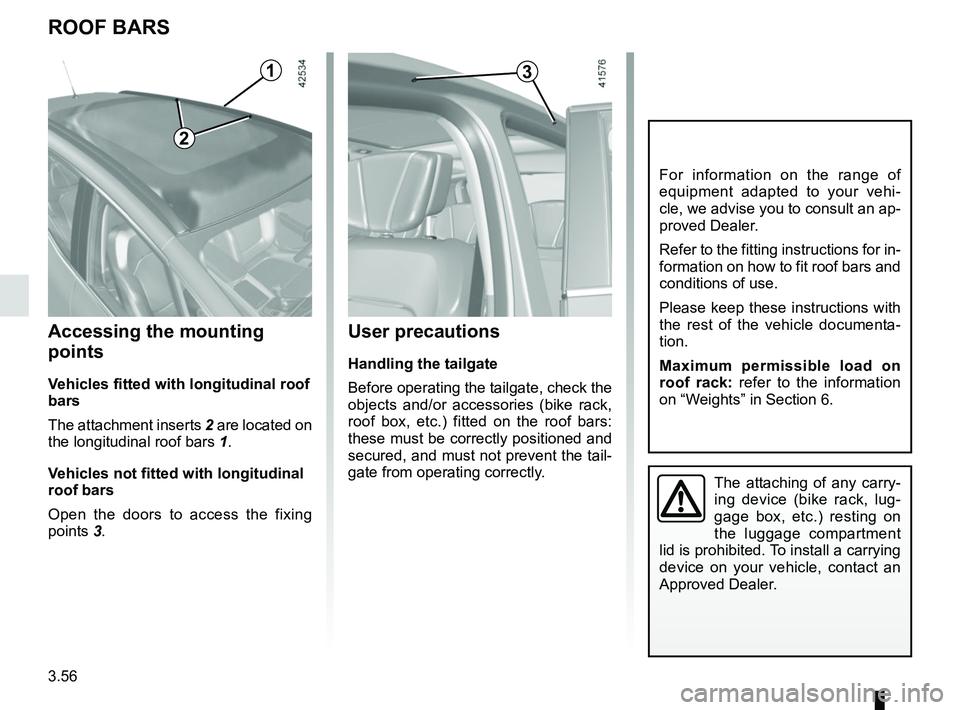
Accessing the mounting
points
Vehicles fitted with longitudinal roof
bars
The attachment inserts 2 are located on
the longitudinal roof bars 1.
Vehicles not fitted with longitudinal
roof bars
Open the doors to access the fixing
points 3.
3
User precautions
Handling the tailgate
Before operating the tailgate, check the
objects and/or accessories (bike rack,
roof box, etc.) fitted on the roof bars:
these must be correctly positioned and
secured, and must not prevent the tail-
gate from operating correctly.
1
2
Page 275 of 364
4.3
BONNET (2/2)
Closing the bonnet
Check that nothing has been left in the
engine compartment.
To close the bonnet again, hold the
bonnet in the middle and lower it to
30 cm above the closed position, then
release it. It will latch automatically
under its own weight.
Ensure that the bonnet is
properly locked.
Check that nothing is pre-
venting the catch from lock-
ing (gravel, cloth, etc.).
After carrying out any work
in the engine compart-
ment, check that nothing
has been left behind (cloth,
tools, etc.).
These may damage the engine or
cause a fire.
In the event of even a slight
impact involving the radia-
tor grille or bonnet, have the
bonnet lock checked by an
authorised dealer as soon as pos-
sible.
Page 285 of 364
4.13
TYRE PRESSURE (1/2)
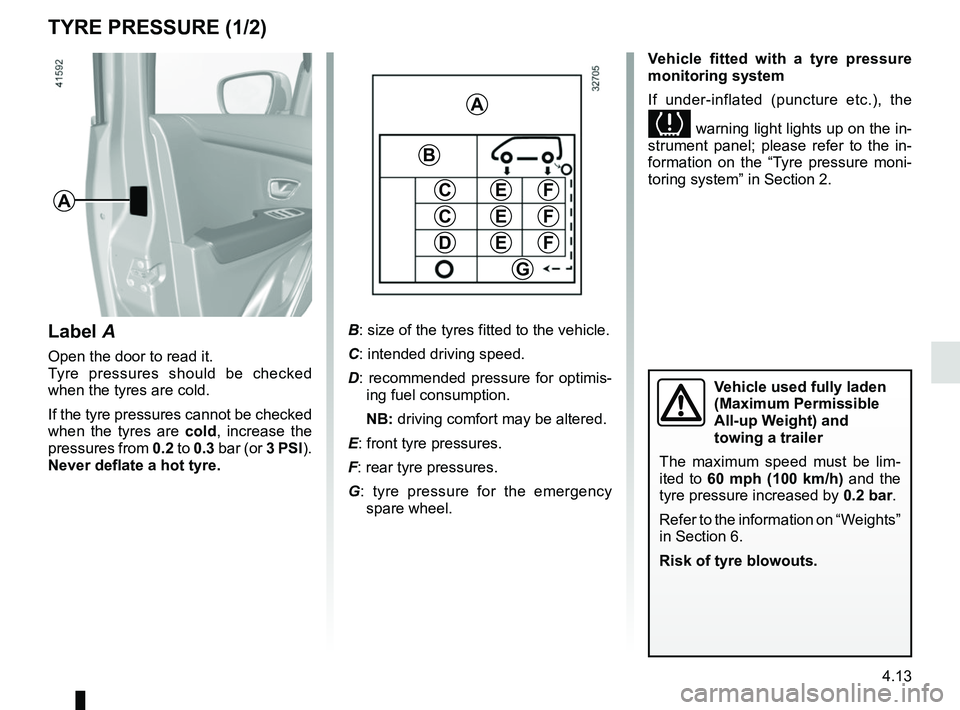
A
Label A
Open the door to read it.
Tyre pressures should be checked
when the tyres are cold.
If the tyre pressures cannot be checked
when the tyres are cold, increase the
pressures from 0.2 to 0.3 bar (or 3 PSI).
Never deflate a hot tyre. Vehicle fitted with a tyre pressure
monitoring system
If under-inflated (puncture etc.), the
warning light lights up on the in-
strument panel; please refer to the in-
formation on the “Tyre pressure moni-
toring system” in Section 2.
B: size of the tyres fitted to the vehicle.
C: intended driving speed.
D: recommended pressure for optimis- ing fuel consumption.
NB: driving comfort may be altered.
E: front tyre pressures.
F: rear tyre pressures.
G : tyre pressure for the emergency
spare wheel.
A
C
D
FE
G
B
C
E
E
F
F
Vehicle used fully laden
(Maximum Permissible
All-up Weight) and
towing a trailer
The maximum speed must be lim-
ited to 60 mph (100 km/h) and the
tyre pressure increased by 0.2 bar.
Refer to the information on “Weights”
in Section 6.
Risk of tyre blowouts.
Page 328 of 364
5.36
TOWING: breakdown (1/2)
Before towing, put the gearbox in neu-
tral, unlock the steering column and re-
lease the parking brake.
For vehicles fitted with an automatic
gearbox, if it is not possible to put the
gear lever into position N, please con-
sult an authorised dealer.
Steering column unlocking
Insert the key into the ignition or, de-
pending on the vehicle, with the
RENAULT card on you, press the
engine start button for approximately
2 seconds.
Reposition the lever to neutral (posi-
tion N for vehicles fitted with an auto-
matic gearbox).
The steering column unlocks, the ac-
cessory functions are powered: you
can use the vehicle’s lights (direction
indicators, brake lights, etc.). At night
the vehicle must have its lights on.
Depending on the vehicle, once you
have finished towing, press the engine
start button twice (risk of running down
the battery). The speed specified by current legis-
lation for towing must always be ob-
served. If your vehicle is the towing
vehicle, do not exceed the maximum
towing weight for your vehicle (refer to
the information on “Weights” in
Section 6).
Towing a vehicle with an
automatic gearbox
Transport the vehicle on a trailer or tow
it with the front wheels off the ground.
In exceptional circumstances
, you
may tow it with all four wheels on the
ground, only in a forward gear, with the
gear lever in neutral position N over a
maximum distance of 50 miles (80 km)
and at a maximum speed of 16 mph
(25 km/h).
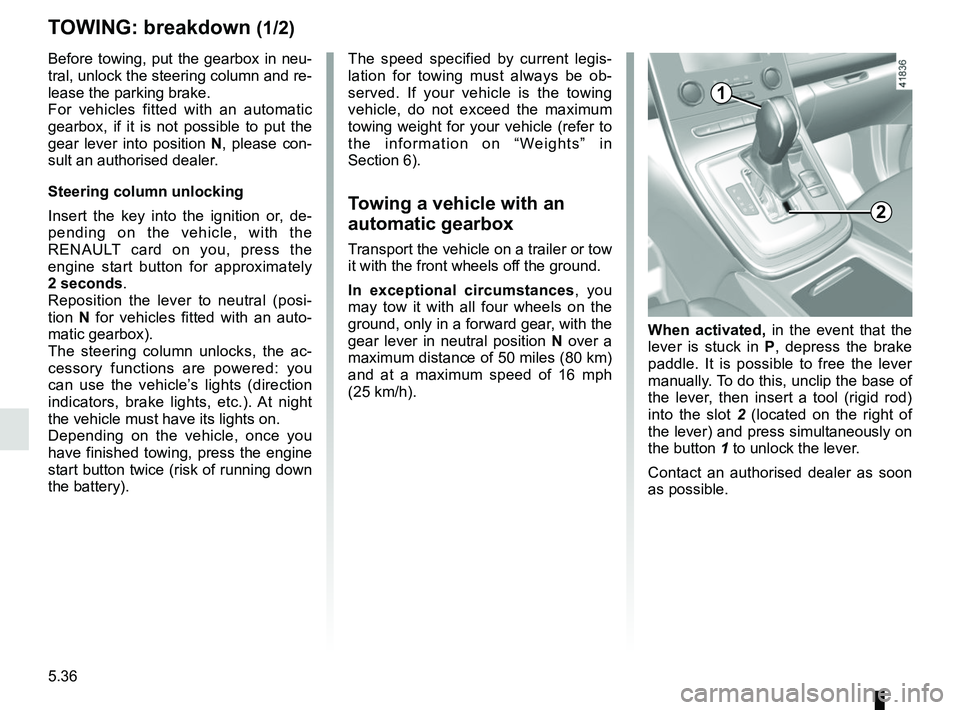
When activated, in the event that the
lever is stuck in P , depress the brake
paddle. It is possible to free the lever
manually. To do this, unclip the base of
the lever, then insert a tool (rigid rod)
into the slot 2 (located on the right of
the lever) and press simultaneously on
the button 1 to unlock the lever.
Contact an authorised dealer as soon
as possible.
2
1
Page 337 of 364

6.1
Section 6: Technical specifications
Vehicle identification plates . . . . . . . . . . . . . . . . . . . . . . . . . . . . . . . . . . . . \
. . . . . . . . . . . . . . . . . . . . 6.2
Engine identification plates . . . . . . . . . . . . . . . . . . . . . . . . . . . . . . . . . . . .\
. . . . . . . . . . . . . . . . . . . . 6.3
Dimensions . . . . . . . . . . . . . . . . . . . . . . . . . . . . . . . . . . . .\
. . . . . . . . . . . . . . . . . . . . . . . . . . . . . . . . 6.4
Engine specifications . . . . . . . . . . . . . . . . . . . . . . . . . . . . . . . . . . . . \
. . . . . . . . . . . . . . . . . . . . . . . . . 6.6
Weights . . . . . . . . . . . . . . . . . . . . . . . . . . . . . . . . . . . .\
. . . . . . . . . . . . . . . . . . . . . . . . . . . . . . . . . . . 6.7
Towing weights . . . . . . . . . . . . . . . . . . . . . . . . . . . . . . . . . . . .\
. . . . . . . . . . . . . . . . . . . . . . . . . . . . . 6.7
Replacement parts and repairs . . . . . . . . . . . . . . . . . . . . . . . . . . . . . . . . . . . . \
. . . . . . . . . . . . . . . . . 6.8
Service sheets . . . . . . . . . . . . . . . . . . . . . . . . . . . . . . . . . . . . \
. . . . . . . . . . . . . . . . . . . . . . . . . . . . . . 6.9
Anticorrosion check . . . . . . . . . . . . . . . . . . . . . . . . . . . . . . . . . . . . \
. . . . . . . . . . . . . . . . . . . . . . . . . . 6.15
Page 338 of 364
6.2
VEHICLE IDENTIFICATION PLATES
A
B
A
97
8
10
5
1
2
3
4
6
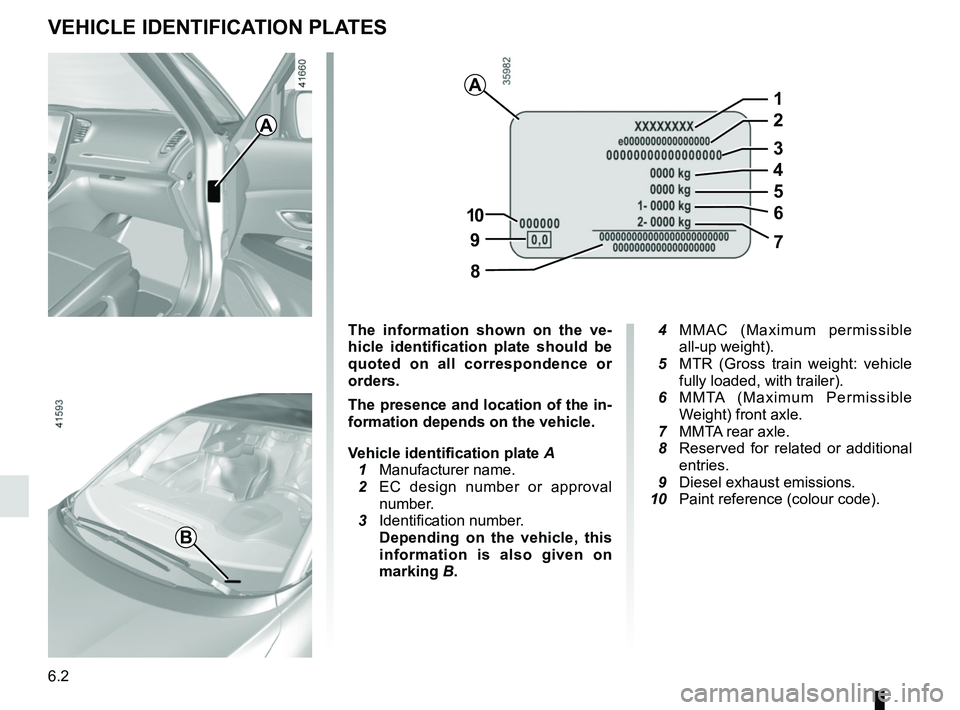
The information shown on the ve-
hicle identification plate should be
quoted on all correspondence or
orders.
The presence and location of the in-
formation depends on the vehicle.
Vehicle identification plate A
1 Manufacturer name.
2 EC design number or approval
number.
3 Identification number.
Depending on the vehicle, this
information is also given on
marking B.
4 MMAC (Maximum permissible
all-up weight).
5 MTR (Gross train weight: vehicle
fully loaded, with trailer).
6 MMTA (Maximum Permissible
Weight) front axle.
7 MMTA rear axle.
8 Reserved for related or additional
entries.
9 Diesel exhaust emissions.
10 Paint reference (colour code).