2018 RENAULT MEGANE air
[x] Cancel search: airPage 271 of 348
4.19
You should not:
Position objects such as deodorants,
scents etc. near air vents as this could
damage your dashboard trim.
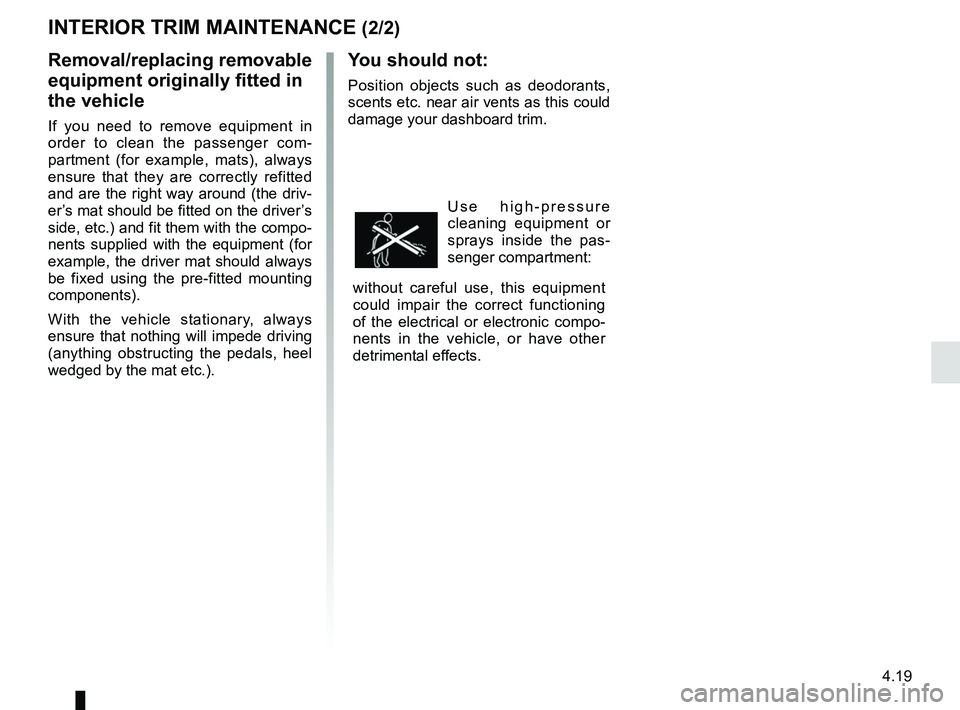
Use high-pressure
cleaning equipment or
sprays inside the pas-
senger compartment:
without careful use, this equipment
could impair the correct functioning
of the electrical or electronic compo-
nents in the vehicle, or have other
detrimental effects.
INTERIOR TRIM MAINTENANCE (2/2)
Removal/replacing removable
equipment originally fitted in
the vehicle
If you need to remove equipment in
order to clean the passenger com-
partment (for example, mats), always
ensure that they are correctly refitted
and are the right way around (the driv-
er’s mat should be fitted on the driver’s
side, etc.) and fit them with the compo-
nents supplied with the equipment (for
example, the driver mat should always
be fixed using the pre-fitted mounting
components).
With the vehicle stationary, always
ensure that nothing will impede driving
(anything obstructing the pedals, heel
wedged by the mat etc.).
Page 275 of 348
5.3
PUNCTURE, EMERGENCY SPARE WHEEL (2/2)
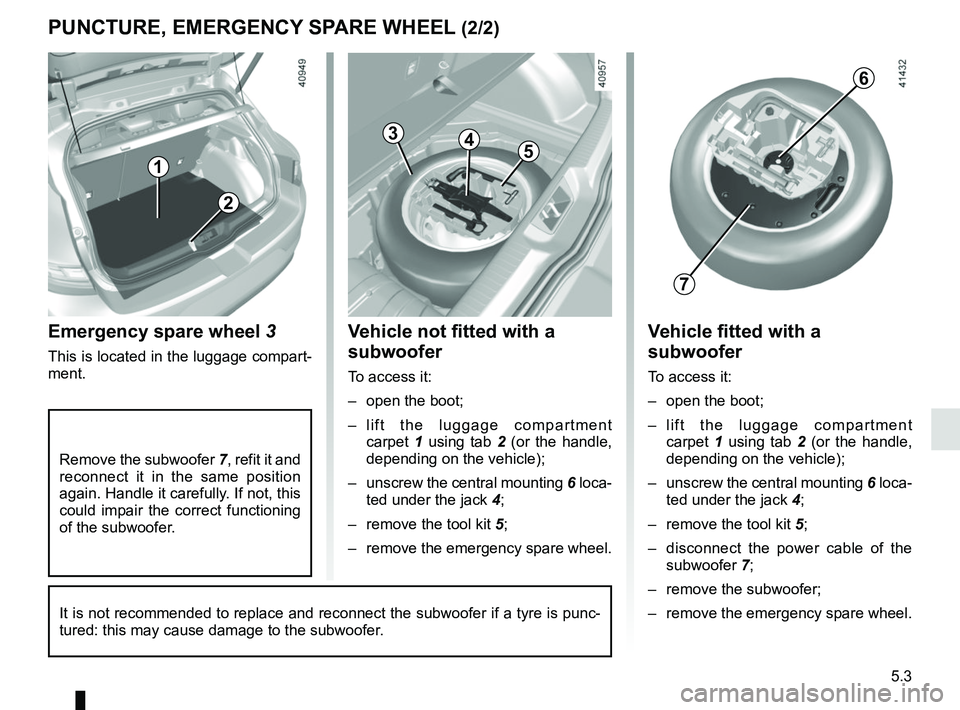
Emergency spare wheel 3
This is located in the luggage compart-
ment.
2
1
43
5
Vehicle not fitted with a
subwoofer
To access it:
– open the boot;
– lift the luggage compartment carpet 1 using tab 2 (or the handle,
depending on the vehicle);
– unscrew the central mounting 6 loca-
ted under the jack 4;
– remove the tool kit 5;
– remove the emergency spare wheel.
Vehicle fitted with a
subwoofer
To access it:
– open the boot;
– lift the luggage compartment carpet 1 using tab 2 (or the handle,
depending on the vehicle);
– unscrew the central mounting 6 loca-
ted under the jack 4;
– remove the tool kit 5;
– disconnect the power cable of the subwoofer 7;
– remove the subwoofer;
– remove the emergency spare wheel.
6
7
Remove the subwoofer 7, refit it and
reconnect it in the same position
again. Handle it carefully. If not, this
could impair the correct functioning
of the subwoofer.
It is not recommended to replace and reconnect the subwoofer if a tyre i\
s punc-
tured: this may cause damage to the subwoofer.
Page 276 of 348

5.4
TYRE PRESSURE KIT (1/3)
The kit is only approved for
inflating the tyres of the ve-
hicle originally equipped
with the kit.
It must never be used to inflate
the tyres of another vehicle, or any
other inflatable object (rubber ring,
rubber boat, etc.).
Avoid spillage on skin when han-
dling the repair product bottle. If
droplets do leak out, rinse them off
with plenty of water.
Keep the repair kit away from chil-
dren.
Do not dispose of the empty bottle
in the countryside. Return it to your
approved dealer or to a recycling or-
ganisation.
The bottle has a limited service
life which is indicated on its label.
Check the expiry date.
Contact an approved dealer to re-
place the inflation tube and repair
product bottle.
A
B
The kit repairs tyres when
tread A has been dam-
aged by objects smaller
than 4 mm. It cannot repair
all types of puncture, such as cuts
larger than 4 mm, or cuts in tyre
sidewall B.
Ensure also that the wheel rim is in
good condition.
Do not pull out the foreign body
causing the puncture if it is still in
the tyre.
Do not attempt to use the
inflation kit if the tyre has
been damaged as a result
of driving with a puncture.
You should therefore carefully check
the condition of the tyre sidewalls
before any operation.
Driving with underinflated, flat or
punctured tyres can be dangerous
and may make the tyre impossible
to repair.
This repair is temporary
A tyre which has been punctured
should always be inspected (and re-
paired, where possible) as soon as
possible by a specialist.
When taking a tyre which has been
repaired using this kit to be replaced,
you must inform the specialist.
When driving, vibration may be felt
due to the presence of the repair
product injected into the tyre.
Page 278 of 348

5.6
TYRE PRESSURE KIT (3/3)
3
If a minimum pressure of 1.8 bar is
not reached after 15 minutes, repair
is not possible; do not drive the ve-
hicle but contact an approved dealer.Once the tyre is correctly inflated,
remove the kit: slowly unscrew the in-
flation end piece
3 to prevent any prod-
uct spatter and store the container in
plastic packaging to prevent product
leaks.
– Affix the driving recommendation label (located under the container) to
the dashboard where the driver can
see it.
– Put the kit away.
– At the end of this initial inflation op- eration, air will still escape from the
tyre. You must drive a short distance
in order to seal the hole.
– Start immediately and drive at be- tween 12 and 40 mph (20 and
60 km/h) in order to distribute the
product evenly in the tyre and, after
driving for 2 miles (3 km), stop and
check the pressure.
– If the pressure is greater than 1.3 bar but less than the recommended
pressure, re-adjust it (refer to the
label affixed to the edge of the driv-
er’s door), otherwise contact an ap-
proved dealer: repair is not possible.
Please be aware that a
poorly tightened or miss-
ing valve cap can make the
tyres less airtight and may
lead to pressure loss.
Always use valve caps identical to
those fitted originally and tighten
them fully.
Following repair with the kit,
do not travel further than
120 miles (200 km). In addi-
tion, reduce your speed and
under no circumstances exceed
48 mph (80 km/h). The sticker,
which you must affix in a prominent
position on the dashboard, reminds
you of this.
Depending on the country or local
legislation, a tyre repaired with the
inflation kit may need to be replaced.
Nothing should be placed
around the driver’s feet
as such objects may slide
under the pedals during
sudden braking manoeuvres and
obstruct their use.
Precautions when using the
kit
The kit should not be operated for more
than 15 consecutive minutes.
Page 279 of 348
5.7
TOOLS
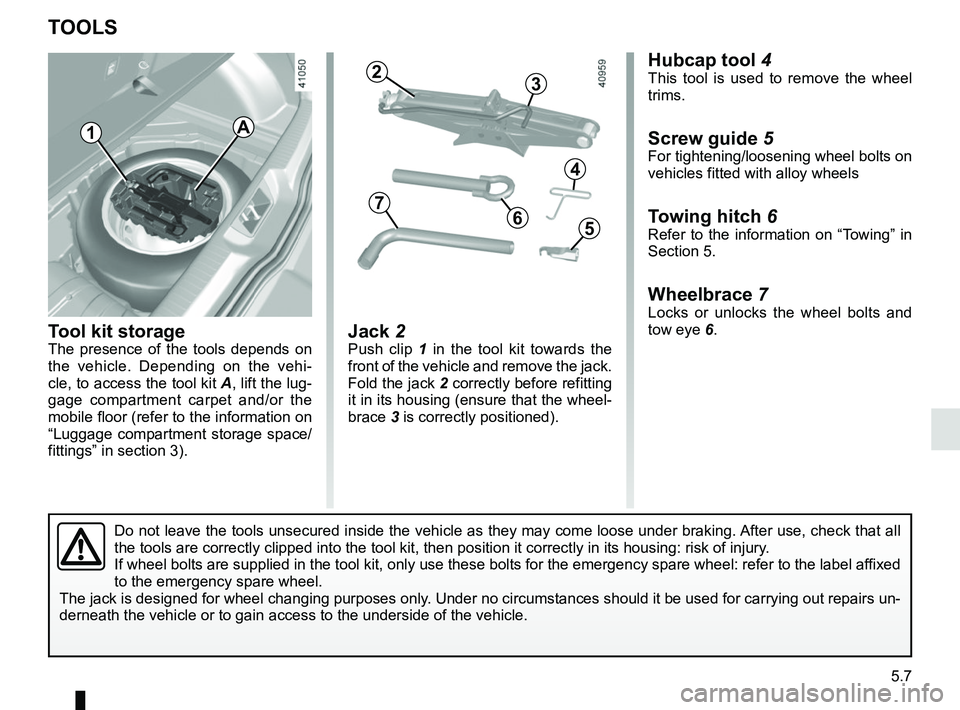
Tool kit storageThe presence of the tools depends on
the vehicle. Depending on the vehi-
cle, to access the tool kit A, lift the lug-
gage compartment carpet and/or the
mobile floor (refer to the information on
“Luggage compartment storage space/
fittings” in section 3).Jack 2Push clip 1 in the tool kit towards the
front of the vehicle and remove the jack.
Fold the jack 2 correctly before refitting
it in its housing (ensure that the wheel-
brace 3 is correctly positioned).
Hubcap tool 4This tool is used to remove the wheel
trims.
Screw guide 5For tightening/loosening wheel bolts on
vehicles fitted with alloy wheels
Towing hitch 6Refer to the information on “Towing” in
Section 5.
Wheelbrace 7Locks or unlocks the wheel bolts and
tow eye 6.
7
4
6
3
5
A1
2
Do not leave the tools unsecured inside the vehicle as they may come loo\
se under braking. After use, check that all
the tools are correctly clipped into the tool kit, then position it corr\
ectly in its housing: risk of injury.
If wheel bolts are supplied in the tool kit, only use these bolts for th\
e emergency spare wheel: refer to the label affixed
to the emergency spare wheel.
The jack is designed for wheel changing purposes only. Under no circumstances should it be used for carrying out repairs un-
derneath the vehicle or to gain access to the underside of the vehicle.
Page 282 of 348
5.10
Undo the bolts and take off the wheel.
Fit the emergency spare wheel onto
the hub and rotate it until the mounting
holes in the wheel coincide with those
of the hub.
If bolts are supplied with the emergency
spare wheel, only use these bolts for
the emergency spare wheel. Tighten
the bolts, checking that the wheel is
correctly positioned on its hub and un-
screw the jack.
With the wheel on the ground, tighten
the bolts fully and have the tightness of
the bolts checked and the emergency
spare wheel pressure checked as soon
as possible.
Anti-theft bolt
If you use anti-theft bolts, fit these
nearest the valve (wheel embel-
lisher may not be able to fit).
If you have a puncture, re-
place the wheel as soon as
possible.
A tyre which has been punc-
tured should always be inspected
(and repaired, where possible) by a
specialist.
CHANGING A WHEEL (2/2)
Page 284 of 348
5.12
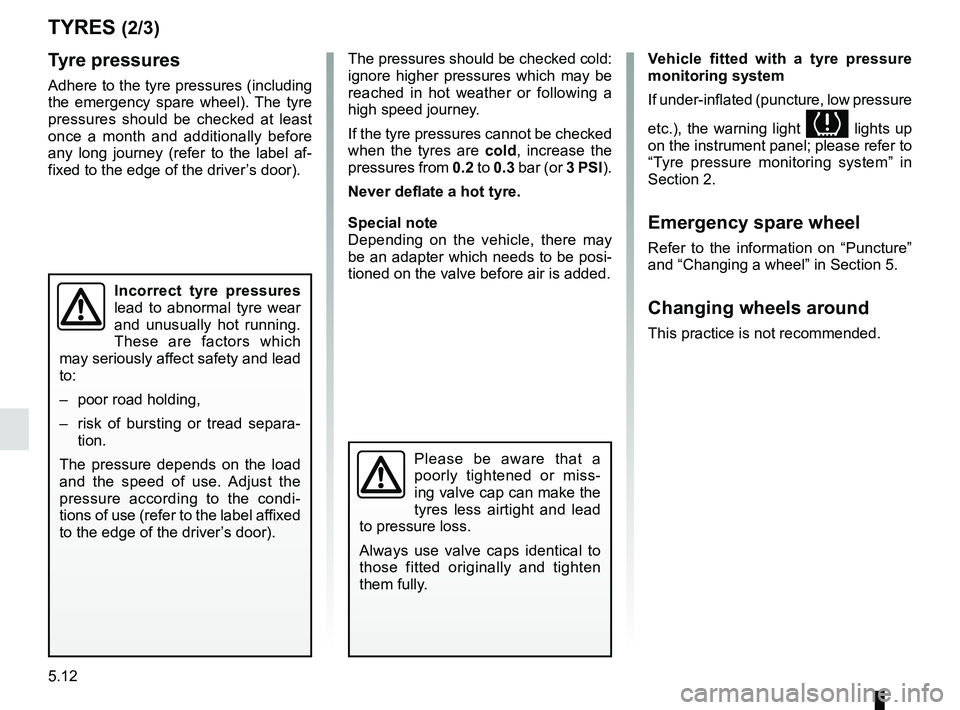
TYRES (2/3)
Tyre pressures
Adhere to the tyre pressures (including
the emergency spare wheel). The tyre
pressures should be checked at least
once a month and additionally before
any long journey (refer to the label af-
fixed to the edge of the driver’s door).The pressures should be checked cold:
ignore higher pressures which may be
reached in hot weather or following a
high speed journey.
If the tyre pressures cannot be checked
when the tyres are
cold, increase the
pressures from 0.2 to 0.3 bar (or 3 PSI).
Never deflate a hot tyre.
Special note
Depending on the vehicle, there may
be an adapter which needs to be posi-
tioned on the valve before air is added. Vehicle fitted with a tyre pressure
monitoring system
If under-inflated (puncture, low pressure
etc.), the warning light
lights up
on the instrument panel; please refer to
“Tyre pressure monitoring system” in
Section 2.
Emergency spare wheel
Refer to the information on “Puncture”
and “Changing a wheel” in Section 5.
Changing wheels around
This practice is not recommended.
Incorrect tyre pressures
lead to abnormal tyre wear
and unusually hot running.
These are factors which
may seriously affect safety and lead
to:
– poor road holding,
– risk of bursting or tread separa- tion.
The pressure depends on the load
and the speed of use. Adjust the
pressure according to the condi-
tions of use (refer to the label affixed
to the edge of the driver’s door).
Please be aware that a
poorly tightened or miss-
ing valve cap can make the
tyres less airtight and lead
to pressure loss.
Always use valve caps identical to
those fitted originally and tighten
them fully.
Page 319 of 348

6.1
Section 6: Technical specifications
Vehicle identification plates . . . . . . . . . . . . . . . . . . . . . . . . . . . . . . . . . . . . \
. . . . . . . . . . . . . . . . . . . . 6.2
Engine identification plates . . . . . . . . . . . . . . . . . . . . . . . . . . . . . . . . . . . .\
. . . . . . . . . . . . . . . . . . . . 6.3
Dimensions . . . . . . . . . . . . . . . . . . . . . . . . . . . . . . . . . . . .\
. . . . . . . . . . . . . . . . . . . . . . . . . . . . . . . . 6.5
Engine specifications . . . . . . . . . . . . . . . . . . . . . . . . . . . . . . . . . . . . \
. . . . . . . . . . . . . . . . . . . . . . . . . 6.8
Weights . . . . . . . . . . . . . . . . . . . . . . . . . . . . . . . . . . . .\
. . . . . . . . . . . . . . . . . . . . . . . . . . . . . . . . . . . 6.9
Towing weights . . . . . . . . . . . . . . . . . . . . . . . . . . . . . . . . . . . .\
. . . . . . . . . . . . . . . . . . . . . . . . . . . . . 6.9
Replacement parts and repairs . . . . . . . . . . . . . . . . . . . . . . . . . . . . . . . . . . . . \
. . . . . . . . . . . . . . . . . 6.10
Service sheets . . . . . . . . . . . . . . . . . . . . . . . . . . . . . . . . . . . . \
. . . . . . . . . . . . . . . . . . . . . . . . . . . . . . 6.11
Anticorrosion check . . . . . . . . . . . . . . . . . . . . . . . . . . . . . . . . . . . . \
. . . . . . . . . . . . . . . . . . . . . . . . . . 6.17