2018 RENAULT MASTER Passenger door
[x] Cancel search: Passenger doorPage 31 of 290
1.25
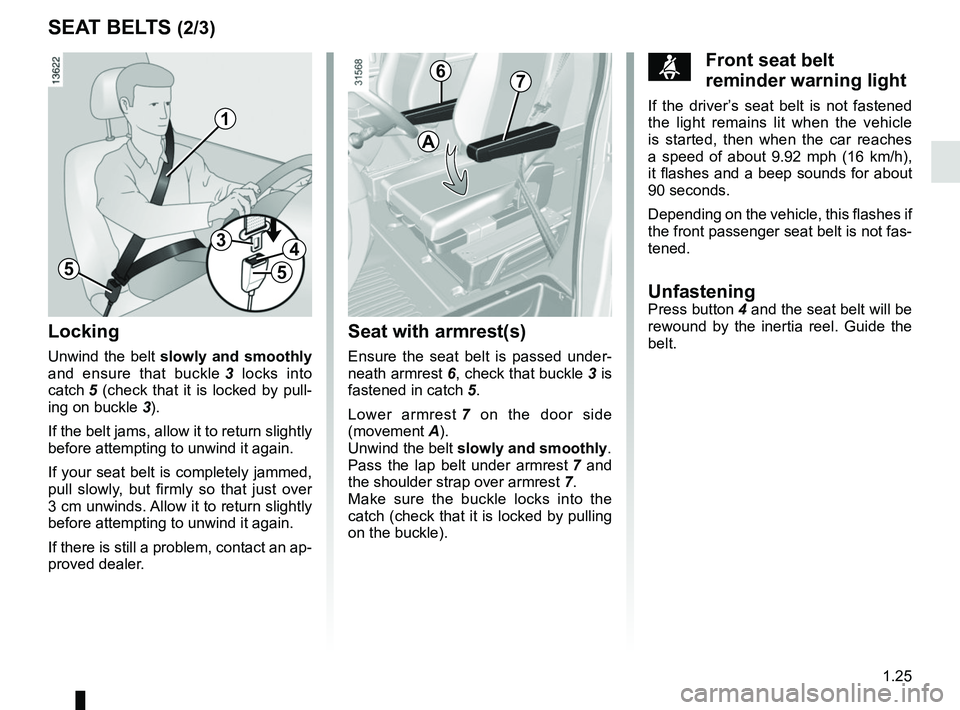
SEAT BELTS (2/3)
5
34
5
1
Locking
Unwind the belt slowly and smoothly
and ensure that buckle 3 locks into
catch 5 (check that it is locked by pull- ing on buckle 3).
If the belt jams, allow it to return slightly
before attempting to unwind it again.
If your seat belt is completely jammed,
pull slowly, but firmly so that just over
3 cm unwinds. Allow it to return slightly
before attempting to unwind it again.
If there is still a problem, contact an ap-
proved dealer.
Seat with armrest(s)
Ensure the seat belt is passed under-
neath armrest 6, check that buckle 3 is
fastened in catch 5.
Lower armrest 7 on the door side
(movement A).
Unwind the belt slowly and smoothly .
Pass the lap belt under armrest 7 and
the shoulder strap over armrest 7.
Make sure the buckle locks into the
catch (check that it is locked by pulling
on the buckle).
ßFront seat belt
reminder warning light
If the driver’s seat belt is not fastened
the light remains lit when the vehicle
is started, then when the car reaches
a speed of about 9.92 mph (16 km/h),
it flashes and a beep sounds for about
90 seconds.
Depending on the vehicle, this flashes if
the front passenger seat belt is not fas-
tened.
UnfasteningPress button 4 and the seat belt will be
rewound by the inertia reel. Guide the
belt.
A
76
Page 39 of 290

1.33
CHILD SAFETY: General information (1/2)
Carrying children
Children, and adults, must be correctly
seated and strapped in for all journeys.
The children being carried in your vehi-
cle are your responsibility.
A child is not a miniature adult. Children
are at risk of specific injuries as their
muscles and bones have not yet fin-
ished growing. The seat belt alone
would not provide suitable protection.
Use an approved child seat and ensure
you use it correctly.
A collision at 30 mph
(50 km/ h) is the same
as falling a distance of
10 metres. Transporting a
child without a restraint is the equiv-
alent of allowing him or her to play
on a fourth-floor balcony without
railings.
Never travel with a child held in your
arms. In the event of an accident,
you will not be able to keep hold of
the child, even if you yourself are
wearing a seat belt.
If your vehicle has been involved
in a road accident, replace the
child seat and have the seat belts
checked.
To prevent the doors being
opened, use the childproof
locks (please refer to the in-
formation on “Locking/un-
locking the doors” in Section 1).
Driver’s responsibility
when parking or stopping
the vehicle
Never leave an animal,
child or adult who is not self-suffi-
cient alone on your vehicle, even for
a short time.
They may pose a risk to themselves
or to others by starting the engine,
activating equipment such as the
electric windows or by locking the
doors.
Also, in hot and/or sunny weather,
please remember that the tempera-
ture inside the passenger compart-
ment increases very quickly.
RISK OF DEATH OR SERIOUS
INJURY.
Page 110 of 290

1.104
Please ensure that you comply with the
legislation of your country.
It is important to remember that failure
to respect regulations in force could
lead to legal action being taken against
the vehicle owner.
Operating principleThe use of additives reduces exhaust
emissions by transforming the pollu-
tants into water vapour and nitrogen.
Topping upCapacity of the fuel tank: 20 litres ap-
proximately.
Open the front passenger door to open
the cover 2. Unscrew the cap 1.
ADDITIVE TANK (1/6)
Fuel filler cap: this is spe-
cific.
If you have to replace it,
make sure it is identical to
the original cap. Contact an appro-
ved Dealer. Do not wash the filler
area with a high pressure washer.
2
1
Vehicle fitted with the Stop and
Start function
To fill up with additive, the engine
must be stopped (and not on
standby): stop the engine (Please
See “Starting, stopping the engine”
in Section 2).
No work whatsoever is
permitted on any part of
the system. To prevent
damage, only qualified per-
sonnel from our network may work
on the system.
If the warning “XXX KM
STOP ADD ADBLUE” ap-
pears, fill the additive tank
and refer to the filling in-
structions.
Risk of immobilisation of the
vehicle.
Topping up
After filling the additive
tank, check that the cap and
cover are closed, start the
engine and IMPERATIVELY wait
for 10 seconds with the vehicle
stationary, engine running before
setting off again.
If this operation is not carried out,
the filling of the tank will only be
taken into account automatically
after at least several dozens of mi-
nutes of driving.
The message “--- ADD ADBLUE”
and/or the warning lights will conti-
nue to appear until the filling has
been taken into account by the
system.
Page 119 of 290

2.3
STARTING, STOPPING THE ENGINE
Starting the engine
Turn the ignition key to the “Ignition on”
position M and hold this position until
the engine preheating warning light
É goes out.
Stopping the engine
With the engine idling, turn the key to
the “Stop” position St.
Starting the vehicle
For rear-wheel drive versions on
level ground, with the vehicle un-
laden, we recommend that you start
in second gear.
Never switch off the igni-
tion before the vehicle has
stopped completely. Once
the engine has stopped, the
brake servo, power-assisted steer-
ing, etc. and the passive safety de-
vices such as air bags and preten-
sioners will no longer operate.
Driver’s responsibility
when parking or stopping
the vehicle
Never leave an animal,
child or adult who is not self-suffi-
cient alone in your vehicle, even for
a short time.
They may pose a risk to themselves
or to others by starting the engine,
activating equipment such as the
electric windows or locking the
doors, for example.
Also, in hot and/or sunny weather,
please remember that the tempera-
ture inside the passenger compart-
ment increases very quickly.
RISK OF DEATH OR SERIOUS
INJURY.
Never start your vehicle
while freewheeling on a
gradient. Risk of non-acti-
vation of power-assisted
steering.
There is a risk of accidents.
Depending on the vehicle, if a gear is
engaged, the message “Depress clutch
+ start” is displayed on the instrument
panel. Press the clutch pedal.
Turn the key to starter position D with-
out depressing the accelerator
pedal.
Release the key as soon as the engine
starts.
Page 170 of 290
3.4
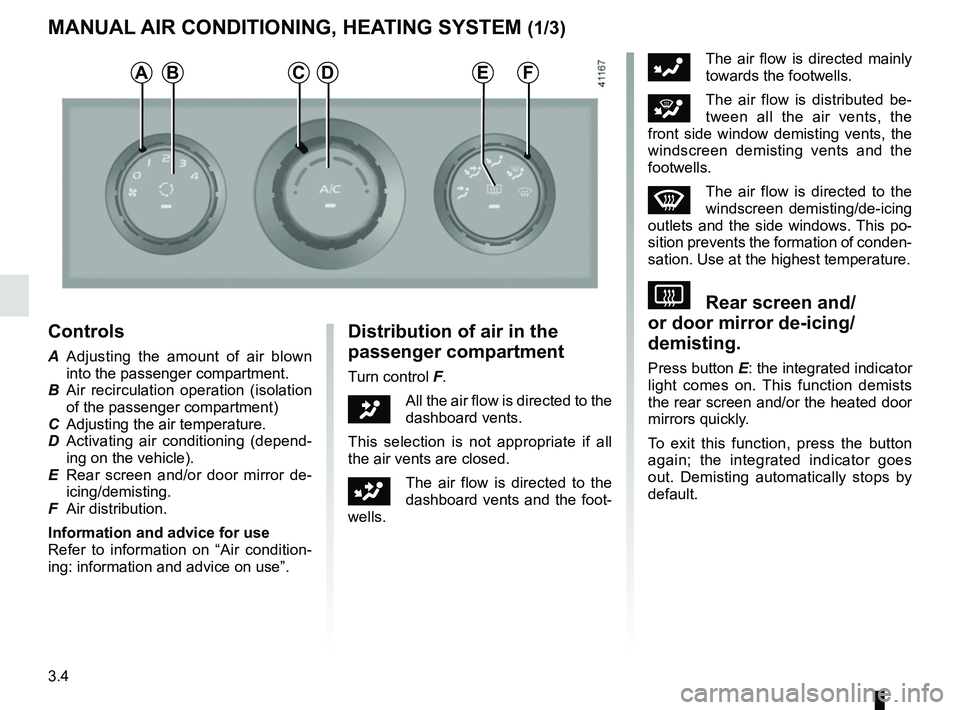
MANUAL AIR CONDITIONING, HEATING SYSTEM (1/3)
Controls
A Adjusting the amount of air blown into the passenger compartment.
B Air recirculation operation (isolation of the passenger compartment)
C Adjusting the air temperature.
D Activating air conditioning (depend- ing on the vehicle).
E Rear screen and/or door mirror de- icing/demisting.
F Air distribution.
Information and advice for use
Refer to information on “Air condition-
ing: information and advice on use”.
Distribution of air in the
passenger compartment
Turn control F.
JAll the air flow is directed to the
dashboard vents.
This selection is not appropriate if all
the air vents are closed.
GThe air flow is directed to the
dashboard vents and the foot-
wells.
FThe air flow is directed mainly
towards the footwells.
iThe air flow is distributed be-
tween all the air vents, the
front side window demisting vents, the
windscreen demisting vents and the
footwells.
WThe air flow is directed to the
windscreen demisting/de-icing
outlets and the side windows. This po-
sition prevents the formation of conden-
sation. Use at the highest temperature.
VRear screen and/
or door mirror de-icing/
demisting.
Press button E: the integrated indicator
light comes on. This function demists
the rear screen and/or the heated door
mirrors quickly.
To exit this function, press the button
again; the integrated indicator goes
out. Demisting automatically stops by
default.
ABDFCE
Page 173 of 290
3.7
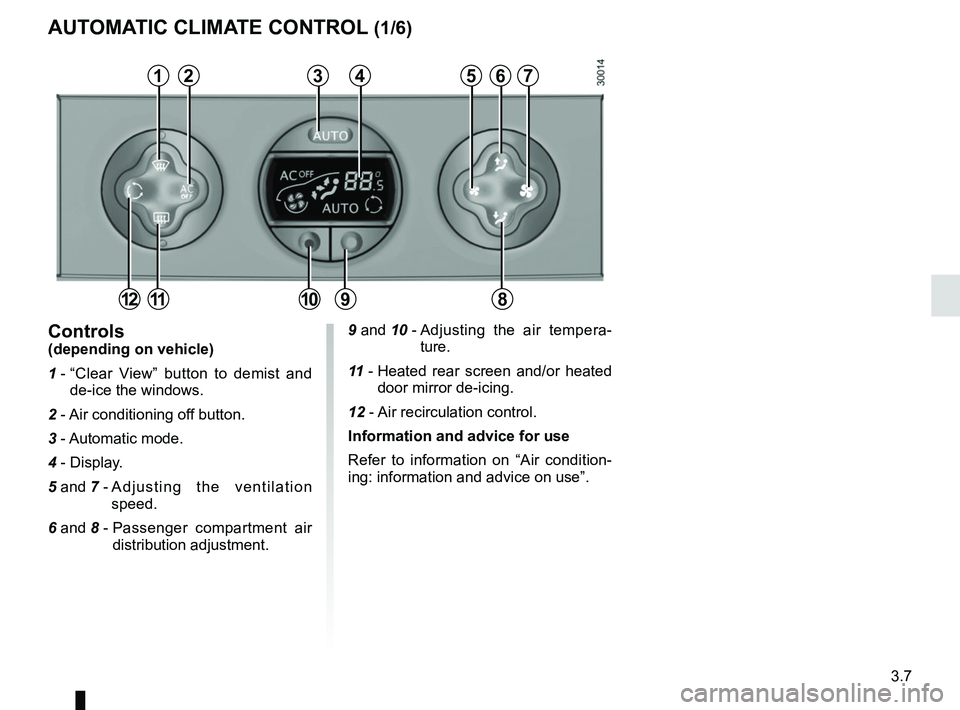
9 and 10 - Adjusting the air tempera-
ture.
11 - Heated rear screen and/or heated
door mirror de-icing.
12 - Air recirculation control.
Information and advice for use
Refer to information on “Air condition-
ing: information and advice on use”.Controls(depending on vehicle)
1 - “Clear View” button to demist and
de-ice the windows.
2 - Air conditioning off button.
3 - Automatic mode.
4 - Display.
5 and 7 - Adjusting the ventilation
speed.
6 and 8 - Passenger compartment air
distribution adjustment.
AUTOMATIC CLIMATE CONTROL (1/6)
23456
891112
17
10
Page 177 of 290

3.11
In automatic mode, depending on
the outside air conditions, the ven-
tilation may not start immediately at
maximum power but will increase
progressively until the engine tem-
perature is warm enough to heat the
passenger compartment air. This
may take from a few seconds to
several minutes.
Switching air conditioning on
or off
In automatic mode, the system switches
the air conditioning system on or off,
depending on the climate conditions.
Exit automatic mode by pressing
button 2: AUTO goes out on display 4
and AC OFF lights up.
Note: the “Clear View” function auto-
matically activates the air conditioning.
Press button 3 to return to automatic
mode.
Varying the ventilation speed
In automatic mode, the system uses
the most suitable amount of air to reach
and maintain the desired comfort level.
Exit automatic mode by pressing but-
tons 5 and 7.
These buttons allow you to increase or
decrease ventilation speed.
Rear screen and/or door
mirror de-icing/demisting.
Press button 11: the integrated indica-
tor light comes on.
This function allows electric demisting
of the rear screen and/or the electric
heated door mirrors, depending on the
vehicle.
To exit this function , press button 11
again. Demisting automatically stops
by default.
AUTOMATIC CLIMATE CONTROL (5/6)
23457
11
Page 178 of 290
3.12
Clear View function
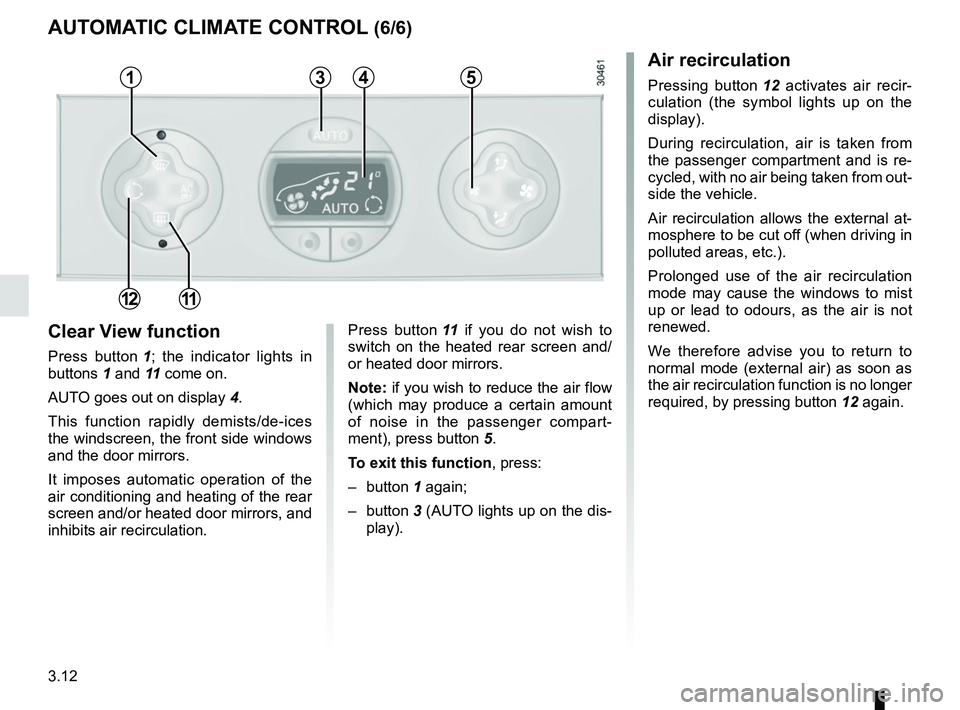
Press button 1; the indicator lights in
buttons 1 and 11 come on.
AUTO goes out on display 4.
This function rapidly demists/de-ices
the windscreen, the front side windows
and the door mirrors.
It imposes automatic operation of the
air conditioning and heating of the rear
screen and/or heated door mirrors, and
inhibits air recirculation. Press button
11 if you do not wish to
switch on the heated rear screen and/
or heated door mirrors.
Note: if you wish to reduce the air flow
(which may produce a certain amount
of noise in the passenger compart-
ment), press button 5.
To exit this function , press:
– button 1 again;
– button 3 (AUTO lights up on the dis-
play).
Air recirculation
Pressing button 12 activates air recir-
culation (the symbol lights up on the
display).
During recirculation, air is taken from
the passenger compartment and is re-
cycled, with no air being taken from out-
side the vehicle.
Air recirculation allows the external at-
mosphere to be cut off (when driving in
polluted areas, etc.).
Prolonged use of the air recirculation
mode may cause the windows to mist
up or lead to odours, as the air is not
renewed.
We therefore advise you to return to
normal mode (external air) as soon as
the air recirculation function is no longer
required, by pressing button 12 again.
AUTOMATIC CLIMATE CONTROL (6/6)
35
12
4
11
1