2018 RENAULT KOLEOS REAR LOCK
[x] Cancel search: REAR LOCKPage 235 of 332

3.39
Do not keep your foot in the air. Carry
out the movement without stopping.
Note: With the tailgate open, after de-
tecting a closure control, it waits around
3 seconds before triggering the closure
(a beep is emitted every second).
Using the dashboard control
Depending on the vehicle, press and
hold switch
4.
Using the hands-free function
The hands-free function grants access
to the boot or allows it to be closed
while you have your hands full.
With the RENAULT card on your person
and with the ignition off, perform a for-
wards/backwards movement with your
foot under the rear bumper.
The sensor detects the approach and
removal of your foot and triggers the
opening or closing of the tailgate.
AUTOMATIC TAILGATE (3/5)
Activation/deactivation of the
hands-free function
Using the multifunction screen, select
menu “Vehicle”, “User settings” then
“Use handsfree card: open/close”.
Select “ON” or “OFF” to activate or de-
activate the function.
Usage features of the hands-free
function
– the hands-free function is no longer available after a few days of lack of
movement of the vehicle, or after
around 15 minutes if the vehicle is
unlocked. To reactivate it, use the
unlocking button on the RENAULT
card.
– The “Hands-free” function is only available if the vehicle is stationary
and the engine is switched off (and
not on standby with the Stop and
Start function).
– The «hands-free» feature may not work if the vehicle is equipped with a
towbar or is in an area of high elec-
tromagnetic radiation.
4
Page 237 of 332

3.41
AUTOMATIC TAILGATE (5/5)Operating faults
If you activate the automatic tailgate
continuously for around a minute (se-
quence of opening and closing), it will
stop in order to avoid overheating. The
operation will return to normal after
about a minute.
The automatic tailgate will not operate
if the battery is on low charge. In this
case, operate the automatic tailgate
with the engine started.
Note
In very cold weather conditions, the au-
tomatic opening may not operate if the
trunk lid joints are frozen.
Precautions during use
Before opening/closing the tailgate,
ensure that the surrounding space is
sufficient to allow the tailgate to ope-
rate. If not, stop the tailgate movement
with the external tailgate control and
hold the tailgate in position by hand
(the tailgate may continue to open ma-
nually).
If the tailgate is moving and the engine
is started, the movement will stop for a
seconds before continuing.
Avoid multiple manual stops during the
automatic tailgate movement (risk of
damaging the tailgate system).
Make sure that the sensors are not
obscured (by dirt, mud, snow, road salt
etc.).
Driver’s responsibility
when parking or stopping
the vehicle
Never leave your vehicle
with a child, an adult who is not self-
sufficient or a pet inside or at the
rear of the tailgate, even for a short
while.
They may pose a risk to themselves
or to others by starting the engine,
activating equipment such as the
electric windows, the automatic
tailgate or by locking the doors.
RISK OF DEATH OR SERIOUS
INJURY.
Disable the «hands-free» function before washing the vehicle manua\
lly
or handling the emergency spare wheel or the towbar.
Risk of accidental opening or closing of the tailgate which may
cause injury.
Page 281 of 332
5.17
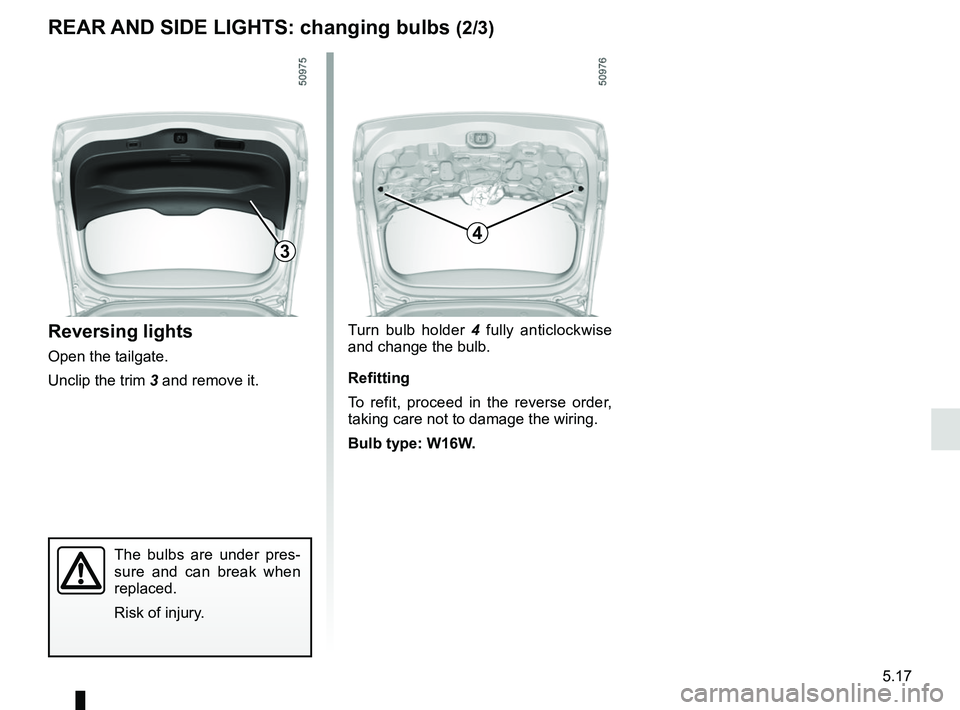
Turn bulb holder 4 fully anticlockwise
and change the bulb.
Refitting
To refit, proceed in the reverse order,
taking care not to damage the wiring.
Bulb type: W16W.
The bulbs are under pres-
sure and can break when
replaced.
Risk of injury.
Reversing lights
Open the tailgate.
Unclip the trim 3 and remove it.
REAR AND SIDE LIGHTS: changing bulbs (2/3)
3
4
Page 285 of 332
5.21
Operating faults
If the battery is too weak to ensure cor-
rect operation, you can still start and
lock/unlock the vehicle (please refer to
the information on “Locking/unlocking
the opening elements” in Section 1).
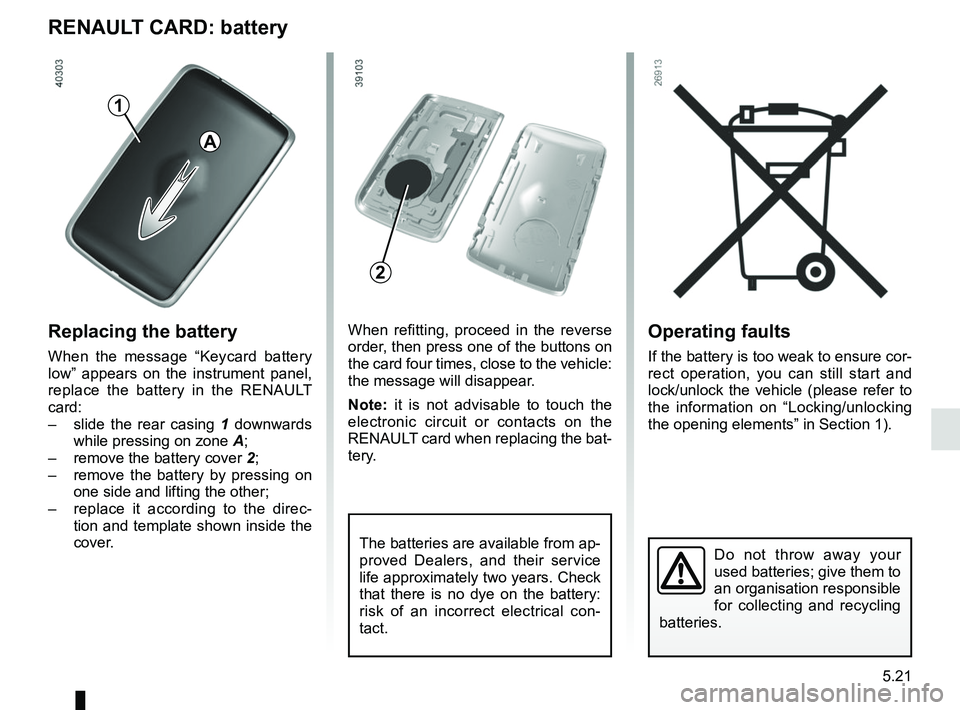
RENAULT CARD: battery
Replacing the battery
When the message “Keycard battery
low” appears on the instrument panel,
replace the battery in the RENAULT
card:
– slide the rear casing 1 downwards
while pressing on zone A;
– remove the battery cover 2;
– remove the battery by pressing on
one side and lifting the other;
– replace it according to the direc-
tion and template shown inside the
cover.
Do not throw away your
used batteries; give them to
an organisation responsible
for collecting and recycling
batteries.
When refitting, proceed in the reverse
order, then press one of the buttons on
the card four times, close to the vehicle:
the message will disappear.
Note: it is not advisable to touch the
electronic circuit or contacts on the
RENAULT card when replacing the bat-
tery.
The batteries are available from ap-
proved Dealers, and their service
life approximately two years. Check
that there is no dye on the battery:
risk of an incorrect electrical con-
tact.
2
A
1
Page 289 of 332

Allocation of fuses
(the presence of certain fuses depends on the vehicle equipment level)\
Symbol Allocation Symbol AllocationSymbol Allocation
BLOWER Ventilation VDCVehicle dynami")
5.25
FUSES (3/3)
Allocation of fuses
(the presence of certain fuses depends on the vehicle equipment level)\
Symbol Allocation Symbol AllocationSymbol Allocation
BLOWER Ventilation VDCVehicle dynamic
control H/MIRR Heated door mirrors
TURN
HAZARD Hazard lamp
STOP LAMP Stop lamp HEATER
SEAT Heater seat
2ND
POWER
SOCKET 2nd power socket
POWER
DR LOCK2 Power door lock EC AUTO
ACC Air conditioner control
unit
REAR
WIPER Rear wiper CIGAR
LIGHTER Cigar lighter REAR
VIEW Rear view mirror
POWER
DR LOCK Power door lock HEAT
STEER
WHEEL Heat steering wheel
WASH
MTR Washer motor
ELEC B, B2 Electrical equipment RR DEFElectrically defrosted
rear window GEAR BOX
OIL PUMP Gear box oil pump
IMOB Immobilizer BOSE Bose amp BCM Body control module
AUDIO Audio ACC RADIOAccessory socket,
radio POWER
WINDOW Power window
ABS/EPS Anti lock brake system JUNCTION
MODULE Junction module SEAT BELT
WARNING Seat belt warning
module
MEDIA Multimedia equipment AIR CON Air condition control
unitSTRG
WHEEL ANGLE Steering wheel angle
sensor
Page 294 of 332
5.30
WINDSCREEN WIPER BLADES: replacement (2/2)
Keep monitoring the condition of the
wiper blades. How long they last de-
pends on you:
– clean the blades, windscreen and rear screen regularly with soapy
water;
– do not use them when the wind- screen or rear screen are dry;
– free them from the windscreen or rear screen when they have not
been used for a long time.
4
5
A
B
6
To refit
To refit the wiper blade, proceed in re-
verse order to removal. Make sure that
the blade is correctly locked in position.
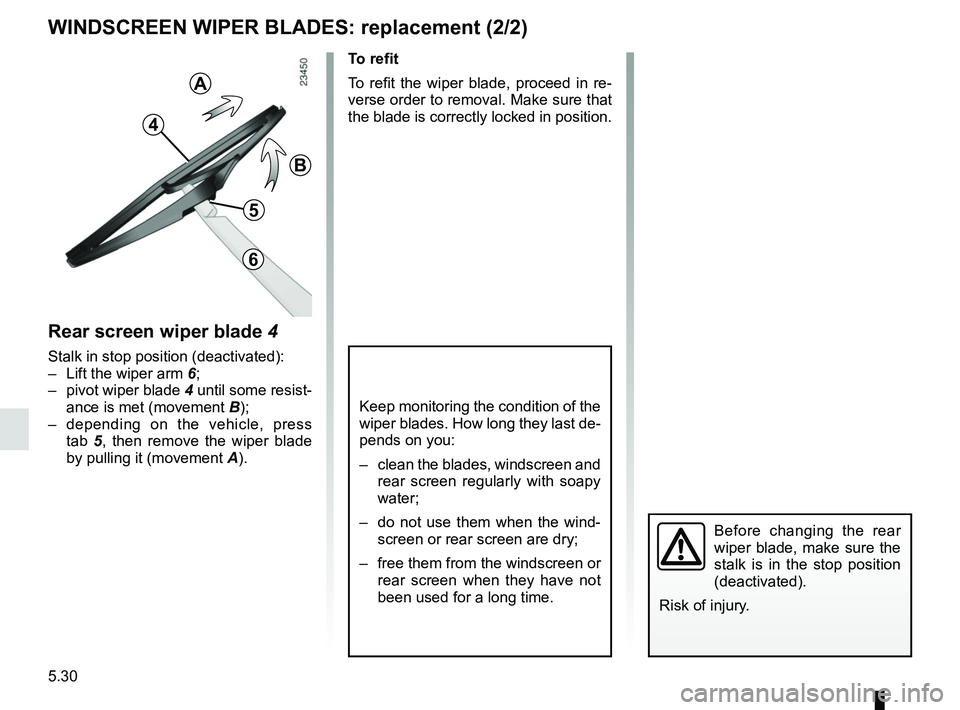
Rear screen wiper blade 4
Stalk in stop position (deactivated):
– Lift the wiper arm 6;
– pivot wiper blade 4 until some resist-
ance is met (movement B);
– depending on the vehicle, press tab 5, then remove the wiper blade
by pulling it (movement A).
Before changing the rear
wiper blade, make sure the
stalk is in the stop position
(deactivated).
Risk of injury.
Page 298 of 332
5.34
TOWING: breakdown recovery (4/4)
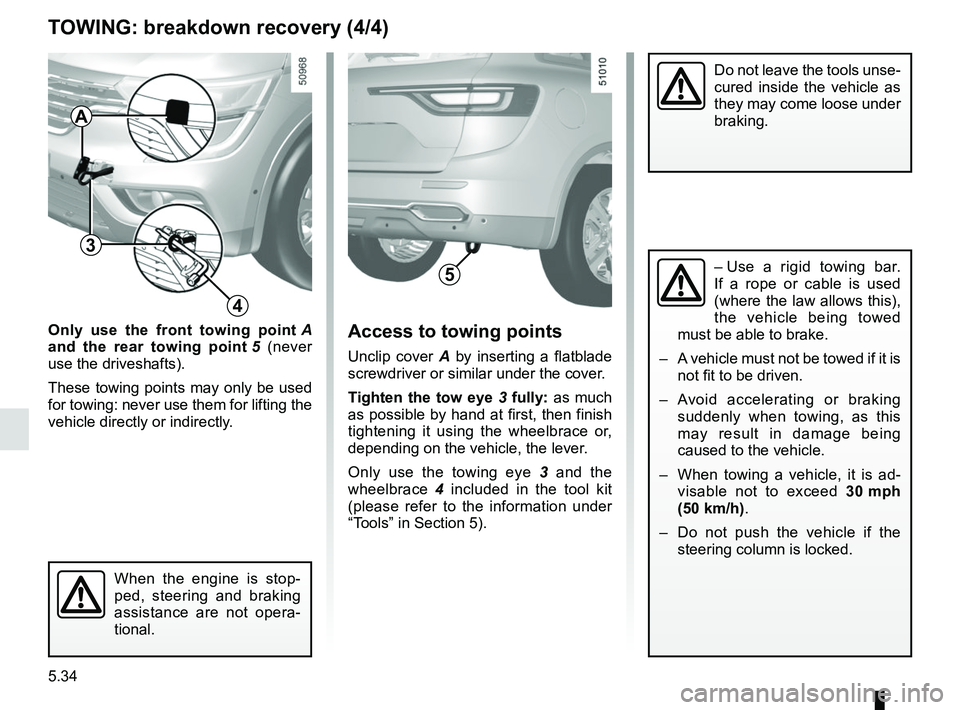
Only use the front towing point A
and the rear towing point 5 (never
use the driveshafts).
These towing points may only be used
for towing: never use them for lifting the
vehicle directly or indirectly.Access to towing points
Unclip cover A by inserting a flatblade
screwdriver or similar under the cover.
Tighten the tow eye 3 fully: as much
as possible by hand at first, then finish
tightening it using the wheelbrace or,
depending on the vehicle, the lever.
Only use the towing eye 3 and the
wheelbrace 4 included in the tool kit
(please refer to the information under
“Tools” in Section 5).
When the engine is stop-
ped, steering and braking
assistance are not opera-
tional.
Do not leave the tools unse-
cured inside the vehicle as
they may come loose under
braking.
– Use a rigid towing bar.
If a rope or cable is used
(where the law allows this),
the vehicle being towed
must be able to brake.
– A vehicle must not be towed if it is not fit to be driven.
– Avoid accelerating or braking suddenly when towing, as this
may result in damage being
caused to the vehicle.
– When towing a vehicle, it is ad- visable not to exceed 30 mph
(50 km/h).
– Do not push the vehicle if the steering column is locked.
3
4
A
5
Page 325 of 332
7.1
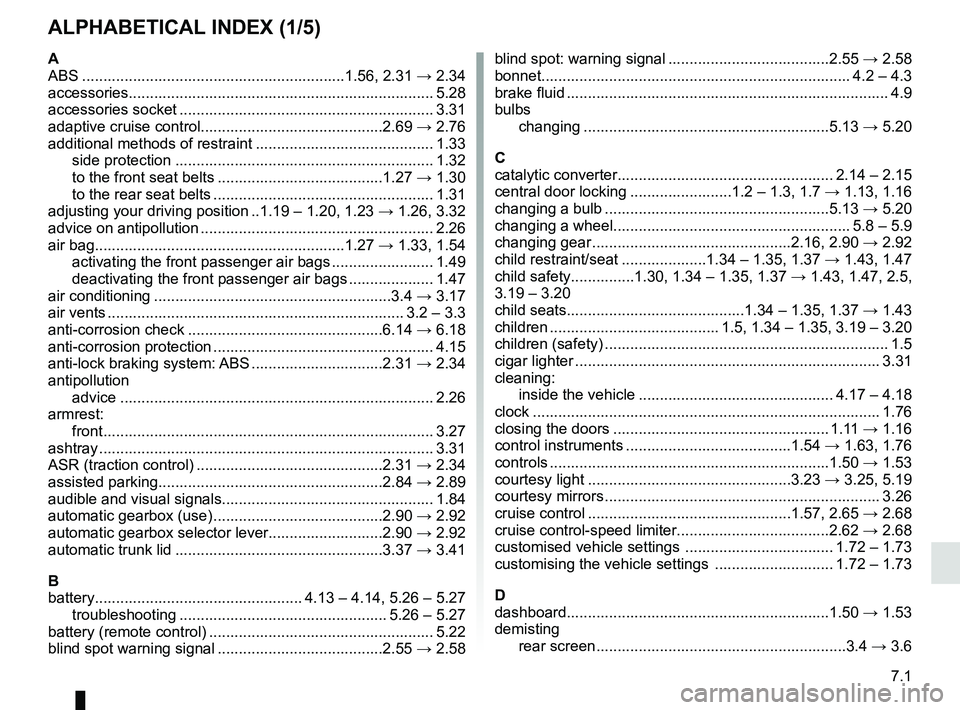
ALPHABETICAL INDEX (1/5)
A
ABS ..............................................................1.56, 2.31 → 2.34
accessories........................................................................\
5.28
accessories socket ............................................................ 3.31
adaptive cruise control...........................................2.69 → 2.76
additional methods of restraint .......................................... 1.33 side protection ............................................................. 1.32
to the front seat belts .......................................1.27 → 1.30
to the rear seat belts .................................................... 1.31
adjusting your driving position ..1.19 – 1.20, 1.23 → 1.26, 3.32
advice on antipollution ....................................................... 2.26
air bag...........................................................1.27 → 1.33, 1.54
activating the front passenger air bags ........................ 1.49
deactivating the front passenger air bags .................... 1.47
air conditioning ........................................................3.4 → 3.17
air vents ...................................................................... 3.2 – 3.3
anti-corrosion check ..............................................6.14 → 6.18
anti-corrosion protection .................................................... 4.15
anti-lock braking system: ABS ...............................2.31 → 2.34
antipollution advice .................................................................\
......... 2.26
armrest: front ..................................................................\
............ 3.27
ashtray ................................................................\
............... 3.31
ASR (traction control) ............................................2.31 → 2.34
assisted parking.....................................................2.84 → 2.89
audible and visual signals.................................................. 1.84
automatic gearbox (use) ........................................2.90 → 2.92
automatic gearbox selector lever...........................2.90 → 2.92
automatic trunk lid .................................................3.37 → 3.41
B
battery................................................. 4.13 – 4.14, 5.26 – 5.27 troubleshooting ................................................. 5.26 – 5.27
battery (remote control) ..................................................... 5.22
blind spot warning signal .......................................2.55 → 2.58blind spot: warning signal ......................................2.55
→ 2.58
bonnet........................................................................\
. 4.2 – 4.3
brake fluid ........................................................................\
.... 4.9
bulbs changing ..........................................................5.13 → 5.20
C
catalytic converter................................................... 2.14 – 2.15
central door locking ........................1.2 – 1.3, 1.7 → 1.13, 1.16
changing a bulb .....................................................5.13 → 5.20
changing a wheel........................................................ 5.8 – 5.9
changing gear ...............................................2.16, 2.90 → 2.92
child restraint/seat ....................1.34 – 1.35, 1.37 → 1.43, 1.47
child safety...............1.30, 1.34 – 1.35, 1.37 → 1.43, 1.47, 2.5,
3.19 – 3.20
child seats..........................................1.34 – 1.35, 1.37 → 1.43
children ........................................ 1.5, 1.34 – 1.35, 3.19 – 3.20
children (safety) ................................................................... 1.5
cigar lighter ........................................................................\
3.31
cleaning: inside the vehicle .............................................. 4.17 – 4.18
clock ..................................................................\
................ 1.76
closing the doors ................................................... 1.11 → 1.16
control instruments .......................................1.54 → 1.63, 1.76
controls ...............................................................\
...1.50 → 1.53
courtesy light ................................................3.23 → 3.25, 5.19
courtesy mirrors ................................................................. 3.26
cruise control ................................................1.57, 2.65 → 2.68
cruise control-speed limiter....................................2.62 → 2.68
customised vehicle settings ................................... 1.72 – 1.73
customising the vehicle settings ............................ 1.72 – 1.73
D
dashboard..............................................................1.50 →
1.53
demisting rear screen ...........................................................3.4 → 3.6