2018 RENAULT KOLEOS power steering
[x] Cancel search: power steeringPage 111 of 332

2.7
STARTING, STOPPING THE ENGINE: vehicle with RENAULT CARD (3/5)
If the RENAULT card is no longer in the
passenger compartment or if the card
battery is low when you try to switch
the engine off, the message “No key-
card Press and hold” appears on the in-
strument panel: press the button 2 for
longer than two seconds. If the card is
no longer in the passenger compart-
ment, make sure you can retrieve it
before pressing and holding the button.
Without the RENAULT card, you will
not be able to restart the vehicle.
With the engine switched off, any ac-
cessories being used (radio, etc.) will
continue to function for approximately
10 minutes.
When the driver’s door is opened, the
accessories stop working.
Conditions for stopping the
engine
The vehicle must stationary, with the
lever positioned in N or P for vehicles
with an automatic transmission.
With the RENAULT card in the vehicle,
press the 2 button: the engine will stop. The steering column is locked when the
driver’s door is opened or the vehicle
is locked.
When you leave your vehi-
cle, especially if you have
your RENAULT card with
you, check that the engine
is completely switched off.
2
Driver’s responsibility
when parking or stopping
the vehicle
Never leave an animal,
child or adult who is not self-suffi-
cient alone in your vehicle, even for
a short time.
They may pose a risk to themselves
or to others by starting the engine,
activating equipment such as the
electric windows or locking the
doors, for example.
Also, in hot and/or sunny weather,
please remember that the tempera-
ture inside the passenger compart-
ment increases very quickly.
RISK OF DEATH OR SERIOUS
INJURY.
Never switch off the igni-
tion before the vehicle has
stopped completely. Once
the engine has stopped, the
brake servo, power-assisted steer-
ing, etc. and the passive safety de-
vices such as air bags and preten-
sioners will no longer operate.
Page 136 of 332

2.32
Electronic stability control
ESC with understeer control
and traction control
Electronic stability control ESC
This system helps you to keep control
of the vehicle in critical driving condi-
tions (avoiding an obstacle, loss of grip
on a bend, etc.).
Operating principle
A sensor in the steering wheel detects
the direction selected by the driver.
Other sensors throughout the vehicle
measure the actual direction.
The system compares driver input to
the actual trajectory of the vehicle and
corrects the trajectory if necessary by
controlling the braking of certain wheels
and/or engine power. In the event that
the system is engaged, indicator light
flashes on the instrument panel.Understeer control
This system optimises the action of the
ESC in the case of pronounced under-
steer (loss of front axle road holding).
Traction control
This system helps to limit wheelspin of
the drive wheels and to control the ve-
hicle when pulling away accelerating or
decelerating.
Operating principle
Using the wheel sensors, the system
measures and compares the speed of
the drive wheels at all times and slows
down their over-rotation. If a wheel is
starting to slip, the system brakes au-
tomatically until the drive supplied be-
comes compatible with the level of grip
under the wheel again.
The system also adjusts the engine
speed to the grip available under the
wheels, independently of the pressure
exerted on the accelerator pedal.
DRIVING CORRECTION DEVICES AND AIDS (2/4)
Operating faults
When the system detects an operat-
ing fault the message “Check ESC” and
warning light
© and appear
on the instrument panel.
In this case, the ESC and traction con-
trol system are deactivated. Consult an
authorised dealer.
Page 246 of 332
3.50
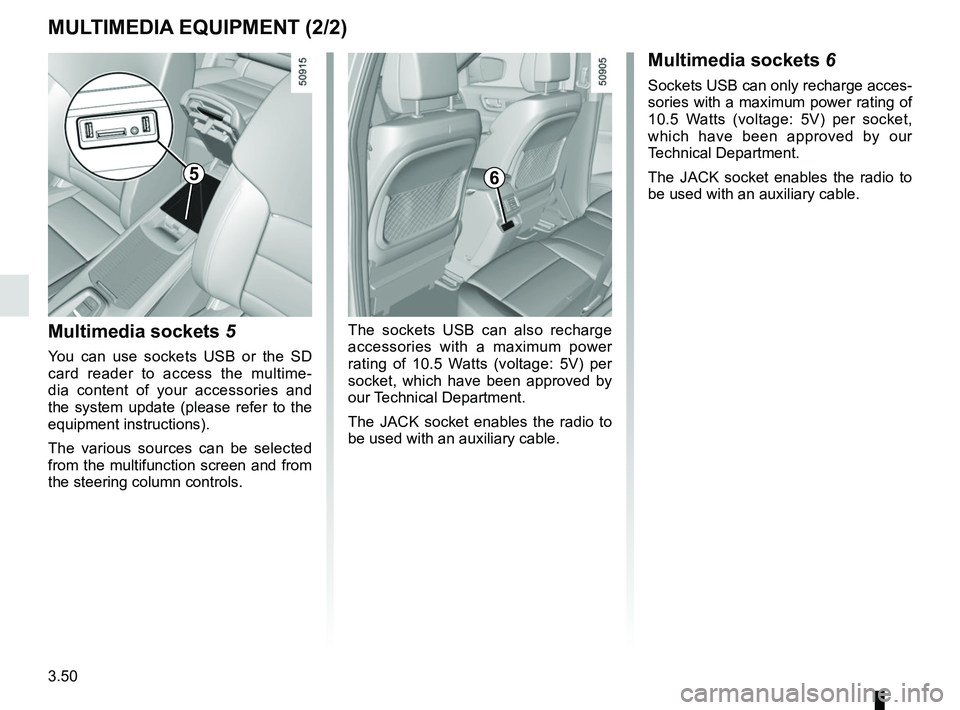
MULTIMEDIA EQUIPMENT (2/2)
Multimedia sockets 5
You can use sockets USB or the SD
card reader to access the multime-
dia content of your accessories and
the system update (please refer to the
equipment instructions).
The various sources can be selected
from the multifunction screen and from
the steering column controls.
Multimedia sockets 6
Sockets USB can only recharge acces-
sories with a maximum power rating of
10.5 Watts (voltage: 5V) per socket,
which have been approved by our
Technical Department.
The JACK socket enables the radio to
be used with an auxiliary cable.
The sockets USB can also recharge
accessories with a maximum power
rating of 10.5 Watts (voltage: 5V) per
socket, which have been approved by
our Technical Department.
The JACK socket enables the radio to
be used with an auxiliary cable.
56
Page 289 of 332

Allocation of fuses
(the presence of certain fuses depends on the vehicle equipment level)\
Symbol Allocation Symbol AllocationSymbol Allocation
BLOWER Ventilation VDCVehicle dynami")
5.25
FUSES (3/3)
Allocation of fuses
(the presence of certain fuses depends on the vehicle equipment level)\
Symbol Allocation Symbol AllocationSymbol Allocation
BLOWER Ventilation VDCVehicle dynamic
control H/MIRR Heated door mirrors
TURN
HAZARD Hazard lamp
STOP LAMP Stop lamp HEATER
SEAT Heater seat
2ND
POWER
SOCKET 2nd power socket
POWER
DR LOCK2 Power door lock EC AUTO
ACC Air conditioner control
unit
REAR
WIPER Rear wiper CIGAR
LIGHTER Cigar lighter REAR
VIEW Rear view mirror
POWER
DR LOCK Power door lock HEAT
STEER
WHEEL Heat steering wheel
WASH
MTR Washer motor
ELEC B, B2 Electrical equipment RR DEFElectrically defrosted
rear window GEAR BOX
OIL PUMP Gear box oil pump
IMOB Immobilizer BOSE Bose amp BCM Body control module
AUDIO Audio ACC RADIOAccessory socket,
radio POWER
WINDOW Power window
ABS/EPS Anti lock brake system JUNCTION
MODULE Junction module SEAT BELT
WARNING Seat belt warning
module
MEDIA Multimedia equipment AIR CON Air condition control
unitSTRG
WHEEL ANGLE Steering wheel angle
sensor
Page 295 of 332
5.31
TOWING: breakdown recovery (1/4)
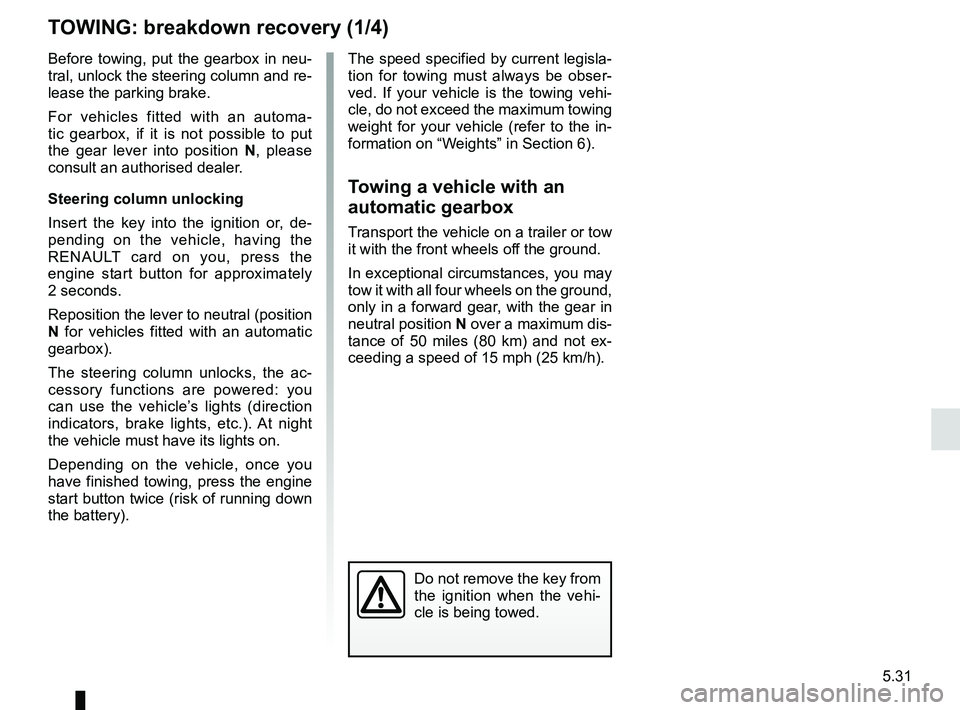
Do not remove the key from
the ignition when the vehi-
cle is being towed.
Before towing, put the gearbox in neu-
tral, unlock the steering column and re-
lease the parking brake.
For vehicles fitted with an automa-
tic gearbox, if it is not possible to put
the gear lever into position N, please
consult an authorised dealer.
Steering column unlocking
Insert the key into the ignition or, de-
pending on the vehicle, having the
RENAULT card on you, press the
engine start button for approximately
2 seconds.
Reposition the lever to neutral (position
N for vehicles fitted with an automatic
gearbox).
The steering column unlocks, the ac-
cessory functions are powered: you
can use the vehicle’s lights (direction
indicators, brake lights, etc.). At night
the vehicle must have its lights on.
Depending on the vehicle, once you
have finished towing, press the engine
start button twice (risk of running down
the battery). The speed specified by current legisla-
tion for towing must always be obser-
ved. If your vehicle is the towing vehi-
cle, do not exceed the maximum towing
weight for your vehicle (refer to the in-
formation on “Weights” in Section 6).
Towing a vehicle with an
automatic gearbox
Transport the vehicle on a trailer or tow
it with the front wheels off the ground.
In exceptional circumstances, you may
tow it with all four wheels on the ground,
only in a forward gear, with the gear in
neutral position
N over a maximum dis-
tance of 50 miles (80 km) and not ex-
ceeding a speed of 15 mph (25 km/h).
Page 328 of 332

7.4
ALPHABETICAL INDEX (4/5)
mechanical ..............................4.4, 4.13 – 4.14, 6.8 → 6.13
map reading lights .................................................3.23 → 3.25
menu for customising the vehicle settings .............. 1.72 – 1.73
methods of restraint in addition to the seat belts ...1.27 → 1.33
multimedia equipment ............................................ 3.49 – 3.50
N
navigation system ................................................... 3.49 – 3.50
O
oil change ..................................................................4.5 → 4.7
opening the doors .................................................. 1.11 → 1.15
operating faults ................................ 1.54 → 1.59, 5.35 → 5.41
overspeed warning ................................................2.59 → 2.61
P
paintwork maintenance ..................................................... 4.15 – 4.16
parking assistance: assisted parking .....................2.84 → 2.89
parking brake ..................................................................... 2.17
parking distance control.........................................2.77 → 2.81
power-assisted steering..................................................... 1.74
powered tailgate ....................................................3.37 → 3.41
pretensioners .........................................................1.27 → 1.30
puncture.....................................................5.2 – 5.3, 5.7 → 5.9
R
radio........................................................................\
3.49 – 3.50
radio frequency remote control/key use ....................................................................\
...1.2 → 1.4
rear bench seat......................................................3.33 → 3.35
rear parcel shelf ................................................................. 3.42
rear screen de-icing/demisting ............................................ 3.9
rear seats........................................................................\
... 1.25 functions ..........................................................3.33 → 3.35
rear view mirrors ..................................................... 1.77 – 1.78 remote control door locking
batteries ..............................................................\
......... 5.22
remote control door locking unit ................................1.2 → 1.4
RENAULT ANTI-INTRUDER DEVICE (RAID) ................... 1.16
RENAULT card battery ................................................................\
.......... 5.21
use ................................................... 1.5 → 1.10, 2.5 → 2.9
RENAULT card battery ...................................................... 5.21
replacement parts ................................................................ 6.7
reverse gear selecting ..................................................2.16, 2.90 → 2.92
reversing sensor ....................................................2.77 → 2.81
roof bars ........................................................................\
.... 3.48
roof rack roof bars ....................................................................... 3.48
running in .................................................................... 2.2 – 2.3
S
seat belt pretensioners front seat belt ...................................................1.27 → 1.30
seat belts ......................................................1.23 → 1.30, 1.33
service sheets..........................................................6.8 → 6.13
side protection devices ...................................................... 1.32
sign detection: overspeed warning ........................2.59 → 2.61
signals and lights ...................................................1.79 → 1.86
special features of diesel versions..................................... 2.15
special features of petrol vehicles ..................................... 2.14
speed limiter .................................................1.57, 2.62 → 2.64
spoiler ................................................................\
................ 3.48
starting the engine ...................................................2.3 → 2.13
steering wheel adjustment ........................................................ 1.74 – 1.75
Stop & Start
..................................................1.57, 2.10 → 2.13
Stop & Start function..............................................2.10 → 2.13
stopping the engine ...................................................2.4 → 2.9
storage compartment.............................................3.26 → 3.30
Page 329 of 332

storage compartments ...........................................3.26 → 3.30
sun visor ........................................................................\
.... 3.26")
7.5
ALPHABETICAL INDEX (5/5)
storage compartments ...........................................3.26 → 3.30
sun visor ........................................................................\
.... 3.26
sunroof.................................................................... 3.21 – 3.22
switching on the vehicle ignition .........................2.3, 2.5 → 2.9
T
tailgate ...............................................3.36 → 3.41, 3.45 – 3.46
tanks and reservoirs brake fluid ...................................................................... 4.9
coolant ................................................................\
........... 4.8
tanks and reservoirs: windscreen washer ...................................................... 4.10
technical specifications ..............................................6.4 → 6.7
telephone ................................................................ 3.49 – 3.50
temperature regulation ............................................3.7 → 3.17
tool kit ........................................................................\
.......... 5.7
towing breakdown .......................................................5.31 → 5.34
towing equipment ......................................................... 3.47
towing a caravan ........................................................ 3.47, 6.6
towing equipment fitting ................................................................\
............ 3.47
towing hitch.....................................................5.7, 5.31 → 5.34
towing rings ....................................................................... 3.46
towing weights ..................................................................... 6.6
traction control: ASR ..............................................2.31 → 2.34
transporting children .................1.34 – 1.35, 1.37 → 1.43, 1.47
transporting objects in the luggage compartment ........................................ 3.46
on the roof ...................................................................... 6.6
trip computer and warning system... 1.54 → 1.59, 1.62 → 1.71
tyre inflation kit...........................................................5.4 → 5.6
tyre pressure............................. 2.28 → 2.30, 4.11 – 4.12, 5.11
tyre pressure loss warning.....................................2.28 → 2.30
tyre pressures ......................................................... 4.11 – 4.12
tyres .................... 2.24, 2.28 → 2.30, 4.11 – 4.12, 5.10 → 5.12 U
unlocking the doors ............................................... 1.11
→ 1.13
V
variable power-assisted steering ....................................... 1.74
vehicle identification plates .................................................. 6.3
ventilation .......................................................1.22, 3.2 → 3.17
W
warning lights.........................................................1.54 → 1.71
washing .................................................................. 4.15 – 4.16
weights ................................................................\
................ 6.6
wheelbrace .............................................................\
............. 5.7
wheels (safety) ......................................................5.10 → 5.12
windscreen de-icing/demisting ............................................ 3.9
windscreen washer ................................................1.87 → 1.94
wiper blades ........................................................... 5.29 – 5.30
wipers .................................................................\
...1.87 → 1.94
blades ............................................................... 5.29 – 5.30