2018 RENAULT KOLEOS height
[x] Cancel search: heightPage 215 of 332

3.19
ELECTRIC WINDOWS (1/2)
These systems operate with the igni-
tion switched on.
Press or pull the switch to raise or lower
a window to the desired height (the rear
windows do not open fully);
From the driver’s seat, use switch:
1 for the driver’s side;
3 for the front passenger side;
4 and 5 for the rear passengers.
From the passenger seats, use
switch 6.
1
3
4
56
Avoid resting any objects against a
half-open window: there is a risk that
the electric window winder could be
damaged.
Passenger safety
The driver can prevent the
front and rear passenger
electric windows from op-
erating (and the driver’s window)
by pressing switch 2. A confirmation
message is displayed on the instru-
ment panel.
Driver’s responsibility
Never leave your vehicle with the
RENAULT card or key inside, and
never leave a child, adult who is not
self-sufficient or a pet, even for a
short while. They may pose a risk to
themselves or to others by starting
the engine or activating equipment
(such as the gear lever or electric
windows). If any part of the body be-
comes trapped, reverse the direc-
tion of the window immediately by
pressing the relevant switch.
Risk of serious injury.
2
Page 228 of 332

3.32
The headrest is a safety
component; check that it is
fitted and in the correct po-
sition. The top of the head-
rest should be as close as possible
to the top of the head.
Centre seat headrest storage
position
Press the button A and lower the cen-
tral headrest 1 completely.
When the headrest is set at the
lowest position, this is for storage
only. It should not be in this position
when a seat is occupied.
Position for use
Lift the headrest to maximum height,
then lower it until it locks.
To remove a headrest
Raise the headrest as far as it will go,
then press button A and remove the
headrest.
To refit a headrest
Insert the rods in the holes, press the
button A and lower the headrest. Check
that it is correctly locked in place.
REAR HEADRESTS
A
Note: When the headrest need to be
reassembled, pay attention to its posi-
tion which is drawn in the label.
Page 236 of 332
3.40
AUTOMATIC TAILGATE (4/5)
Stopping the tailgate
manoeuvre
The automatic tailgate manoeuvre can
be stopped at any time by a short press
on one of the controls. Depending on
the opening position, the tailgate hatch
can however continue to be opened
manually.
If the tailgate is stationary in the inter-
mediate position, your next press will
move the tailgate in the opposite direc-
tion to when you stopped it.
Manual mode
After stopping the tailgate, you can per-
form the manoeuvre manually if you
wish.
You can switch to automatic movement
at any time by pressing one of the con-
trols.
Obstacle detection
When the tailgate window encounters
an obstacle (presence of an object or
person) when it is moving, it stops.
Depending on the opening position, the
tailgate hatch can however continue to
be opened manually.
Press the tailgate opening/closing con-
trol to reperform the tailgate movement
in the same direction as before encoun-
tering the obstacle.
Limiting the tailgate opening
angle
You can adjust the maximum tailgate
opening height It will always stop at the
chosen position:
– open the tailgate to an intermediate position;
– manually adjust the tailgate to the chosen position;
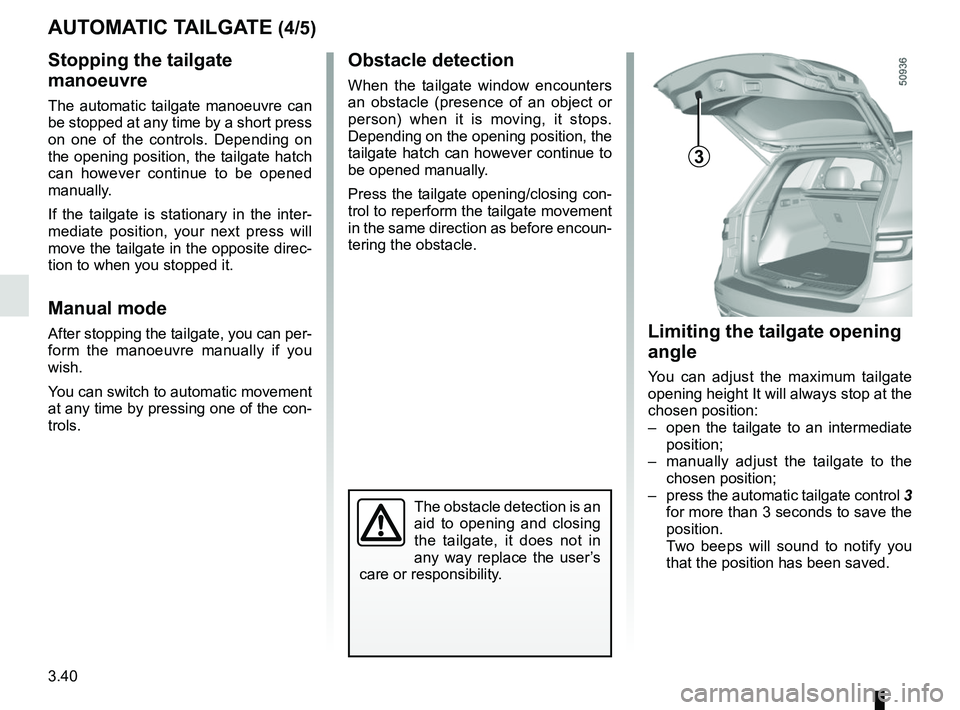
– press the automatic tailgate control 3
for more than 3 seconds to save the
position.
Two beeps will sound to notify you
that the position has been saved.
3
The obstacle detection is an
aid to opening and closing
the tailgate, it does not in
any way replace the user’s
care or responsibility.
Page 326 of 332

windscreen ...........................................................3.4 → 3.6
dimensions .............................................................\
............. 6")
7.2
ALPHABETICAL INDEX (2/5)
windscreen ...........................................................3.4 → 3.6
dimensions .............................................................\
............. 6.4
dipstick................................................................\
................. 4.4
display ................................................................\
...1.54 → 1.61
doors/tailgate .........................................................\
..1.4 → 1.16
driver assistance.............................. 2.59 → 2.61, 2.69 → 2.76
driver’s position .....................................................1.50 → 1.59
driving ....... 2.2 → 2.9, 2.14 – 2.15, 2.18 → 2.25, 2.31 → 2.38,
2.62 → 2.81, 2.90 → 2.92
driving aids .................. 2.53 – 2.54, 2.59 → 2.61, 2.69 → 2.76
driving position settings ............................................................1.23 → 1.26
driving recommendations ......................................2.21 → 2.25
E
ECO driving ...........................................................2.21 → 2.25
ECO mode ........................................................................\
. 2.22
electric beam height adjustment ............................. 1.85 – 1.86
electric windows ..................................................... 3.19 – 3.20
electronic parking brake ........................................2.18 → 2.20
electronic stability control: ESC .............................2.31 → 2.34
emergency active braking......................................2.39 → 2.49
emergency brake assist.........................................2.31 → 2.34
emergency braking ................................................2.31 → 2.34
emergency key ........................................................... 1.5 – 1.6
emergency spare wheel ............................................. 5.2 – 5.3
engine technical specifications .................................................. 6.5
engine coolant ..................................................................... 4.8
engine oil ...................................................................4.4 → 4.7
engine oil capacity .....................................................4.5 → 4.7
engine oil level ...........................................................4.4 → 4.7
engine specifications .................................................... 6.3, 6.5
engine standby ......................................................2.10 → 2.13
engine start/stop button .............................................2.5 → 2.9
environment ............................................................\
........... 2.27 ESC: electronic stability control ....................1.56, 2.31
→ 2.34
F
4 wheel drive (4WD) ..............................................2.35 → 2.38
F
fatigue detection warning........................................ 2.53 – 2.54
F
faults operating faults ................................................5.35 → 5.41
filter air filter ........................................................................\
. 4.10
oil filter .................................................................4.5 → 4.7
passenger compartment filter ...................................... 4.10
fittings ...............................................................\
.....3.26 → 3.30
front passenger air bag deactivation ................................. 1.47
front seat adjustment ......................................................... 1.20
front seats adjustment ............................................... 1.19 – 1.20, 1.23
with electric controls
.................................................... 1.21
fuel advice on fuel economy ...................................2.21 → 2.25
consumption ....................................................2.21 → 2.25
filling ........................................................1.54, 1.95 → 1.97
grade ................................................................1.95 → 1.97
fuel consumption ...................................................2.21 → 2.25
fuel economy .........................................................2.21 → 2.25
fuel filler cap ..........................................................1.95 → 1.97
fuel level ................................................................1.54 → 1.60
fuel tank capacity ...............................................................\
......... 1.95
fuel tank capacity ...................................................1.95 → 1.97
fuses ..................................................................\
....5.23 → 5.25