2018 RENAULT KOLEOS engine oil
[x] Cancel search: engine oilPage 251 of 332

4.5
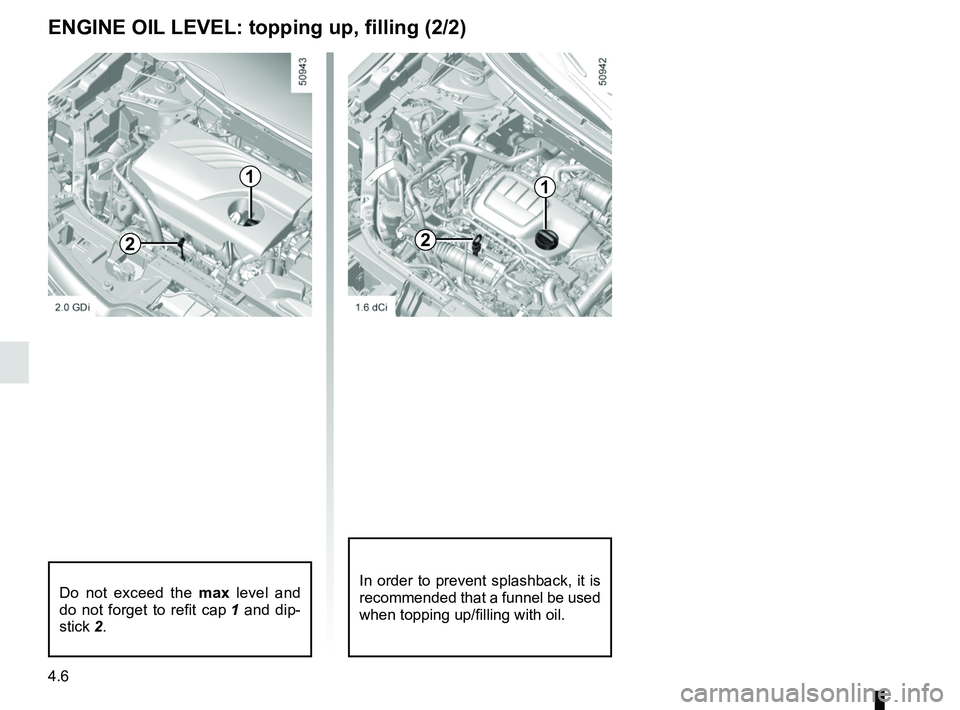
Topping up/filling
The vehicle must be parked on level
ground and the engine should be cold
(for instance, before the engine is
started up for the first time in the day).– Unscrew cap
1;
– top up the level (as a guide, the ca- pacity between the minimum and
maximum reading on the dipstick 2
is between 1.5 and 2 litres, depend-
ing on the engine);
– wait for approximately 10 minutes to allow the oil to flow into the engine;
– check the level using the dipstick 2
(as described above).
Once the operation has been com-
pleted, ensure that the dipstick is
pushed in as far as it will go and that
the cap is completely screwed in.
ENGINE OIL LEVEL: topping up, filling (1/2)
1
2
Before performing any
action in the engine com-
partment, the ignition must
be switched off by pressing
the engine stop button (please see
the information on “Starting, stop-
ping the engine” in Section 2).
1
2
Page 252 of 332
4.6
ENGINE OIL LEVEL: topping up, filling (2/2)
Do not exceed the max level and
do not forget to refit cap 1 and dip-
stick 2.In order to prevent splashback, it is
recommended that a funnel be used
when topping up/filling with oil.
1
2
1
2
Page 253 of 332

4.7
Engine oil grade
Refer to the maintenance document for
your vehicle.
ENGINE OIL LEVEL: OIL CHANGE
Never run the engine in an
enclosed space as exhaust
gases are poisonous.
Engine oil change: if you
are changing the oil when
the engine is hot, be careful
not to scald yourself if the
oil overflows.
Filling: take care when
topping up the oil that
no oil drips onto engine
components - risk of fire.
Remember to refit the cap securely
as there is a risk of fire if oil splashes
onto hot engine components.
When working in the engine
compartment, ensure that
the windscreen wiper stalk
is in the park position.
Risk of injury.
The engine may be hot
when carrying out opera-
tions in close proximity. In
addition, the engine cooling
fan can come on at any moment.
Risk of injury.
Oil change
Service interval: refer to the
Maintenance Document for your vehi-
cle.
Oil change capacity
Please refer to the maintenance docu-
ment for your vehicle, or contact an au-
thorised dealer.
Always check the engine oil level using
the dipstick, as explained previously (it
should never fall below the minimum
level, or be over the maximum level on
the dipstick).
Consult your approved dealer at
once if you notice an abnormal or
repeated drop in any of the fluid
levels.
Exceeding the maximum
engine oil level
Under no circumstances
must the maximum fill level
be exceeded: risk of damage to the
engine and catalytic converter.
If the oil level exceeds the maximum
level, do not start your vehicle and
contact an approved Dealer.
Page 302 of 332

5.38
OPERATING FAULTS (4/7)
On the roadPOSSIBLE CAUSESWHAT TO DO
Vibrations. Tyres not inflated to correct pres-
sures, incorrectly balanced or dam-
aged. Check the tyre pressures: if this is not the
problem, have them checked by an ap-
proved Dealer.
White smoke from the exhaust. In the diesel version, this is necessar-
ily a fault. Smoke may be caused by
particle filter regeneration. Please refer to the information on “Special
features of diesel versions” in Section 2.
Smoke under the bonnet. Short-circuit or cooling system leak. Stop, switch off the ignition, stand away
from the vehicle and contact an approved
dealer.
The oil pressure warning light comes
on: while cornering or braking The level is too low. Top up the engine oil level (refer to the in-
formation on “Engine oil level: topping up,
filling” in Section 4).
is slow to go out or remains lit
under acceleration Loss of oil pressure.
Stop the vehicle and contact an approved
Dealer.
Page 303 of 332

5.39
OPERATING FAULTS (5/7)
On the roadPOSSIBLE CAUSESWHAT TO DO
Steering becomes heavy. Assistance overheating.
Fault with the electric assistance
motor.
Fault in assistance system. Drive carefully at reduced speed, be aware
of the level of force in the steering wheel
needed to turn the wheels. Consult an ap-
proved dealer.
The engine is overheating. The cool-
ant temperature indicator is in the
warning zone and warning light
® comes on. Engine cooling fan not working. Stop the vehicle, switch off the engine and
contact an approved dealer.
Coolant leaks. Check the coolant reservoir: it should con- tain fluid. If there is no coolant, consult an
approved dealer as soon as possible.
Coolant boiling in the coolant reser-
voir. Mechanical fault: damaged cylinder
head gasket. Stop the engine.
Contact an approved dealer.
Radiator:
If there is a significant lack of coolant, remember that it must never b\
e topped up using cold coolant while
the engine is very warm. After any procedure on the vehicle which has involved even partial drain\
ing of the cooling
system, it must be refilled with a new mixture prepared in the correct p\
roportions. Reminder: only products approved
by our Technical Department may be used for this purpose.
Page 326 of 332

windscreen ...........................................................3.4 → 3.6
dimensions .............................................................\
............. 6")
7.2
ALPHABETICAL INDEX (2/5)
windscreen ...........................................................3.4 → 3.6
dimensions .............................................................\
............. 6.4
dipstick................................................................\
................. 4.4
display ................................................................\
...1.54 → 1.61
doors/tailgate .........................................................\
..1.4 → 1.16
driver assistance.............................. 2.59 → 2.61, 2.69 → 2.76
driver’s position .....................................................1.50 → 1.59
driving ....... 2.2 → 2.9, 2.14 – 2.15, 2.18 → 2.25, 2.31 → 2.38,
2.62 → 2.81, 2.90 → 2.92
driving aids .................. 2.53 – 2.54, 2.59 → 2.61, 2.69 → 2.76
driving position settings ............................................................1.23 → 1.26
driving recommendations ......................................2.21 → 2.25
E
ECO driving ...........................................................2.21 → 2.25
ECO mode ........................................................................\
. 2.22
electric beam height adjustment ............................. 1.85 – 1.86
electric windows ..................................................... 3.19 – 3.20
electronic parking brake ........................................2.18 → 2.20
electronic stability control: ESC .............................2.31 → 2.34
emergency active braking......................................2.39 → 2.49
emergency brake assist.........................................2.31 → 2.34
emergency braking ................................................2.31 → 2.34
emergency key ........................................................... 1.5 – 1.6
emergency spare wheel ............................................. 5.2 – 5.3
engine technical specifications .................................................. 6.5
engine coolant ..................................................................... 4.8
engine oil ...................................................................4.4 → 4.7
engine oil capacity .....................................................4.5 → 4.7
engine oil level ...........................................................4.4 → 4.7
engine specifications .................................................... 6.3, 6.5
engine standby ......................................................2.10 → 2.13
engine start/stop button .............................................2.5 → 2.9
environment ............................................................\
........... 2.27 ESC: electronic stability control ....................1.56, 2.31
→ 2.34
F
4 wheel drive (4WD) ..............................................2.35 → 2.38
F
fatigue detection warning........................................ 2.53 – 2.54
F
faults operating faults ................................................5.35 → 5.41
filter air filter ........................................................................\
. 4.10
oil filter .................................................................4.5 → 4.7
passenger compartment filter ...................................... 4.10
fittings ...............................................................\
.....3.26 → 3.30
front passenger air bag deactivation ................................. 1.47
front seat adjustment ......................................................... 1.20
front seats adjustment ............................................... 1.19 – 1.20, 1.23
with electric controls
.................................................... 1.21
fuel advice on fuel economy ...................................2.21 → 2.25
consumption ....................................................2.21 → 2.25
filling ........................................................1.54, 1.95 → 1.97
grade ................................................................1.95 → 1.97
fuel consumption ...................................................2.21 → 2.25
fuel economy .........................................................2.21 → 2.25
fuel filler cap ..........................................................1.95 → 1.97
fuel level ................................................................1.54 → 1.60
fuel tank capacity ...............................................................\
......... 1.95
fuel tank capacity ...................................................1.95 → 1.97
fuses ..................................................................\
....5.23 → 5.25
Page 328 of 332

7.4
ALPHABETICAL INDEX (4/5)
mechanical ..............................4.4, 4.13 – 4.14, 6.8 → 6.13
map reading lights .................................................3.23 → 3.25
menu for customising the vehicle settings .............. 1.72 – 1.73
methods of restraint in addition to the seat belts ...1.27 → 1.33
multimedia equipment ............................................ 3.49 – 3.50
N
navigation system ................................................... 3.49 – 3.50
O
oil change ..................................................................4.5 → 4.7
opening the doors .................................................. 1.11 → 1.15
operating faults ................................ 1.54 → 1.59, 5.35 → 5.41
overspeed warning ................................................2.59 → 2.61
P
paintwork maintenance ..................................................... 4.15 – 4.16
parking assistance: assisted parking .....................2.84 → 2.89
parking brake ..................................................................... 2.17
parking distance control.........................................2.77 → 2.81
power-assisted steering..................................................... 1.74
powered tailgate ....................................................3.37 → 3.41
pretensioners .........................................................1.27 → 1.30
puncture.....................................................5.2 – 5.3, 5.7 → 5.9
R
radio........................................................................\
3.49 – 3.50
radio frequency remote control/key use ....................................................................\
...1.2 → 1.4
rear bench seat......................................................3.33 → 3.35
rear parcel shelf ................................................................. 3.42
rear screen de-icing/demisting ............................................ 3.9
rear seats........................................................................\
... 1.25 functions ..........................................................3.33 → 3.35
rear view mirrors ..................................................... 1.77 – 1.78 remote control door locking
batteries ..............................................................\
......... 5.22
remote control door locking unit ................................1.2 → 1.4
RENAULT ANTI-INTRUDER DEVICE (RAID) ................... 1.16
RENAULT card battery ................................................................\
.......... 5.21
use ................................................... 1.5 → 1.10, 2.5 → 2.9
RENAULT card battery ...................................................... 5.21
replacement parts ................................................................ 6.7
reverse gear selecting ..................................................2.16, 2.90 → 2.92
reversing sensor ....................................................2.77 → 2.81
roof bars ........................................................................\
.... 3.48
roof rack roof bars ....................................................................... 3.48
running in .................................................................... 2.2 – 2.3
S
seat belt pretensioners front seat belt ...................................................1.27 → 1.30
seat belts ......................................................1.23 → 1.30, 1.33
service sheets..........................................................6.8 → 6.13
side protection devices ...................................................... 1.32
sign detection: overspeed warning ........................2.59 → 2.61
signals and lights ...................................................1.79 → 1.86
special features of diesel versions..................................... 2.15
special features of petrol vehicles ..................................... 2.14
speed limiter .................................................1.57, 2.62 → 2.64
spoiler ................................................................\
................ 3.48
starting the engine ...................................................2.3 → 2.13
steering wheel adjustment ........................................................ 1.74 – 1.75
Stop & Start
..................................................1.57, 2.10 → 2.13
Stop & Start function..............................................2.10 → 2.13
stopping the engine ...................................................2.4 → 2.9
storage compartment.............................................3.26 → 3.30
Page 331 of 332

A passion for performance
ELF, partner of
RENAULT recommends ELF
Partners in cutting-edge automotive technology, Elf and Renault combine their expertise on both
the racetrack and the city streets. This enduring partnership gives drivers a range of lubricants
perfectly suited to Renault cars. Lasting protection and optimum performance for your engine –
guaranteed. Whether changing the oil or simply topping up, to find the approved ELF lubricant
best suited to your vehicle, ask your Renault dealer for a recommendation or consult your vehi-
cle maintenance handbook.
www.lubricants.elf.com
A brand from
2016-Elf-ENG.indd 118/05/2016 14:20