2018 Peugeot Boxer Dis
[x] Cancel search: DisPage 108 of 232
106
If the windscreen is damaged, it is strongly
recommended that you go to a PEUGEOT
dealer or a
qualified workshop for any
replacement and calibration of the camera.
Operation
The system starts automatically when moving
of f.
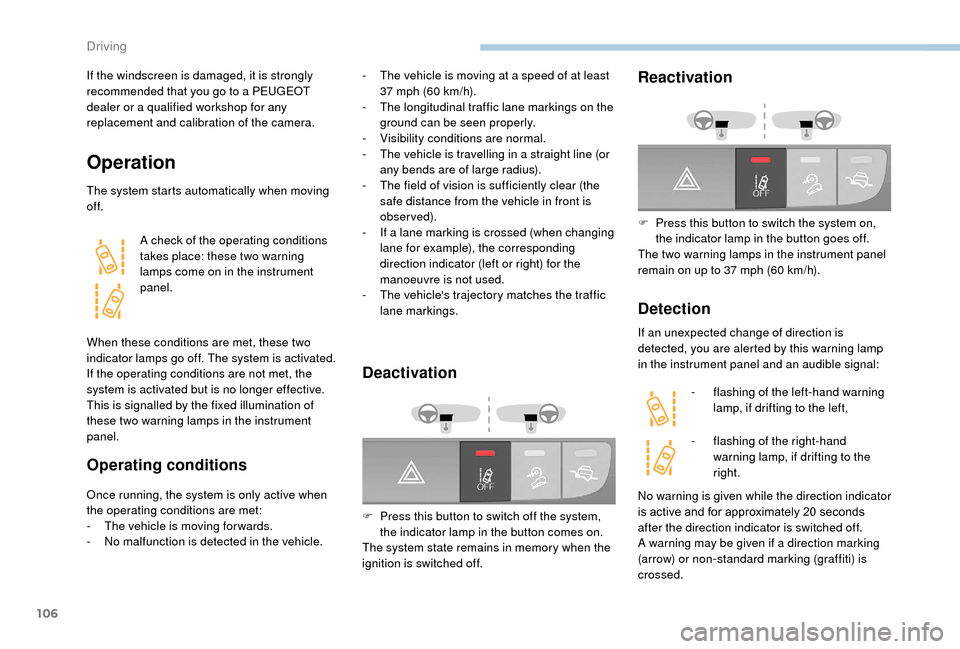
A check of the operating conditions
takes place: these two warning
lamps come on in the instrument
panel.
When these conditions are met, these two
indicator lamps go off. The system is activated.
If the operating conditions are not met, the
system is activated but is no longer effective.
This is signalled by the fixed illumination of
these two warning lamps in the instrument
panel.
Operating conditions
Once running, the system is only active when
the operating conditions are met:
-
T
he vehicle is moving for wards.
-
N
o malfunction is detected in the vehicle.
Deactivation
F Press this button to switch off the system, the indicator lamp in the button comes on.
The system state remains in memory when the
ignition is switched off.
Reactivation
F Press this button to switch the system on, the indicator lamp in the button goes off.
The two warning lamps in the instrument panel
remain on up to 37
mph (60 km/h).
Detection
If an unexpected change of direction is
detected, you are alerted by this warning lamp
in the instrument panel and an audible signal:-
f
lashing of the left-hand warning
lamp, if drifting to the left,
-
f
lashing of the right-hand
warning lamp, if drifting to the
right.
-
T
he vehicle is moving at a
speed of at least
37
mph (60
km/h).
-
T
he longitudinal traffic lane markings on the
ground can be seen properly.
-
V
isibility conditions are normal.
-
T
he vehicle is travelling in a
straight line (or
any bends are of large radius).
-
T
he field of vision is sufficiently clear (the
safe distance from the vehicle in front is
observed).
-
I
f a
lane marking is crossed (when changing
lane for example), the corresponding
direction indicator (left or right) for the
manoeuvre is not used.
-
T
he vehicle's trajectory matches the traffic
lane markings.
No warning is given while the direction indicator
is active and for approximately 20 seconds
after the direction indicator is switched off.
A warning may be given if a
direction marking
(arrow) or non-standard marking (graffiti) is
crossed.
Driving
Page 110 of 232
108
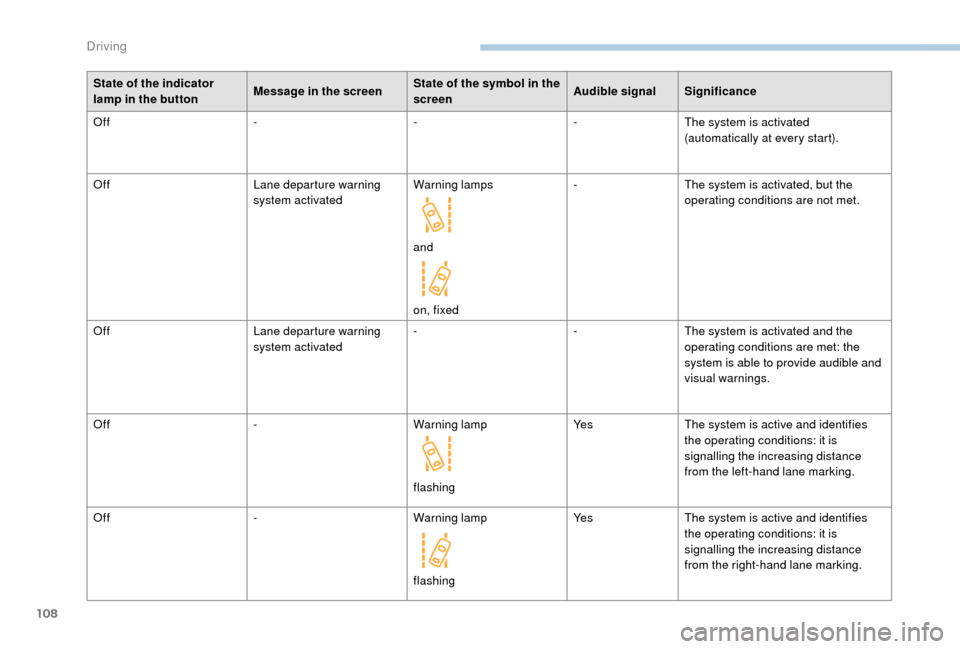
State of the indicator
lamp in the buttonMessage in the screenState of the symbol in the
screenAudible signal Significance
Off ---The system is activated
(automatically at every start).
Off Lane departure warning
system activatedWarning lamps
and
on, fixed-
The system is activated, but the
operating conditions are not met.
Off Lane departure warning
system activated-
-The system is activated and the
operating conditions are met: the
system is able to provide audible and
visual warnings.
Off -Warning lamp
flashingYe s
The system is active and identifies
the operating conditions: it is
signalling the increasing distance
from the left-hand lane marking.
Off -Warning lamp
flashingYe s
The system is active and identifies
the operating conditions: it is
signalling the increasing distance
from the right-hand lane marking.
Driving
Page 112 of 232

110
Under-inflation detection
The tyre under-inflation detection system
is a driving aid which does not replace the
need for vigilance on the part of the driver.This system does not relieve you of
the monthly check of the tyre inflation
pressures (including the spare) and before
a
long journey.
Driving with under-inflated tyres impairs
handling, extends braking distances and
causes premature tyre wear, particularly
in adverse conditions (heavy loads, high
speeds, long journeys).
Driving with under-inflated tyres
increases fuel consumption. The tyre pressure measurement unit can be
configured with the MODE
button: in the "Tyre
pressure measurement" menu, select "psi/bar/
k Pa".
For more information on Vehicle
configuration , refer to the corresponding
section.
Under-inflation warning
This warning is indicated by
continuous illumination of this lamp,
an audible signal and, depending on
the equipment installed, a message
displayed on the screen.
System which automatically checks the
pressures of the tyres while driving.
The system continuously monitors the
pressures of the four tyres, as soon as the
vehicle is moving.
A pressure sensor is located in the valve of
each tyre (except the spare wheel).
The system triggers an alert as soon as it
detects a
drop in the inflation pressure of one
or more tyres. In the event of a
problem with one of the tyres,
depending on equipment the symbol or the
message appears to identify it.
-
R
educe speed immediately, avoid excessive
steering movements and sudden braking.
-
S
top as soon as possible, as traffic
conditions allow.
-
I
n case of a puncture, use the temporary
puncture repair kit or the spare wheel
(depending on equipment).
-
I
n the event of under-inflation:
•
i
f you have a compressor (such as the
one in the temporary puncture repair kit)
check the pressures of the four tyres
when cold.
or
The tyre pressure specifications for your
vehicle can be found on the tyre pressure
label.
Tyre pressures should be checked when
the tyres are "cold" (vehicle stopped for
1
hour or after a
journey of less than
6
miles (10
km) at moderate speeds).
Other wise, add 0.3
bar to the values
indicated on the label.
For more information on Identification
markings , including in particular the tyre
pressure label, refer to the corresponding
section.
Driving
Page 113 of 232

111
• if it is not possible to check the tyre pressures at the time, drive carefully at
reduced speed and go to the nearest
PEUGEOT dealer or a
qualified
workshop.
The loss of pressure detected does not
always cause visible bulging of the tyre.
Do not rely on just a
visual check.
The alert continues until the tyre or tyres
concerned is reinflated, repaired or
replaced.
Malfunction
The flashing and then fixed
illumination of this warning lamp
accompanied by the illumination
of the ser vice warning lamp, and
depending on equipment, the display
of a message indicates a fault with
the system.
In this case, monitoring of the tyre pressures is
not assured. This alert is also displayed when one or
more wheels is not fitted with a
sensor.
Go to a PEUGEOT dealer or a qualified
workshop to have the system checked or,
following a puncture, to have the original wheel,
equipped with a sensor, refitted with a tyre.
Rear parking sensors,
audible assistance
If your vehicle is so equipped, the system
consists of four proximity sensors, installed in
the rear bumper.
They detect any obstacle: a person, vehicle,
tree, fence, behind the vehicle during the
manoeuvre.
Certain types of object detected at the beginning
of the manoeuvre will no longer be detected at
the end of the manoeuvre if they are located in
the blind spots between and below the sensors. For example, a post, roadworks cone or
pavement bollard.
The rear parking sensor system may be linked
with the reversing camera.
This system cannot in any circumstances
replace the need for vigilance on the part
of the driver.
Take even greater care if you reverse with
the rear doors open.
In bad or wintry weather, ensure that the
sensors are not covered by mud, ice or
snow.
Operation
F Engage reverse gear using the gear lever.
The proximity information is indicated by an
audible signal which becomes more rapid as
the vehicle approaches the obstacle.
6
Driving
Page 114 of 232

112
Switching off
F Move from reverse gear into neutral.
Malfunction
If this warning lamp comes on in the
instrument panel accompanied by
a message in the screen, contact
a
PEUGEOT dealer or a qualified
workshop.
Reversing camera
If your vehicle is fitted with this camera, it is
located at the rear, next to the third brake lamp.
Switching on
The camera comes into operation when
reverse gear is engaged and remains active
up to approximately 9
mph (15 km/h). It is
deactivated above 11
mph (18 km/h).
The camera also comes on with the vehicle
stationary, when the rear doors are opened.
Switching off
When a for ward gear is engaged, the last
im age remains displayed for approximately
5
seconds then switches off.
In the same way, the last image also remains
displayed, with the vehicle stationary, when the
rear doors are closed.
With optimum vehicle conditions (position
on the road, loading level) the maximum
area of visibility covered by the camera
has a
field depth approximately 3 m long
and 5.5
m wide.
The area of visibility may vary depending
on the external weather conditions
(brightness, rain, snow, fog, etc.), the
load in the vehicle and the position of the
vehicle on the road.
When cleaning the camera and the
screen, avoid using a
detergent or a tool
which may scratch the glass.
Use a
non-abrasive cloth or a small brush.
It sends images to the screen installed in the
cab.
Activation and deactivation of the system is
done in the settings menu of the touch screen
audio-telematic system.
This rear vision is an aid to manoeuvring. The
reversing camera may be linked with the rear
parking sensors.
When the distance between the rear of the
vehicle and the obstacle is less than about
12 inches (30 centimetres), the audible signal
becomes continuous.
Driving
Page 115 of 232
113
Pneumatic suspensionThere is a nominal level as well as 6 height
a djustment levels, raising (from +1 to +3) or
lowering (from -1
t
o -3). The levels are indicated
in the instrument panel screen.
Manual adjustment of the
loading height
Raise: upwards adjustment of the
load floor
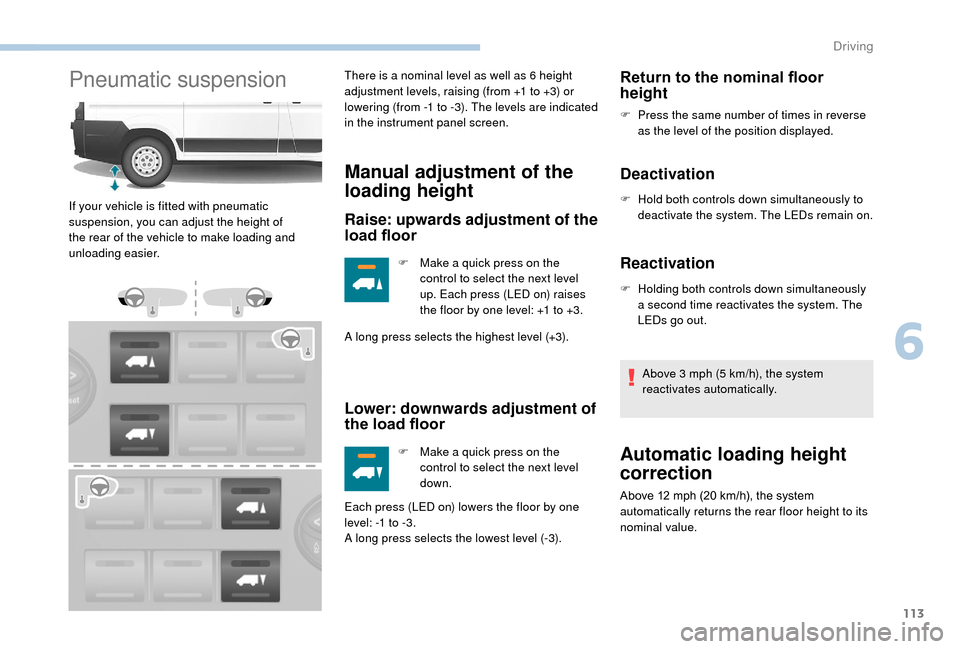
F Make a quick press on the
control to select the next level
up. Each press (LED on) raises
the floor by one level: +1
to +3.
A long press selects the highest level (+3).
Lower: downwards adjustment of
the load floor
F Make a quick press on the
control to select the next level
down.
If your vehicle is fitted with pneumatic
suspension, you can adjust the height of
the rear of the vehicle to make loading and
unloading easier.
Each press (LED on) lowers the floor by one
level: -1
to -3.
A long press selects the lowest level (-3).
Return to the nominal floor
height
F Press the same number of times in reverse as the level of the position displayed.
Deactivation
F Hold both controls down simultaneously to deactivate the system. The LEDs remain on.
Reactivation
F Holding both controls down simultaneously a second time reactivates the system. The
LEDs go out.
Above 3
mph (5 km/h), the system
reactivates automatically.
Automatic loading height
correction
Above 12 mph (20 km/h), the system
a utomatically returns the rear floor height to its
nominal value.
6
Driving
Page 126 of 232

124
Maximum load on the roof, evenly
distributed: 150 kg, for all models, within
the vehicle's weight limit (Gross Vehicle
Weight).
On all H3
height models, the roof cannot
be fitted with a
carrying system.
Fully comply with the legal requirements
for carrying oversized loads.
For more information on the Technical
data of your vehicle and particularly the
dimensions, refer to the corresponding
section.Changing a wiper blade
Check that the screenwash or headlamp
wash jets are not blocked.
Changing a front wiper
blade
F Raise the wiper arm.
F
U nclip the blade by pressing the button and
remove it by pulling it outwards.
F
F
it the new blade and ensure that it is
secured correctly.
F
R
eturn the wiper arm to the normal position.
The steps, located in the front bumper, enable
you to reach the blades and the screenwash
jets.
Practical information
Page 128 of 232

126
Diesel engines
1.Windscreen/headlamp wash fluid
reservoir.
2. Power steering fluid reservoir.
3. Coolant tank.
4. Brake and clutch fluid reser voir.
5. Diesel fuel filter.
6. Fusebox.
7. A i r f i l t e r.
8. Dipstick.
9. Engine oil filler cap.
Battery connections:
+ Positive terminal.
- Negative terminal (earth). The Diesel circuit is under very high
pressure.
All work on this circuit must be carried out
only by a
PEUGEOT dealer or a qualified
workshop.
Checking levels
Check all of these levels regularly, in line with
the manufacturer's service schedule. Top them
up if necessary, unless other wise indicated.
If a
level drops significantly, have the
corresponding system checked by a
PEUGEOT
dealer or a
qualified workshop.
If you have to remove/refit the engine
cover, handle it with care to avoid
damaging the fixing clips.
Used products
Avoid prolonged contact of used oil or
fluids with the skin.
Most of these fluids are harmful to health
or indeed very corrosive. Do not discard used oil or fluids into
sewers or onto the ground.
Take used oil to a
PEUGEOT dealer or
a qualified workshop and dispose of it in
the containers reser ved for this purpose.
Engine oil level
Check this regularly and top up as
necessary between two oil changes
(the maximum consumption is 0.5
litres
for 620
miles (1,000 km)). Make the
check with the vehicle standing level,
engine cold, using the dipstick.
Checking using the dipstick
2 marks on the dipstick:
A = MA X
B = MIN
Practical information