2018 Peugeot 308 maintenance
[x] Cancel search: maintenancePage 3 of 324
1
Welcome
The descriptions and illustrations are given as indications only.
Automobiles PEUGEOT reser ves the right to modify the technical data,
equipment and accessories without having to update this edition of the
guide.
In this document you will find all of the instructions and recommendations
on use that will allow you to enjoy your vehicle to the fullest. It is strongly
recommended that you familiarise yourself with it as well as the Warranty
and Maintenance Record which will provide you with information about
warranties, ser vicing and roadside assistance associated with your
vehicle. This document presents the information and recommendations required
for you to be able to explore your vehicle in complete safety. Thank you for choosing a Peugeot 308.
Your vehicle will be fitted with only some of the equipment described in
this document, depending on its trim level, version and the specification
for the country in which it was sold.
If ownership of your vehicle is transferred, please ensure this Handbook
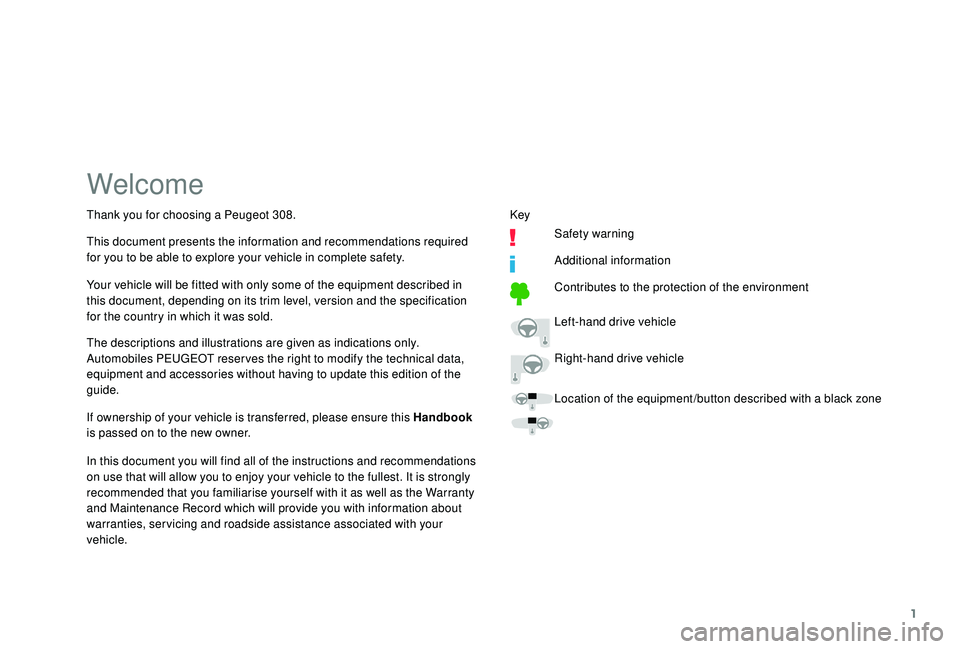
is passed on to the new owner. Key
Safety warning
Additional information
Contributes to the protection of the environment
Left-hand drive vehicle
Right-hand drive vehicle
Location of the equipment /button described with a black zone
Page 9 of 324
7
Limit the causes of excess
consumption
Spread loads throughout the vehicle; place
the heaviest items in the bottom of the boot,
as close as possible to the rear seats.
Limit the loads carried in the vehicle and
reduce wind resistance (roof bars, roof rack,
bicycle carrier, trailer, etc.). Preferably, use a
roof box.
Remove roof bars and roof racks after use.
At the end of winter, remove snow tyres and
refit your summer tyres.
Observe the recommendations
on maintenance
Check the tyre pressures regularly, when cold,
referring to the label in the door aperture,
driver's side.
Carry out this check in particular:
-
b
efore a long journey,
-
a
t each change of season,
-
a
fter a long period out of use.
Do not forget the spare wheel and the tyres on
any trailer or caravan. Have your vehicle ser viced regularly (engine
oil, oil filter, air filter, cabin filter, etc.) and
obser ve the schedule of operations in the
manufacturer's service schedule.
When filling the tank, do not continue after the
3
rd cut-off of the nozzle to avoid over flow.
At the wheel of your new vehicle, it is only
after the first 1,900
miles (3,000 kilometres)
that you will see the fuel consumption settle
down to a consistent average. With a BlueHDi Diesel engine, if the SCR
system is faulty, your vehicle becomes
polluting. Visit a PEUGEOT dealer or a
qualified workshop as soon as possible to
bring your vehicle’s nitrogen oxides emissions
back in line with the regulations.
For vehicles fitted with it, avoid using the
Dynamic Pack for too long, in order to limit
your fuel consumption.
.
Eco-driving
Page 67 of 324

65
2.Front side window demisting-defrosting
vents.
3. Adjustable and closable side air vents.
4. Adjustable and closable central air vents.
5. Air outlets to the front footwells.
6. Air outlets to the rear footwells.Advice
Using the ventilation and air
conditioning system
F
T
o ensure that the air is distributed
evenly, keep the external air intake
grilles at the base of the windscreen,
the nozzles, the vents, the air outlets
and the air extractor in the boot free
from obstructions.
F
D
o not cover the sunshine sensor,
located on the dashboard; this is used
for regulation of the automatic air
conditioning system.
F
O
perate the air conditioning system for
at least 5 to 10
minutes, once or twice
a month to keep it in per fect working
o r d e r.
F
I
f the system does not produce cold air,
switch it off and contact a PEUGEOT
dealer or a qualified workshop.
When towing the maximum load on a
steep gradient in high temperatures,
switching off the air conditioning increases
the available engine power and so
improves the towing ability. If after an extended stop in sunshine, the
interior temperature is very high, first air
the passenger compartment for a few
moments.
Put the air flow control at a setting high
enough to quickly change the air in the
passenger compartment.
The condensation created by the air
conditioning results in a discharge of water
under the vehicle which is per fectly normal.
Servicing the ventilation and air
conditioning system
F
E
nsure that the passenger compartment
filter is in good condition and have the
filter elements replaced regularly.
We recommend the use of a combined
passenger compartment filter. Thanks to
its special active additive, it contributes
to the purification of the air breathed by
the occupants and the cleanliness of the
passenger compartment (reduction of
allergic symptoms, bad odours and greasy
deposits).
F
T
o ensure correct operation of the
air conditioning system, you are also
advised to have it checked regularly
as recommended in the Warranty and
Maintenance Record.
3
Ease of use and comfort
Page 94 of 324
92
Maintenance
In accordance with current safety
regulations, for all repairs on your
vehicle's seat belts, go to a qualified
workshop with the skills and equipment
needed, which a PEUGEOT dealer is able
to provide.
Have your seat belts checked regularly
by a PEUGEOT dealer or a qualified
workshop, particularly if the straps show
signs of damage.
Clean the seat belt straps with soapy
water or a textile cleaning product, sold by
PEUGEOT dealers.
Instructions for children
Use a suitable child seat if the passenger
is less than 12 years old or shorter than
one and a half metres.
Never use the same seat belt to secure
more than one child.
Never allow a child to travel on your lap.
For more information on Child seats , refer
to the corresponding section. In case of impact
Depending on the nature and
seriousness of the impact
, the
pyrotechnic pretensioner may be deployed
before and independently of the airbags.
Deployment of the pretensioners is
accompanied by a slight discharge of
harmless smoke and a noise, due to the
activation of the pyrotechnic cartridge
incorporated in the system.
In all cases, the airbag warning lamp
comes on.
Following an impact, have the seat belt
system checked, and, if necessary,
replaced, by a PEUGEOT dealer or a
qualified workshop.
Airbags
General information
System designed to contribute towards improving
passenger safety (with the exception of the
rear centre passenger) in the event of violent
collisions. The airbags supplement the action of
the seat belts fitted with force limiters (all except
the rear centre passenger).
If a collision occurs, the electronic detectors
record and analyse the front and side impacts
sustained in the impact detection zones:
The airbags do not operate when the
ignition is switched off.
This equipment will only deploy once. If a
second impact occurs (during the same or
a subsequent accident), the airbag will not
be deployed again.
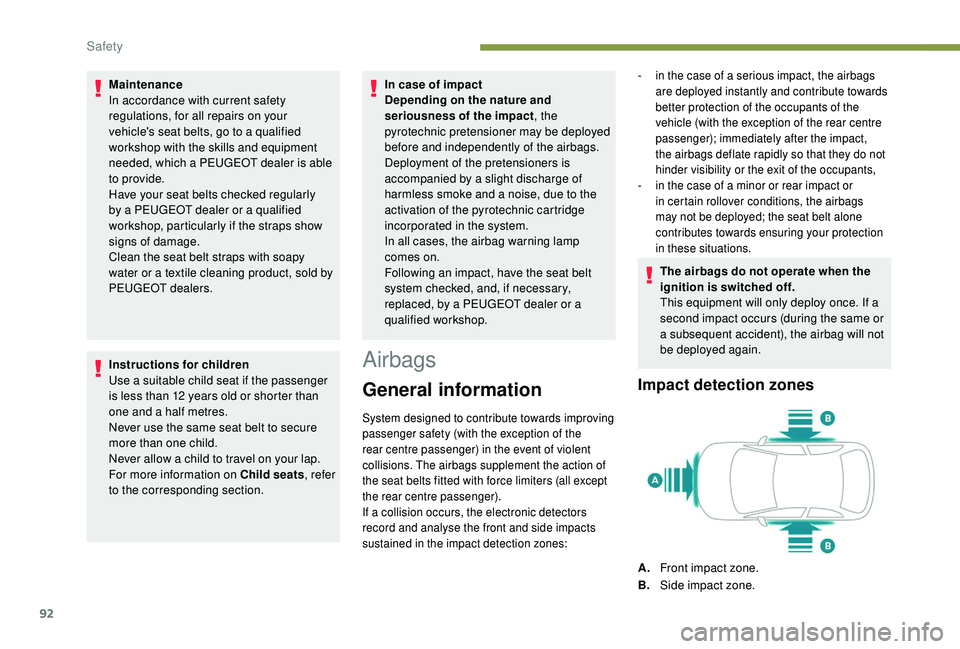
Impact detection zones
A. Front impact zone.
B. Side impact zone.
- in the case of a serious impact, the airbags
are deployed instantly and contribute towards
better protection of the occupants of the
vehicle (with the exception of the rear centre
passenger); immediately after the impact,
the airbags deflate rapidly so that they do not
hinder visibility or the exit of the occupants,
-
i
n the case of a minor or rear impact or
in certain rollover conditions, the airbags
may not be deployed; the seat belt alone
contributes towards ensuring your protection
in these situations.
Safety
Page 122 of 324
120
The steering mounted controls do not
allow neutral to be selected and reverse
gear to be engaged or disengaged.
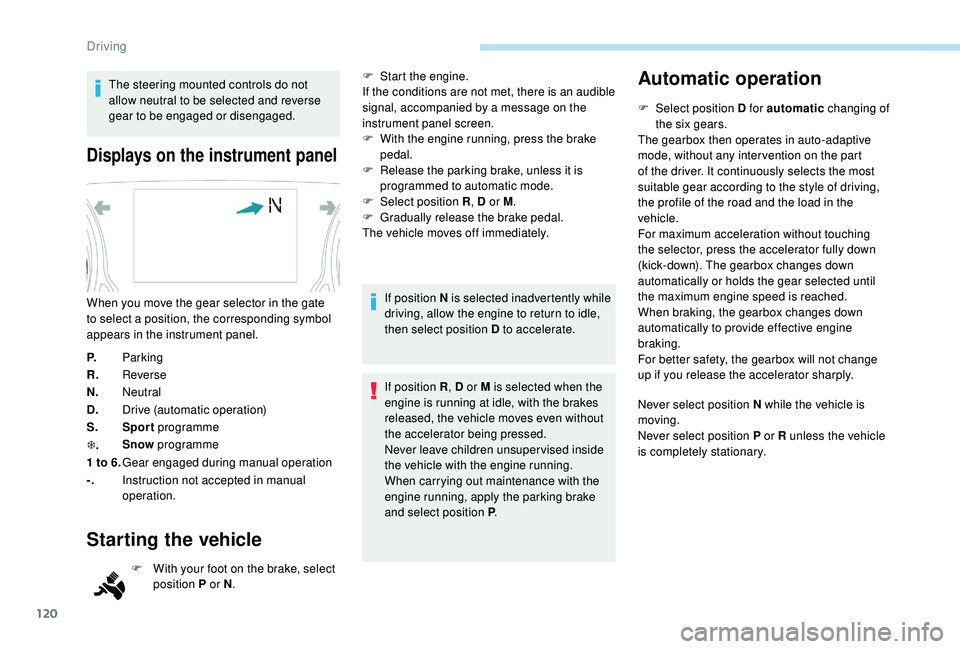
Displays on the instrument panel
P.Parking
R. Reverse
N. Neutral
D. Drive (automatic operation)
S. Sport programme
T . Snow
programme
1 to 6. Gear engaged during manual operation
-. Instruction not accepted in manual
operation.
Starting the vehicle
F With your foot on the brake, select
position P or N .
When you move the gear selector in the gate
to select a position, the corresponding symbol
appears in the instrument panel.
F
S
tart the engine.
If the conditions are not met, there is an audible
signal, accompanied by a message on the
instrument panel screen.
F
W
ith the engine running, press the brake
pedal.
F
R
elease the parking brake, unless it is
programmed to automatic mode.
F
Sel
ect position R
, D or M.
F
G
radually release the brake pedal.
The vehicle moves off immediately.
If position N is selected inadvertently while
driving, allow the engine to return to idle,
then select position D to accelerate.
If position R , D or M is selected when the
engine is running at idle, with the brakes
released, the vehicle moves even without
the accelerator being pressed.
Never leave children unsuper vised inside
the vehicle with the engine running.
When carrying out maintenance with the
engine running, apply the parking brake
and select position P .
Automatic operation
F Select position D for automatic changing of
the six gears.
The gearbox then operates in auto-adaptive
mode, without any inter vention on the part
of the driver. It continuously selects the most
suitable gear according to the style of driving,
the profile of the road and the load in the
vehicle.
For maximum acceleration without touching
the selector, press the accelerator fully down
(kick-down). The gearbox changes down
automatically or holds the gear selected until
the maximum engine speed is reached.
When braking, the gearbox changes down
automatically to provide effective engine
braking.
For better safety, the gearbox will not change
up if you release the accelerator sharply.
Never select position N while the vehicle is
moving.
Never select position P or R unless the vehicle
is completely stationary.
Driving
Page 159 of 324
157
The sound emitted by the speaker (front or
rear) locates the obstacle in relation to the
vehicle, in front or behind.
Deactivation/activation of
the front and rear parking
sensors
The system is deactivated in the
Vehicle/Driving menu, then the
Driving functions tab of the touch
screen.
F
P
ress this button. The indicator
lamp in the button comes on.
Pressing this button again reactivates the function.
The indicator lamp in the button goes off.
The function will be automatically
deactivated when connecting a trailer or a
bicycle carrier on a towing device installed
in accordance with the manufacturer's
recommendations.
The parking sensors are deactivated while the
Park Assist system is measuring a space.
For more information on Park Assist , refer to
the corresponding section.
Operating limits
- Certain obstacles located in the sensors’ blind spots may not be detected or no
longer be detected during the manoeuvre.
-
S
ounds such as those emitted by noisy
vehicles and machinery (e.g. lorries,
pneumatic drills, etc.) may inter fere with the
vehicle's sensors.
-
C
ertain materials (fabrics) absorb sound
waves: pedestrians may not be detected.
-
A
ccumulated snow or dead leaves on the
road sur face can inter fere with the vehicle's
sensors.
-
A f
ront or rear impact to the vehicle can
distort the settings of the sensors, which is
not always detected by the system: distance
measurements may be incorrect.
-
T
he tilting of the vehicle if the boot is
very loaded can affect the distance
measurements.
-
T
he sensors may be affected by poor
weather conditions (heavy rain, thick fog,
snowfall, etc.).
Maintenance
recommendations
In bad or wintry weather, ensure that the
sensors are not covered with mud, ice or
snow. When reverse gear is engaged, an
audible signal (long beep) indicates that
the sensors may be dirty.
High pressure jet wash
When washing your vehicle, keep the
lance at least 12 inches (30
cm) away from
the sensors.
Operating fault
On engaging reverse gear:
This warning lamp comes on in the
instrument panel and/or a message
appears, accompanied by an audible
signal.
Contact a PEUGEOT dealer or a qualified
workshop.
6
Driving
Page 180 of 324

178
Maintenance
Correct operation is only possible if the towball
and its carrier are kept clean.
Before cleaning the vehicle with a high-
pressure jet wash, the towball must be removed
and the protective plug fitted to the carrier.Apply the label provided to a clearly visible
area, close to the carrier or in the boot.
Go to a PEUGEOT dealer or a qualified
workshop for any work on the towing
device system.
Towing device with
quickly detachable towball
(SW)
Presentation
F Extract the towball from the bottom of its carrier 1 .
F
R
elease the locking wheel; this
automatically stops in the unlocked position
(position B ).
F
R
efit protective plug 2 to carrier 1 .
F
C
arefully stow the towball in its bag away
from knocks and dirt. No tools are required to install or remove the
towball on this genuine towing device. 1.
Carrier.
2. Protective plug.
3. Safety eye.
4. Connection socket.
5. Detachable towball.
6. Locking/unlocking latch.
7. Locking/unlocking trigger.
8. Safety key lock.
9. Safety lock protective cap.
10. Stowing bag.
Practical information
Page 181 of 324
179
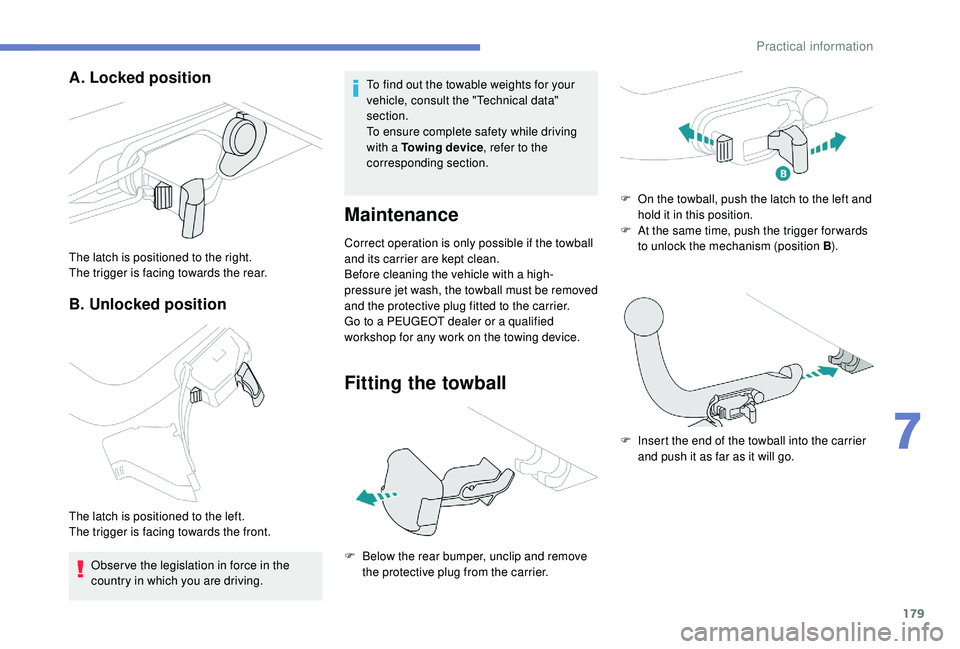
A. Locked position
B. Unlocked position
The latch is positioned to the right.
The trigger is facing towards the rear.
The latch is positioned to the left.
The trigger is facing towards the front. Obser ve the legislation in force in the
country in which you are driving. To find out the towable weights for your
vehicle, consult the "Technical data"
section.
To ensure complete safety while driving
with a Towing device
, refer to the
corresponding section.
Maintenance
Correct operation is only possible if the towball
and its carrier are kept clean.
Before cleaning the vehicle with a high-
pressure jet wash, the towball must be removed
and the protective plug fitted to the carrier.
Go to a PEUGEOT dealer or a qualified
workshop for any work on the towing device.
Fitting the towball
F Below the rear bumper, unclip and remove the protective plug from the carrier. F
O
n the towball, push the latch to the left and
hold it in this position.
F
A
t the same time, push the trigger for wards
to unlock the mechanism (position B ).
F
I
nsert the end of the towball into the carrier
and push it as far as it will go.
7
Practical information