2018 NISSAN VERSA SEDAN weight
[x] Cancel search: weightPage 334 of 702
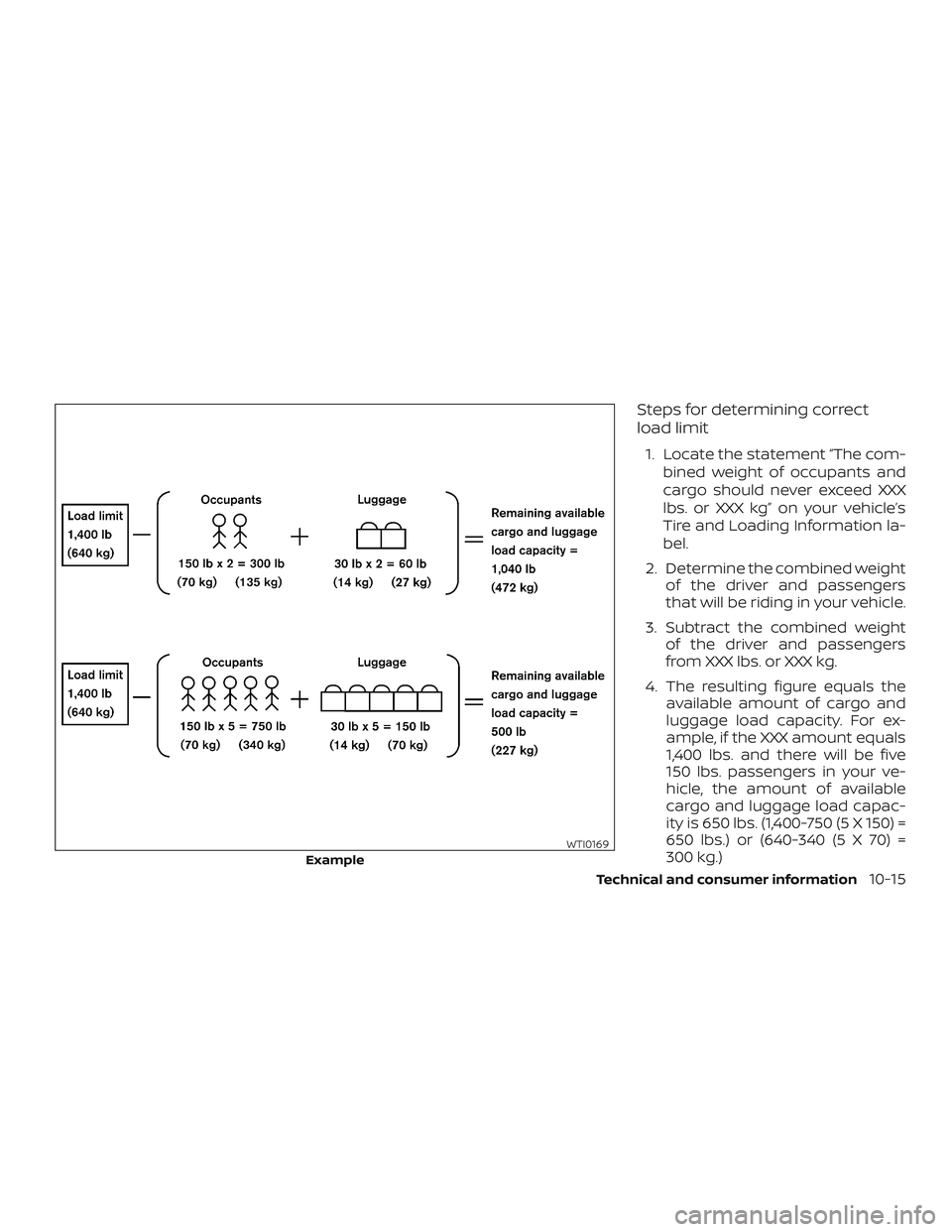
Steps for determining correct
load limit
1. Locate the statement “The com-
bined weight of occupants and
cargo should never exceed XXX
lbs. or XXX kg” on your vehicle’s
Tire and Loading Information la-
bel.
2. Determine the combined weight
of the driver and passengers
that will be riding in your vehicle.
3. Subtract the combined weight
of the driver and passengers
from XXX lbs. or XXX kg.
4. The resulting figure equals the
available amount of cargo and
luggage load capacity. For ex-
ample, if the XXX amount equals
1,400 lbs. and there will be five
150 lbs. passengers in your ve-
hicle, the amount of available
cargo and luggage load capac-
ity is 650 lbs. (1,400-750 (5 X 150) =
650 lbs.) or (640-340 (5 X 70) =
300 kg.)
Example
WTI0169
Technical and consumer information10-15
Page 335 of 702
5.Determine the combined weight
of luggage and cargo being
loaded on the vehicle. That
weight may not safely exceed the
available cargo and luggage load
capacity calculated in step 4.
Before driving a loaded vehicle, con-
firm that you do not exceed the
Gross Vehicle Weight Rating (GVWR)
or the Gross Axle Weight Rating
(GAWR) for your vehicle. For addi-
tional information, refer to “Measure-
ment of weights” in this section.
Also check tires for proper inflation
pressures. For additional informa-
tion, refer to “Tire and Loading Infor-
mation label” in this section.
LOADING TIPS
∙ The GVW must not exceed GVWR
or GAWR as specified on the F.M-
.V.S.S. certification label.
∙ Do not load the front and rear
axle to the GAWR. Doing so will
exceed the GVWR.
WARNING
∙ Properly secure all cargo with
ropes or straps to help prevent
it from sliding or shif ting. Do not
place cargo higher than the
seatbacks. In a sudden stop or
collision, unsecured cargo could
cause personal injury.
∙ Do not load your vehicle any
heavier than the GVWR or the
maximum front and rear
GAWRs. If you do, parts of your
vehicle can break, tire damage
could occur, or it can change the
way your vehicle handles. This
could result in loss of control
and cause personal injury.
∙
Overloading and improper load-
ing not only can shorten the life
of your vehicle and the tire, but
can also cause unsafe vehicle
handling and longer braking dis-
tances. This may cause a prema-
ture tire failure which could re-
sult in a serious accident and
personal injury. Failures caused
by overloading are not covered
by the vehicle’s warranty.
MEASUREMENT OF WEIGHTS
Secure loose items to prevent
weight shif ts that could affect the
balance of your vehicle. When the ve-
hicle is loaded, drive to a scale and
weigh the front and the rear wheels
separately to determine axle loads.
Individual axle loads should not ex-
ceed either of the Gross Axle Weight
Ratings (GAWR). The total of the axle
loads should not exceed the Gross
Vehicle Weight Rating (GVWR). These
ratings are given on the vehicle cer-
tification label. If weight ratings are
exceeded, move or remove items to
bring all weights below the ratings.
10-16
Technical and consumer information
Page 343 of 702

CD player
(See audio system).......4-28,4-34,4-39
Childrestraints........1-18, 1-18, 1-20, 1-23
LATCH (Lower Anchors and Tethers for
CHildren)System..............1-23
Precautions on child
restraints .........1-20, 1-27, 1-33, 1-38
Top tether strap anchor point
locations...................1-25
Child safety rear door lock..........3-6
Chimes, audible reminders.........2-20
Cleaningexteriorandinterior......7-2,7-4
Clock set/adjustment . . .4-27, 4-31, 4-33, 4-36
Clock setting (models without Navigation
System)..................4-27,4-38
Clutch
Clutchfluid.................8-10
Coldweatherdriving.............5-28
Compact disc (CD) player . . .4-28, 4-34, 4-39
Continuously Variable Transmission
(CVT).....................5-8,5-11
Continuously Variable Transmission
(CVT) fluid...................8-9
Driving with Continuously Variable
Transmission (CVT)..........5-8,5-11
Controls
Audio controls (steering wheel).....4-47
Heater and air conditioner controls. . .4-8
Coolant
Capacities and recommended
fuel/lubricants...............10-2
Changing engine coolant.........8-5
Checking engine coolant level......8-5
Engine coolant temperature gauge . .2-9
Corrosionprotection..............7-7
Cruisecontrol..................5-18Cupholders...................2-29
Curtain side-impact and rollover air
bag........................1-57
D
Defroster switch
Rearwindowdefrosterswitch.....2-22
Dimensions and weights...........10-9
Dimmer switch for instrument panel . . .2-24
Door locks..................3-3,3-4
Door open warning light...........2-14
Drivebelt ....................8-14
Driving
Cold weather driving...........5-28
Driving with Continuously Variable
Transmission (CVT)..........5-8,5-11
Driving with manual
transmission..............5-9,5-15
Precautions when starting and
driving.....................5-2
Drivingthevehicle...............5-11
E
Economy - fuel.................5-21
Emission control information label. . . .10-11
Emission control system warranty . . . .10-18
Engine
Before starting the engine........5-9
Blockheater................5-30
Capacities and recommended
fuel/lubricants...............10-2
Changing engine coolant.........8-5Changing engine oil............8-7
Changing engine oil filter.........8-8
Checking engine coolant level......8-5
Checking engine oil level.........8-6
Engine compartment check
locations...................8-3
Engine coolant temperature gauge . .2-9
Engine cooling system..........8-4
Engine oil...................8-6
Engine oil and oil filter
recommendation.............10-6
Engine oil pressure warning light....2-14
Engine oil viscosity.............10-7
Engine serial number...........10-11
Engine specifications...........10-8
Starting the engine............5-10
Engine coolant temperature gauge....2-9
EventDatarecorders............10-20
Exhaust gas (Carbon monoxide).......5-2
Explanation of maintenance items.....9-2
Explanation of scheduled maintenance
items .......................9-5
Extended storage switch..........8-20
F
Flashers
(Seehazardwarningflasherswitch)....6-2
Flattire....................6-2,6-3
Floormatpositioningaid...........7-6
Fluid
Brakefluid..................8-9
Capacities and recommended
fuel/lubricants...............10-2
Clutchfluid.................8-10
11-2
Page 347 of 702

Precautions on supplemental restraint
system....................1-42
Supplemental restraint system
(Supplemental air bag system).......1-42
Switch
Automatic power window switch . . .2-32
Foglightswitch..............2-25
Hazard warning flasher switch......6-2
Headlight and turn signal switch....2-22
Headlightcontrolswitch.........2-22
Ignition switch................5-8
Instrument brightness control.....2-24
Power door lock switch..........3-5
Rearwindowdefrosterswitch.....2-22
Turn signal switch.............2-24
Vehicle dynamic control (VDC) off
switch....................2-26
T
Tachometer...................2-8
Temperature gauge
Engine coolant temperature gauge . .2-9
Three-waycatalyst...............5-2
Tilting steering wheel.............3-16
Tire
Flattire..................6-2,6-3
Spare tire...............6-4,8-39
Tire and Loading Information label . .10-12
Tire chains.................8-35
Tire pressure................8-28
Tirerotation ................8-36
Types of tires................8-34
Uniform tire quality grading.......10-17
Wheels and tires..........8-28,10-9Wheel/tire size...............10-9
Tire pressure
Low tire pressure warning light.....2-15
Tire Pressure Monitoring System (TPMS) . .5-3
Towing
2-wheel drive models...........6-13
4-wheel drive models...........6-12
Flattowing.................10-17
Towtrucktowing..............6-11
Trailertowing ...............10-17
Towingatrailer................10-17
Transmission
Continuously Variable Transmission (CVT)
fluid......................8-9
Driving with Continuously Variable
Transmission (CVT)..........5-8,5-11
Driving with manual
transmission..............5-9,5-15
Travel (See registering a vehicle in another
country).....................10-10
Trip computer.................2-10
Trip odometer...............2-5,2-6
Trunk lid lock opener lever..........3-12
Turn signal switch...............2-24
U
Uniform tire quality grading.........10-17
USBinterface..................4-41
Audio file operation............4-41
V
Vanitymirror ..................3-17Variable voltage control system......8-13
Vehicle dimensions and weights......10-9
Vehicle dynamic control (VDC) off
switch......................2-26
Vehicle dynamic control (VDC) system . .5-26
Vehicle Dynamic Control (VDC) system . .5-26
Vehicle identification.............10-10
Vehicle identification number (VIN). . . .10-10
Vehicle identification number (VIN)
(Chassis number)...............10-10
Vehicle identification number (VIN)
plate.......................10-10
Vehicle loading information........10-13
Vehiclerecovery................6-14
Ventilators....................4-8
Visors.......................3-16
Voice Prompt Interrupt........4-52,4-67
W
Warning
Airbagwarninglight........1-60, 2-18
Anti-lock brake warning light......2-13
Battery charge warning light.....
.2-14
Brakewarninglight............2-13
Door open warning light.........2-14
Engine oil pressure warning light....2-14
Hazard warning flasher switch......6-2
Loosefuelcapwarning..........2-7
Lowfuelwarninglight ..........2-15
Low tire pressure warning light.....2-15
Passenger air bag and status light . . .1-51
Seatbeltwarninglight .......1-13, 2-17
Supplemental air bag warning
light...................1-60, 2-18
11-6
Page 348 of 702

Warning/indicator lights and audible
reminders..................2-18
Warning labels (for SRS)..........1-59
Warning/indicator lights and audible
reminders....................2-18
Audible reminders.............2-18
Indicatorlights...............2-18
Warninglights ...............2-18
Warninglights .................2-18
Warning lights, indicator lights and audible
reminders....................2-12
Weights (See dimensions and weights) . .10-9
Wheels and tires............8-28,10-9
Wheel/tire size.................10-9
When traveling or registering in another
country.....................10-10
Windows.....................2-30
Locking passengers' windows.....2-31
Manual windows..............2-32
Powerrearwindows............2-31
Powerwindows..............2-30
Rearpowerwindows...........2-31
Windshield-washer fluid...........8-10
Windshield wiper blades...........8-16
Wiper
Wiper blades................8-16
Wiper and washer switch..........2-21
11-7
Page 364 of 702
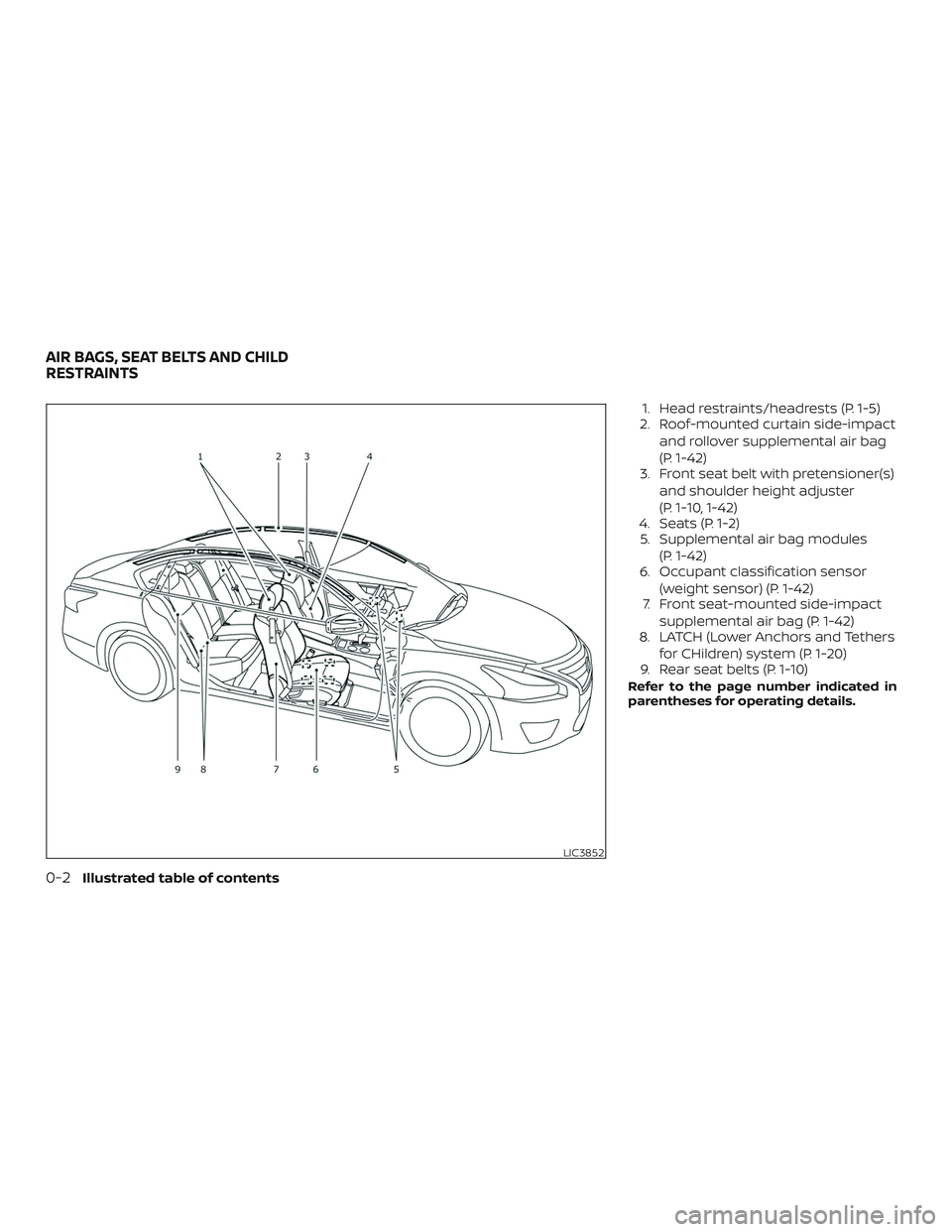
1. Head restraints/headrests (P. 1-5)
2. Roof-mounted curtain side-impact
and rollover supplemental air bag
(P. 1-42)
3. Front seat belt with pretensioner(s)
and shoulder height adjuster
(P. 1-10, 1-42)
4. Seats (P. 1-2) 5. Supplemental air bag modules
(P. 1-42)
6. Occupant classification sensor
(weight sensor) (P. 1-42)
7. Front seat-mounted side-impact
supplemental air bag (P. 1-42)
8. LATCH (Lower Anchors and Tethers
for CHildren) system (P. 1-20)
9. Rear seat belts (P. 1-10)
Refer to the page number indicated in
parentheses for operating details.
LIC3852
AIR BAGS, SEAT BELTS AND CHILD
RESTRAINTS
0-2Illustrated table of contents
Page 391 of 702

INFANTS
Infants up to at least 1 year old should be
placed in a rear-facing child restraint.
NISSAN recommends that infants be
placed in child restraints that comply with
Federal Motor Vehicle Safety Standards or
Canadian Motor Vehicle Safety Standards.
You should choose a child restraint that fits
your vehicle and always follow the manu-
facturer’s instructions for installation and
use.
SMALL CHILDREN
Children that are over 1 year old and weigh
at least 20 lbs. (9 kg) should remain in a
rear-facing child restraint as long as pos-
sible up to the height or weight limit of the
child restraint. Children who outgrow the
height or weight limit of the rear-facing
child restraint and are at least 1 year old
should be secured in a forward-facing child
restraint with a harness. Refer to the manu-
facturer’s instructions for minimum and
maximum weight and height recommen-
dations. NISSAN recommends that small
children be placed in child restraints that
comply with Federal Motor Vehicle Safety
Standards or Canadian Motor Vehicle
Safety Standards. You should choose a
child restraint that fits your vehicle and al-ways follow the manufacturer’s instruc-
tions for installation and use.
LARGER CHILDREN
Children should remain in a forward-facing
child restraint with a harness until they
reach the maximum height or weight limit
allowed by the child restraint manufac-
turer.
Once a child outgrows the height or weight
limit of the harness-equipped forward-
facing child restraint, NISSAN recommends
that the child be placed in a commercially
available booster seat to obtain proper
seat belt fit. For a seat belt to fit properly, the
booster seat should raise the child so that
the shoulder belt is properly positioned
across the chest and the top, middle por-
tion of the shoulder. The shoulder belt
should not cross the neck or face and
should not fall off the shoulder. The lap belt
should lie snugly across the lower hips or
upper thighs, not the abdomen. A booster
seat can only be used in seating positions
that have a three-point type seat belt. The
booster seat should fit the vehicle seat and
have a label certif ying that it complies with
Federal Motor Vehicle Safety Standards or
Canadian Motor Vehicle Safety Standards.
A booster seat should be used until the
child can pass the seat belt fit test below:
∙ Are the child’s back and hips against the vehicle seatback?
∙ Is the child able to sit without slouch- ing?
∙ Do the child’s knees bend easily over the front edge of the seat with feet flat
on the floor?
∙ Can the child safely wear the seat belt (lap belt low and snug across the hips
and shoulder belt across mid-chest
and shoulder)?
∙ Is the child able to use the properly ad- justed head restraint/headrest?
∙ Will the child be able to stay in position for the entire ride?
Safety—Seats, seat belts and supplemental restraint system1-19
Page 394 of 702
∙ When the child restraint is not in use,keep it secured with the LATCH system
or a seat belt. In a sudden stop or col-
lision, loose objects can injure occu-
pants or damage the vehicle.
CAUTION
A child restraint in a closed vehicle can
become very hot. Check the seating
surface and buckles before placing a
child in the child restraint.
This vehicle is equipped with a universal
child restraint anchor system, referred to
as the LATCH (Lower Anchors and Tethers
for CHildren) system. Some child restraints
include rigid or webbing-mounted attach-
ments that can be connected to these an-
chors. For additional information, refer to
“LATCH (Lower Anchors and Tethers for
CHildren) system” in this section.
If you do not have a LATCH compatible
child restraint, the vehicle seat belts can be
used. Several manufacturers offer child re-
straints for infants and children of various
sizes. When selecting any child restraint,
keep the following points in mind:
∙ Choose only a restraint with a label cer- tif ying that it complies with Federal Mo-
tor Vehicle Safety Standard 213 or Cana-
dian Motor Vehicle Safety Standard 213.
∙ Check the child restraint in your vehicle to be sure it is compatible with the vehi-
cle’s seat and seat belt system.
∙ If the child restraint is compatible with your vehicle, place your child in the child
restraint and check the various adjust-
ments to be sure the child restraint is
compatible with your child. Choose a
child restraint that is designed for your
child’s height and weight. Always follow
all recommended procedures.
∙ If the combined weight of the child and child restraint is less than 65 lbs.
(29.5 kg), you may use either the LATCH
anchors or the seat belt to install the
child restraint (not both at the same
time). ∙ If the combined weight of the child and
child restraint is greater than 65 lbs.
(29.5 kg), use the vehicle’s seat belt (not
the lower anchors) to install the child
restraint.
∙ Be sure to follow the child restraint manufacturer’s instructions for installa-
tion.
All U.S. states and Canadian provinces or
territories require that infants and small
children be restrained in an approved
child restraint at all times while the ve-
hicle is being operated. Canadian law re-
quires the top tether strap on forward-
facing child restraints be secured to the
designated anchor point on the vehicle.
1-22Safety—Seats, seat belts and supplemental restraint system