Page 99 of 460
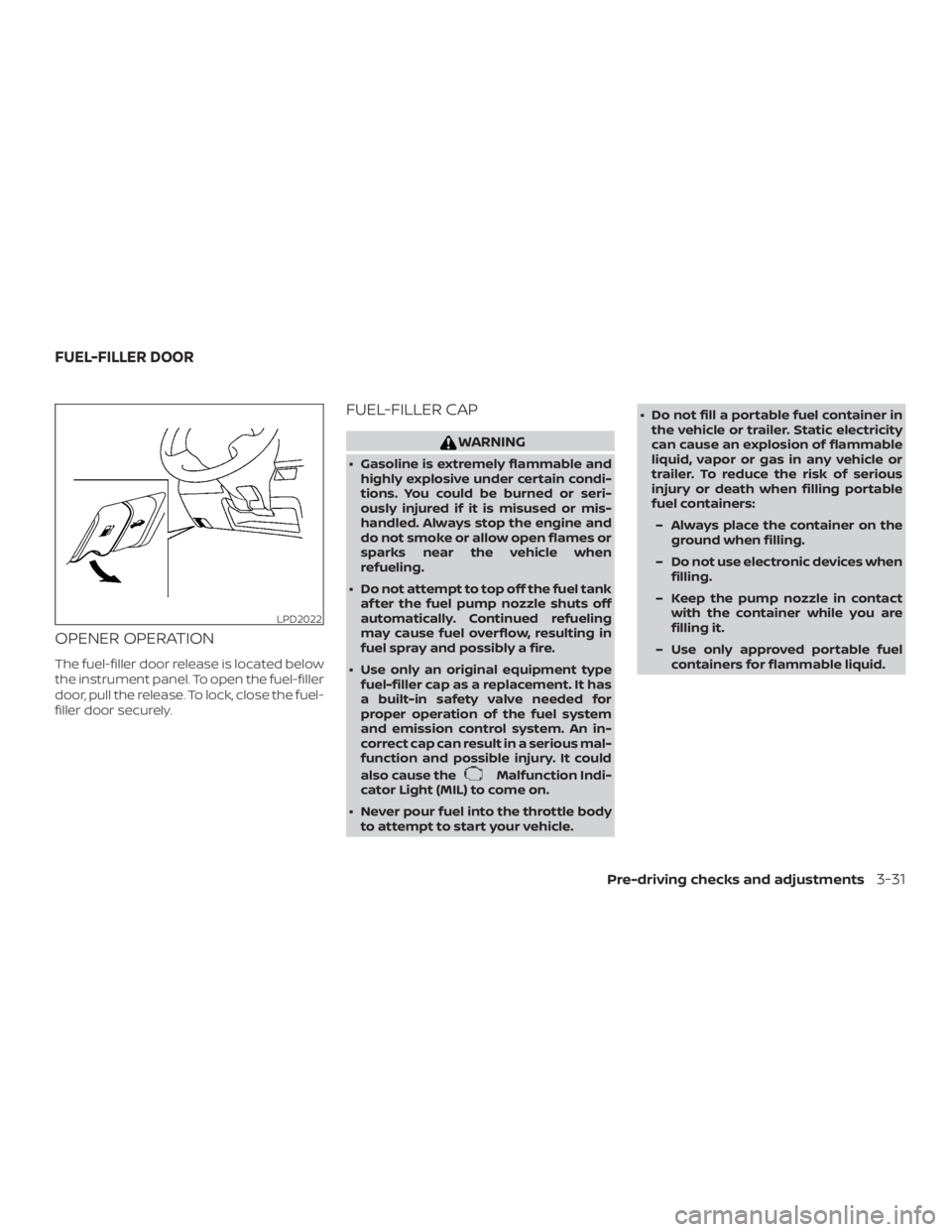
FUEL GAUGE
The gauge indicates theapproximatefuel
level in the tank.
The gauge may move slightly during brak-
ing, turning, acceleration, or going up or
down hills.
The gauge needle returns to 0 (Empty) af-
ter the ignition switch is placed in the OFF
position.
The low fuel warning message shows in
the vehicle information display when the
amount of fuel in the tank is getting low. Refill the fuel tank before the gauge reg-
isters 0 (Empty).
The
Page 193 of 460
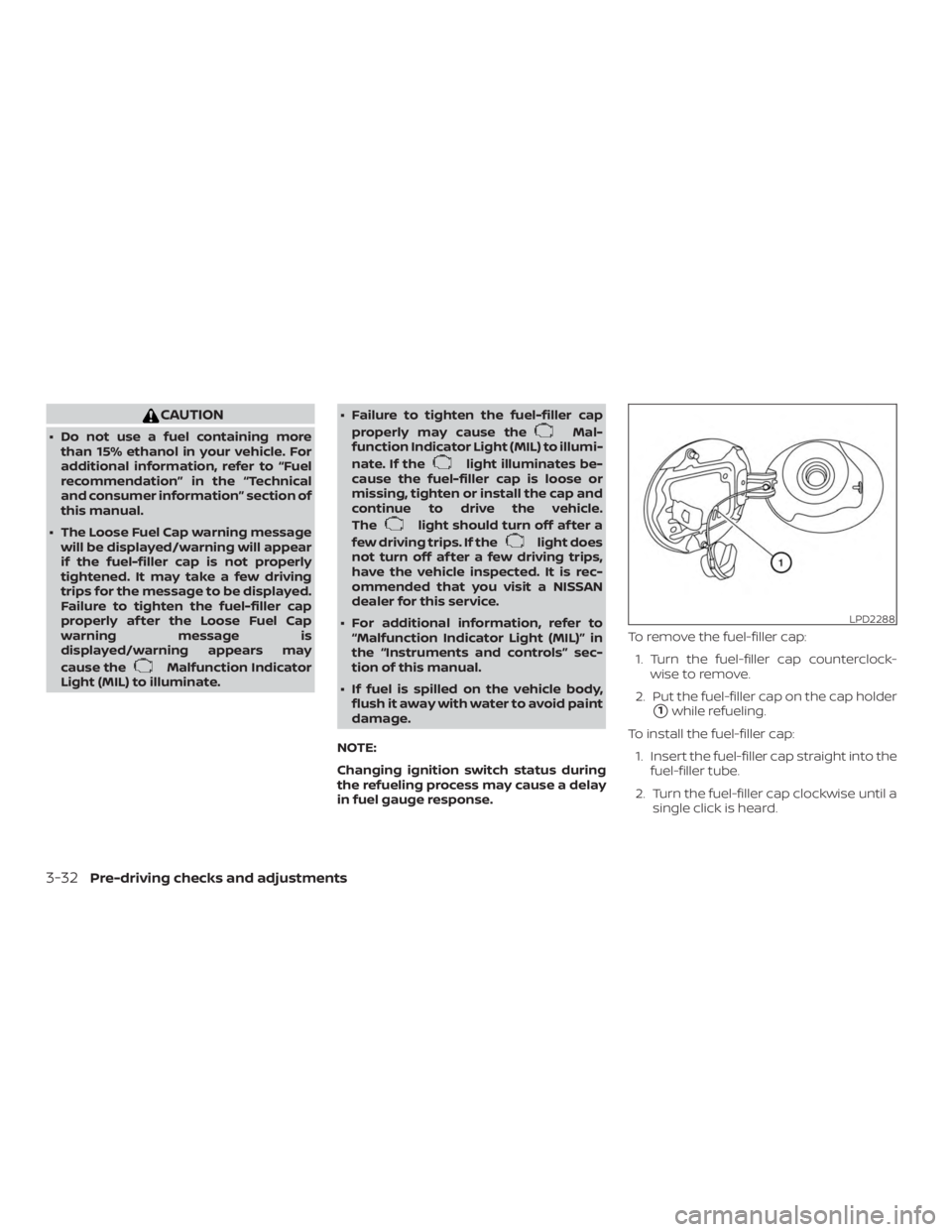
OPENER OPERATION
The fuel-filler door release is located below
the instrument panel. To open the fuel-filler
door, pull the release. To lock, close the fuel-
filler door securely.
FUEL-FILLER CAP
Page 194 of 460
CAUTION
∙ Do not use a fuel containing morethan 15% ethanol in your vehicle. For
additional information, refer to “Fuel
recommendation” in the “Technical
and consumer information” section of
this manual.
∙ The Loose Fuel Cap warning message will be displayed/warning will appear
if the fuel-filler cap is not properly
tightened. It may take a few driving
trips for the message to be displayed.
Failure to tighten the fuel-filler cap
properly af ter the Loose Fuel Cap
warning message is
displayed/warning appears may
cause the
Page 195 of 460
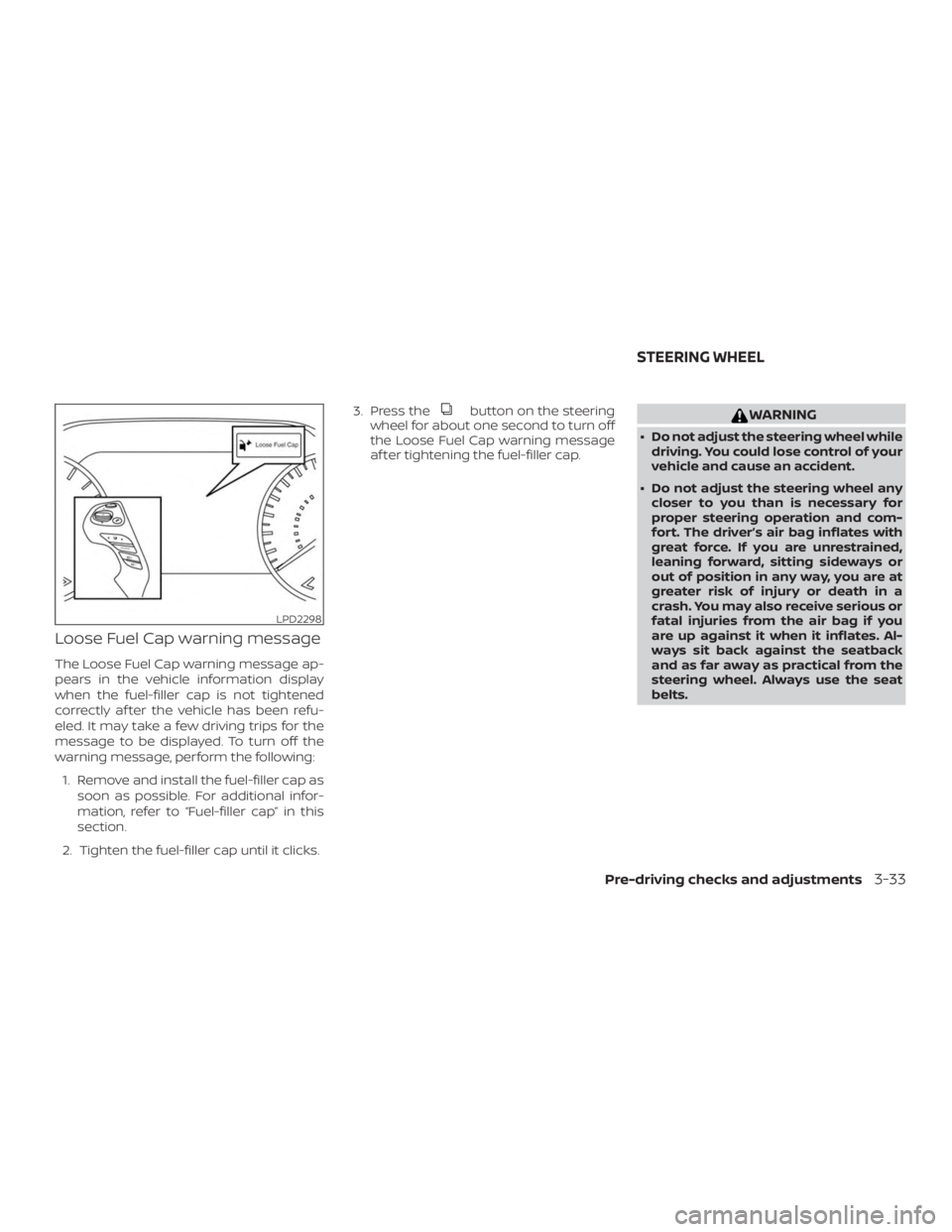
Loose Fuel Cap warning message
The Loose Fuel Cap warning message ap-
pears in the vehicle information display
when the fuel-filler cap is not tightened
correctly af ter the vehicle has been refu-
eled. It may take a few driving trips for the
message to be displayed. To turn off the
warning message, perform the following:1. Remove and install the fuel-filler cap as soon as possible. For additional infor-
mation, refer to “Fuel-filler cap” in this
section.
2. Tighten the fuel-filler cap until it clicks. 3. Press the
Page 255 of 460
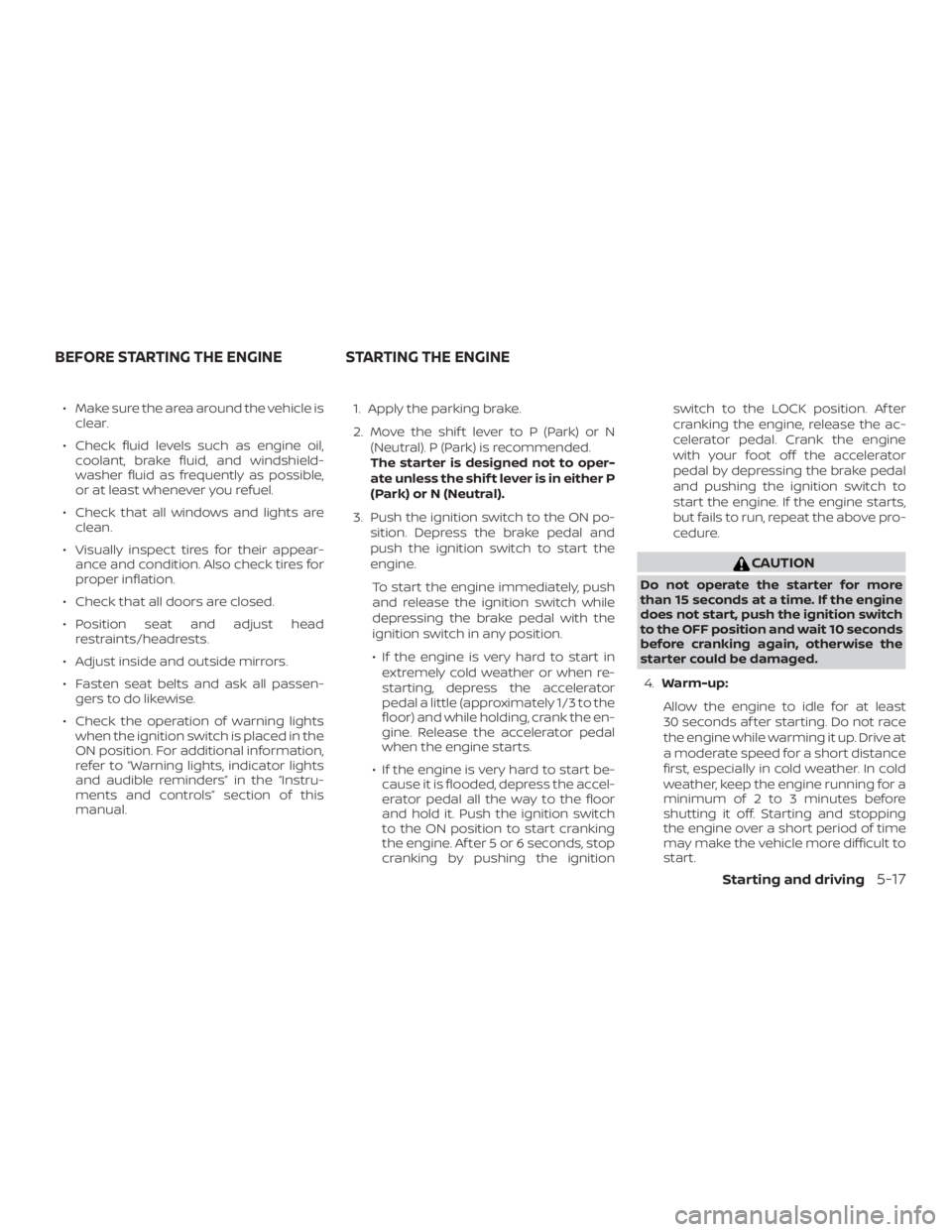
∙ Make sure the area around the vehicle isclear.
∙ Check fluid levels such as engine oil, coolant, brake fluid, and windshield-
washer fluid as frequently as possible,
or at least whenever you refuel.
∙ Check that all windows and lights are clean.
∙ Visually inspect tires for their appear- ance and condition. Also check tires for
proper inflation.
∙ Check that all doors are closed.
∙ Position seat and adjust head restraints/headrests.
∙ Adjust inside and outside mirrors.
∙ Fasten seat belts and ask all passen- gers to do likewise.
∙ Check the operation of warning lights when the ignition switch is placed in the
ON position. For additional information,
refer to “Warning lights, indicator lights
and audible reminders” in the “Instru-
ments and controls” section of this
manual. 1. Apply the parking brake.
2. Move the shif t lever to P (Park) or N
(Neutral). P (Park) is recommended.
The starter is designed not to oper-
ate unless the shif t lever is in either P
(Park) or N (Neutral).
3. Push the ignition switch to the ON po- sition. Depress the brake pedal and
push the ignition switch to start the
engine.
To start the engine immediately, push
and release the ignition switch while
depressing the brake pedal with the
ignition switch in any position.
∙ If the engine is very hard to start in extremely cold weather or when re-
starting, depress the accelerator
pedal a little (approximately 1/3 to the
floor) and while holding, crank the en-
gine. Release the accelerator pedal
when the engine starts.
∙ If the engine is very hard to start be- cause it is flooded, depress the accel-
erator pedal all the way to the floor
and hold it. Push the ignition switch
to the ON position to start cranking
the engine. Af ter 5 or 6 seconds, stop
cranking by pushing the ignition switch to the LOCK position. Af ter
cranking the engine, release the ac-
celerator pedal. Crank the engine
with your foot off the accelerator
pedal by depressing the brake pedal
and pushing the ignition switch to
start the engine. If the engine starts,
but fails to run, repeat the above pro-
cedure.
Page 356 of 460
CAUTION
∙ NEVER remove dirt, sand or other de-bris from the passenger compart-
ment by washing it out with a hose.
Remove dirt with a vacuum cleaner or
broom.
∙ Never allow water or other liquids to come in contact with electronic com-
ponents inside the vehicle as this may
damage them.
Chemicals used for road surface de-icing
are extremely corrosive. They accelerate
corrosion and deterioration of underbody
components such as the exhaust system,
fuel and brake lines, brake cables, floor pan
and fenders.
In winter, the underbody must be
cleaned periodically.
For additional protection against rust and
corrosion, which may be required in some
areas, it is recommended that you visit a
NISSAN dealer.
7-8Appearance and care
Page 415 of 460
Fluid typeCapacity (approximate) Recommended Fluids/Lubricants
Metric
Measure US
Measure Imperial
Measure
Windshield-washer fluid 4.6 L 1-1/4 gal 1 gal• Genuine NISSAN Windshield Washer Concentrate Cleaner & An-
tifreeze or equivalent.
Air conditioning system refrigerant ———• HFC-134a (R-134a).
• For additional information, refer to “Air conditioner system re-
frigerant and oil recommendations” in this section.
Air conditioning system oil ———• NISSAN A/C System Oil Type ND-OIL8 or equivalent.
• For additional information, refer to “Air conditioner system re-
frigerant and oil recommendations” in this section.
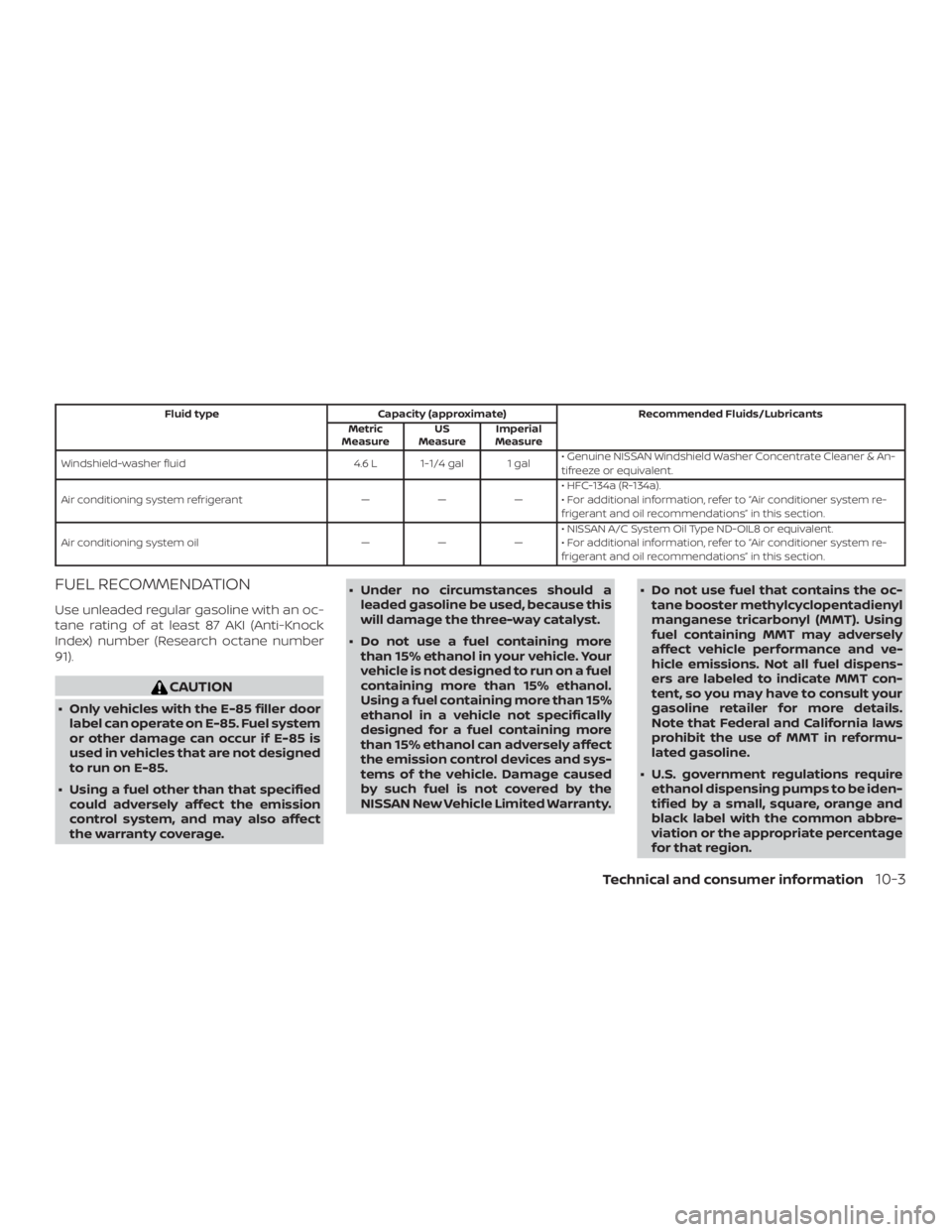
FUEL RECOMMENDATION
Use unleaded regular gasoline with an oc-
tane rating of at least 87 AKI (Anti-Knock
Index) number (Research octane number
91).
Page 446 of 460
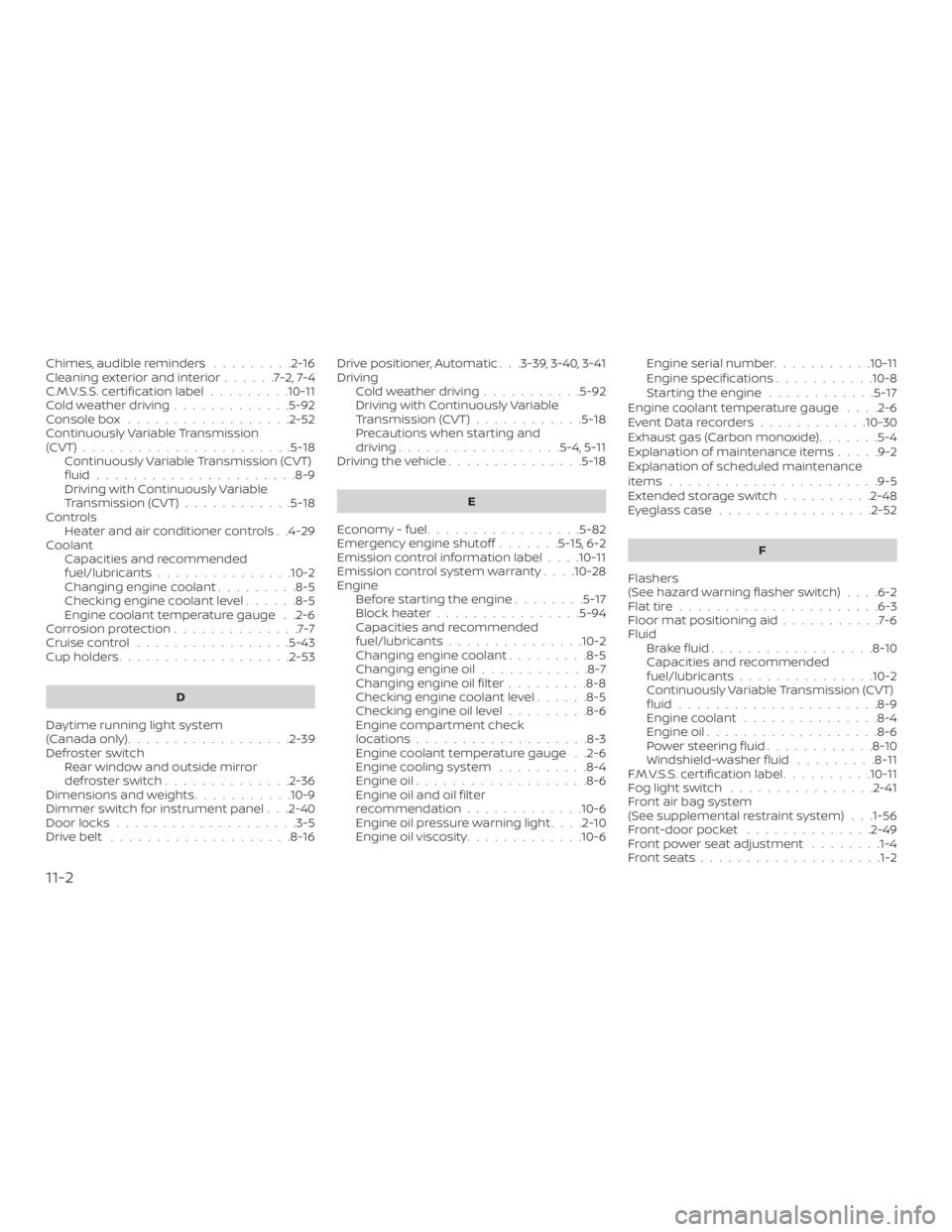
Chimes, audible reminders.........2-16
Cleaningexteriorandinterior......7-2,7-4
C.M.V.S.S. certification label .........10-11
Coldweatherdriving.............5-92
Console box ..................2-52
Continuously Variable Transmission
(CVT) .......................5-18
Continuously Variable Transmission (CVT)
fluid......................8-9
Driving with Continuously Variable
Transmission (CVT) ............5-18
Controls Heater and air conditioner controls . .4-29
Coolant Capacities and recommended
fuel/lubricants...............10-2
Changing engine coolant .........8-5
Checking engine coolant level ......8-5
Engine coolant temperature gauge . .2-6
Corrosionprotection..............7-7
Cruisecontrol .................5-43
Cupholders...................2-53
D
Daytime running light system
(Canada only) ..................2-39
Defroster switch Rear window and outside mirror
defrosterswitch..............2-36
Dimensions and weights ...........10-9
Dimmer switch for instrument panel . . .2-40
Door locks ....................3-5
Drivebelt ....................8-16 Drive positioner, Automatic . . .3-39, 3-40, 3-41
Driving
Cold weather driving ...........5-92
Driving with Continuously Variable
Transmission (CVT) ............5-18
Precautions when starting and
driving..................5-4,5-11
Drivingthevehicle...............5-18
E
Economy - fuel .................5-82
Emergency engine shutoff .......5-15,6-2
Emission control information label . . . .10-11
Emission control system warranty . . . .10-28
Engine Before starting the engine ........5-17
Blockheater................5-94
Capacities and recommended
fuel/lubricants...............10-2
Changing engine coolant .........8-5
Changing engine oil ............8-7
Changing engine oil filter .........8-8
Checking engine coolant level ......8-5
Checking engine oil level .........8-6
Engine compartment check
locations...................8-3
Engine coolant temperature gauge . .2-6
Engine cooling system ..........8-4
Engine oil ...................8-6
Engine oil and oil filter
recommendation .............10-6
Engine oil pressure warning light ....2-10
Engine oil viscosity .............10-6 Engine serial number
...........10-11
Engine specifications ...........10-8
Starting the engine ............5-17
Engine coolant temperature gauge ....2-6
EventDatarecorders............10-30
Exhaust gas (Carbon monoxide) .......5-4
Explanation of maintenance items .....9-2
Explanation of scheduled maintenance
items .......................9-5
Extended storage switch ..........2-48
Eyeglasscase .................2-52
F
Flashers
(Seehazardwarningflasherswitch)....6-2
Flattire......................6-3
Floormatpositioningaid...........7-6
Fluid Brakefluid..................8-10
Capacities and recommended
fuel/lubricants...............10-2
Continuously Variable Transmission (CVT)
fluid......................8-9
Engine coolant ...............8-4
Engine oil ...................8-6
Powersteeringfluid............8-10
Windshield-washer fluid .........8-11
F.M.V.S.S. certification label ..........10-11
Foglightswitch ................2-41
Front air bag system
(See supplemental restraint system) . . .1-56
Front-door pocket ..............2-49
Front power seat adjustment ........1-4
F
rontseats....................1-2
11-2