Page 361 of 460
CHECKING ENGINE COOLANT
LEVEL
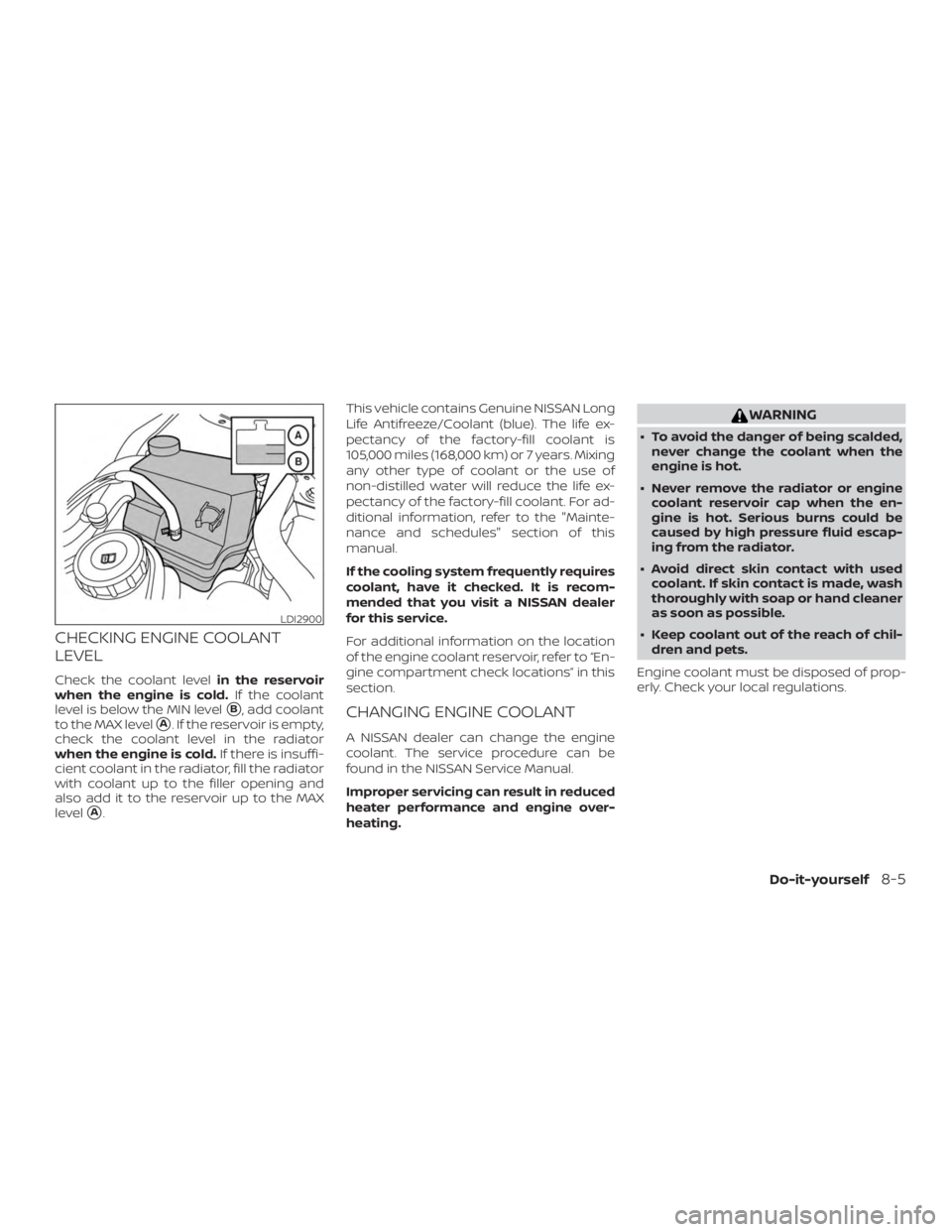
Check the coolant levelin the reservoir
when the engine is cold. If the coolant
level is below the MIN level
�B, add coolant
to the MAX level
�A. If the reservoir is empty,
check the coolant level in the radiator
when the engine is cold. If there is insuffi-
cient coolant in the radiator, fill the radiator
with coolant up to the filler opening and
also add it to the reservoir up to the MAX
level
�A. This vehicle contains Genuine NISSAN Long
Life Antifreeze/Coolant (blue). The life ex-
pectancy of the factory-fill coolant is
105,000 miles (168,000 km) or 7 years. Mixing
any other type of coolant or the use of
non-distilled water will reduce the life ex-
pectancy of the factory-fill coolant. For ad-
ditional information, refer to the "Mainte-
nance and schedules" section of this
manual.
If the cooling system frequently requires
coolant, have it checked. It is recom-
mended that you visit a NISSAN dealer
for this service.
For additional information on the location
of the engine coolant reservoir, refer to “En-
gine compartment check locations” in this
section.
CHANGING ENGINE COOLANT
A NISSAN dealer can change the engine
coolant. The service procedure can be
found in the NISSAN Service Manual.
Improper servicing can result in reduced
heater performance and engine over-
heating.
WARNING
∙ To avoid the danger of being scalded,
never change the coolant when the
engine is hot.
∙ Never remove the radiator or engine coolant reservoir cap when the en-
gine is hot. Serious burns could be
caused by high pressure fluid escap-
ing from the radiator.
∙ Avoid direct skin contact with used coolant. If skin contact is made, wash
thoroughly with soap or hand cleaner
as soon as possible.
∙ Keep coolant out of the reach of chil- dren and pets.
Engine coolant must be disposed of prop-
erly. Check your local regulations.
LDI2900
Do-it-yourself8-5
Page 362 of 460
CHECKING ENGINE OIL LEVEL
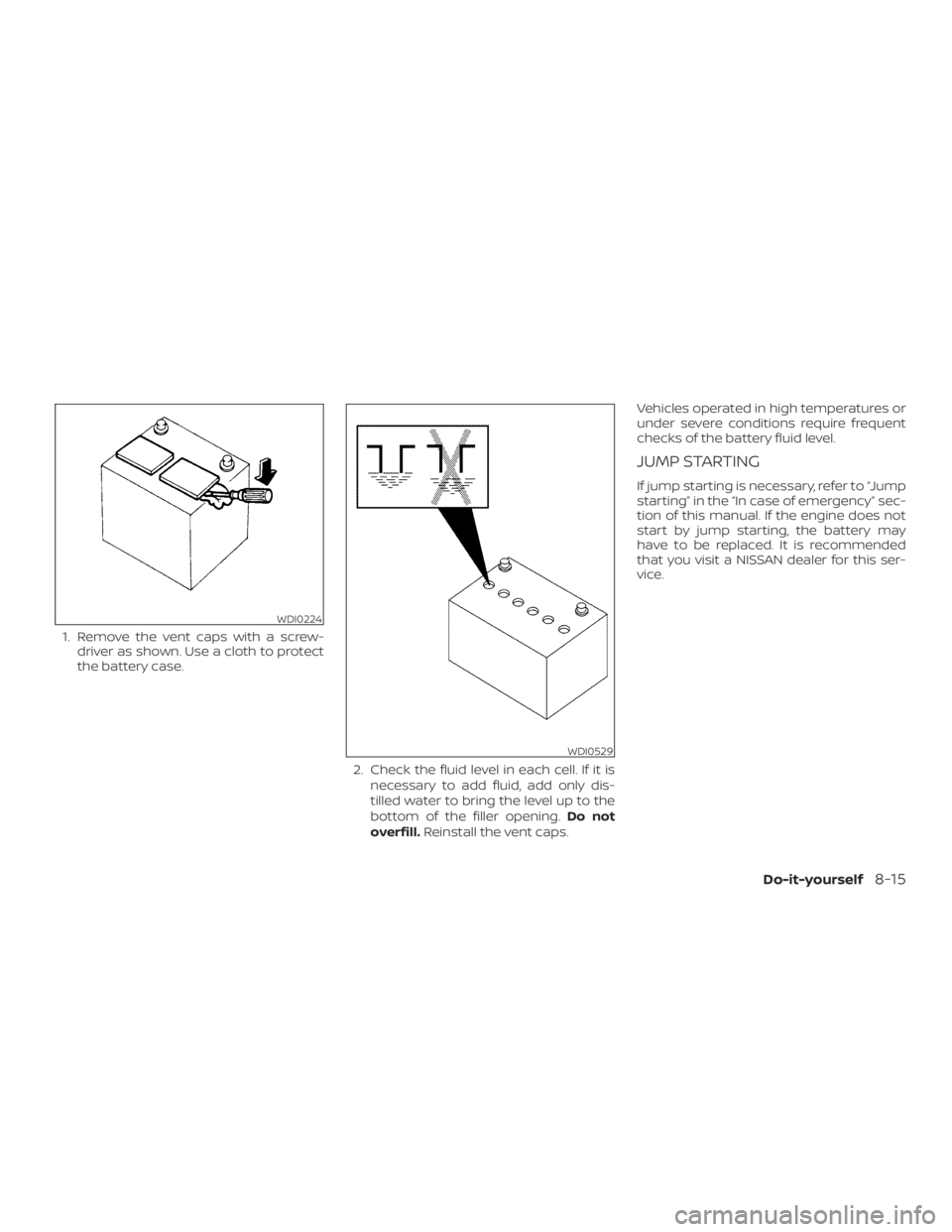
1. Park the vehicle on a level surface andapply the parking brake.
2. Start the engine and let it idle until it reaches operating temperature.
3. Turn off the engine. Wait more than
10 minutes for the oil to drain back
into the oil pan.
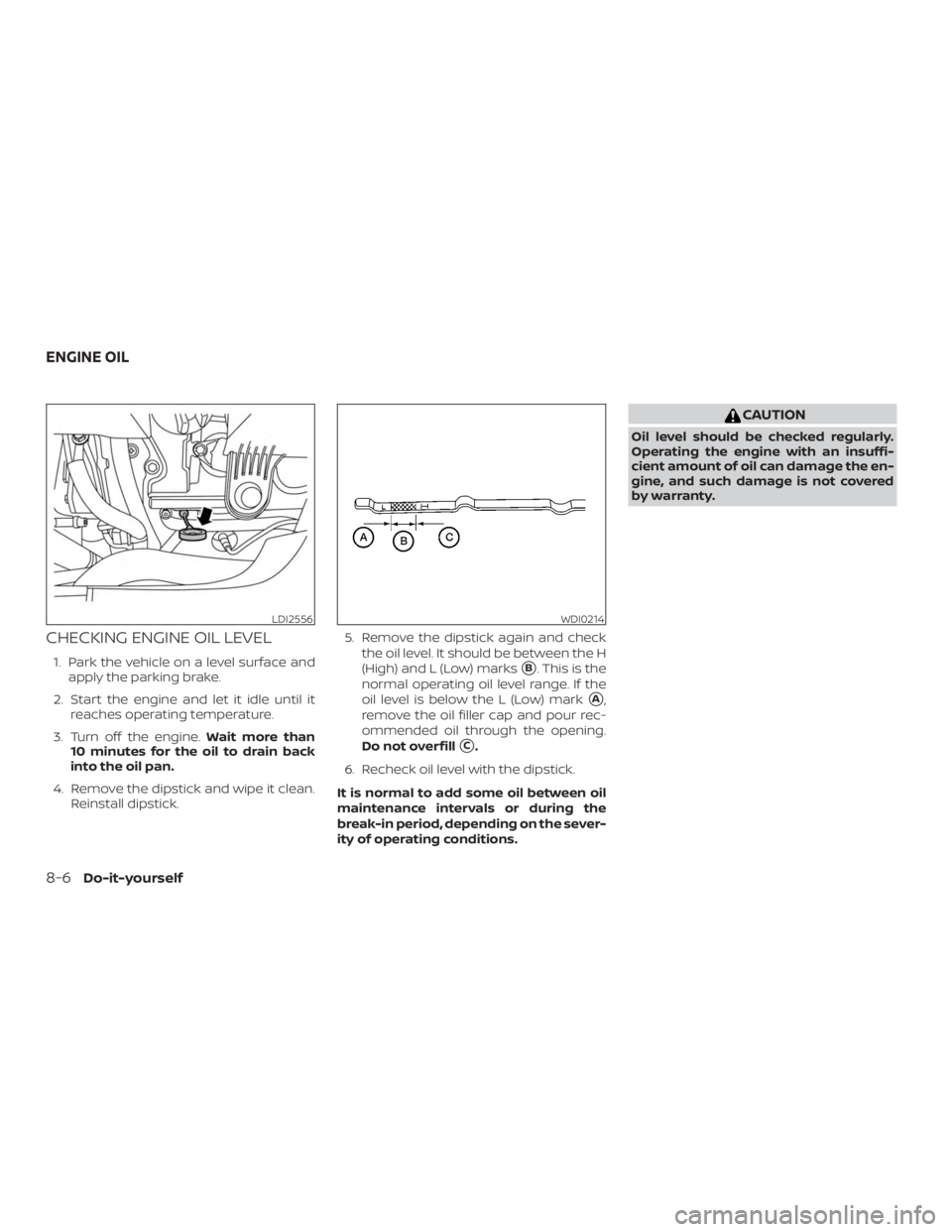
4. Remove the dipstick and wipe it clean. Reinstall dipstick. 5. Remove the dipstick again and check
the oil level. It should be between the H
(High) and L (Low) marks�B. This is the
normal operating oil level range. If the
oil level is below the L (Low) mark
�A,
remove the oil filler cap and pour rec-
ommended oil through the opening.
Do not overfill
�C.
6. Recheck oil level with the dipstick.
It is normal to add some oil between oil
maintenance intervals or during the
break-in period, depending on the sever-
ity of operating conditions.
CAUTION
Oil level should be checked regularly.
Operating the engine with an insuffi-
cient amount of oil can damage the en-
gine, and such damage is not covered
by warranty.
LDI2556WDI0214
ENGINE OIL
8-6Do-it-yourself
Page 363 of 460
CHANGING ENGINE OIL
1. Park the vehicle on a level surface andapply the parking brake.
2. Start the engine and let it idle until it reaches operating temperature, then
turn it off.
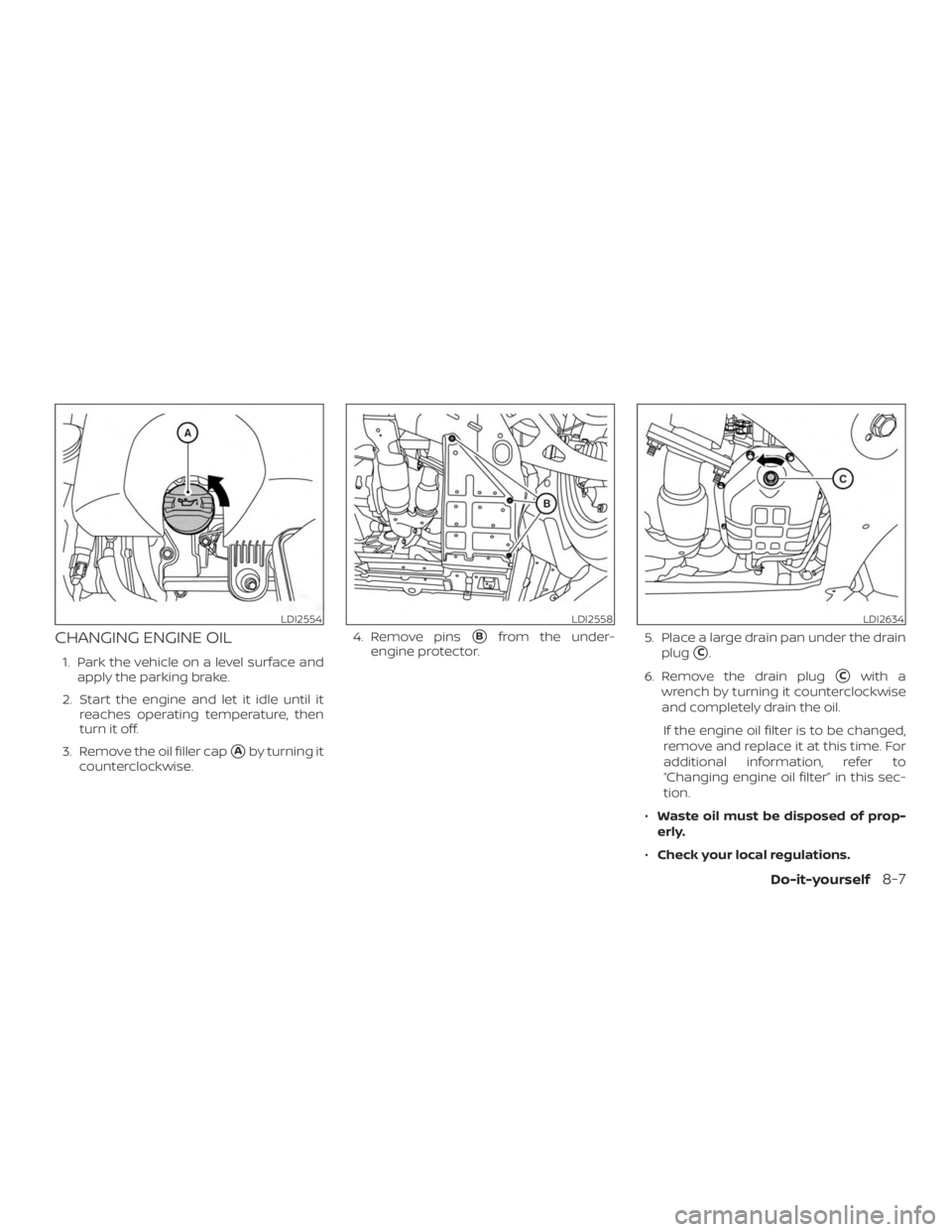
3. Remove the oil filler cap
�Aby turning it
counterclockwise. 4. Remove pins
�Bfrom the under-
engine protector. 5. Place a large drain pan under the drain
plug
�C.
6. Remove the drain plug
�Cwith a
wrench by turning it counterclockwise
and completely drain the oil.
If the engine oil filter is to be changed,
remove and replace it at this time. For
additional information, refer to
“Changing engine oil filter” in this sec-
tion.
∙ Waste oil must be disposed of prop-
erly.
∙ Check your local regulations.
LDI2554LDI2558LDI2634
Do-it-yourself8-7
Page 364 of 460
WARNING
∙ Prolonged and repeated contact withused engine oil may cause skin
cancer.
∙ Try to avoid direct skin contact with used oil. If skin contact is made, wash
thoroughly with soap or hand cleaner
as soon as possible.
∙ Keep used engine oil out of reach of children.
CAUTION
Be careful not to burn yourself. The en-
gine oil may be hot.
7. Clean and reinstall the drain plug and a new washer. Securely tighten the drain
plug with a wrench. Do not use exces-
sive force.
Drain plug tightening torque: 25 f t-lb (34 N·m)
8. Refill engine with recommended oil through the oil filler opening, then in-
stall the oil filler cap securely.
For additional information on drain
and refill capacity, refer to “Recom-
mended fluids/lubricants and capaci- ties” in the “Technical and consumer
information” section of this manual.
The drain and refill capacity depends
on the oil temperature and drain time.
Use these specifications for reference
only. Always use the dipstick to deter-
mine when the proper amount of oil is
in the engine.
9. Start the engine. Check for leakage around the drain plug and oil filter. Cor-
rect as required.
10. Turn the engine off and wait more than 10 minutes. Check the oil level with the
dipstick. Add engine oil if necessary.
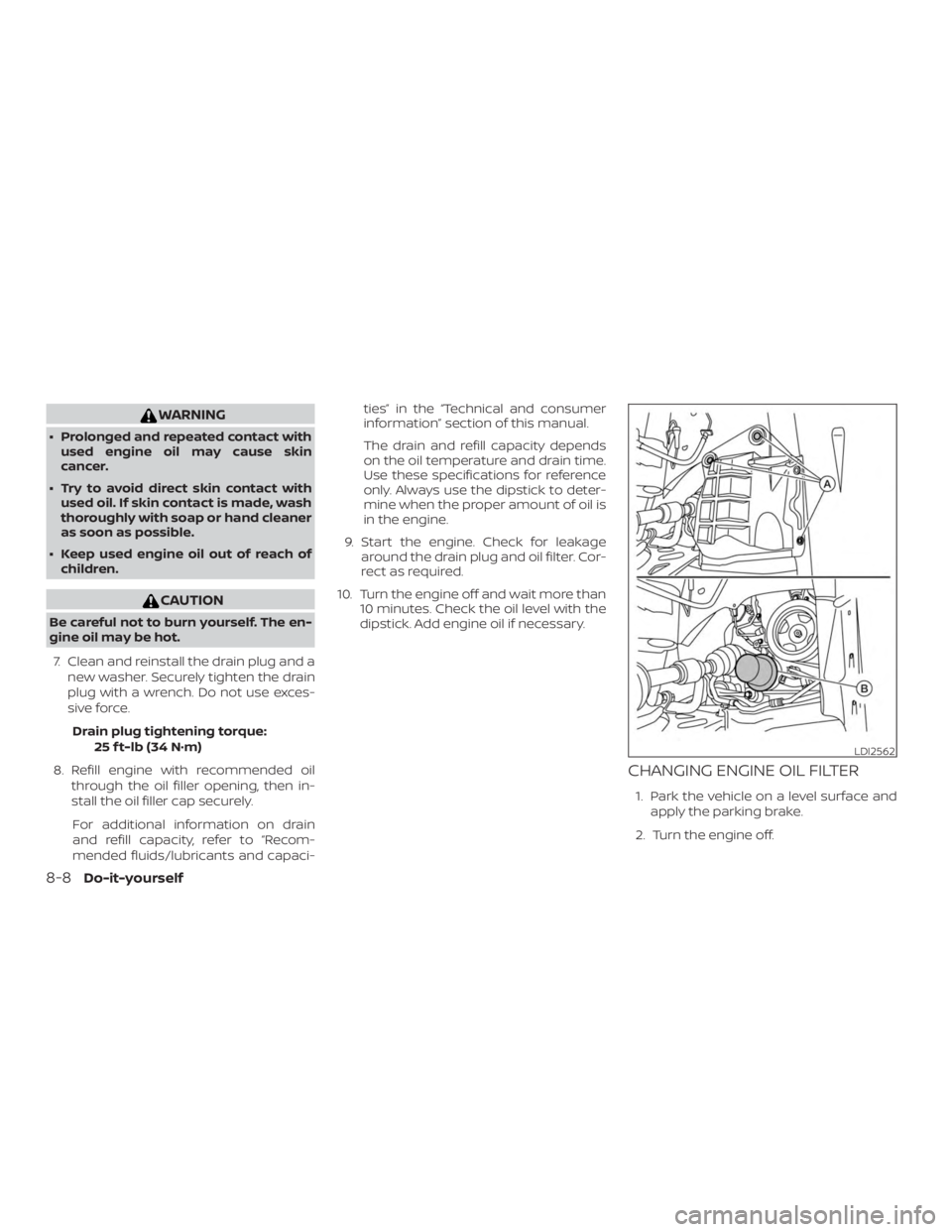
CHANGING ENGINE OIL FILTER
1. Park the vehicle on a level surface and
apply the parking brake.
2. Turn the engine off.
LDI2562
8-8Do-it-yourself
Page 365 of 460

3. Place a large drain pan under the oilfilter
�B.
4. Remove pins
�Afrom the right engine
protector located inside the right
wheel well and then remove protector.
Remove oil filter
�Bwith an oil filter
wrench by turning it counterclockwise.
Then remove the oil filter by turning it
by hand.
CAUTION
Be careful not to burn yourself. The en-
gine oil may be hot.
5. Wipe the engine oil filter sealing surface with a clean rag.
CAUTION
∙ Be sure to remove any old gasketmaterial remaining on the sealing
surface of the engine. Failure to do
so could lead to an oil leak and en-
gine damage.
∙ The dipstick must be inserted in place to prevent oil spillage from
the dipstick hole when filling the
engine with oil.
6. Coat the gasket on the new filter with clean engine oil. 7. Screw on the oil filter until a slight resis-
tance is felt, then tighten an additional
2/3 turn.
8. Start the engine and check for leakage around the oil filter. Correct as required.
9. Turn the engine off and wait more than 10 minutes. Check the oil level. Add en-
gine oil if necessary.
CAUTION
∙ NISSAN recommends using GenuineNISSAN CVT Fluid NS-3 (or equivalent)
ONLY in NISSAN CVTs. Do not mix with
other fluids.
∙ Do not use Automatic Transmission Fluid (ATF) or manual transmission
fluid in a NISSAN CVT, as it may dam-
age the CVT. Damage caused by the
use of fluids other than as recom-
mended is not covered under
NISSAN’s New Vehicle Limited
Warranty.
∙ Using fluids that are not equivalent to Genuine NISSAN CVT Fluid NS-3 may
also damage the CVT. Damage caused
by the use of fluids other than as rec-
ommended is not covered under
NISSAN’s New Vehicle Limited
Warranty.
When checking or replacement of CVT fluid
is required, we recommend a NISSAN
dealer for servicing.
CONTINUOUSLY VARIABLE
TRANSMISSION (CVT) FLUID
Do-it-yourself8-9
Page 367 of 460
CAUTION
Do not spill the fluid on any painted sur-
faces. This will damage the paint. If fluid
is spilled, immediately wash the surface
with water.
Check the fluid level in the reservoir. If the
brake fluid is below the MIN line
�B, the
brake warning light will illuminate. Add
brake fluid up to the MAX line
�A. For addi-
tional information on brake fluid type, refer
to “Recommended fluids/lubricants and
capacities” in the “Technical and consumer
information” section of this manual.
If the brake fluid must be added frequently,
the brake system should be thoroughly
checked. It is recommended that you visit a
NISSAN dealer for this service.
WINDSHIELD-WASHER FLUID
RESERVOIR
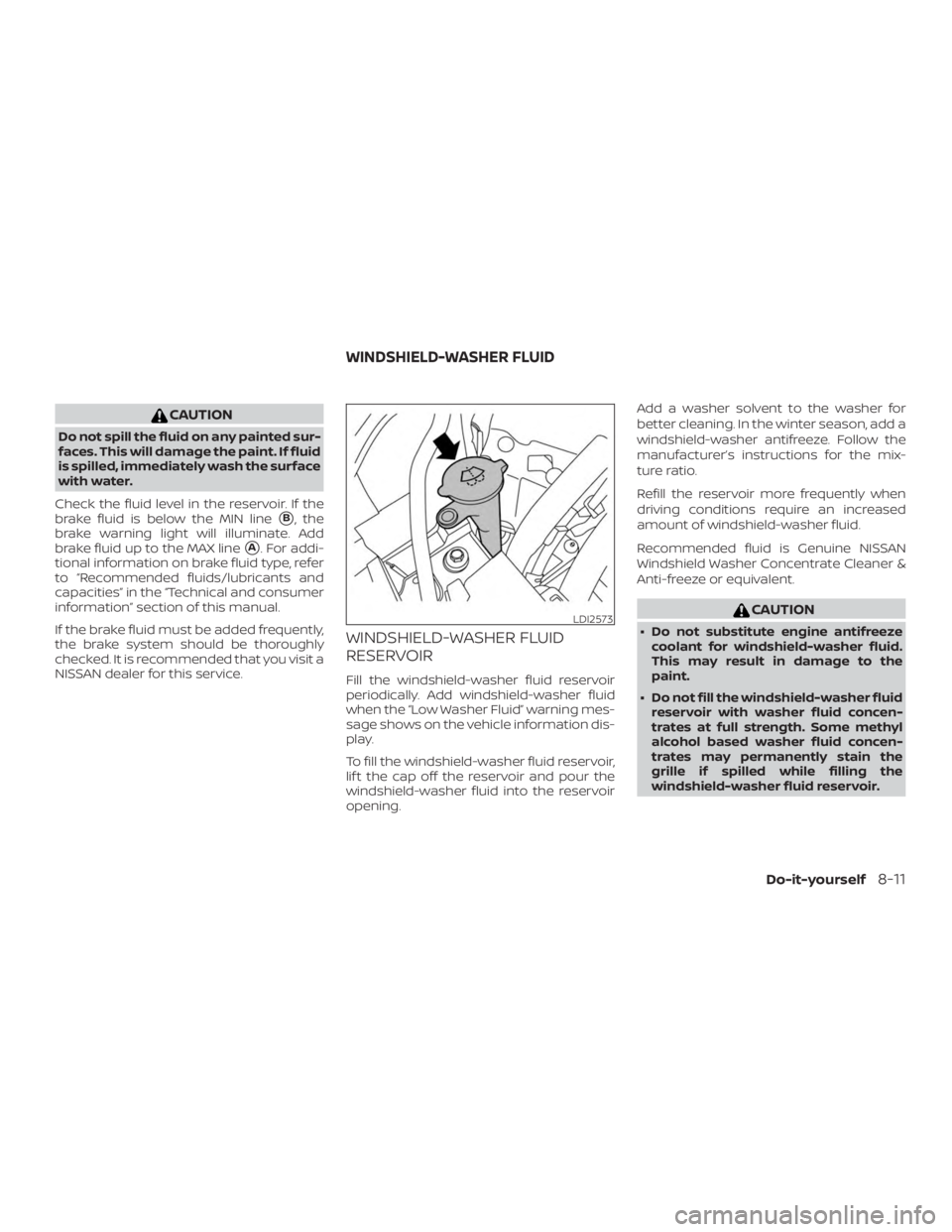
Fill the windshield-washer fluid reservoir
periodically. Add windshield-washer fluid
when the “Low Washer Fluid” warning mes-
sage shows on the vehicle information dis-
play.
To fill the windshield-washer fluid reservoir,
lif t the cap off the reservoir and pour the
windshield-washer fluid into the reservoir
opening. Add a washer solvent to the washer for
better cleaning. In the winter season, add a
windshield-washer antifreeze. Follow the
manufacturer’s instructions for the mix-
ture ratio.
Refill the reservoir more frequently when
driving conditions require an increased
amount of windshield-washer fluid.
Recommended fluid is Genuine NISSAN
Windshield Washer Concentrate Cleaner &
Anti-freeze or equivalent.
CAUTION
∙ Do not substitute engine antifreeze
coolant for windshield-washer fluid.
This may result in damage to the
paint.
∙ Do not fill the windshield-washer fluid reservoir with washer fluid concen-
trates at full strength. Some methyl
alcohol based washer fluid concen-
trates may permanently stain the
grille if spilled while filling the
windshield-washer fluid reservoir.LDI2573
WINDSHIELD-WASHER FLUID
Do-it-yourself8-11
Page 371 of 460
1. Remove the vent caps with a screw-driver as shown. Use a cloth to protect
the battery case.
2. Check the fluid level in each cell. If it isnecessary to add fluid, add only dis-
tilled water to bring the level up to the
bottom of the filler opening. Do not
overfill. Reinstall the vent caps. Vehicles operated in high temperatures or
under severe conditions require frequent
checks of the battery fluid level.
JUMP STARTING
If jump starting is necessary, refer to “Jump
starting” in the “In case of emergency” sec-
tion of this manual. If the engine does not
start by jump starting, the battery may
have to be replaced. It is recommended
that you visit a NISSAN dealer for this ser-
vice.
WDI0224
WDI0529
Do-it-yourself8-15
Page 372 of 460
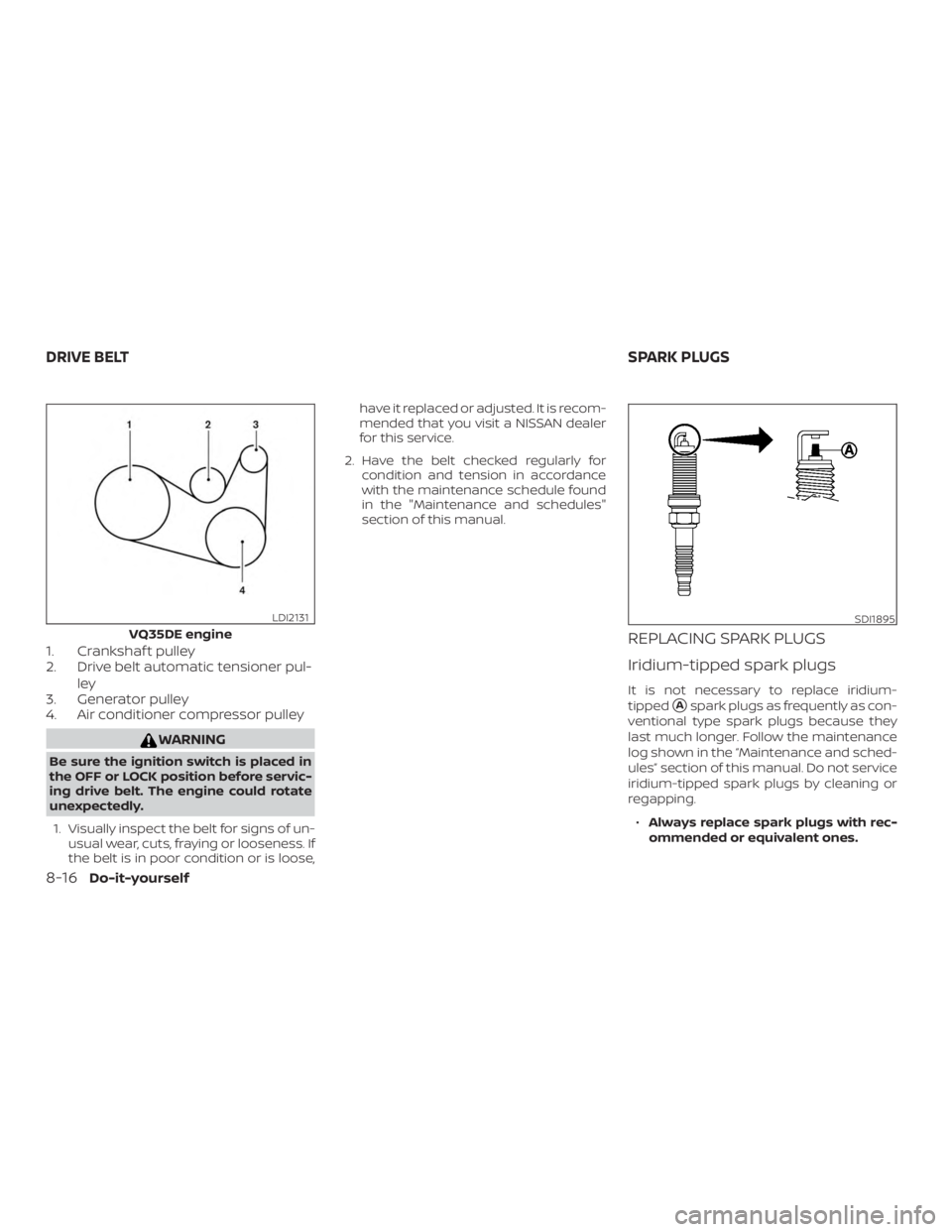
1. Crankshaf t pulley
2. Drive belt automatic tensioner pul-ley
3. Generator pulley
4. Air conditioner compressor pulley
WARNING
Be sure the ignition switch is placed in
the OFF or LOCK position before servic-
ing drive belt. The engine could rotate
unexpectedly.
1. Visually inspect the belt for signs of un- usual wear, cuts, fraying or looseness. If
the belt is in poor condition or is loose, have it replaced or adjusted. It is recom-
mended that you visit a NISSAN dealer
for this service.
2. Have the belt checked regularly for condition and tension in accordance
with the maintenance schedule found
in the "Maintenance and schedules"
section of this manual.
REPLACING SPARK PLUGS
Iridium-tipped spark plugs
It is not necessary to replace iridium-
tipped
�Aspark plugs as frequently as con-
ventional type spark plugs because they
last much longer. Follow the maintenance
log shown in the “Maintenance and sched-
ules” section of this manual. Do not service
iridium-tipped spark plugs by cleaning or
regapping.
∙ Always replace spark plugs with rec-
ommended or equivalent ones.
VQ35DE engine
LDI2131SDI1895
DRIVE BELT SPARK PLUGS
8-16Do-it-yourself