2018 MITSUBISHI OUTLANDER PHEV Eco
[x] Cancel search: EcoPage 36 of 538

Approx. ambi-
ent temperaturePhenomenaCorrective actionl The motor output may be restricted and the regenerative
braking performance may be decreased or lost when
“BATTERY TOO COLD” is displayed.* 3l
Immediately stop the vehicle in
a safe place.
Also, when braking, depress the
brake pedal harder.Charging and batteryl Charging may become impossible or charging may stop
during charging, before the battery is fully charged.l In the daytime, wait for the
temperature to rise, restart the plug-in hybrid EV system.CAUTIONl “BATTERY TOO COLD” is displayed* 3
, contact a MITSUBISHI MOTORS Authorized Service Point.
l When blinking of the ready indicator* 2
continues and “BATTERY TOO COLD” is displayed* 3
on the multi information display with vehicle conditions, the
drive battery cannot be warmed up.
Cautions and actions to deal with intense cold
2-12OGGE18E1General information2
Page 37 of 538

NOTEl*1
: Refer to “PROPULSION POWER IS REDUCED warning display” on page 6-41.
Display of the “PROPULSION POWER IS REDUCED” warning display does not indicate a malfunction.
l *2
: Refer to “Ready indicator” on page 6-48.
l *3
: Refer to “Warning display list” on page 6-23.
l *4
: To warm up the drive battery, you should perform to register the wireless LAN device (which conforms to IEEE 802.11 b and supports iOS 4.1.0 and
subsequent OS version or Android 2.1.0 and subsequent OS version) for MITSUBISHI Remote Control to the vehicle. If the information of “
” mark on
the wireless LAN device is displayed, connect the EV charging cable as soon as possible.
Refer to “MITSUBISHI Remote Control*” on page 3-24. When using a home charging device or a public charging device (EVSE: Electric Vehicles Supply Equipment), charging and warm-up of the drive battery may be stopped.
While warming up the drive battery, the following phenomena may occur.
• The operation sound of on board equipment and the state of charge is displayed on the multi information display.
Refer to “Charging from rated AC 220-240 V outlet” on page 3-12.
• Inside of the vehicle may be heated automatically.
• The drive battery may not become full charge, or the remaining capacity of drive battery may decrease.
Fuel selection
E00200105041Recom-
mended fuelUnleaded petrol octane number(EN228)
95 RON or higherCAUTIONl The use of leaded fuel can result in serious
damage to the engine and catalytic convert- er. Do not use leaded fuel.NOTEl Poor quality petrol can cause problems such
as difficult starting, stalling, engine noise
and hesitation. If you experience these prob- lems, try another brand and/or grade of pet-
rol.
If the check engine warning lamp flashes,
have the system checked as soon as possible at a MITSUBISHI MOTORS Authorized
Service Point.Graphical expression for con-
sumer information
Identifier for petrol-type fuels
Fuel selection
2-13OGGE18E1General information2
Page 39 of 538
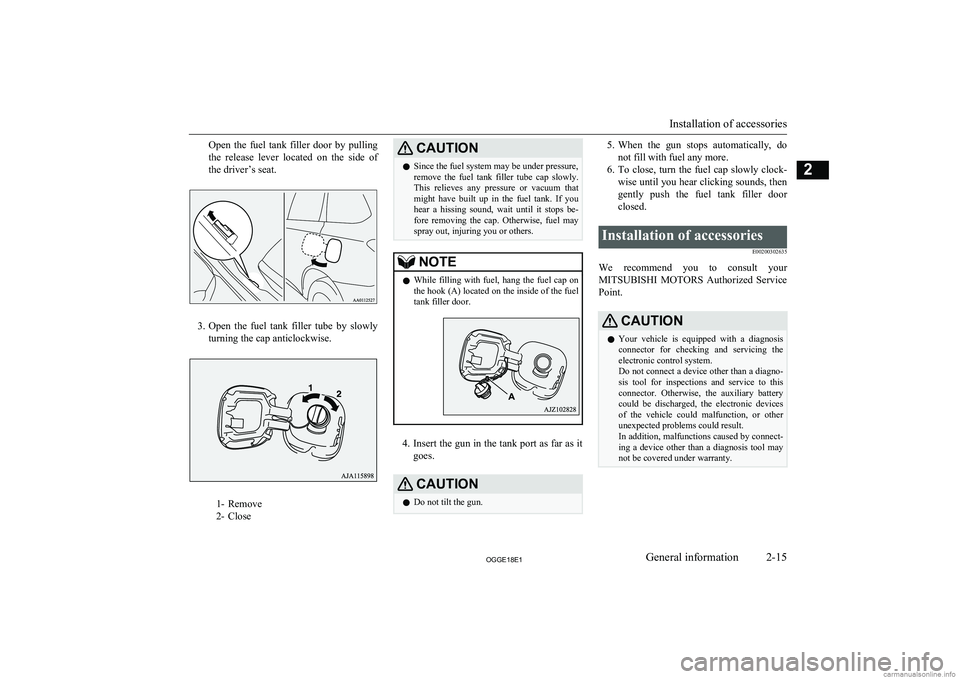
Open the fuel tank filler door by pullingthe release lever located on the side of
the driver’s seat.
3. Open the fuel tank filler tube by slowly
turning the cap anticlockwise.
1- Remove
2- Close
CAUTIONl Since the fuel system may be under pressure,
remove the fuel tank filler tube cap slowly. This relieves any pressure or vacuum that
might have built up in the fuel tank. If you
hear a hissing sound, wait until it stops be- fore removing the cap. Otherwise, fuel may
spray out, injuring you or others.NOTEl While filling with fuel, hang the fuel cap on
the hook (A) located on the inside of the fuel
tank filler door.
4. Insert the gun in the tank port as far as it
goes.
CAUTIONl Do not tilt the gun.5.
When the gun stops automatically, do
not fill with fuel any more.
6. To close, turn the fuel cap slowly clock-
wise until you hear clicking sounds, then
gently push the fuel tank filler door
closed.Installation of accessories
E00200302635
We recommend you to consult yourMITSUBISHI MOTORS Authorized Service
Point.
CAUTIONl Your vehicle is equipped with a diagnosis
connector for checking and servicing theelectronic control system.
Do not connect a device other than a diagno-
sis tool for inspections and service to this connector. Otherwise, the auxiliary battery
could be discharged, the electronic devices
of the vehicle could malfunction, or other unexpected problems could result.
In addition, malfunctions caused by connect-
ing a device other than a diagnosis tool may not be covered under warranty.
Installation of accessories
2-15OGGE18E1General information2
Page 40 of 538
lThe installation of accessories, optional
parts, etc., should only be carried out
within the limits prescribed by law in your country, and in accordance with the
guidelines and warnings contained with-
in the documents accompanying this ve- hicle.
l Installing electric components incorrect-
ly could lead to a fire. Refer to the “Modification/alterations to the electri-
cal or fuel systems” section within this
owner’s manual.
l When installing the radio, for the re-
quired information (frequency, transmis-
sion output, installing procedure), con- sult a MITSUBISHI MOTORS Author-
ized Service Point.
If the frequency, transmission output and installing condition are not appropriate,
it can adversely affect the electronic de- vices and could lead to unsafe vehicle operation.
l Using a cellular phone or radio set inside
the vehicle without an external antenna
may cause electrical system interference, which could lead to unsafe vehicle oper-ation.
l Tyres and wheels which do not meet
specifications must not be used.
Refer to the “Specifications” section for information regarding wheel and tyre
sizes.Important points!
Due to large number of accessory and re-
placement parts of different manufactures
available in the market, it is not possible, not only for MITSUBISHI MOTORS , but also
for a MITSUBISHI MOTORS Authorized
Service Point, to check whether the attach- ment or installation of such parts affects theoverall safety of your vehicle.
Even when such parts are officially author-
ized, for example by a “general operators permit” (an appraisal for the part) or throughthe execution of the part in an officially ap-
proved manner of construction, or when a single operation permit following the attach-
ment or installation of such parts, it cannot be deduced from that alone, that the driving
safety of your vehicles has not been affected.
Consider also that there basically exists no li- ability on the part of the appraiser or the offi- cial. Maximum safety can only be ensured
with parts recommended, sold and fitted or
installed by a MITSUBISHI MOTORS au-
thorized Service Point ( MITSUBISHI
MOTORS GENUINE replacement parts and
MITSUBISHI MOTORS accessories). The
same also pertains to modifications of vehi- cles with respect to the production specifica- tions. For safety reasons, do not attempt anymodifications other than those that follow the
recommendations of a MITSUBISHI
MOTORS authorized Service Point.
Modification/alterations to
the electrical or fuel systems E00200401583
MITSUBISHI MOTORS CORPORATION
has always manufactured safe, high quality vehicles. In order to maintain this safety and
quality, it is important that any accessory that is to be fitted, or any modifications carried
out which involve the electrical or fuel sys- tems, should be carried out in accordancewith MITSUBISHI MOTORS guidelines.CAUTIONl If the wires interfere with the vehicle body
or improper installation methods are used (protective fuses not included, etc.), elec- tronic devices may be adversely affected, re-
sulting in a fire or other accident.Genuine parts
E00200500499
MITSUBISHI MOTORS has gone to great
lengths to bring you a superbly crafted auto-
mobile offering the highest quality and de- pendability.
Modification/alterations to the electrical or fuel systems
2-16OGGE18E1General information2
Page 41 of 538
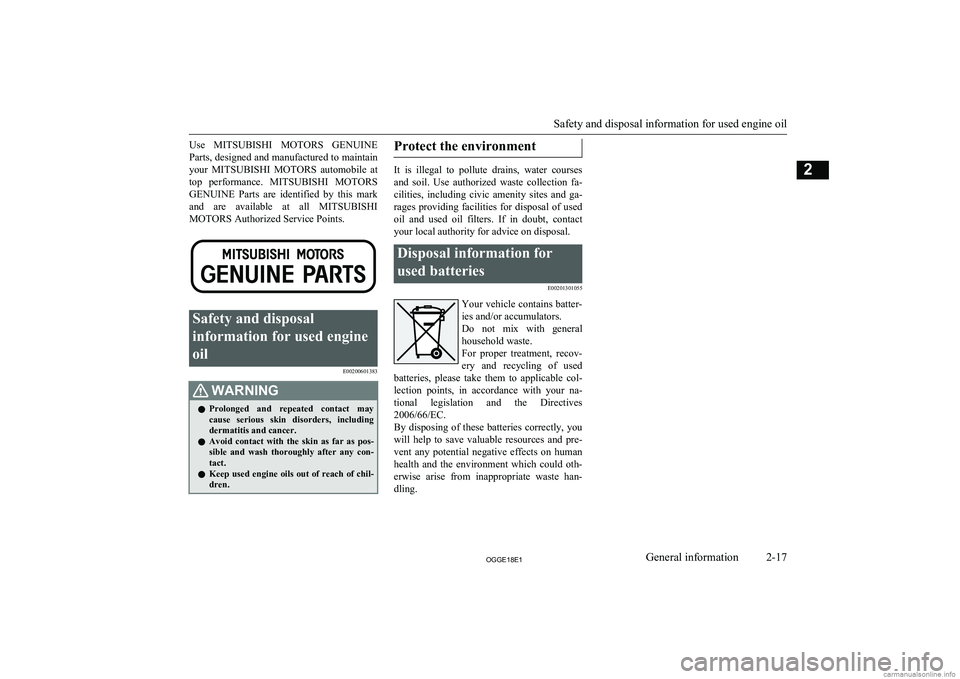
Use MITSUBISHI MOTORS GENUINE
Parts, designed and manufactured to maintain your MITSUBISHI MOTORS automobile at
top performance. MITSUBISHI MOTORS
GENUINE Parts are identified by this mark and are available at all MITSUBISHI
MOTORS Authorized Service Points.Safety and disposal
information for used engine
oil E00200601383WARNINGlProlonged and repeated contact may
cause serious skin disorders, including
dermatitis and cancer.
l Avoid contact with the skin as far as pos-
sible and wash thoroughly after any con- tact.
l Keep used engine oils out of reach of chil-
dren.Protect the environment
It is illegal to pollute drains, water courses
and soil. Use authorized waste collection fa-cilities, including civic amenity sites and ga- rages providing facilities for disposal of used
oil and used oil filters. If in doubt, contact your local authority for advice on disposal.
Disposal information for
used batteries E00201301055
Your vehicle contains batter-ies and/or accumulators.
Do not mix with general
household waste.
For proper treatment, recov-
ery and recycling of used
batteries, please take them to applicable col-
lection points, in accordance with your na- tional legislation and the Directives 2006/66/EC.
By disposing of these batteries correctly, you
will help to save valuable resources and pre-
vent any potential negative effects on human
health and the environment which could oth- erwise arise from inappropriate waste han- dling.
Safety and disposal information for used engine oil
2-17OGGE18E1General information2
Page 47 of 538

WARNINGlTo reduce the risk of electric shock or fire
due to electric leak, always use an earthed
outlet protected by a residual current de-
tector, rated for amperage equal to or greater than the value specified by MITSUBISHI MOTORS , and that is con-
nected to a dedicated branch circuit. If
the circuit is shared, and another electri- cal device is being used at the same time
as the vehicle is charging, the circuit may heat abnormally, the breaker may trip
and the circuit may cause adverse inter- ference on the household electrical appli-
ances such as TVs and audio systems.
l It is possible to charge even in rain or
snow. However, be sure to pay attention to the following:
• Do not touch normal charge port, nor-
mal charge connector, outlet and plug with wet hands.
• Keep away from water when connect-
ing the normal charge port, normal
charge connector, outlet and plug.
• Do not perform the charging in the out
of doors when heavy rain, heavy snow, strong winds, and when bad weather is
expected.
• Do not charge if there is possibility a
lightning strike. When thunder rum- bling begins suddenly during normal
charging, do not touch the vehicle and the EV charging cable and turn off the
breaker.WARNINGl If water goes into the normal charge port
or the normal charge connector, it couldcause a short circuit, a fire and an electric shock.
Be sure to completely close the charging
lid and the inner lid and do not leave the EV charging cable in an outdoors.
l If the connected part of the charging plug
has been buried in snow while charging, turn off the hand switch or the breaker
connected with the outlet first, then re- move the snow and disconnect the charg-
ing plug. If your vehicle body has been buried in snow while charging, remove
the snow and then disconnect the charge connector.
l When you perform the normal charging
at away from home, some normal charg-
ers may not correspond to your vehicle. Consult an administrator or a maker of
the normal charger that it corresponds to your vehicle before using it. Also perform
normal charging according to the operat-
ing procedure indicated on the body of
normal charger.
l Do not open the charging lid for anything
other than charging and using the exter-
nal power feed.CAUTIONl Do not attempt to perform a jump start on
the auxiliary battery at the same time that the
drive battery is being charged. Doing so may
damage the vehicle or charging cable and
could cause injury.
Refer to “Emergency starting” on page 9-02.NOTEl If you open the charging lid with the opera-
tion mode of the power switch is ON, a buz- zer sounds approximately 10 minutes inter-mittently to alert the charging cannot be star- ted. If you close the charging lid or put theoperation mode in OFF, the buzzer stops.
l If you insert the charge connector to the
charge port with the operation mode is ON,
a buzzer sounds continuously approximately
10 minutes to alert the charging cannot be started.
If you pull the charge connector out or put the operation mode in OFF, the buzzer stops.
l Repeatedly performing only quick charging
may reduce the battery capacity.
In usual charge, normal charging is recom-
mended.
l To maintain the capacity of the drive battery,
the following is recommended:
• If you repeatedly perform only the quick
charging, fully charge the vehicle in nor- mal charging every 2 weeks.
Basic knowledge for charging
3-05OGGE18E1Charging3
Page 50 of 538
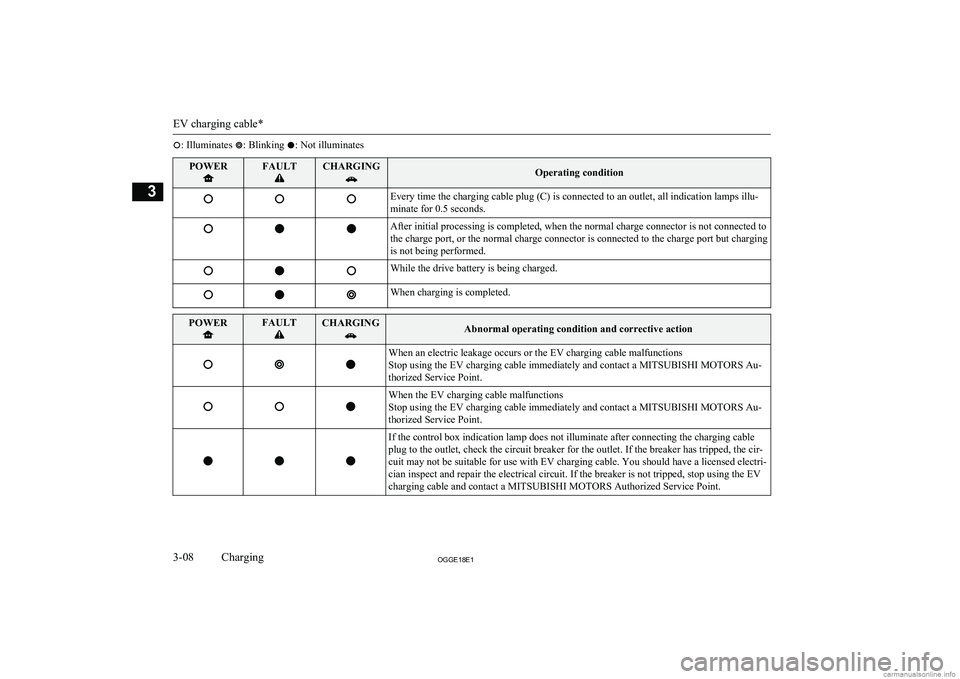
: Illuminates : Blinking : Not illuminatesPOWERFAULTCHARGINGOperating conditionEvery time the charging cable plug (C) is connected to an outlet, all indication lamps illu-
minate for 0.5 seconds.After initial processing is completed, when the normal charge connector is not connected to
the charge port, or the normal charge connector is connected to the charge port but charging
is not being performed.While the drive battery is being charged.When charging is completed.POWERFAULTCHARGINGAbnormal operating condition and corrective actionWhen an electric leakage occurs or the EV charging cable malfunctions
Stop using the EV charging cable immediately and contact a MITSUBISHI MOTORS Au-
thorized Service Point.When the EV charging cable malfunctions
Stop using the EV charging cable immediately and contact a MITSUBISHI MOTORS Au-
thorized Service Point.If the control box indication lamp does not illuminate after connecting the charging cable
plug to the outlet, check the circuit breaker for the outlet. If the breaker has tripped, the cir-
cuit may not be suitable for use with EV charging cable. You should have a licensed electri-
cian inspect and repair the electrical circuit. If the breaker is not tripped, stop using the EV
charging cable and contact a MITSUBISHI MOTORS Authorized Service Point.
EV charging cable*
3-08OGGE18E1Charging3
Page 53 of 538

WARNING•Do not open the tailgate, for example to
remove or place an item in the cargo area.
Charging may affect the operation of elec-
tric medical devices and result in serious personal injury or death.
l Do not charge when the EV charging ca-
ble is coiled up.
Doing so the cable may be heated abnor- mally and this might result in fire.
l Before charging, make sure that there is
no foreign matter such as dust at the nor-
mal charge port and the normal charge connector.
At this time, do not touch the normal
charge port.
l When the normal charge connector is
connected to the charge port, prevent for- eign matter such as water or dust from
entering in the connection.
Connection with foreign matter such as
water or dust may cause fire or an electric shock. Do not perform charging if there
might be strong exposure to water at the connection.
l Never pull the cable to remove the plug.
And never submerge the EV charging
connector, control box or plug in water.
l Please observe the following in order to
prevent accidents during charging such as
electrocution.
• Only use the EV charging cable that is
supplied with the vehicle.WARNING• Do not charge another vehicle by the
EV charging cable. The cable may overheat and this may result in a fire.
• When charging outdoors, make sure to
use an outlet that is protected from wa-
ter entering.
• Do not perform charging with the vehi-
cle covered by a car cover, except for
the MITSUBISHI MOTORS GENU-
INE car cover.
• Do not connect or disconnect the plug
and connector with wet hands.
l While it is normal for the connector and
charging cable to become warm during charging, discontinue use immediately if
the connector or charging cable becomes hot to the touch.
l While it is normal for the control box to
become warm during charging, discontin-
ue use immediately if the control box be- comes hot to the touch.
l If abnormal smells are detected or the ve-
hicle produces smoke, quickly stop charg-
ing.
l Do not perform charging in a poorly ven-
tilated area or in an enclosed area. Keep
sparks, cigarettes, and flames away from
the auxiliary battery.
Flammable gas generated from the auxili- ary battery during charging may be trap- ped, resulting in explosion.
If charging is inevitably required, venti-
late the area well.WARNINGl Grasp the normal charge connector when
connecting or disconnecting the EVcharging cable.
Grasping the cable may damage the cable
and could cause an electric shock, short circuit, and/or fire.CAUTIONl During charging, the cooling fans inside the
engine compartment may automatically be operated even if the operation mode of the
power switch is in OFF.
Keep your hands away from the cooling fan during charging.
l Do not perform charging from other power
source like a generator. Doing so could cause a malfunction.NOTEl If the charge connector is not easily connec-
ted to the charge port due to foreign materialentering, never force the connection. Doing so could damage the charging equipment or
the vehicle. Please contact a MITSUBISHI
MOTORS Authorized Service Point.
l The on board charger is only for rated AC
220-240V outlets.
Normal charging (charging method with rated AC 220-240V outlet)
3-11OGGE18E1Charging3