2018 MITSUBISHI OUTLANDER III parking brake
[x] Cancel search: parking brakePage 285 of 441
Warning lights5-204 Features and controls
5
N00520501814
This indicator is a pa
rt of the onboard diag-
nostic (OBD) system which monitors theemissions, engine control system or auto-matic transaxle control system/continuouslyvariable transmission (CVT) control system.If a problem is detected in one of these sys-tems, this indicator illuminates or flashes.When the ignition switch is turned to the“ON” position or the ope
ration mode is put in
ON, this indicator
normally comes on and
goes off after the engine has started.
This indicator will come on if the fuel tankfiller cap is not properly tightened. If thisindicator comes on and stays on after refuel-ing, stop the engine and check that the cap isproperly tightened. (Turn the cap clockwiseuntil you hear clicking sounds.)If this indicator does not go off after severalseconds or lights up while driving, have thesystem checked as soon as possible at anauthorized Mitsubishi Motors dealer or arepair facility of your choice.
N00520601323
This light comes on in the event of a malfunc-tion in the charging system or when the igni-
CAUTIONWhen the warning light remains on or doesnot come on, there is the possibility that theparking brake cannot
be operated or
released. Immediately contact the nearestauthorized Mitsubishi
Motors dealer. When
the warning light comes on during driving,immediately stop the vehi
cle in a safe place,
and contact an authorized Mitsubishi Motorsdealer. If you inevitably have to park, parkthe vehicle on level a
nd stable ground, shift
the selector lever in “P” (PARK) positionand place chocks
or blocks.
Engine malfunction indicator (“SERVICE ENGINE SOON” or “Check engine light”)
CAUTIONDriving for a long time
with the engine mal-
function indicator on may cause more dam-age to the emission control system. Thiscould also affect fuel
economy and drivabil-
ity.If this indicator does not come on when theignition switch is turned to the “ON” posi-tion or the operation mode is put in ON, havethe system checked at an authorized Mitsubi-shi Motors dealer or a repair facility of yourchoice.
If the engine malfuncti
on indicator comes on
while the engine is running, avoid driving athigh speeds.During vehicle operation
with the indicator
on, the vehicle may not
accelerate when you
depress the accelerator pedal.When the vehicle is stat
ionary with the indi-
cator on, you must depress the brake pedalmore firmly than usual since the engineidling speed is higher than usual and a vehi-cle with an automatic transaxle or CVT has astronger tendency to creep forward.NOTE
Do not disconnect the ba
ttery cable when the
engine malfunction i
ndicator (“SERVICE
ENGINE SOON” or “Ch
eck engine light”) is
on.The engine electronic
control module stores
critical OBD informati
on (especially exhaust
emission data), which ma
y be lost if the bat-
tery cable is disconne
cted while the engine
malfunction indicator is
on. This will make it
difficult to diagnose th
e cause of future prob-
lems.
Charging system warning light
CAUTION
BK0249100US.book 204 ページ 2017年5月10日 水曜日 午前8時49分
Page 287 of 441
Information screen display (Vehicle equipped with the multi information display - Type 1)5-206 Features and controls
5
N00590300034
This light comes on when the washer fluid isrunning low.If the light comes on, replenish the containerwith washer fluid.Refer to “Washer fl
uid” on page 9-12.
Refer to “Capacity” on page 11-7.
N00558301064N00558401179
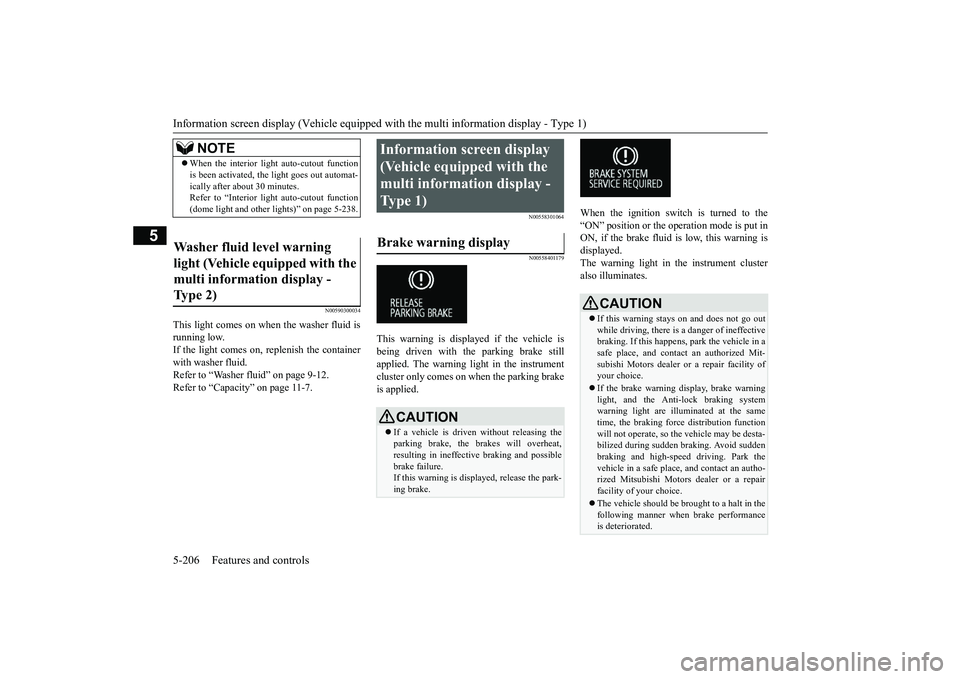
This warning is displayed if the vehicle isbeing driven with the parking brake stillapplied. The warning light in the instrumentcluster only comes on when the parking brakeis applied.
When the ignition switch is turned to the“ON” position or the ope
ration mode is put in
ON, if the brake fluid is
low, this warning is
displayed.The warning light in the instrument clusteralso illuminates.
NOTE
When the interior light auto-cutout functionis been activated, the light goes out automat-ically after about 30 minutes.Refer to “Interior light
auto-cutout function
(dome light and other
lights)” on page 5-238.
Washer fluid level warning light (Vehicle e
quipped with the
multi information display - Type 2)
Information screen display (Vehicle equipped with the multi information display - Type 1) Brake warning display
CAUTIONIf a vehicle is driven without releasing theparking brake, the brakes will overheat,resulting in ineffective braking and possiblebrake failure.If this warning is displayed, release the park-ing brake.
CAUTIONIf this warning stays on and does not go outwhile driving, there is
a danger of ineffective
braking. If this happens
, park the vehicle in a
safe place, and contac
t an authorized Mit-
subishi Motors dealer or a repair facility ofyour choice.If the brake warning display, brake warninglight, and the Anti-lock braking systemwarning light are illu
minated at the same
time, the braking forc
e distribution function
will not operate, so th
e vehicle may be desta-
bilized during sudden br
aking. Avoid sudden
braking and high-speed driving. Park thevehicle in a safe place,
and contact an autho-
rized Mitsubishi Motors
dealer or a repair
facility of your choice.The vehicle should be brought to a halt in thefollowing manner when
brake performance
is deteriorated.
BK0249100US.book 206 ページ 2017年5月10日 水曜日 午前8時49分
Page 288 of 441
Combination headlights and dimmer switch
Features and controls 5-207
5
N00558601113
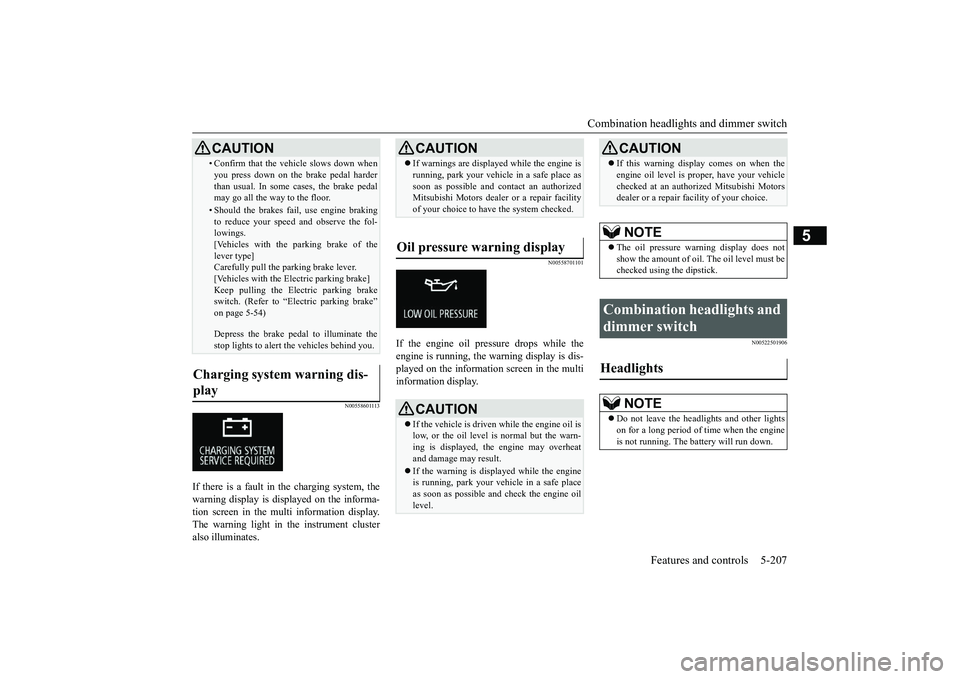
If there is a fault in the charging system, thewarning display is di
splayed on the informa-
tion screen in the multi information display.The warning light in the instrument clusteralso illuminates.
N00558701101
If the engine oil pressure drops while theengine is running, the
warning display is dis-
played on the information screen in the multiinformation display.
N00522501906
• Confirm that the vehicle slows down whenyou press down on the brake pedal harderthan usual. In some cases, the brake pedalmay go all the way to the floor.• Should the brakes fail, use engine brakingto reduce your speed and observe the fol-lowings.[Vehicles with the parking brake of thelever type]Carefully pull the pa
rking brake lever.
[Vehicles with the Electric parking brake]Keep pulling the Elec
tric parking brake
switch. (Refer to “Electric parking brake”Depress the brake pedal to illuminate thestop lights to alert th
e vehicles behind you.
Charging system warning dis-play
CAUTION
CAUTIONIf warnings are displaye
d while the engine is
running, park your vehicl
e in a safe place as
soon as possible and contact an authorizedMitsubishi Motors dealer
or a repair facility
of your choice to have the system checked.
Oil pressure warning display
CAUTIONIf the vehicle is driven while the engine oil islow, or the oil level is normal but the warn-ing is displayed, th
e engine may overheat
and damage may result.If the warning is displayed while the engineis running, park your ve
hicle in a safe place
as soon as possible and check the engine oillevel.
If this warning display comes on when theengine oil level is prope
r, have your vehicle
checked at an author
ized Mitsubishi Motors
dealer or a repair fa
cility of your choice.
NOTE
The oil pressure warning display does notshow the amount of oil. The oil level must bechecked using the dipstick.
Combination headlights and dimmer switch Headlights
NOTE
Do not leave the head
lights and ot
her lights
on for a long period of time when the engineis not running. The battery will run down.CAUTION
BK0249100US.book 207 ページ 2017年5月10日 水曜日 午前8時49分
Page 289 of 441
Combination headlights and dimmer switch5-208 Features and controls
5
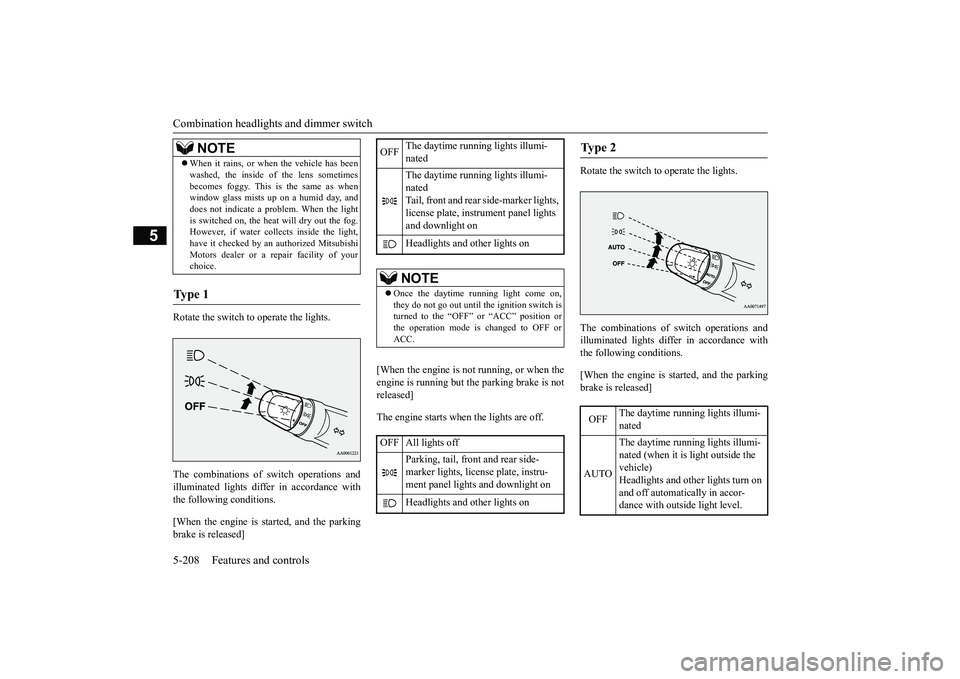
Rotate the switch to operate the lights.The combinations of
switch operations and
illuminated lights differ in accordance withthe following conditions.[When the engine is st
arted, and the parking
brake is released]
[When the engine is not
running, or when the
engine is running but the parking brake is notreleased]The engine starts when the lights are off.
Rotate the switch to operate the lights.The combinations of
switch operations and
illuminated lights differ in accordance withthe following conditions.[When the engine is st
arted, and the parking
brake is released]
When it rains, or wh
en the vehicle has been
washed, the inside of the lens sometimesbecomes foggy. This is the same as whenwindow glass mists up on a humid day, anddoes not indicate a pr
oblem. When the light
is switched on, the heat will dry out the fog.However, if water collects inside the light,have it checked by an authorized MitsubishiMotors dealer or a re
pair facility of your
choice.
Ty p e 1
NOTE
OFF
The daytime running lights illumi-natedThe daytime running lights illumi-natedTail, front and rear
side-marker lights,
license plate, inst
rument panel lights
and downlight onHeadlights and other lights onNOTE
Once the daytime running light come on,they do not go out until the ignition switch isturned to the “OFF” or “ACC” position orthe operation mode is changed to OFF orACC.
OFF All lights off
Parking, tail, front
and rear side-
marker lights, license plate, instru-ment panel lights
and downlight on
Headlights and other lights on
Ty p e 2 OFF
The daytime running lights illumi-nated
AUTO
The daytime running lights illumi-nated (when it is
light outside the
vehicle)Headlights and other lights turn on and off automatically in accor-dance with outside light level.
BK0249100US.book 208 ページ 2017年5月10日 水曜日 午前8時49分
Page 290 of 441
![MITSUBISHI OUTLANDER III 2018 Owners Manual Combination headlights and dimmer switch
Features and controls 5-209
5
[When the engine is not
running, or when the
engine is running but the parking brake is notreleased]The engine starts when the l](/manual-img/19/58144/w960_58144-289.png "MITSUBISHI OUTLANDER III 2018 Owners Manual Combination headlights and dimmer switch
Features and controls 5-209
5
[When the engine is not
running, or when the
engine is running but the parking brake is notreleased]The engine starts when the l")
Combination headlights and dimmer switch
Features and controls 5-209
5
[When the engine is not
running, or when the
engine is running but the parking brake is notreleased]The engine starts when the lights are off.
N00532601649
If the following operation is performedwith the combination headlights and dim-mer switch in the “ ” or “ ” position,the lights automatically turn off.[Except for vehicles equipped with theF. A . S . T. - k e y ]The ignition switch is turned to the “OFF”
the key is removed
from the ignition switch and the driver’sdoor is opened.[For vehicles equipped with the F.A.S.T.-key]The operation mode is changed to OFF orACC and the driver’s door is opened.If the following operation is performedwith the combination headlights and dim-mer switch in the “ ” or “ ” position,the lights automatically turn off afterapproximately 3 minutes.[Except for vehicles equipped with theF. A . S . T. - k e y ]The ignition switch is turned to the “OFF”
the key is removed
from the ignition switch and the driver’sdoor is not opened.
The daytime running lights illumi-natedTail, front and re
ar side-marker
lights, license pl
ate, instrument
panel lights and downlight onHeadlights and other lights on
NOTE
Once the daytime running light come on,they do not go out until the ignition switch isturned to the “OFF” or “ACC” position orthe operation mode is changed to OFF orACC.OFF All lights offAUTO
Headlights and other lights turn on and off automatically in accor-dance with outside light level.Parking, tail, front
and rear side-
marker lights, license plate, instru-ment panel lights and downlight onHeadlights and other lights on
NOTE
The sensitivity of the automatic on/off con-trol can be adjusted.For further informati
on, please contact your
authorized Mitsubishi
Motors dealer or a
repair facility
of your choice.
On vehicles equippe
d with the Smartphone
Link Display Audio, sc
reen operations can
be used to make the adjustment.Refer to the separate
owner’s manual for
details.Do not cover the sensor (A) for the automaticon/off control by affixing
a sticker or label to
the windshield.If the lights do not turn on or off with theswitch in the “AUTO”operate the switch. Have the system checkedby an authorized Mitsubishi Motors dealer ora repair facility of your choice.
Light auto-cutout function (headlights and other lights)
BK0249100US.book 209 ページ 2017年5月10日 水曜日 午前8時49分
Page 333 of 441

Vehicle preparation before driving6-4 Driving safety
6
N00629001709
For a safer and more enjoyable trip, alwayscheck for the following:Before starting the vehicle, make certainthat you and all passengers are seated andwearing their seat
belts properly (with
children in the rear seat, in appropriaterestraints), and that all the doors and theliftgate are locked.
Move the driver’s seat as far backward aspossible, while keeping good visibility,and good control of the steering wheel,brakes, accelerator, and controls. Checkthe instrument panel indicators and multi-information display
for any possible prob-
lem.Similarly, the front
passenger seat should
also be moved as fa
r back as possible.
Make sure that infants and small childrenare properly restrained in accordance withall laws and
regulations.
Check these by selecting the defroster mode,and set the blower swit
ch on high. You should
be able to feel the air blowing against thewindshield. Refer to “Defrosti
ng or defogging (wind-
shield, door windows)” on page 7-12Check all the tires for heavy tread wear oruneven wear patterns. Look for stones, nails,glass, or other objects
stuck in the tread. Look
for any tread cuts or
sidewall cracks. Check
the wheel nuts for tightness, and the tires(including spare tire) for proper pressure.
Replace your tires before they are heavilyworn out.As your vehicle is equi
pped with a tire pres-
sure monitoring system, there is a risk ofdamage to the tire inflation pressure sensorswhen the tire is replaced on the rim. Tirereplacement should, onl
y, be performed by an
authorized Mitsubishi Motors dealer.Have someone watch wh
ile you turn all the
exterior lights on and off. Also check the turnsignal indicators and hi
gh-beam indicators on
the instrument panel.Check the ground under the vehicle afterparking overnight, for
fuel, water, oil, or
other leaks. Make sure
all the fluid levels are
correct. Also, if you
can smell fuel, you need
to find out why imme
diately and have it
fixed.
N00629201134
Even this vehicle’s sa
fety equipment, and
your safest driving, ca
nnot guarantee that you
can avoid an accident or injury. However, if
Vehicle preparation before driving Seat belts and seats
Defrosters Tires
Lights Fluid leaks Safe driving techniques
BK0249100US.book 4 ページ 2017年5月10日 水曜日 午前8時49分
Page 335 of 441
Parking6-6 Driving safety
6
On snowy roads, ice can form on the brakingsystem, making the brakes less effective.While driving in such conditions, pay closeattention to surrounding
vehicles and to the
condition of the road surface. From time totime, lightly depress the brake pedal andcheck how effective the brakes are.It is important to take
advantage of the engine
braking by downshifting while driving onsteep downhill roads in order to prevent thebrakes from overheating.
N00629601385
When parking on a hill, set the parking brake,and turn the front wheels toward the curb on adownhill, or away from
the curb on an uphill.
If necessary, apply chocks to the wheels.Be sure that the parki
ng brake is firmly set
when parked and that the selector lever is inthe “P” (PARK) position.
When parking on a hill, it is important to setthe parking brake befo
re moving the selector
lever to the “P” (PARK) position. This pre-vents loading the parking brake against thetransaxle. When this ha
ppens, it is difficult to
move the selector lever out of the “P”Never leave the engine running while youtake a short nap or rest. Also, never leave theengine running in a closed or poorly venti-lated place.Your front bumper can be damaged if youscrape it over curbs or parking stop blocks.Be careful when traveling up or down steepslopes where your bumper can scrape theroad.
Always carry the key and lock all doors andthe liftgate when leaving the vehicle unat-tended.Always try to park your vehicle in a well litarea.Move effort could be required to turn thesteering wheel.Refer to “Electric power steering system(EPS)” on page 5-99.
N00629901434
It is very important to know how muchweight your vehicle can carry. This weight iscalled the vehicle ca
pacity weight and
includes the weight of
all occupants, cargo
(including the roof load), non-factory-
When driving in cold weather When driving downhill Parking Parking on a hill
Parking with the engine run-ning
WA R N I N GLeaving the engine ru
nning risks injury or
death from accidentally moving the selec-tor lever or the accumulation of toxicexhaust fumes in the passenger compart-ment.
Where you park
WA R N I N GDo not park your vehicle in areas wherecombustible materials
such as dry grass or
leaves can come in contact with a hotexhaust, since a fire could occur.
When leaving the vehicle Do not keep the steering wheel fully turned for a long time Loading information
BK0249100US.book 6 ページ 2017年5月10日 水曜日 午前8時49分
Page 344 of 441
Trailer towing
Driving safety 6-15
6
You’ll need more passing distance up aheadwhen you’re towing a trailer. And, becauseyou’re a good deal longer, you’ll need to gomuch farther beyond the passed vehiclebefore you can return to your lane.Hold the bottom of the steering wheel withone hand. Then, to move the trailer to the left,just move that hand to the left. To move thetrailer to the right, move your hand to theright. Always back up sl
owly and, if possible,
have someone guide you.When you’re turning with a trailer, makewider than normal turns to help prevent thetrailer from striking shoulders, curbs, roadsigns, trees or other objects.
Avoid jerky or sudden maneuvers. Signalwell in advance.Towing a trailer puts additional burden on theengine and transaxle,
which may cause over-
heating. Following ar
e some suggestions to
reduce overheating:When towing at high al
titudes, engine coolant
and automatic transaxle oil will overheat at alower temperature than at normal altitudes.If you turn your engine off immediately aftertowing at high altitude
on steep uphill grades,
your vehicle may show
signs similar to over-
heating. To avoid this
, let the engine run
while parked (preferably on level ground)with the automatic transaxle in the “P”turning the engine off.
If the engine coolant temperature indica-tor flashes on the information screen inthe multi-information display or theengine power drops suddenly, refer to“Engine overheati
ng” on page 8-4.
If the warning display or warningdisplay illuminates, re
fer to “Warning dis-
play” on page 5-70, 5-78.
Reduce speed and downshift before you startdown a long or steep downgrade. If you don’tdownshift, over using the brakes can causereduced brake efficiency.You can tow in “D” (DRIVE) position. Youmay want to shift the selector lever to the 3rdor a lower position, under heavy loads or hillyconditions.Always place chocks or blocks under both thevehicle and trailer wheels when parking. Besure that the parking brake is firmly set andthat the selector lever is in the “P” (PARK)position. Avoid parki
ng on a hill with a
trailer, but if it cannot be avoided, do so onlyafter performing the following:
Passing Backing up Making turns
CAUTIONMaking sharp turns while towing a trailercould cause the
trailer to come in contact
with the vehicle. Your
vehicle could be dam-
aged. Avoid making sharp turns while tow-ing a trailer.
Overheating Cause of overheating
Solution
Air conditioning on Turn offHighway speeds Reduce speedGoing up hills Select lower gear posi-
tion
Stop-and-go city traf-fic
With the vehicle stopped, shift to the “N” (NEUTRAL) position and idle the engine at high idle.
Driving on hills Parking
BK0249100US.book 15 ページ 2017年5月10日 水曜日 午前8時49分