2018 MITSUBISHI ASX clearance
[x] Cancel search: clearancePage 233 of 514

Once the emergency braking has worked, you
are alerted to this by a message on the infor- mation screen of the multi-information dis- play.
The FCM braking function operates at the
following vehicle speed:
l Against a vehicle: Approximately
5 km/h to 80 km/h
l Against a pedestrian: Approximately
5 km/h to 65 km/h
CAUTIONl Do not use the FCM as a normal braking.
l After your vehicle has stopped following the
activation of the FCM, automatic braking is
released. As the vehicle will then start creep-
ing, be sure to depress the brake pedal to hold the vehicle stationary.
l When applying the brake during the auto-
matic braking condition the pedal will feel
firm.
This is not abnormal.
You can apply more pressure to the pedal to
assist in braking.
l In the following situations, the system pro-
vides neither control nor alarming.CAUTION• When a vehicle or a pedestrian suddenly
cuts in front of your vehicle.
• When the distance from a vehicle or a pe-
destrian in front is extremely short.
• To an oncoming vehicle.
• On vehicles equipped with
A/T or CVT,
when the selector lever is in the “P” (PARK) or “R” (REVERSE) position.
• On vehicles equipped with
M/T, when the
gearshift lever is in the “R” (Reverse) po-
sition.
• When the FCM has detected a problem in
the system.
l If the ASC is deactivated, the FCM braking
function will not operate. Refer to “Active
Stability Control (ASC)” on page 6-51.
l The FCM may or may not detect a motorcy-
cle, bicycle or wall depending on the situa-
tion. The FCM is not designed to detect these objects.
l The forward collision warning function
and/or the FCM braking function may not
activate in the following situations.
• When a vehicle suddenly appears just in
front of your vehicle.
• When a vehicle cuts in front of your vehi-
cle very closely.
• When the vehicle in front is offset to the
left or right.
• When the vehicle in front is towing a
trailer.
• A freight trailer that is not carrying a con-
tainer.CAUTION• The vehicle has a protruding load from
the carrier.
• The vehicle has a low vehicle height.
• The vehicle has an extremely high ground
clearance.
• When a vehicle in front is extremely dirty.
• When a vehicle in front is covered with
snow.
• When a vehicle in front has a large glass
surface.
• When a vehicle in front does not have re-
flectors (lamp reflector) or the position of the reflector is low.
• When a vehicle in front is a car carrier or
a similar shaped vehicle.
• When there is a different object near the
vehicle.
• When driving on a road with many and
successive curves, including when pass- ing their entrances and outlets.
• When accelerating and decelerating
quickly.
• When the system recognizes driver’s
steering, accelerating, braking or gear
shifting actions as evasive actions to
avoid collision.
• When you are driving on a road with
steep and alternating up and down slopes.
• When driving on a slippery road covered
by rain water, snow, ice etc.
• When a road surface is surging, and there
is unevenness.
• When driving in dark areas, such as in a
tunnel or at night.
Forward Collision Mitigation system (FCM)*
6-61OGAE18E1Starting and driving6
Page 234 of 514

CAUTION•When your vehicle changed lanes, and
your vehicle approached immediately be-
hind the vehicle in front.
• During a certain time after your vehicle
turns left or right.
• When you are carrying extremely heavy
loads in the rear seats or luggage area.
• After the engine has been running for an
extended period of time.
• When using a windscreen washer.
• If windscreen wipers are not
MITSUBISHI MOTORS GENUINE
parts or equivalent.
• When the sensor becomes extremely hot
or cold.
• If the battery becomes weak or runs
down.
• When the sensor is affected by strong
light, such as direct sunlight or the head-lamps of an oncoming vehicle.
• Under adverse weather conditions (rain,
snow, sand storms, etc.)
• When the windscreen of the sensor por-
tion is covered with dirt, water droplets,
snow and ice, etc.
• When water, snow or sand on the road are
extorted by the vehicle in front or an on- coming vehicle.
l The FCM may not detect a pedestrian in cer-
tain situations. Some of these include:
• It the pedestrian is shorter than approxi-
mately 1 m or taller than approximately 2 m.CAUTION• If the pedestrian is wearing loose-fitting
clothes.
• If part of a pedestrian’s body is hidden,
such as when holding an umbrella, large
bag, etc.
• If a pedestrian bends forward, sits or lies
on the road.
• When a pedestrian is pushing/pulling
something, such as a stroller, bicycle or
wheelchair.
• When pedestrians gather in a group.
• When a pedestrian’s clothing appears to
be nearly the same colour or brightness as
its surroundings.
• When a pedestrian is very close to an ob-
ject, such as a vehicle.
• When a pedestrian is in a dark area, such
as at night or in a tunnel.
• When the pedestrian is walking fast or
running.
• When a pedestrian suddenly rushes in
front of the vehicle.
• When the position of a pedestrian is close
to the edge of the vehicle.
l Factors such as the positional relationship
between your vehicle and a vehicle in front,
driver’s own technique of steering the vehi-
cle and irregularly moving traffic due to ac-
cidents or vehicle trouble may deter the
FCM control and alarm from functioning.
l When the system recognizes driver’s steer-
ing or accelerating actions as evasive actions to avoid a collision, the FCM control and
alarm functions may be cancelled.CAUTIONl The FCM control and alarm functions may
be triggered in the following situations.
• When there is a structure (B) beside the
entrance of a curve and intersection.
• When running on a narrow iron bridge.
• When passing through a gate with small
head or side clearances.
• When there are metallic objects, steps or
projections on the road surface.
• When quickly approaching a vehicle in
front to overtake it.
• When passing an electronic toll collection
gate.
• When running under an overpass, an pe-
destrian overpass or a small tunnel.
• When running in Multi-storey car park.
• When the road gradiently and suddenly
changes while running.
• When stopping very close to a wall or a
vehicle in front.
Forward Collision Mitigation system (FCM)*
6-62OGAE18E1Starting and driving6
Page 257 of 514

Refitting the covers
1.With each cover, put the tabs (C) on the
cover in the holes (D) in the roof.
2. Slide the cover (B) towards the rear of
the vehicle to install it.
Roof carrier precaution
CAUTIONl Make sure that the weight of the luggage
does not exceed the allowable roof load.
If the allowable roof load is exceeded, this may cause damage to the vehicle.
The roof load is the total allowable load on
the roof (the weight of the roof carrier plus
the weight of luggage placed on the roof car- rier).
For the specific value, refer to “Maximum
roof load” on page 11-07.CAUTIONl When luggage is loaded onto the vehicle,
please make sure to drive slowly and avoid
excessive manoeuvres such as sudden brak- ing or quick turning.
In addition, place the luggage on the carrier
so that its weight is distributed evenly with the heaviest items on the bottom. Do not load items that are wider than the roof carri-
er.
The additional weight on the roof could raise
the vehicle’s centre of gravity and affect ve-
hicle handling characteristics.
As a result, driving errors or emergency ma- noeuvres could lead to a loss of control and
result in an accident.
l Before driving and after travelling a short
distance, always check the load to make sure
it is securely fastened to the roof carrier.
Check periodically during your travel that the load remains secure.NOTEl To prevent wind noise or reduction in fuel
economy, remove the roof carrier when not
in use.
l Remove the roof carrier before using an au-
tomatic car wash.
l Be sure that adequate clearance is main-
tained for raising the tailgate when installing a roof carrier.Trailer towing
E00610001948
In order to tow a trailer with your vehicle,
have a trailer towing device mounted that
meets all relevant regulations in your area, consult a MITSUBISHI MOTORS Author-
ized Service Point.
The regulations concerning the towing of a
trailer may differ from country to country. You are advised to obey the regulations in
each area.CAUTIONl Danger of Accident!
A towing bar should be fitted according to MITSUBISHI MOTORS guidelines.
Maximum towable weight with
brake and maximum trailer- nose weight
Never exceed the maximum towable weight
with brake and the maximum trailer-nose weight as listed in the specifications.
(Refer to page 11-07.)
If you tow a trailer at an altitude of more than
1,000 m above sea-level, reduce your weight by 10 % of the gross combination weight for
every increase of 1,000 m above sea-level, as
the engine output is lowered owing to de-
crease in atmospheric pressure.
Trailer towing
6-85OGAE18E1Starting and driving6
Page 357 of 514

Temporary spare wheel (spare
wheel with a speed limit label)*
The T155/90D16 size spare wheel is stored
beneath the luggage floor board of the lug-
gage compartment. It is designed to save
space in the luggage compartment and its light weight makes it easy to handle in the event of a flat tyre.
CAUTIONl The temporary spare wheel is for temporary
use only and should be removed as soon as
the original wheel can be repaired or re- placed. (For vehicles that are equipped with a tyre pressure monitoring system, while the
temporary spare wheel is being used, the
tyre pressure monitoring system will not
function properly.)
l The vehicle must not be driven at speeds in
excess of 80 km/h (50 mph) while using the temporary spare wheel.
l The
T155/90D16 size spare wheel is not as
good as a standard wheel in controllability and stability. When the temporary spare
wheel is used, avoid quick starts, sudden braking and sharp steering.
The tyre size of the 215/65R16 size tempo-
rary spare tyre is different from that of the standard tyre. When the temporary spare
tyre is used, avoid quick starts, sudden brak- ing and sharp steering.CAUTIONl The temporary spare wheel is specifically
designed for your vehicle and it should not
be used on any other vehicle.
When you purchase a 215/65R16 size spare
wheel, be sure to purchase the type designed
specially for your vehicle from your
MITSUBISHI MOTORS Authorized Serv-
ice Point.
l Do not use tyre chains with your temporary
spare wheel. Because of the smaller tyresize, a tyre chain will not fit properly. This
could cause damage to the wheel and result in loss of the chain.
If a front tyre becomes flat when using tyre
chains, first replace a rear wheel with the temporary spare wheel and then use the re-
moved rear wheel to replace the flat front
wheel so that you can continue to use the chains.CAUTIONl Upon installation of the
T155/90D16 size
spare wheel, the ground clearance is reduced as the tyre is smaller in diameter than thestandard tyre.
When passing over the projections on the road, take care not to damage the vehicle’s
undercarriage.
l Do not install more than one temporary
spare wheel at the same time.To remove the spare wheel
E00803301185
1. Lift up the luggage floor board.
2. To remove the spare wheel, remove the
spare tyre pad (A), and then remove the
installation clamp (B) by turning it anti-
clockwise.
How to change a tyre
8-15OGAE18E1For emergencies8
Page 415 of 514
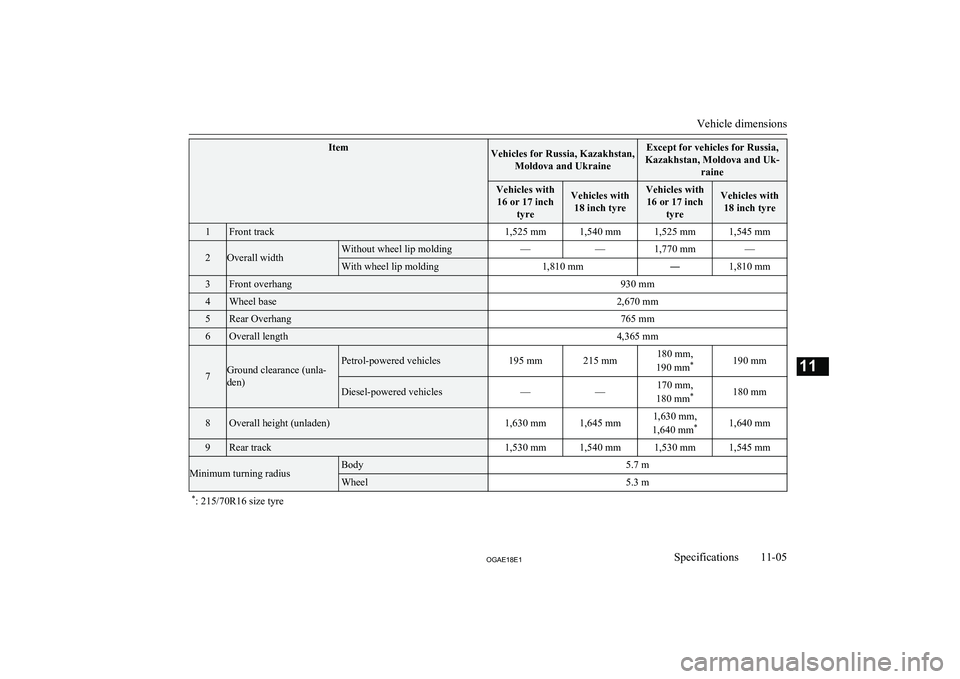
ItemVehicles for Russia, Kazakhstan,Moldova and UkraineExcept for vehicles for Russia,
Kazakhstan, Moldova and Uk- raineVehicles with16 or 17 inch tyreVehicles with18 inch tyreVehicles with16 or 17 inch tyreVehicles with18 inch tyre1Front track1,525 mm1,540 mm1,525 mm1,545 mm2Overall widthWithout wheel lip molding——1,770 mm—With wheel lip molding1,810 mm―1,810 mm3Front overhang930 mm4Wheel base2,670 mm5Rear Overhang765 mm6Overall length4,365 mm
7Ground clearance (unla-
den)
Petrol-powered vehicles195 mm215 mm180 mm,
190 mm *190 mmDiesel-powered vehicles——170 mm,
180 mm *180 mm8Overall height (unladen)1,630 mm1,645 mm1,630 mm,
1,640 mm *1,640 mm9Rear track1,530 mm1,540 mm1,530 mm1,545 mmMinimum turning radiusBody5.7 mWheel5.3 m*
: 215/70R16 size tyre
Vehicle dimensions
11-05OGAE18E1Specifications11