2018 MERCEDES-BENZ S-CLASS CABRIOLET roof
[x] Cancel search: roofPage 4 of 502

Atagl ance .................................................... 6
Cockpit ........................................................... 6
Wa rning and indicator lamps ........................ 10
Overhead contro l panel ................................ 12
Door control panel and seat adjustment ....... 14
Control settings inthere ar compartment .... .16
Emergencies and breakdowns ...................... 18
DigitalOperator' sManua l........................ .20
Callin gup the Digital Operator's Manual ...... 20
General no tes............................................. 21
Pr otecting the environment .......................... 21
Mercedes-Benz GenuineParts ....................... 21
Operator's Manual ........................................2 2
Service and vehicle operation ......................2 3
Operating saf ety.......................................... .24
Declaration of conformity for wireless
ve hicle components .....................................2 5
Diagnost ics connection ................................ 26
Qualified specialist workshop ....................... 27
Cor rect use of theve hicle ............................. 27
Problems with your vehicle ........................... 27
Re porting saf etydefects .............................. .27 Limited
Warranty .......................................... 28
QR codes forth ere scue card ....................... 28
Data storage .................................................2 8
Copyright .. .................................................... 32
Occupant safety......................................... 33
Re stra int sy stem .......................................... .33
Seat belts ..................................................... 35
Airbags ......................................................... 40
PRE-SAFE
®sy stem ....................................... 47
Childr en intheve hicle ..................................4 9
No tes on pets in theve hicle .........................5 6
Opening and closing.................................. 57
SmartK ey...................................................... 57
Doors ............................................................ 61
Tr unk ............................................................ 65
Ro ller sun blinds .......................................... .71
Side windo ws................................................ 72
Pa noramic roof ............................................. 76
Anti-theft pr otection .................................... .79
Seats and stowing ...................................... 81
No tes on the cor rect driver's seat posi‐
tion ............................................................... 81
Seats ............................................................ 82
St eering wheel ..............................................9 0
Using the memory function .......................... 93
St ow age areas .............................................. 94
Cup holder .................................................. 100
Ashtr ayand cigar ette lighter ...................... .101
Soc kets ....................................................... 102
Re frigerator box .......................................... 103
Wi reless charging of the mobile phone
and connection with theex terior antenna .. 105
Ins talling or removing thefloor mats ..........1 07
Light and visibility ................................... 108
Exterior lighting .......................................... 108
Interior lighting ............................................ 113
Wi ndshield wiper and windshield washer
sy stem ........................................................ 114
Mir rors ........................................................ 116
Operating the sun visors ............................. 119
Infrared reflective windshield function ........ 119
2
Conte nts
Page 23 of 502

Protecting the environment
+ENVIRONMENTAL NOTEEnvironmental
damage duetooperating conditions and
personal driving style
The pollutant emission of your vehicle is
directly related tothewa yyo u operate your
ve hicle.
Yo u can help toprotect the environment by
operating your vehicle in an environmentally-
re sponsible manner. Please obser vethefo l‐
lowing recommendations on ope rating condi‐
tions and pe rsonal driving style.
Operating conditions:
#Make sure that the tire pressure is cor‐
re ct.
#Do not car ryany unnecessary weight
(e.g. roof luggage rack s once you no
longe r need them).
#Ad here tothe service inter vals.
A regularly serviced vehicle will contri b‐
ute toenvironmen tal pr otection.
#Alw ays ha vemaintenance workcar ried
out at a qualified specialist workshop.
Pe rsonal driving style:
#Do not depress the accelera tor pedal
when starting the engine.
#Do not warm upthe engine while the
ve hicle is stationar y.
#Drive carefully and maintain a suitable
dist ance from theve hicle in front.
#Av oid frequent, sudden acceleration
and braking.
#Change gear in good time and use each
ge ar only uptoÔ of its maximum
engine speed.
#Switch off the engine in stationary traf‐
fi c, e.g. byusing the ECO start/ stop
function.
#Drive fuel-ef ficiently.
Environmental issues and recommendations:
it is recommended that youre -use or recycle
materials ins tead of just disposing of them. The
releva nt environmental guidelines and regu‐
lations ser vetoprotect the environment and
must be strictly obser ved.
Mercedes-Benz GenuineParts
+ENVIRONMEN TALNO TEEnvironmental
damage causedbynot using recycled
re conditioned components
Daimler AGoffers recycled reconditioned
components and part s withthe same quality
as new parts. The same entitlement from the
Limited Warranty is valid as for new parts.
#Use recycled reconditioned compo‐
nents and part s from Daimler AG.
Gene ral no tes 21
Page 50 of 502

RVehicles with sliding sunroof: Closingthe
sliding sunroof.
RVe hicles with memory function: Moving
th e front passenger seat toa more favo rable
seat position.
RVe hicles with multicontour seat: Increas‐
ing the air pressure in the seat side bols ters
of the seat backrest.
RPRE-SAFE®Sound: pr ovided that the multi‐
media sy stem is switched on, generates a
brief noise signal tostimulate the innate pro‐
te ctive mechanism of a person's heari ng.
* NO
TEDama gecaused byobjects in the
fo ot we ll or behind the seat
The automatic adjustment of the seat posi‐
tion may result in damage tothe seat and/or
th e object.
#St ow objects in a suitable place.
Reversing the PRE- SAFE®system measures
If an accident did not occur, the pre-em ptive
measures that we retake n are reve rsed.
Yo uwill need toper form certain settings your‐
self.
#If th e seat belt pre-tensioning is not reduced,
mo vethe seat backrest back slightl y.
The locking mechanism releases.
Fu nction of PRE-SAFE®PLUS (anticipatory
occupant pr otection plus)
PRE- SAFE®PLUS can de tect cer tain impacts,
particular lyan imminent rear impact, and take
pre-em ptive measures toprotect theve hicle
occupants. These measures cannot necessarily
pr eve nt an imminent impact.
PRE-SAFE
®PLUS can implement thefo llowing
measures independently of each other:
RTightening the seat belts on the driver's seat
and front passenger seat.
RInc reasing brake pressure when theve hicle
is stationar y.This brake application is can‐ celed automatically when
theve hicle pulls
aw ay.
If an accident did not occur, the pre-em ptive
measures that we retake n are reve rsed.
Sy stem limitations
The sy stem will not initiate any action in thefo l‐
lowing situations:
Rwhen backing up
The sy stem will not initiate any braking applica‐
tion in thefo llowing situations:
Rwhilst driving
or
Rwhen entering or exiting a parking space
while using Active Parking Assist
48
Occupant saf ety
Page 78 of 502

Panoramic roof
Operating the panoramic roof's roller sun‐
blind
& WARNING Risk of becoming trapped
when opening and closing thero ller sun‐
blinds
Body parts can become trapped between the
ro ller sunblind and frame when opening or
closing.
#When opening or closing, make sure
th at no body parts are in thera nge of
mo vement of thero ller sunblind.
#Re lease the button immediately if
somebody becomes trapped.
or
#Brief lypress the button in any direction
during automatic operation.
The opening/closing process is stop‐
ped.
Re quirementsRThe po wer supply is switched on. Opening or closing
thero ller sunblind
#To open: pushthe3 button in direction
1 or pull in direction 2.
#Toclose: pullthe3 button in direction
3.
If yo u press or pull the3 button be yond the
pressure point, you will start automatic opera‐
tion in the cor responding direction. You can stop automatic operation
bypressing or pulling the
button again.
Ve hicles without MAGIC SKY CONTROL: You
can start and inter rupt automatic operation via
button 1.
#Press button 1.
Depending on how far open it is thero ller
sunblind is comple tely opened or closed.
76
Opening and closing
Page 79 of 502
Automatic reve rsing function of thero ller
sunblind
If th ere is an object obstructing thero ller sun‐
blind during the closing process, thero ller sun‐
blind opens again automaticall y.The automatic
re ve rsing function is only an aid and is not a sub‐
st itute foryo ur attentiveness.
#When closing thero ller sunblind, make sure
th at no body parts are in thera nge of mo ve‐
ment.
& WARNING Risk of becoming trapped
despite reve rsing function
In particular, there ve rsing function does not
re act tosoft, light and thin objects, e.g. small
fi ngers.
This means that there ve rsing function can‐
not pr event entrapment in these situations.
#When closing thero ller sunblind, make
sure that no body parts are in thera nge
of mo vement.
#Re lease the button immediately if
somebody becomes trapped.
or
#Press the button in any direction during
th e automatic closing process.
The closing process is stopped.
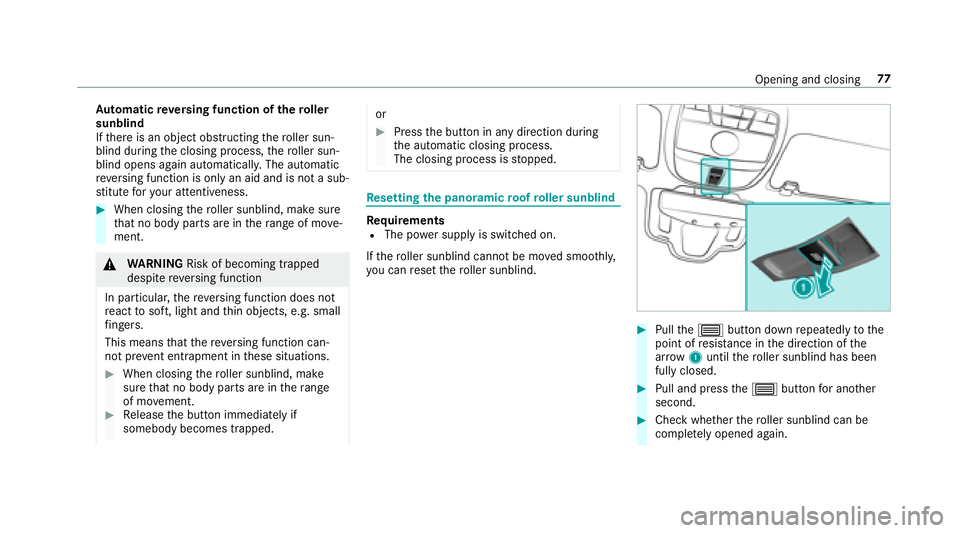
Re setting the panoramic roof roller sunblind
Re quirementsRThe po wer supply is switched on.
If th ero ller sunblind cannot be mo ved smoo thly,
yo u can reset thero ller sunblind.
#Pull the3 button down repeatedly tothe
point of resis tance in the direction of the
ar row 1until thero ller sunblind has been
fully closed.
#Pull and press the3 button for ano ther
second.
#Check whe ther thero ller sunblind can be
comple tely opened again.
Opening and closing 77
Page 80 of 502
#Ifth is is not the case: repeat thesteps abo ve
again.
#If th ero ller sunblind still cannot be mo ved
smoo thly, con tact a qualified specialist work‐
shop.
MAGIC SKY CONTROL
MAGIC SKY CONTROL function
MAGIC SKY CONTROL is a function with which
yo u can change the transparency of the panor‐
amic roof. You can choose tohave the panor‐
amic roof dar kened or transpa rent.
&
DANG ER Risk of fata l injury caused by
to uching electrical co mponents of
MAGIC SKY CONTROL
MAGIC SKY CONTROL operates using high
vo ltage. If thero of lining behind the panor‐
amic roof is damaged or remo ved, elect ric
components will be exposed.
If yo uto uch these components, you could
get an electric shoc k.
#Neverre mo vethero of lining behind the
panoramic roof.
#Ifth ero of lining is damaged, ne ver
to uch the electrical components behind
it.
#Alw ays ha vewo rkon MAGIC SKY CON‐
TROL car ried out at a qualified special‐
ist workshop.
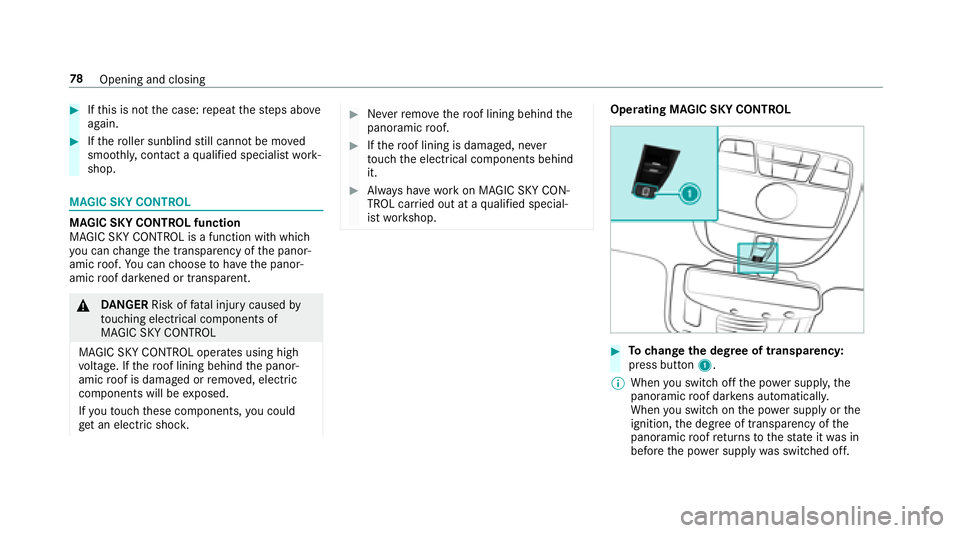
Operating MAGIC SKY CONTROL
#To change the deg ree of transparency:
press button 1.
% When you switch offthe po wer supply, the
panoramic roof dar kens au tomatical ly.
When you switch onthe po wer supply or the
ignition, the degree of transparency of the
panoramic roof returns tothest ate it was in
before the po wer supply was switched off.
78
Opening and closing
Page 133 of 502

RThe panic alarm is not activated.
RThe hazardwarning lights are switched off.
RThe hood is closed.
RThe doors are closed and loc ked.
RThe windo wsand sliding sunro of are closed.
#Start theve hicle using the smartphone:RAf tereve ryvehicle start, the engine runs for
te n minu tes.
RYo u can car ryout a maximum of two consec‐
utive starting attem pts. The vehicle must be
st ar ted once with the SmartK eybefore trying
to start theve hicle again with the smart‐
phone.
RYo u can stop theve hicle again at any time.
RFu rther information can be found inthe
smartphone app.
Securing the engine against starting before
car rying out maintenance or repair work:
#Switch on the hazard warning lights.
or
#Un lock the doors. or
#Open a side window or
the sliding sunroof.
Breaking-in no tes
Mercedes-AMG vehicles: observeth e no tes in
th e Supplement. Otherwise, you may failto rec‐
ognize dangers.
To preser vethe engine during thefirs t
1, 000 miles (1,500 km):
Rdrive at varying road speeds and engine
speeds.
Rdrive theve hicle in drive program A
or ;.
Rchange gear before theta ch ome ter needle is
Ô ofthewa yto there d area of theta ch ome‐
te r.
Rdo not shift down a gear manually in order to
brake.
Ravo idoverstra ining theve hicle, e.g. driving at
full thro ttle.
Rdo not depress the accelera tor pedal past
th e pressure point (kickdown).
Ronly increase the engine speed gradually and
accelerate theve hicle tofull speed af ter
1, 000 miles (1,500 km).
This also applies when the engine or parts of the
driv etra in ha vebeen replaced.
Please also obser vethefo llowing breaking-in
no tes:
Rin cer tain driving and driving saf etysy stems,
th e sensor sy stem adjusts automatically
while a cer tain dis tance is driven af terth e
ve hicle has been delivered or af terre pairs.
Fu ll sy stem ef fectiveness is not achie ved
unt ilth e end of this teach-in process.
Rbrakepads, brake discs and tires that are
either new or ha vebeen replaced only ach‐
ie ve opt
imum braking ef fect and grip af ter
se veral hundred kilom eters of driving. Com‐
pensate forth ere duced braking ef fect by
applying greater forc eto the brake pedal.
Driving and parking 13
1
Page 395 of 502

1Front roof area
2Re ar roof area
3Re ar wing
4Trunk lid
On there ar fende rs, it is recommended that you
ins tallth e antenna on the side of theve hicle
closest tothe center of thero ad. Use
Tech nical Specification ISO/TS 21609 (Road
Ve hicles – "EMCs for ins tallation of af term arke t
ra dio frequency transmitting equipment") when
ins talling two-w ayradios. Comply with the legal
re qu irements for de tach able parts.
If yo ur vehicle has pre-ins tallations for two-w ay
ra dio equipment, use the po wer supply and
antenna connec tors prov ided in the pre-ins talla‐
tion. Obser vethe manufacturer's supplements
when ins talling.
Tw o-w ayradio transmission output
The maximum transmission output (PEAK) at the
base of the antenna must not exceed theva lues
in thefo llowing table: Wa
veband and maximum transmission out‐
put
Wa veband Maximum transmis‐
sion output
Short wave
3 - 54 MHz 10
0 W
4 m waveband
74 -78 MHz 30 W
2 m waveband
14 4 - 174 MHz 50 W
Tr unked radio sys‐
te m/T etra
380 - 460 MHz 10
W
70 cm waveband
400 - 460 MHz 35 W
Tw o-w ayradio
(2G/3G/4G) 10
W
Tech nical da ta393