2018 MERCEDES-BENZ S-CLASS CABRIOLET tire pressure
[x] Cancel search: tire pressurePage 206 of 502

RVehicles approaching and overtaking you
at a very differe nt speed.
As a result, Active Blind Spot Assi stmay nei‐
th er give warnings nor inter vene in such sit‐
uations.
#Alw ays pay careful attention tothe traf‐
fi c situation and maintain a safe dis‐
ta nce at the side of theve hicle.
Ac tive Blind Spot Assi stis only an aid. It may fail
to detect some vehicles and is not a substitute
fo r attentive driving. Alw ays ensure that there is
suf ficient dist ancetothe side forot her road
users and obs tacles.
If a cours e-correcting brake application occurs,
th ere dwa rning lamp flashes in the outside mir‐
ro r and a warning tone sounds. In addition, a dis‐
pl ay 1 indicating the danger of a side collision
appears in the multifunction displa y.
In rare cases, the sy stem may make an inappro‐
priate brake application. This brake application
may be inter rupte d at any time if yousteer
slightly in the opposite direction or accelera te.
Sy stem limitations
Either a course-cor recting brake application
appropria teto the driving situation, or none at
all, may occur in thefo llowing situations:
RVe hicles or obs tacles, e.g. crash barr iers, are
located on bo thsides of your vehicle.
RAve hicle approaches too closely on the side.
RYo u ha veadop ted a sporty driving style with
high cornering speeds.
RYo ubr ake or accelerate signif icantly.
RA driving safe ty system inter venes, e.g. ESP®
or Active Brake Assi st.
RESP®is deacti vated.
RA loss of tire pressure or a defective tire is
de tected.
Ac tivating or deactivating Blind Spot Assi st
or Active Blind Spot Assi st
Multimedia sy stem:
,Vehicle.k Assistance.Blind
Spot Assist
#Ac tivate Oor deacti vate ª the function.
204
Driving and parking
Page 208 of 502

System limitations
No lane-cor recting brake application occurs in
th efo llowing situations:
RYo u clear lyand actively steer, brake or accel‐
erate.
RYo u ha veswitched on the turn signal indica‐
to r.
RA driving safe ty system inter venes, such as
ESP®, Ac tive Brake Assi stor Active Blind
Spot Assi st.
RYo u ha veadop ted a sporty driving style with
high cornering speeds or high rates of accel‐
eration.
RESP®is deactivated.
RIf a loss of tire pressure or a defective tire
has been de tected and displ ayed.
The sy stem may be impaired or may not function
in thefo llowing situations:
RIf th ere is poor visibility, e.g. due toinsuf fi‐
cient illumination of thero ad, highly variable
shade conditions, or due torain, sno w,fog or
heavy spr ay.
RThere is glare, e.g. from oncoming traf fic, the
sun or reflections.
RIf th ere is dirt on the windshield in the vicin‐
ity of the multifunction camera or the camera
is mis ted up, damaged or obscured.
RNo or se veral, unclear lane markings are
present for one lane, e.g. near roadwor ks.
RThe lane markings are worn, dark or co vered.
RThe dis tance totheve hicle in front is too
small and the lane markings thus cannot be
de tected.
RThe lane markings change quickl y,e.g. lanes
branch off, cross one ano ther or mer ge.
RThe roadw ayisvery nar row and winding.
Ve hicles with Driving Assistance pac kage or
Driving Assistance Plus pa ckage: Active Lane
Ke eping Assist uses radar sensors tomonitor
se veral areas around theve hicle. If thera dar
sensors in there ar bumper are dirty or co vered
with snow ,th e sy stem may be impaired or may
not function. If an obs tacle in the lane in which
yo u are driving has been de tected, no lane-cor‐
re cting brake application occurs .Ac
tivating Active Lane Keeping Assist
&
WARNING Risk of accident despite
Ac tive Lane Keeping Assist warning
A lane-cor recting brake application cannot
al wa ys bring theve hicle back into the origi‐
nal lane.
#Alw aysst eer, brake or accelera teyour‐
self, especially if Active Lane Keeping
Assist warnsyo u or makes a lane-cor‐
re cting brake application.
&
WARNING Risk of accident despite inter‐
ve ntion of Active Lane Keeping Assist
Ac tive Lane Keeping Assist does not de tect
traf fic conditions or road users. In very rare
cases, the sy stem may make an inappropri‐
ate brake application, e.g. af ter intentional ly
driving over a solid lane marking.
The brake application can be inter rupte d at
any time if yousteer slightly in the opposite
direction.
206 Driving and parking
Page 214 of 502
Menus and submenus
Functions in the Service menu of the on-
board compu ter
On-board computer:
,Service
#To select the function: swipe upwards or
down wards on the left-hand Touch Control.
#Press the left-hand Touch Control.
Fu nctions in theService menu:
RMessage memory (→page 404)
RTires:
-Checking the tire pressure with the tire
pressure monitoring sy stem
(
→page 368)
-Re starting the tire pressure monitoring
sy stem (→page 369)
RASSYST PLUS : calling upthe service due
date (→page 327)
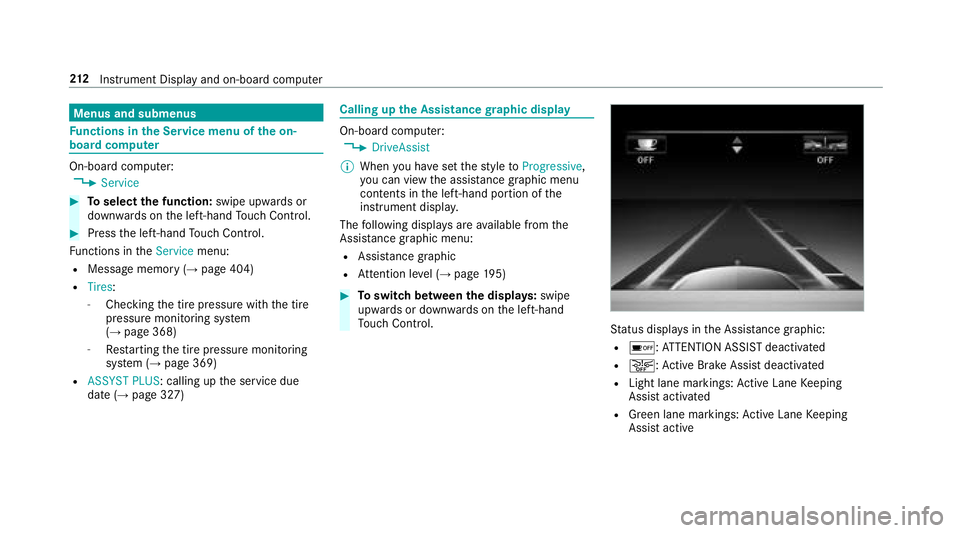
Calling up the Assistance graphic display
On-board computer:
,DriveAssist
% When you ha veset thest yle to Progressive,
yo u can view the assis tance graphic menu
contents in the left-hand portion of the
instrument displa y.
The following displa ysare available from the
Assist ance graphic menu:
RAssistance graphic
RAt tention le vel (→page 195)
#To switch between the displa ys:swipe
up wa rds or down wards on the left-hand
To uch Control.
Status displa ysinthe Assis tance graphic:
Ré: ATTENTION ASSIST deactivated
Ræ: Active Brake Assi stdeactivated
RLight lane markings: Active Lane Keeping
Assist activated
RGreen lane markings: Active Lane Keeping
Assist active
21 2
Instrument Display and on-board computer
Page 337 of 502

Information on using a powerwa sher
&
WARNING Risk of accident when using
high-pressure cleaning equipment wi th
ro und-s pray nozzles
The wate r jet from a round-s pray nozzle (dirt
grinder) may cause damage totires and sus‐
pension components that is not visible.
Components damaged in this wa yma yfa il
unexpec tedly.
#Do not use high-pressure cleaning
equipment wi thround-s pray nozzles to
clean your vehicle.
#Damaged tires or suspension compo‐
nents must be replaced immediatel y.
Toavo id damage to yourvehicle, obser vethefo l‐
lowing when using a po werwa sher:
RKeep the SmartK eyat least 10ft(3 m) away
from theve hicle. Otherwise the trunk lid
could open unintentionall y.
RMaintain a distance of at least 11.8 in
(30 cm) totheve hicle.
RVe hicles with deco rative foil: parts of your
ve hicle are co vered with a decorative foil.
Maintain a dis tance of at least 27.6 in
(70 cm) between thefo il-c ove red parts of the
ve hicle and the nozzle of the high pressure
cleaner. Mo vethe po werwa sher nozzle
around whilst cleaning.
RObser vethe information on the cor rect dis‐
ta nce in the equipment manufacturer's oper‐
ating instructions.
RDo not point the nozzle of the po werwa sher
directly at sensitive parts such as tires, slits,
electrical component parts, batteries, light
sources and ventilation slot s.
Washing theve hicle byhand
Obser vethe legal requ irements, e.g. in a number
of countries, washing byhand is only permitted
in specially designated wash ba ys.
#Use a mild cleaning agent, e.g. car shampoo.
#Wa shtheve hicle with luk ewarmwate r using
a soft car sponge. When doing so, do not
ex pose theve hicle todirect sunlight.
#Carefully hose theve hicle off with water and
dry using a chamois. Take care not topoint
th ewate r jet directly towa rdsth e air inlet
grille.
Maintenance and care 335
Page 345 of 502

Intheeve nt of a flat tire, thefo llowing options
are available depending on your vehicle's equip‐
ment:
RVe hicles with MOExtended tires: it is pos‐
sible tocontinue the journey for a short
period of time. Make sure you observ eth e
no tes on MOExtended tires (run-flat tires)
(
→page 343).
RVe hicles with a TIREFIT kit: you can repair
th e tire so that it is possible tocontinue the
journ eyfor a short period of time. Todo this,
use the TIREFIT kit (
→page 344).
RVe hicles with Mercedes-Benz
mbrace®(USA only): you can make a call for
Ro adside Assis tance via theove rhead control
panel in the case of a breakdown
(
→page 294).
RAll vehicles: change the wheel
(→page 386).
Note s on MOExtended tires (run-flat tires)
&
WARNING Risk of accident when driving
in li mp-home mode
When driving in emergency mode the han‐
dling characteristics are impaired, e.g. when
cornering, when accelerating stronglyand
when braking.
#Do not exceed the specified maximum
speed.
#Av oid any abrupt steering and driving
maneuvers as well as driving over
obs tacles (curbs, pot holes, off-road).
This applies, in part icular,toa loaded
ve hicle.
#Stop driving in the emer gency mode if
yo u notice:
Rbanging noise
Rvehicle vibration
Rsmoke which smells like rubber
Rcontinuous ESP®inter vention
Rcrac ksin tire side walls
#After driving in emergency mode ha ve
th erims checkedby aqu alified special‐
ist workshop with rega rd totheir fur ther
use.
#The defective tire must be replaced in
eve rycase.
With MOExtended tires (run-flat tires), you can
continue todrive your vehicle even if there is a
tot al loss of pressure in one or more tires. How‐
eve r,th e tire af fected must not show any clearly
visible damage.
Yo u can recognize MOExtended tires bythe
MOExtended marking which appears onthe side
wa ll of the tire.
Ve hicles with tire pressure monitoring sys‐
te m: MOExtended tires may only be used in con‐
junction wi than activated tire pressure monitor‐
ing sy stem.
If a pressure loss warning message appears in
th e multifunction display:
RCheck the tire for dama ge.
RIf driving on, obser vethefo llowing no tes.
Breakdown assis tance 34
3
Page 346 of 502

Drivingdistance possibl ein limp-hom emod e
af te r the pressure loss warning:
Load condition Driving distance pos‐
sible in limp-homemode
Pa rtially laden 50 miles (80 km)
Fu lly laden 19miles (30 km)
RThe driving dis tance possible in li mp-home
mode may vary depending on the driving
st yle.
RMaximum permissible speed 50 mph
(80 km/h).
If a tire has gone flat and cannot be replaced
with an MOEx tended tire, you can use a stand‐
ard tire as a temp orary measure.
TIREFIT kit storage location
The TIREFIT kit is located under the trunk floor.
Mercedes‑AMG vehicles: observeth e no tes in
th e Supplement. Otherwise, you may not recog‐
nize dangers.
1Ti re sealant bottle
2Tire inflation compressor
Using the TIREFIT kit
Re quirements
Ha ve thefo llowing tools readily available:
RTire sealant bottle
RTIREFIT sticke r pr ovided
RTire inflation compressor
RDisposable glove s
Yo u can use TIREFIT tire sealant toseal per fora ‐
tion damage of upto0.16 in (4 mm), particular lyth
ose in the tire conta ct surface.You can use
TIRE FIT in outside temp eratures down to-4 °F
(-20 °C).
& WARNING Risk of accident when using
tire sealant.
In thefo llowing situations, the tire sealant is
unable toprov ide suf ficient breakdown assis‐
ta nce, as it is unable toseal the tire properly:
RThere are cuts or punctures in the tire
larger than those pr eviously mentioned.
RThe wheel rim is dama ged.
RYo u ha vedriven at a very low tire pres‐
sure or on a flat tire.
#Do not continue driving.
#Consult a qualified specialist workshop.
&
WARNING Risk of injury and poisoning
from tire sealant
The tire sealant is harmful and causes ir rita ‐
tion. Do not allow it tocome into contact
wi th th e skin, eyes or clo thing, and do not
34 4
Breakdown assis tance
Page 348 of 502

#Pushthe plug of hose 5into flange 6of
tire sealant bottle 1until the plug engages.
#Place tire sealant bottle 1head down wards
into recess 2ofthe tire inflation compres‐
sor.
#Re mo vetheva lve cap from valve 7 onthe
defective tire.
#Scr ew filling hose 8onto valve 7.
#Insert plug 4into a 12V soc ket in your
ve hicle.
#Switch on the ignition.
#Press on and off switch 3onthe tire infla‐
tion compressor.
The tire inflation compressor is switched on.
The tire is inflated. Fir st, tire sealant is pum‐
ped into the tire. The pressure may brief ly
ri se toappr oximately 500 kPa (5 bar/73 psi).
Do not switch off the tire inflation compres‐
sor du ring this phase.
#Let the tire inflation compressor runfo r a
maximum of eight minutes.
The tire should then ha veattained a tire
pressure of at least 180 kPa (1.8 bar/26 psi).
If tire sealant leaks out, make sureyou clean the
af fected areas as quickly as possible. It is pref‐
erable touse clean water.
If yo uge t tire sealant on your clo thing, ha veit
cleaned as soon as possible with per chloroe thy‐
lene.
If atire pressure of 180 kPa (1.8 bar/26 psi)
has not been attained af ter eight minutes:
#Switch off the tire inflation compressor.
#Un scr ew thefilling hose from theva lve of the
defective tire.
Please no tethat tire sealant may leak out when
unscr ewing thefilling hose.
#Ve ry slowly drive forw ards or reve rse appr ox‐
imately 33 ft(10 m).
#Pump up the tire again.
Af ter a maximum of eight minutes the tire
pressure must be at least 180 kPa (1.8 bar/
26 psi).
& WARNING Risk of accident due tothe
specified tire pressure not being reached
If th e specified tire pressure is not reached
af te rth e specified time, the tire is too badly
damaged. The tire sealant cannot repair the
tire in this ins tance.
Dama ged tires and a tire pressure that is too
low can significantly impair braking and han‐
dling characteristics.
#Do not continue driving.
#Consult a qualified specialist workshop.
34 6
Breakdown assis tance
Page 349 of 502

If a tire pressureof180 kPa (1.8 bar/26 psi)
has been attained af ter eight minutes:
&
WARNING Risk of accident from driving
wi th sealed tires
A tire temp orarily sealed with tire sealant
impairs handling characteristics and is not
suitable for higher speeds.
#Ad apt your dr ivingst yle according lyand
drive carefull y.
#Do notexceed the specified maximum
speed with a tire that has been sealed
using tire sealant.
Observ eth e maximum permissible speed for a
tire sealed with tire sealant 50 mph(8 0 km/h).
#Af fix th e upper section of the TIREFIT sticke r
to the instrument clus ter where it will be eas‐
ily seen bythe driver.
* NO
TEStaining caused byleaking tire
sealant
Af ter use, excess tire sealant may leak out
from thefilling hose.
#Therefore, place thefilling hose in the
plastic bag that con tained the TIREFIT
kit.
+ENVIRONMEN TALNO TEEnvironmental
pollution caused byenvironmen tally ir re‐
sponsible disposal
Ti re sealant contains polluta nts.
#Have the tire sealant bottle disposed of
professionall y,e.g. at an authorized
Mercedes-Benz Center.
#Switch off the tire inflation compressor.
#Un scr ew thefilling hose from theva lve of the
defective tire.
#St ore the tire sealant bottle, the tire inflation
compressor and thewa rning triangle.
#Pull away immediatel y.
#Stop driving af ter app roxima tely ten minu tes
and check the tire pressure using the tire
inflation compressor.
The tire pressure must now be at least
13 0 kPa (1.3 bar/19 psi).
&
WARNING Risk of accident due tothe
specified tire pressure not being reached
If th e specified tire pressure is not reached
af te r a brief drive, the tire is too badly dam‐
aged. The tire sealant cannot repair the tire
in this ins tance.
Dama ged tires and tire pressure that is too
low can significantly impair the braking prop‐
erties and the handling characteristics.
#Do not continue driving.
#Consult a qualified specialist workshop.
In cases such as the one mentioned abo ve, con‐
ta ct an au thorized Mercedes-Benz Center. Or
call 1-800-FOR-MERC edes (inthe USA) or
1-800-387-0 100 (in Canada).
#Cor rect the tire pressure if it is still at least
13 0 kPa (1.3 bar/19 psi). See theTire and
Loading Info rmation placard on the driver's
side B‑pillar or the tire pressure table in the
fuel filler flap forva lues.
#To increase the tire pressure: switchon
th e tire inflation compressor.
Breakdown assis tance 34
7