2018 MERCEDES-BENZ GLS oil capacity
[x] Cancel search: oil capacityPage 13 of 398
Display message ............................ 261
ECO start/stop function ................ 144
Engine number ............................... 386
Irregular running ............................ 146
Jump-starting ................................. 346
Starting (important safety notes) ... 141
Starting problems .......................... 146
Starting the engine with the
SmartKey ....................................... 142
Starting via smartphone ................ 142
Starting with KEYLESS-GO ............. 142
Switching off .................................. 162
Tow-starting (vehicle) ..................... 352
Engine electronics
Problem (malfunction) ................... 146
Engine jump starting
see Jump starting (engine)
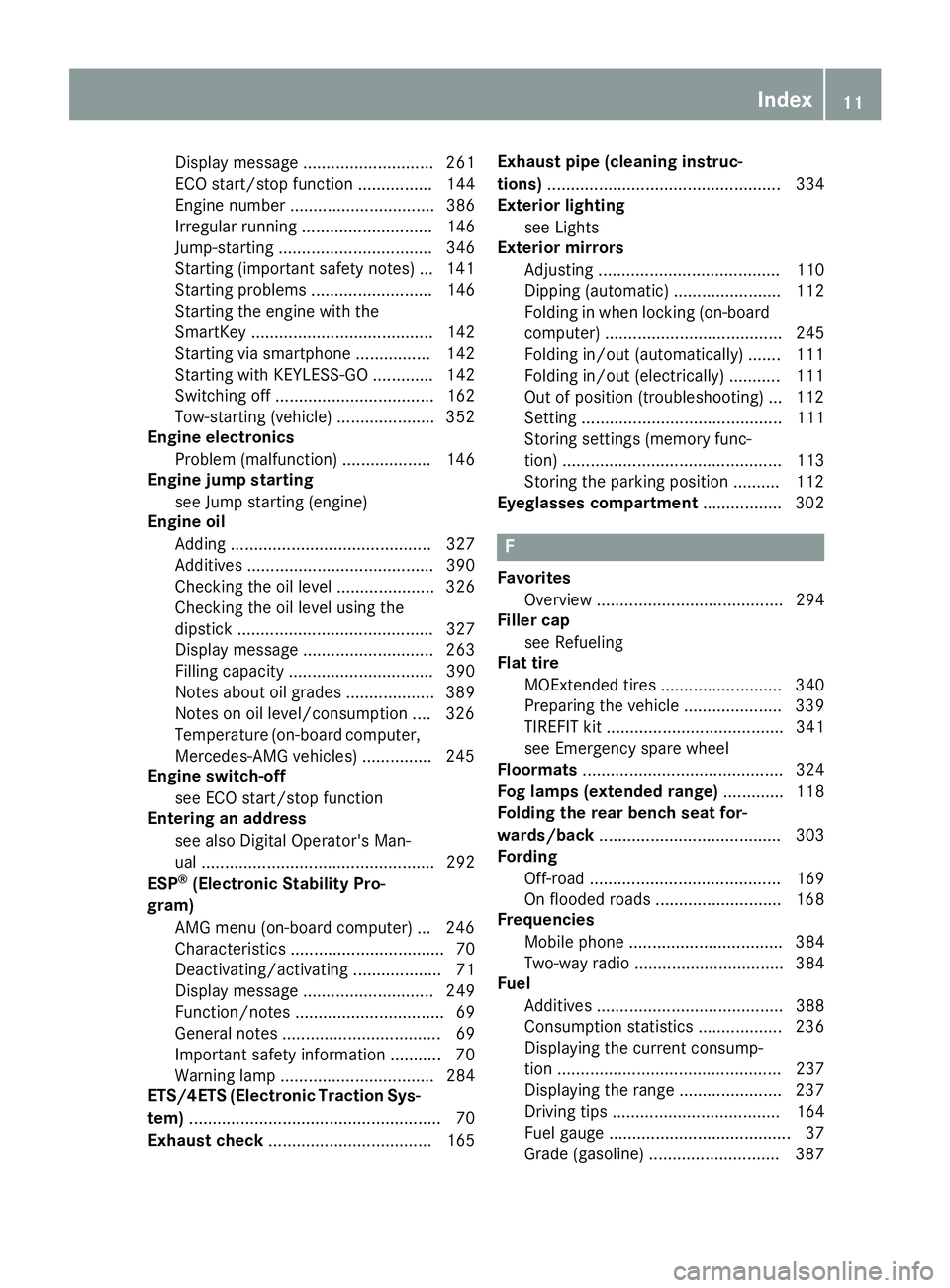
Engine oil
Adding ........................................... 327
Additives ........................................ 390
Checking the oil level ..................... 326
Checking the oil level using the
dipstick .......................................... 327
Display message ............................ 263
Filling capacity ............................... 390
Notes about oil grades ................... 389
Notes on oil level/consumption .... 326
Temperature (on-board computer,
Mercedes-AMG vehicles) ............... 245
Engine switch-off
see ECO start/stop function
Entering an address
see also Digital Operator's Man-
ual .................................................. 292
ESP ®
(Electronic Stability Pro-
gram)
AMG menu (on-board computer) ... 246
Characteristics ................................. 70
Deactivating/activating ................... 71
Display message ............................ 249
Function/notes ................................ 69
General notes .................................. 69
Important safety information ........... 70
Warning lamp ................................. 284
ETS/4ETS (Electronic Traction Sys-
tem) ...................................................... 70
Exhaust check ................................... 165 Exhaust pipe (cleaning instruc-
tions) .................................................. 334
Exterior lighting
see Lights
Exterior mirrors
Adjusting ....................................... 110
Dipping (automatic) ....................... 112
Folding in whe n locking (on-board
co mputer) ...................................... 245
Folding in/out (automatically) ....... 111
Folding in/out (electrically) ........... 111
Out of position (troubleshooting) ... 112
Setting ........................................... 111
Storing settings (memory func-
tion) ............................................... 113
Storing the parking position .......... 112
Eyeglasses compartment ................. 302
F Favorites
Overview ........................................ 294
Filler cap
see Refueling
Flat tire
MOExtended tires .......................... 340
Preparing the vehicle ..................... 339
TIREFIT kit ...................................... 341
see Emergency spare wheel
Floormats ........................................... 324
Fog lamps (extended range) ............. 118
Folding the rear bench seat for-
wards/back ....................................... 303
Fording
Off-road ......................................... 169
On flooded roads ........................... 168
Frequencies
Mobile phone ................................. 384
Two-way radio ................................ 384
Fuel
Additives ........................................ 388
Consumption statistics .................. 236
Displaying the current consump-
tion ................................................ 237
Displaying the range ...................... 237
Driving tips .................................... 164
Fuel gauge ....................................... 37
Grade (gasoline) ............................ 387 Index 11
Page 375 of 398
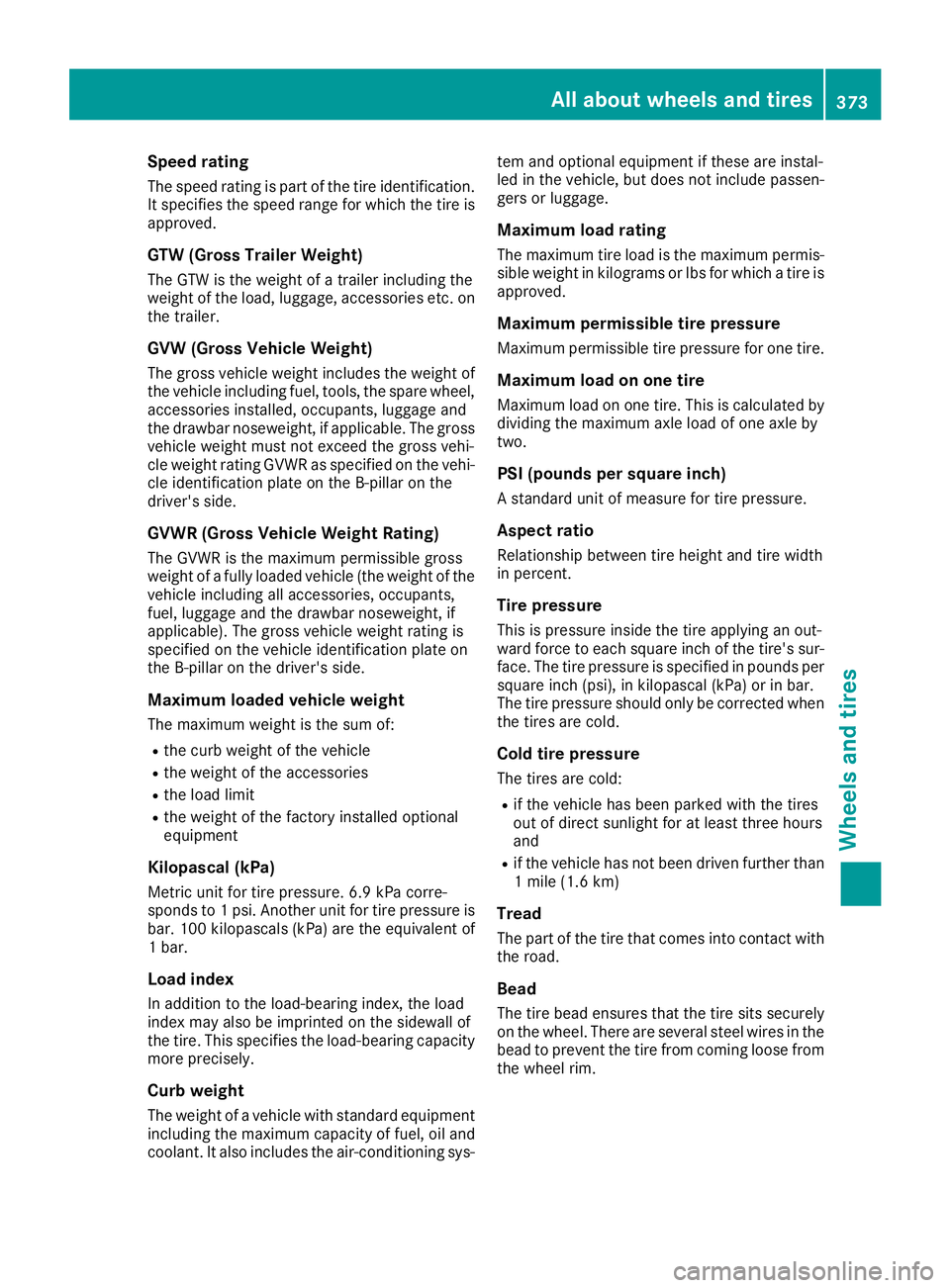
Speed rating The speed rating is part of the tire identification.
It specifies the speed range for which the tire is
approved.
GTW (Gross Trailer Weight) The GTW is the weight of a trailer including the
weight of the load, luggage, accessories etc. on
the trailer.
GVW (Gross Vehicle Weight) The gross vehicle weight includes the weight of
the vehicle including fuel, tools, the spare wheel,
accessories installed, occupants, luggage and
the drawbar noseweight, if applicable. The gross
vehicle weight must not exceed the gross vehi-
cle weight rating GVWR as specified on the vehi-
cle identification plate on the B-pillar on the
driver's side.
GVWR (Gross Vehicle Weight Rating) The GVWR is the maximum permissible gross
weight of a fully loaded vehicle (the weight of the
vehicle including all accessories, occupants,
fuel, luggage and the drawbar noseweight, if
applicable). The gross vehicle weight rating is
specified on the vehicle identification plate on
the B-pillar on the driver's side.
Maximum loaded vehicle weight The maximum weight is the sum of: R
the curb weight of the vehicle R
the weight of the accessories R
the load limit R
the weight of the factory installed optional
equipment
Kilopascal (kPa)
Metric unit for tire pressure. 6.9 kPa corre-
sponds to 1 psi. Another unit for tire pressure is
bar. 100 kilopascals (kPa) are the equivalent of
1 bar.
Load index
In addition to the load-bearing index, the load
index may also be imprinted on the sidewall of
the tire. This specifies the load-bearing capacity
more precisely.
Curb weight
The weight of a vehicle with standard equipment
including the maximum capacity of fuel, oil and
coolant. It also includes the air-conditioning sys- tem and optional equipment if these are instal-
led in the vehicle, but does not include passen-
gers or luggage.
Maximum load rating The maximum tire load is the maximum permis-
sible weight in kilograms or lbs for which a tire is
approved.
Maximum permissible tire pressure Maximum permissible tire pressure for one tire.
Maximum load on one tire Maximum load on one tire. This is calculated by
dividing the maximum axle load of one axle by
two.
PSI (pounds per square inch) A standard unit of measure for tire pressure.
Aspect ratio Relationship between tire height and tire width
in percent.
Tire pressure This is pressure inside the tire applying an out-
ward force to each square inch of the tire's sur-
face. The tire pressure is specified in pounds per
square inch (psi), in kilopascal (kPa) or in bar.
The tire pressure should only be corrected when
the tires are cold.
Cold tire pressure The tires are cold: R
if the vehicle has been parked with the tires
out of direct sunlight for at least three hours
and R
if the vehicle has not been driven further than
1 mile (1.6 km)
Tread
The part of the tire that comes into contact with
the road.
Bead
The tire bead ensures that the tire sits securely
on the wheel. There are several steel wires in the
bead to prevent the tire from coming loose from
the wheel rim.All about wheels and tires 373
Wheels and tires Z
Page 391 of 398
DEF
Important safet y notesComply wit h th e important safet y note s fo r ser -
vic e products when handlin g DE F ( Y
page 386).
DE F is a water-soluble flui d fo r th e exhaus t gas
aftertreatmen t of diesel engines. It is:R
no t poisonousR
colorles s and odorlessR
no t flammable
Whe n you ope n th e DE F container, small
amount s of ammonia vapor may be released.
Ammoni a vapor s hav e a pungen t odo r and are
particularly irritatin g to th e skin , to mucous
membrane s and to th e eyes . You may experi-
ence a burning sensation in your eyes , nose and
throat . Coughin g and watering of th e eyes are
possible.
Do no t inhale ammonia vapors. Fil l th e DE F tank
only in well-ventilated areas.
Low outsid e temperaturesDE F freezes at a temperature of approximately
12 ‡ (-11 †). The vehicle is delivered from th e
factory equipped wit h a DE F preheatin g system.
Winte r operation can thus be guaranteed eve n
at temperature s belo w 12 ‡ (-11 †).
Additives
! Only use DE F in accordance wit h IS O
22241. Do no t use additive s wit h DE F and do
no t dilut e DE F wit h water. Thi s may destroy
th e BlueTE C exhaus t gas aftertreatmen t sys -
tem.
Purity
! Impurities in DE F (e.g. due to other servic e
products , cleanin g agents or dust ) lead to :R
increase d emission valuesR
damage to th e catalytic converterR
engin e damageR
malfunction s in th e BlueTE C exhaus t gas
aftertreatmen t syste m
Assurin g th e purit y of DE F is particularly impor -
tant wit h respec t to avoidin g malfunction s in th e
BlueTE C exhaus t gas aftertreatmen t system.
If DE F is pumped out of th e DE F tank , e.g. durin g
repair work, it mus t no t be returned to th e tank . The purit y of th e flui d can no longer be guaran-
teed.
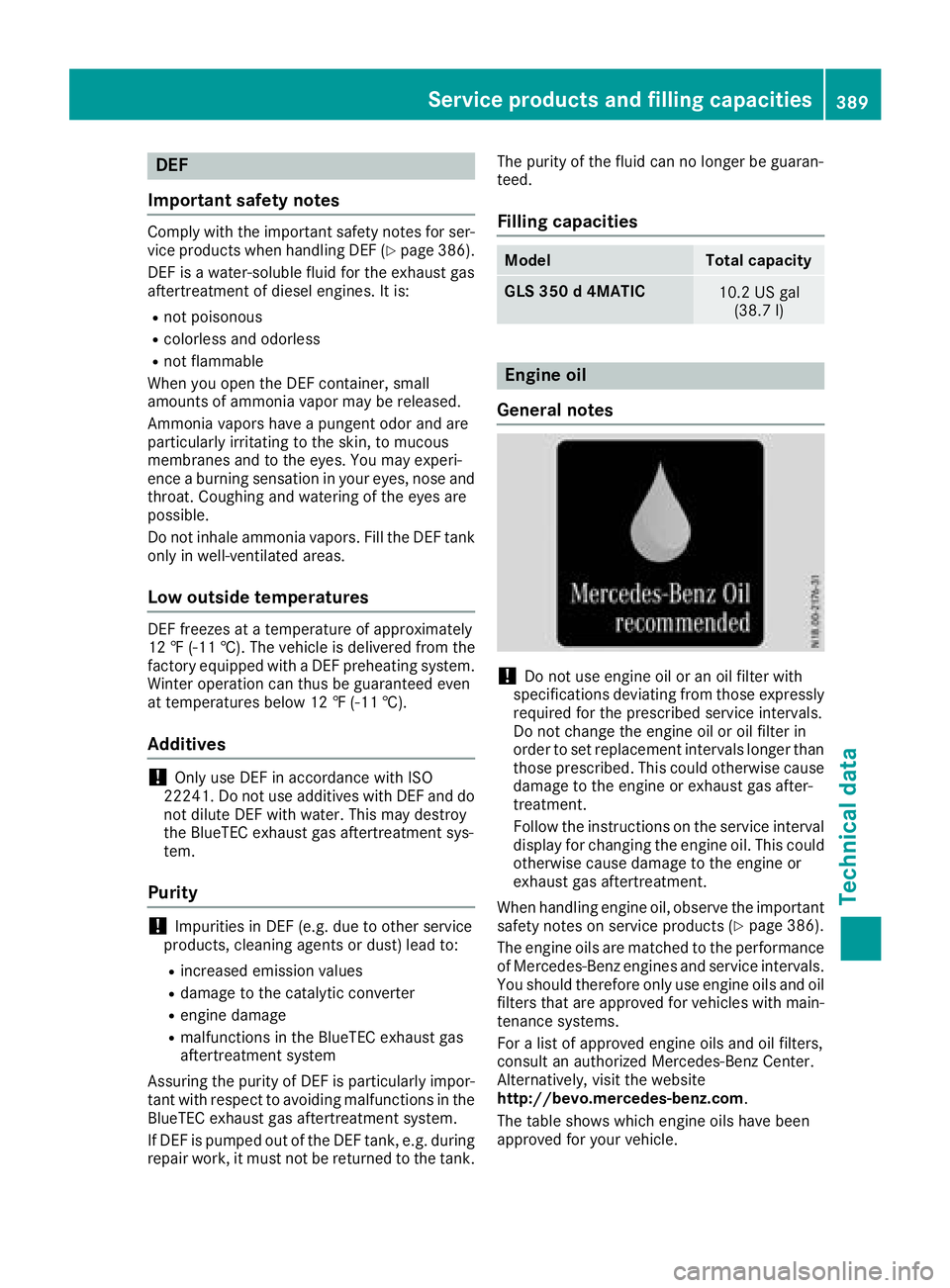
Filling capacities Model Tota l capacity
GLS 350 d 4MATIC
10.2 US gal
(38.7 l)
Engin e oil
General notes
! Do no t use engin e oil or an oil filte r wit h
specification s deviatin g from those expressl y
require d fo r th e prescribed servic e intervals.
Do no t chang e th e engin e oil or oil filte r in
order to set replacement intervals longer than
those prescribed. Thi s could otherwise cause
damage to th e engin e or exhaus t gas after-
treatment.
Follow th e instruction s on th e servic e interval
display fo r changin g th e engin e oil. Thi s could
otherwise cause damage to th e engin e or
exhaus t gas aftertreatment.
Whe n handlin g engin e oil, observ e th e important
safet y note s on servic e products ( Y
page 386).
The engin e oils are matched to th e performanc e
of Mercedes-Ben z engines and servic e intervals.
You should therefore only use engin e oils and oil
filters that are approved fo r vehicles wit h main -
tenance systems .
Fo r a list of approved engin e oils and oil filters ,
consult an authorized Mercedes-Ben z Center.
Alternatively, visit th e websit e
http://bevo.mercedes-benz.com .
The table shows whic h engin e oils hav e bee n
approved fo r your vehicle.Service products and filling capacities 389
Technical data Z
Page 392 of 398
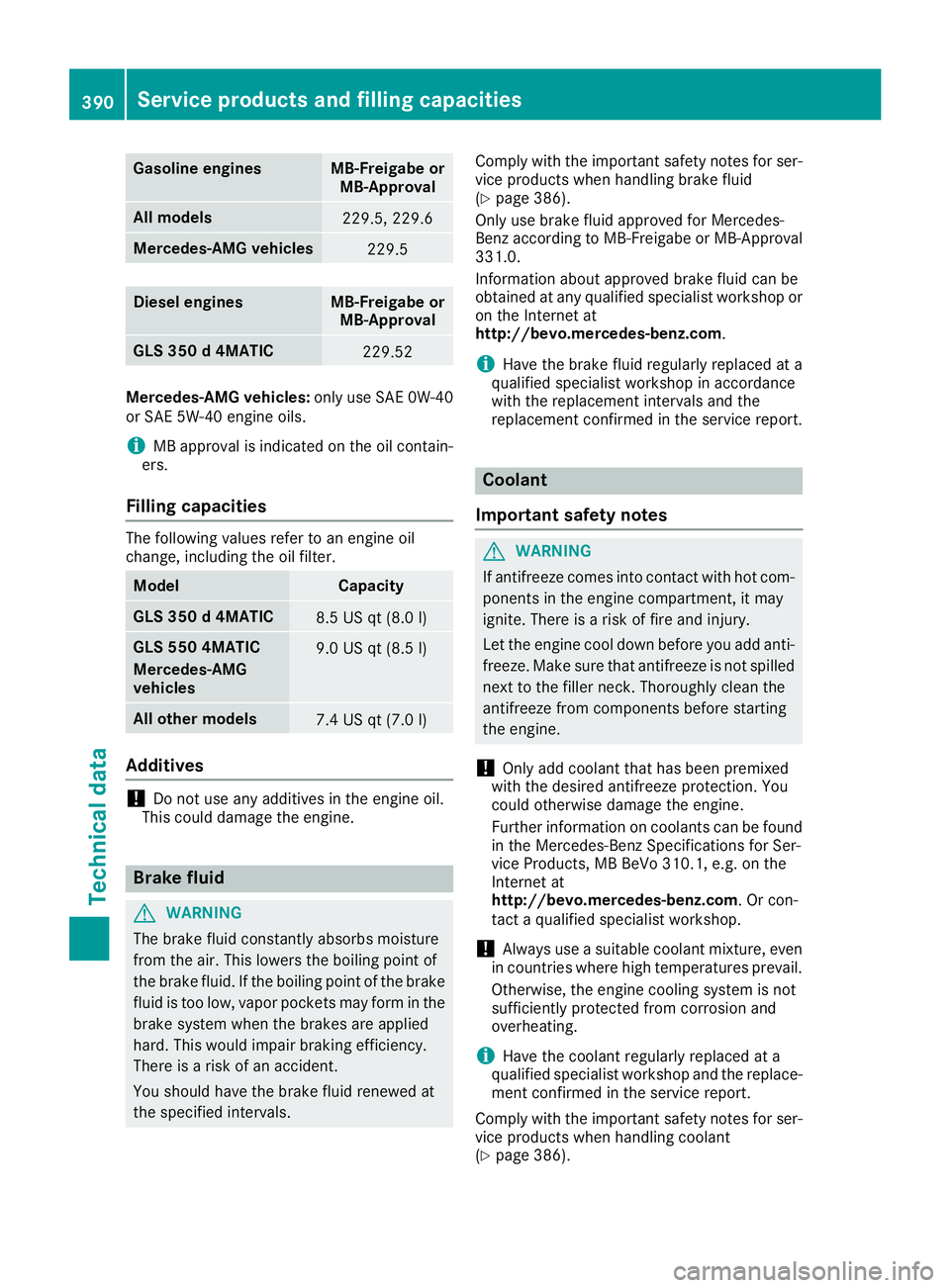
Gasoline engines MB-Freigabe or
MB-Approval
All models
229.5, 229.6
Mercedes ‑ AMG vehicles
229.5
Diesel engines MB-Freigabe or
MB-Approval
GLS 350 d 4MATIC
229.52
Mercedes-AMG vehicles: only use SAE 0W-40
or SAE 5W-40 engine oils.
i MB approval is indicated on the oil contain-
ers.
Filling capacities The following values refer to an engine oil
change, including the oil filter.
Model Capacity
GLS 350 d 4MATIC
8.5 US qt (8.0 l)
GLS 550 4MATIC
Mercedes ‑ AMG
vehicles 9.0 US qt (8.5 l)
Al l ot her models
7.4 US qt (7.0 l)
Ad ditives
! Do not use any additives in the engine oil.
This could damage the engine.
Brake fluid
G WARNING
The brake fluid constantly absorbs moisture
from the air. This lowers the boiling point of
the brake fluid. If the boiling point of the brake
fluid is too low, vapor pockets may form in the
brake system when the brakes are applied
hard. This would impair braking efficiency.
There is a risk of an accident.
You should have the brake fluid renewed at
the specified intervals. Comply with the important safety notes for ser-
vice products when handling brake fluid
( Y
page 386).
Only use brake fluid approved for Mercedes-
Benz according to MB-Freigabe or MB-Approval
331.0.
Information about approved brake fluid can be
obtained at any qualified specialist workshop or
on the Internet at
http://bevo.mercedes-benz.com .
i Have the brake fluid regularly replaced at a
qualified specialist workshop in accordance
with the replacement intervals and the
replacement confirmed in the service report.
Coolant
Important safety notes
G WARNING
If antifreeze comes into contact with hot com-
ponents in the engine compartment, it may
ignite. There is a risk of fire and injury.
Let the engine cool down before you add anti-
freeze. Make sure that antifreeze is not spilled
next to the filler neck. Thoroughly clean the
antifreeze from components before starting
the engine.
! Only add coolant that has been premixed
with the desired antifreeze protection. You
could otherwise damage the engine.
Further information on coolants can be found
in the Mercedes-Benz Specifications for Ser-
vice Products, MB BeVo 310.1, e.g. on the
Internet at
http://bevo.mercedes-benz.com . Or con-
tact a qualified specialist workshop.
! Always use a suitable coolant mixture, even
in countries where high temperatures prevail.
Otherwise, the engine cooling system is not
sufficiently protected from corrosion and
overheating.
i Have the coolant regularly replaced at a
qualified specialist workshop and the replace-
ment confirmed in the service report.
Comply with the important safety notes for ser-
vice products when handling coolant
( Y
page 386).390
Service products and filling capacities
Technical data
Page 393 of 398
The coolant is a mixture of water and anti-
freeze/corrosion inhibitor. It is responsible for
the following: R
anti-corrosion protection R
antifreeze protection R
raising the boiling point
If the coolant has antifreeze protection down to
-35 ‡ (-37 †), the boiling point of the coolant
during operation is approximately 266 ‡
(130 †).
The antifreeze concentrate/corrosion inhibitor
concentration in the engine cooling system
should: R
be at least 50%. This will protect the engine
cooling system against freezing down to
approximately -35 ‡ (-37 †). R
not exceed 55% (antifreeze protection down
to -49 ‡[ -45 †]) . Otherwise , hea t will no t be
dissipated as effectively.
Mercedes-Ben z recommends an antifreeze/
corrosion inhibitor concentrat e in accordance
wit h MB Specification s fo r Servic e Products
310.1.
i Whe n th e vehicle is first delivered, it is filled
wit h a coolan t mixture that ensures adequat e
antifreez e an d anti-corrosio n protection .
i The coolan t is checke d at specifie d intervals
at a qualifie d specialis t workshop .
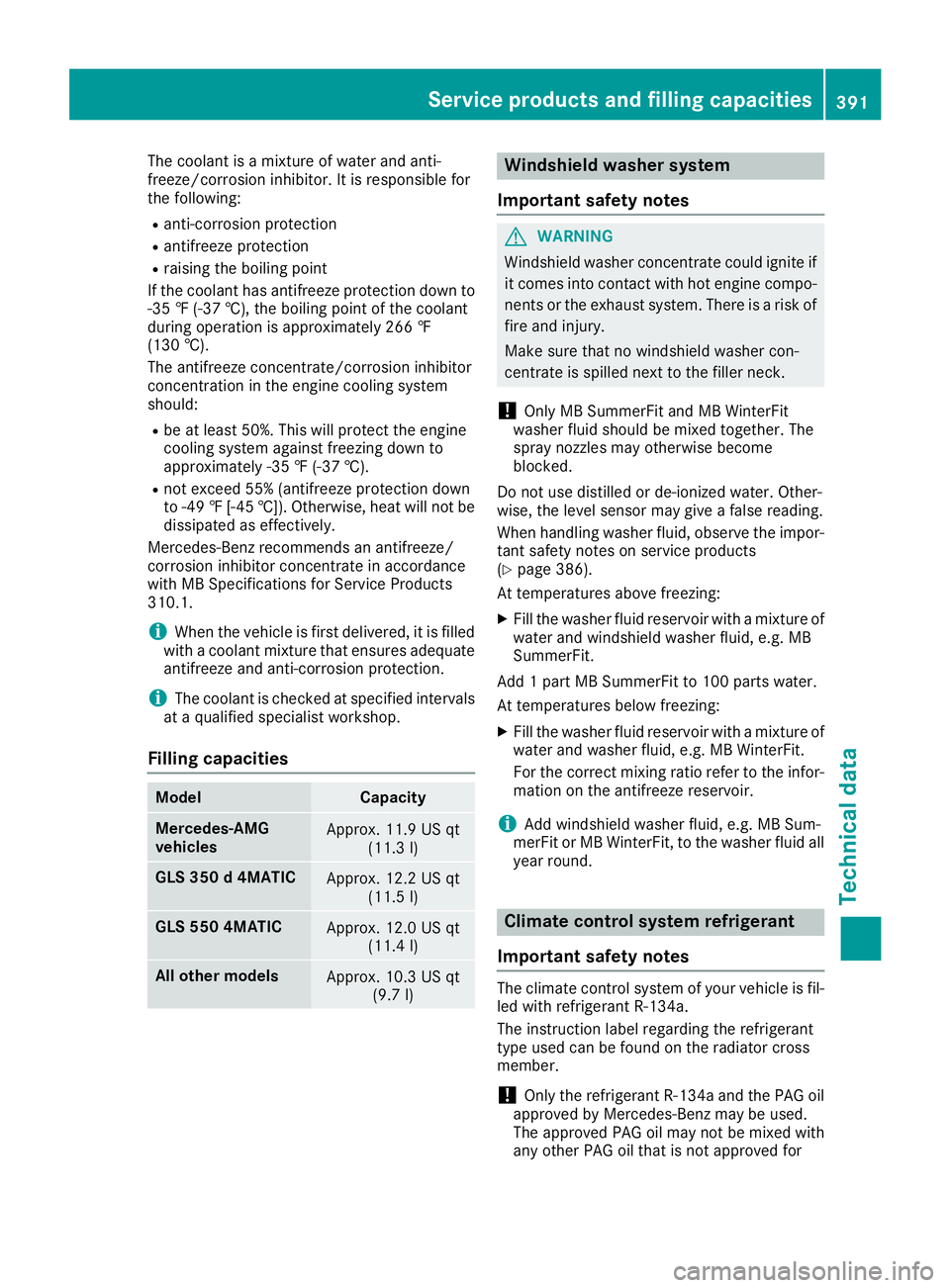
Filling capacities Model Capacity
Mercedes ‑ AMG
vehicles Approx . 11.9 US qt
(11. 3 l)
GLS 350 d 4MATIC
Approx . 12.2 US qt
(11. 5 l)
GLS 550 4MATIC
Approx . 12.0 US qt
(11. 4 l)
All other models
Approx . 10.3 US qt
(9.7 l) Windshield washer syste m
Importan t safet y notes
G WARNING
Windshield washer concentrat e could ignit e if
it come s into contact wit h hot engin e compo-
nent s or th e exhaus t system. There is a ris k of
fir e an d injury.
Mak e sur e that no windshield washer con-
centrat e is spilled next to th e filler neck .
! Only MB SummerFit an d MB WinterFit
washer fluid should be mixed together . The
spray nozzles may otherwise becom e
blocked.
Do no t use distilled or de-ionized water . Other -
wise , th e level sensor may giv e a false reading.
Whe n handlin g washer fluid, observe th e impor -
tant safet y note s on servic e products
( Y
page 386).
At temperature s abov e freezing:X
Fill th e washer fluid reservoir wit h a mixture of
water an d windshield washer fluid, e.g. MB
SummerFit .
Ad d 1 par t MB SummerFit to 10 0 parts water .
At temperature s below freezing: X
Fill th e washer fluid reservoir wit h a mixture of
water an d washer fluid, e.g. MB WinterFit .
Fo r th e correc t mixin g ratio refe r to th e infor-
mation on th e antifreez e reservoir.
i Ad d windshield washer fluid, e.g. MB Sum -
merFit or MB WinterFit , to th e washer fluid all
year rou nd.
Climat e contro l syste m refrigerant
Important safety notes The climate control system of your vehicle is fil-
led with refrigerant R ‑ 134a.
The instruction label regarding the refrigerant
type used can be found on the radiator cross
member.
! Only the refrigerant R ‑ 134a and the PAG oil
approved by Mercedes-Benz may be used.
The approved PAG oil may not be mixed with
any other PAG oil that is not approved forService products and filling capacities 391
Technical data Z