2018 MERCEDES-BENZ E-CLASS COUPE warning
[x] Cancel search: warningPage 45 of 486
&WARNING Risk of injury or death dueto
incor rect positioning of thefo rw ard-
fa cing child restra int sy stem
If yo u secure a child in a forw ard-facing child
re stra int sy stem on the front passenger seat
and you position the front passenger seat too
close tothe cockpit, in theeve nt of an acci‐
dent, thech ild could:
RCome into con tact wi th theve hicle inte‐
ri or if thePA SSENGER AIR BAG OFF indi‐
cator lamp is lit, forex ample.
RBe stru ck bythe air bag if the
PA SSENGER AIR BAG OFF indicator lamp
is off.
#Alw ays mo vethe front passenger seat
as far back as possible and fully retract
th e seat cushion length adjustment.
Alw ays make sure that the shoulder belt
st ra p is cor rectly routed from the seat
belt outlet on theve hicle tothe shoul‐
der belt guide on thech ild restra int sys‐
te m. The shoulder belt stra p must be
ro uted forw ards and down wards from
th eve hicle belt outlet. If necessar y,
adjustthe seat belt outlet and the front
passenger seat accordingly.
#Alw ays obser vethech ild restra int sys‐
te m manufacturer's ins tallation instruc‐
tions.
When ins talling a child restra int sy stem on the
front passenger seat, observ eth eve hicle-spe‐
cific information .
If a person is sitting in the front passenger
seat: PASSENGER AIR BAG OFF may be lit con‐
tinuously or be off, depending on the person's
st ature. Alw ays obser vethefo llowing informa‐
tion.
If th e front passenger seat is occupied by:
RAn adult or a pe rson with a build cor respond‐
ing tothat of an adult, thePA SSENGER AIR
BA G OFF indicator lamp must be off. This
indicates that the front passenger air bag is
enabled.
If th ePA SSENGER AIR BAG OFF indicator
lamp is lit continuousl y,an adult or person
with a build cor responding tothat of an adult should not use
the front passenger seat.
Ins tead, they should use a rear seat.
RA person with a smaller build (e.g. a teenager
or small adult), thePA SSENGER AIR BAG OFF
indicator lamp either lights up and remains lit
depending on there sult of the classification
or, alternativel y,goes out.
-PA SSENGER AIR BAG OFF is off: mo ve
th e front passenger seat as far back as
possible or a person of smaller stature
should use a rear seat.
-Ifth ePA SSENGER AIR BAG OFF indicator
lamp is lit continuously: a person of
smaller stature should not use the front
passenger seat.
& WARNING Risk of injury or death when
th ePA SSENGER AIR BAG OFF indicator
lamp is lit
If th ePA SSENGER AIR BAG OFF indicator
lamp remains lit af terth e sy stem self-test,
th e front passenger air bag is deactivated. It
will not be deplo yed in theeve nt of an acci‐
dent. In this case, the front passenger air bag
Occupant saf ety 43
Page 47 of 486

Information on PRE-SAFE®PLUS (anticipa‐
to ry occupant pr otection plus)
PRE- SAFE®PLUS can de tect cer tain impacts,
particular lyan imminent rear impact, and take
pre-em ptive measures toprotect theve hicle
occupants. These measures cannot necessarily
pr eve nt an imminent impact.
PRE-SAFE
®PLUS can implement thefo llowing
measures independently of each other:
RTightening the seat belts on the driver's seat
and front passenger seat.
RInc reasing brake pressure when theve hicle
is stationar y.This brake application is can‐
celed automatically when theve hicle pulls
aw ay.
If an accident did not occur, the pre-em ptive
measures that we retake n are reve rsed.
PRE-SAFE
®PLUS sy stem limitationsRNo me asures are implemented:
-Ifth eve hicle is backing up.
RThe brakes are not applied:
-Whilst driving. or
-When entering or
exiting a parking space
using Parking Pilot.
Children in theve hicle
Note s onthe safe transportation of children
&
WARNING Risk of accident and injury
due tochildren left unatte nded inthe
ve hicle
If yo u lea vechildren unaccompanied in the
ve hicle, they may be able toset theve hicle in
motion, forex ample by:
RRe leasing the parking brake.
RShifting the transmission out of park
position j.
RStarting the engine.
In addition, they may operate vehicle equip‐
ment.
#Ne ver lea vechildren and animals unat‐
te nded in theve hicle.
#When leaving theve hicle, alw aysta ke
th e SmartK eywith you and lock the
ve hicle.
&
WARNING Risk offata l injury due to
ex posure toextreme heat or cold in the
ve hicle
If people – particularly children – are
ex posed toextreme heat or cold over an
ex tended pe riod of time, there is a risk of
injury or evenfa ta l injur y.
#Never lea veanyone – pa rticularly chil‐
dren – unatte nded intheve hicle.
&
WARNING Risk of burn s whenthech ild
seat is exposed todirect sunlight
If th ech ild restra int sy stem is exposed to
direct sunlight or heat, parts could heat up.
Children could suf fer burns from these parts,
particularly on me tallic parts of thech ild
re stra int sy stem.
Occupant saf ety 45
Page 48 of 486
#Always make sure that thech ild
re stra int sy stem is not exposed to
direct sunlight.
#Pr otect it with a blank et,fo rex ample.
#Ifth ech ild restra int sy stem has been
ex posed todirect sunlight, allow it to
cool before securi ng achild into it.
#Ne ver lea vechildren unatte nded inthe
ve hicle.
The use of seat belts and child restra int sy stems
is requ ired bylaw in:
RAll 50 states
RThe U.S. territories
RThe District of Columbia
RAll Canadian pr ovinces
All child restra int sy stems must meet thefo llow‐
ing standards:
RU. S. Federal Mo torVe hicle Saf etySt andards
21 3 and 225
RCanadian Mo torVe hicle Saf etySt andards
21 3 and 210.2 Yo
u can obtain fur ther information about the
cor rect child restra int sy stem from any author‐
ized Mercedes-Benz Center.
To impr oveprotection forch ildren younger than
12 years old and under 5 ft(1.50 m) in height,
Mercedes-Benz recommends you observ eth e
fo llowing no tes:
ROnly secure children using a child restra int
sy stem which is suitable and recommended
fo r Mercedes-Benz vehicles, as well as appro‐
priate tothe height, age and weight of the
ch ild. Be sure toobser vethe instructions for
cor rect use of thech ild restra int sy stem.
RAlw ays ins tall a child restra int sy stem on a
re ar seat if possible.
ROnly usethefo llowing securing sy stems for
ch ild restra int sy stems:
-th e seat belt sy stem
-th eLA TC H-type (ISOFIX) mounting
brac ket
-theTo pTe ther anchorages
RThe manufacturer's ins tallation instructions
fo rth ech ild restra int sy stem.
RThe warning labels in theve hicle interior and
on thech ild restra int sy stem.
&
WARNING Risk of injury or death caused
by incor rect ins tallation of thech ild
re stra int sy stem
If th ech ild restra int sy stem is incor rectly
ins talled on a suitable seating position, it
cannot per form its intended pr otective func‐
tion.
The child cannot be restra ined in theeve nt of
an accident, heavy braking or a sudden
ch ange of direction.
#Alw ays comply with the manufacturer's
ins tallation instructions forth ech ild
re stra int sy stem and its cor rect use.
#Make surethat the entire base of the
ch ild restra int sy stem alw aysre sts on
th e sitting sur face of the seat.
#Ne ver place objects under or behind
th ech ild restra int sy stem, e.g. cush‐
ions.
46 Occupant saf ety
Page 49 of 486
#Always use child restra int sy stems with
th e original co ver designed forth em.
#Alw aysre place damaged co vers with
ge nuine co vers.
&
WARNING Risk of accident caused by
incor rectly ins talled child restra int sys‐
te ms
If th ech ild restra int sy stem is not cor rectly
ins talled or secured, it could release in the
ev ent of an accident, sudden braking or a
sudden change in direction.
The child restra int sy stem could be flung
around and hit vehicle occupants. This poses
an increased risk of injury or even fata l
injur y.
#Always ins tallch ild restra int sy stems
cor rectl y,eve n when not in use.
#Alw ays comply with thech ild restra int
sy stem manufacturer's ins tallation
instructions.
& WARNING Risk of injury or death caused
by the use of damaged child restra int
sy stems
Child restra int sy stems or their retaining sys‐
te ms that ha vebeen subjec tedto a load in
an accident may then not be able toper form
th eir intended pr otective function.
The child cannot be restra ined in theeve nt of
an accident, heavy braking or a sudden
ch ange of direction.
#Alw aysre place child restra int sy stems
immediately that ha vebeen damaged or
in vo lved in an accident.
#Ha ve the securing sy stems forth ech ild
re stra int sy stems checked at a qualified
specialist workshop before ins talling a
ch ild restra int sy stem again.
A boos ter seat may be necessary toachie ve
proper seat belt positioning forch ildren over
40 lbs (18 kg) in weight until they reach a height
where a thre e-point seat belt can be ins talled
proper lywithout a boos ter seat. The
following no tes must be obser ved:
RWhen ins talling a child restra int sy stem on
th e front passenger seat, the information on
ins talling a child restra int sy stem on the front
passenger seat (
→page 52).
RInstructions and saf etyno tes on the auto‐
matic front passenger air bag shutoff .
RSaf etyno tes on the seat belt (→page 32).
RInformation on the cor rect use of the seat
belt (→page 36).
Ac tivating/deactivating the child seat saf ety
fe ature of the seat belt
&
WARNING Risk of injury or death if a
seat belt is unfas tened while theve hicle
is in motion
If th e seat belt is released while theve hicle is
in motion, thech ild restra int sy stem is no
longer cor rectly secure d. Thechild seat
saf etyfe ature is deactivated and the seat
belt is dr awn in a bit bythe inertia reel.
Occupant saf ety 47
Page 50 of 486
It istherefore not possible toengage the seat
belt again.
#Pull over and stop theve hicle safely as
soon as possible, paying attention to
ro ad and traf fic conditions.
#Ac tivate thech ild seat saf etyfe ature
again and cor rectly secure thech ild
re stra int sy stem.
When enabled, thech ild seat saf etyfe ature
ensures that the seat belts of the front
passenger seat and rear seats do not slac ken
once thech ild restra int sy stem is secured.
Installing a child restra int sy stem:
#Alw ays comply with the manufacturer's
ins tallation instructions when ins talling and
re moving thech ild restra int sy stem.
#Pull the seat belt smoo thly from the seat belt
outlet.
#En gage the seat belt tongue in the seat belt
buckle. Ac
tivating the child seat saf etyfe ature:
#Pull the seat belt out fully and let the inertia
re el retract it again.
When thech ild seat saf etyfe ature is activa‐
te d,you should hear a ratcheting sound.
#Push thech ild restra int sy stem down until
th e seat belt sits tightly.
Deactivating the child seat saf etyfe ature:
#Press there lease button of the seat belt
buckle.
#Hold the seat belt tongue and guide it ba ck
to the seat belt outlet.
LA TC H-type (ISOFIX) child seat attachment
Note s onLATC H-type (ISOFIX) child seat
securing sy stems
&
WARNING Risk of injury or death when
using theLA TC H-type (ISOFIX) child
re stra int sy stems and exceeding the per‐
missible weight limit
LA TC H-type (ISOFIX) child restra int sy stems
do not of fer suf ficient pr otection forch ildren
we ighing more than 65 lbs (29 kg)to ge ther
with thech ild restra int sy stem, who are
secured using the seat belt integrated in the
ch ild restra int sy stem. Forex ample, thech ild
may not be restra ined cor rectly in theeve nt
of an accident.
#If th ech ild and thech ild restra int sys‐
te m toget her weigh more than 65 lbs
(29 kg),only use LATC H-type (ISOFIX)
ch ild restra int sy stems with which the
ch ild is secured with theve hicle seat
belt.
#Also secure thech ild restra int sy stem
with theTo pTe ther belt, if available.
48
Occupant saf ety
Page 51 of 486
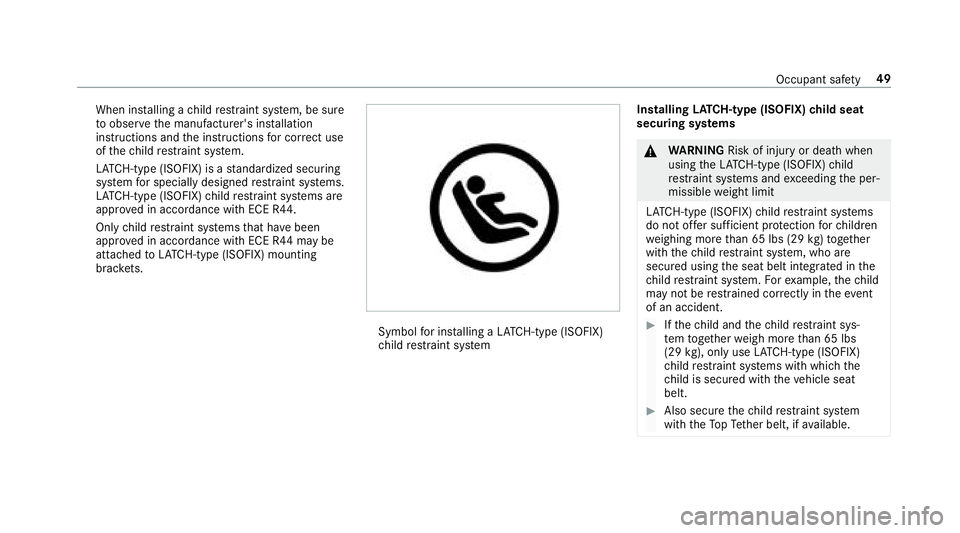
When installing a child restra int sy stem, be sure
to obser vethe manufacturer's ins tallation
instructions and the instructions for cor rect use
of thech ild restra int sy stem.
LA TC H-type (ISOFIX) is a standardized securing
sy stem for specially designed restra int sy stems.
LA TC H-type (ISOFIX) child restra int sy stems are
appr oved in accordance with ECE R44.
Only child restra int sy stems that ha vebeen
appr oved in accordance with ECE R44 may be
attached toLATC H-type (ISOFIX) mounting
brac kets.
Symbol for ins talling a LATC H-type (ISOFIX)
ch ild restra int sy stem Installing
LATC H-type (ISOFIX) child seat
securing sy stems
&
WARNING Risk of injury or death when
using theLA TC H-type (ISOFIX) child
re stra int sy stems and exceeding the per‐
missible weight limit
LA TC H-type (ISOFIX) child restra int sy stems
do not of fer suf ficient pr otection forch ildren
we ighing more than 65 lbs (29 kg)to ge ther
with thech ild restra int sy stem, who are
secured using the seat belt integrated in the
ch ild restra int sy stem. Forex ample, thech ild
may not be restra ined cor rectly in theeve nt
of an accident.
#If th ech ild and thech ild restra int sys‐
te m toget her weigh more than 65 lbs
(29 kg),only use LATC H-type (ISOFIX)
ch ild restra int sy stems with which the
ch ild is secured with theve hicle seat
belt.
#Also secure thech ild restra int sy stem
with theTo pTe ther belt, if available.
Occupant saf ety 49
Page 52 of 486
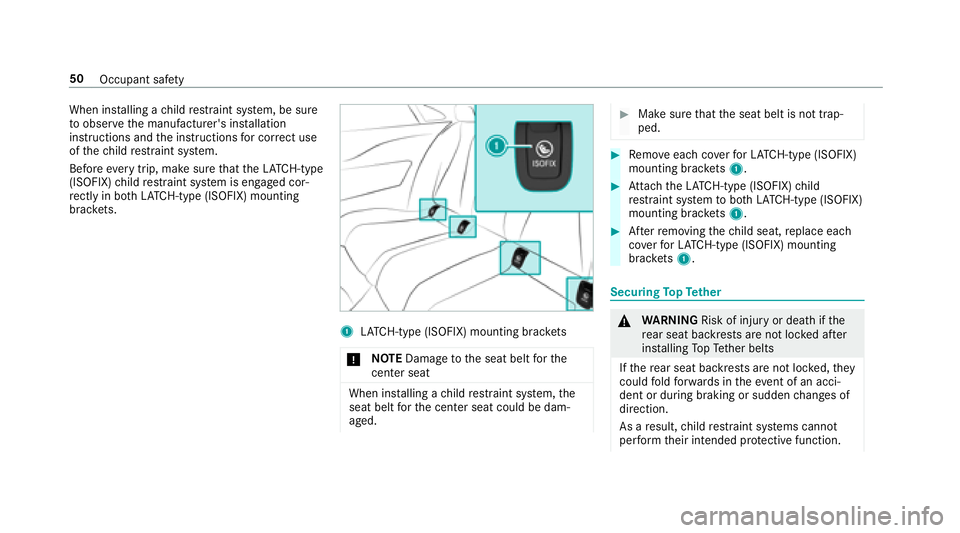
When installing a child restra int sy stem, be sure
to obser vethe manufacturer's ins tallation
instructions and the instructions for cor rect use
of thech ild restra int sy stem.
Before every trip, make sure that theLA TC H-type
(ISOFIX) child restra int sy stem is engaged cor‐
re ctly in bo thLATC H-type (ISOFIX) mounting
brac kets.
1LA TC H-type (ISOFIX) mounting brac kets
* NO
TEDama getothe seat belt forth e
center seat
When ins talling a child restra int sy stem, the
seat belt forth e center seat could be dam‐
aged.
#Make sure that the seat belt is not trap‐
ped.
#Re mo veeach co verfo rLA TC H-type (ISOFIX)
mounting brac kets 1.
#Attach theLA TC H-type (ISOFIX) child
re stra int sy stem toboth LATC H-type (ISOFIX)
mounting brac kets 1.
#Afterre moving thech ild seat, replace each
co verfo rLA TC H-type (ISOFIX) mounting
brac kets 1.
Secu ring TopTe ther
&
WARNING Risk of injury or death ifthe
re ar seat backrests are not loc ked af ter
ins talling TopTe ther belts
If th ere ar seat backrests are not loc ked, they
could fold forw ards in theeve nt of an acci‐
dent or du ring braking or sudden changes of
direction.
As a result, child restra int sy stems cannot
per form their intended pr otective function.
50
Occupant saf ety
Page 55 of 486
Child safety loc ks
Activating/deactivating the child saf ety lock
fo r the rear side windo ws
&
WARNING Risk of accident and injury
due tochildren left unatte nded inthe
ve hicle
If yo u lea vechildren unaccompanied in the
ve hicle, they may be able toset theve hicle in
motion, forex ample by:
RRe leasing the parking brake.
RShifting the transmission out of park
position j.
RStarting the engine.
In addition, they may operate vehicle equip‐
ment.
#Ne ver lea vechildren and animals unat‐
te nded in theve hicle.
#When leaving theve hicle, alw aysta ke
th e SmartK eywith you and lock the
ve hicle.
&
WARNING Risk offata l injury due to
ex posure toextreme heat or cold in the
ve hicle
If people – particularly children – are
ex posed toextreme heat or cold over an
ex tended pe riod of time, there is a risk of
injury or evenfa ta l injur y.
#Never lea veanyone – pa rticularly chil‐
dren – unatte nded intheve hicle.
&
WARNING Thereis arisk of accident
and injury if you lea vechildren unatte n‐
ded in theve hicle
If ch ildren are tra veling in theve hicle, they
could:
ROpen doo rs,th ereby endangering other
persons or road users.
RGet out of theve hicle and be hit by
oncoming traf fic.
ROpe rate ve hicle equipment and become
trapped, forex ample.
#Alw ays activate thech ild saf etyloc ks
av ailable if children are tra veling in the
ve hicle.
#Ne ver lea vechildren unatte nded inthe
ve hicle.
#When leaving theve hicle, alw aysta ke
th e SmartK eywith you and lock the
ve hicle.
Child saf etyloc ksare available forth e side win‐
do ws inthere ar.
Occupant saf ety 53