2018 MERCEDES-BENZ E-CLASS CABRIOLET warning
[x] Cancel search: warningPage 37 of 498
0071WARNING Risk of injury or death dueto
an extended seat belt extender while the
ve hicle is in motion
If th e seat belt extender is extended while
th eve hicle is in motion, the seat belt will not
fi t cor rectly tothe body.
The seat belt may not then pr ovide the
proper pr otection.
00BBAlw ays ensure that the seat belt
ex tender is retracted while theve hicle
is in motion.
If th e seat belt extender does not retract au to‐
matically, it can be retracted manually. Todo so,
press the seat belt extender ba ckasfar as it will
go before starting theve hicle. Pressing the seat
belt extender ba ckinto place requ ires forc e.
0071
WARNING Risk of injury or death when
additional restra int sy stems are not used
fo r persons with a smaller build
Pe rsons under 5 ft(1.50 m) tall cannot wear
th e seat belt cor rectly wi thout a suitable
additional restra int sy stem.
If th e seat belt is not worncor rectly, it can‐
not per form its intended pr otective function.
In addition, an incor rectly fastened seat belt
can also cause injuries, forex ample, in the
ev ent of an accident or when braking or
ch anging direction suddenly .
00BBAlways secure persons under 5 ft
(1.50 m) tall in a suitable restra int sys‐
te m.
0071
WARNING Danger of injury or death
from bloc ked seat belt buckles
If seat belt buckles are bloc ked and cann ot
be mo ved down wards, the function of the
Emergency Tensioning Devices is impaire d.
The Emer gency Tensioning Devices can no
longer function as intended and the seat
belts can no longer pr ovide the intended pro‐
te ction.
00BBAlw ays ensure that the seat belt buck‐
les are not bloc ked.
0071
WARNING Risk of injury or death dueto
damaged or modified seat belts
Seat belts cann otprov ide pr otection in the
fo llowing situations:
RIf th e seat belts are damaged, modified,
ex treme lydirty, bleached or dyed
RIfth e seat belt buckle is damaged or
ex treme lydirty
RIfth e Emer gency Tensioning Devices,
seat belt anchorages or seat belt retrac‐
to rs have been modified
Seat belts may be damaged in an accident,
although the damage may not be visible, e.g.
due tosplinters of glass.
Modified or damaged seat belts may tear or
fa il, e.g. in an accident.
Modified Emer gency Tensioning Devices can
accidental lytrig ger or failto function as
intended.
00BBNe ver modify the seat belts, Emer gency
Te nsioning Devices, seat belt ancho‐
ra ge s or seat belt retractors.
Occupant safe ty35
Page 38 of 498
00BBMake surethat the seat belts are
undamaged, not wornand clean.
00BBAlw ays ha vethe seat belts checked
immediately af ter an accident at a
qu alified specialist workshop.
Only use seat belts that ha vebeen appr ovedfo r
yo ur vehicle byMercedes-Benz.
0071
WARNING Risk of injury or death from
deplo yedpy rotech nic Emergency Ten‐
sioning Devices
Pyro tech nic Emergency Tensioning Devices
th at ha vebeen deplo yed are no longer opera‐
tional and are unable toper form their inten‐
ded pr otective function.
00BBTherefore, ha vedeplo yedpy rotech nic
Emergency Tensioning Devices immedi‐
ately replaced at a qualified specialist
wo rkshop.
Mercedes-Benz recommends that you ha vethe
ve hicle towe dto aqu alified specialist workshop
af te r an accident. 0075
NO
TEDama gecaused bytrapping the
seat belt
If an unused seat belt is not fully retracted, it
may become trapped in the door or in the
seat mechanism.
00BBAlw ays ensure that an unused seat belt
is fully retracted.
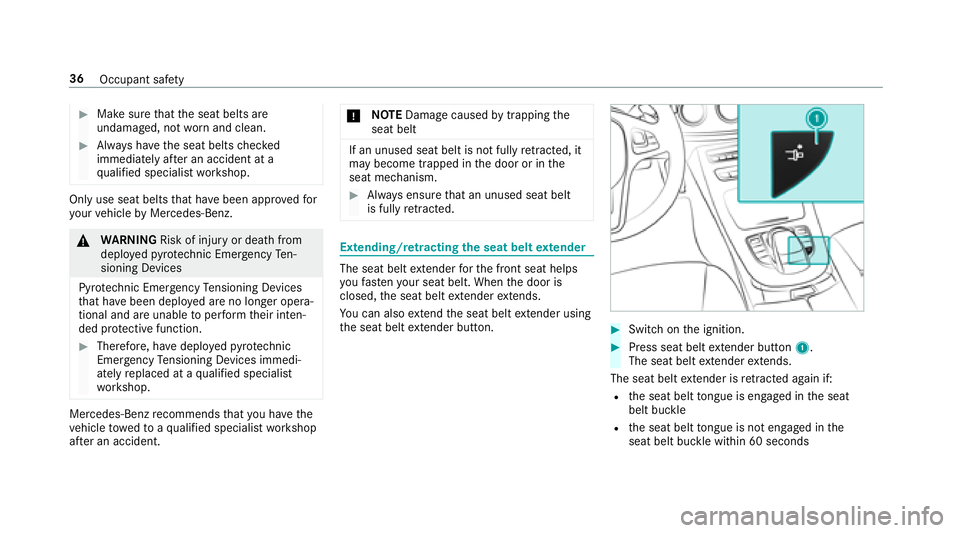
Ex tending/r etra cting the seat belt extender
The seat belt extender forth e front seat helps
yo ufa sten your seat belt. When the door is
closed, the seat belt extender extends.
Yo u can also extend the seat belt extender using
th e seat belt extender button.
00BBSwitch on the ignition.
00BBPress seat belt extender button 1.
The seat belt extender extends.
The seat belt extender is retracted again if:
Rth e seat belt tongue is engaged in the seat
belt buckle
Rth e seat belt tongue is not engaged in the
seat belt buckle within 60 seconds
36 Occupant saf ety
Page 40 of 498

0075NO
TEDeployment of the Emer gency
Te nsioning Device when the front
passenger seat is unoccupied
If th e seat belt tongue is engaged in the seat
belt buckle of the unoccupied front
passenger seat, the Emer gency Tensioning
Device may also depl oyintheev ent of an
accident along with other sy stems.
00BBOnly one person should use each seat
belt at any one time.
Re leasing seat belts
00BBPress there lease button in the seat belt
buckle and guide the seat belt back with the
seat belt tongue.
Ac tivating or deactivating seat belt adjust‐
ment via the multimedia sy stem
Multimedia sy stem:
00869HKLFOH00CFî 9HKLFOH 6HWWLQJV00CF%HOW
$GMXVWPHQW
00BBAc tivate 0073or deacti vate 0053 the function.
Seat belt warning function for the driver and
front passen ger
The 00E9 seat belt warning lamp in the Instru‐
ment Display is a reminder that all vehicle occu‐
pants must weartheir seat belts cor rectly.
The 00E9 seat belt warning lamp lights up for six
seconds af tereve ryengine start.
In addition, an acoustic warning tone may sound.
When the driver's and front passenger doors are
closed and the driver and front passenger ha ve
fast ened their seat belts, the seat belt warning
goes out. During a journe
y,the seat belt warning lights up
if:
RThe vehicle speed exceeds 15mp h
(25 km/h) and the driver's or front
passenger seat belt is not fastened.
RThe driver or front passenger unfas tens their
seat belt while theve hicle is in motion.
Airbags
Overview of air bags
1Driver's knee bag
2Driver's air bag
38
Occupant saf ety
Page 41 of 498

3Front passenger front air bag
4Front passenger knee air bag
5Head air bag
6Side impact air bag
The ins tallation location of an air bag is identi‐
fi ed bythe AIRB AGsymbol.
When activated, an air bag can pr ovide addi‐
tional pr otection for the respective vehicle
occupant.
AIRB AG Potential pr otection for
…
Knee air bag Thigh, knee and lo wer leg
Driver's airbag,
front passenger
front air bag Head and
ribcage
Head air bag Head
Side impact air
bag Ribcage, also pelvis
for
front seat occupants
The front passenger front air bag can only be
deploy ed in an accident if thePA SSENGER AIR BA
G OFF indicator lamp is off. If the front
passenger seat is occupied, make sure, bo th
before and during the journe y,that thest atus of
th e front passenger front air bag is cor rect
(
→page 43).
0075 NO
TEImpo rtant points toremember if
th e front passenger seat is unoccupied
In an accident, the components of the
re stra int sy stem may deploy unnecessarily
on the front passenger side if:
RThere are heavy objects on the front
passenger seat.
RThe seat belt tongue is engaged in the
seat belt buckle of the front passenger
seat and the front passenger seat is
unoccupied.
00BBSt ow objects in a suitable place.
00BBOnly one person should use each seat
belt at any one time.
Protection bythe air bags
Depending on the accident situation, an air bag
may supplement the pr otection of fere dby a cor‐
re ctly fastened seat belt.
0071
WARNING Risk of injury or death dueto
incor rect seat position
If yo ude viate from the cor rect seat position,
th e air bag cannot perform its intended pro‐
te ctive function and deployment may even
cause fur ther injuries.
To avo id hazardous situations, alw ays make
sure that all vehicle occupants:
RHa ve their seat belt fastened cor rectly,
including pregnant women.
RAre seated properly and that dis tance to
th e air bags is as large as possible.
RObser vethefo llowing information.
00BBAlw ays make sure that there are no
objects between the air bag and the
ve hicle occupant.
Occupant saf ety 39
Page 42 of 498

Toavo idtherisks resulting from the deployment
of an air bag, each vehicle occupant must
obser vethefo llowing information:
RBefore starting your journe y,adjust your seat
co rrectly ;th e driver's seat and front
passenger seat should be mo ved as far back
as possible.
When doing so, alw ays obser vethe informa‐
tion on the cor rect driver's seat position
(
→page 85).
ROnly hold thesteering wheel bythesteering
wheel rim. This all owsth e air bag tobe fully
deplo yed.
RAlw ays lean against the seat backrest when
th eve hicle is in motion. Do not lean forw ards
or against the door or side windo w.You may
ot herwise be in the deployment area of the
air bags.
RAlw ayske ep your feet on thefloor. Do not
put your feet on the cockpit, forex ample.
Yo ur feet may otherwise be in the deploy‐
ment area of the air bag.
RIfch ildren are tra veling in theve hicle,
obser vethe additional no tes (→page 47).
RAlw aysstow and secure objects cor rectl y.
Objects in theve hicle interior may pr event an air
bag from functioning cor rectl y.Each vehicle
occupant must alw ays make sure of thefo llow‐
ing:
RThere are no people, animals or objects
between theve hicle occupants and an air
bag.
RThere are no objects between the seat , door
and door pillar (B-pillar).
RThere are no hard objects, e.g. coat hangers,
hanging on the grab handles or coat hooks.
RThere are no accessory parts, such as cup
holders, attached totheve hicle within the
deployment area of an air bag, e.g. on doors,
side windo wsor side trim.
RThere are no heavy, sharp-edged or fragile
objects in the poc kets of your clo thing. Store
such objects in a suitable place.
Re duced air bag pr otection
0071
WARNING Risk of injury from modifica‐
tions tothe airbag co ver
If yo u modify an airbag co ver or af fix objects
such assticke rs to it,the airbag can no lon‐
ge r function cor rectl y.
00BBNe ver modify an airbag co ver and do
not af fix objects toit.
The ins tallation location of an air bag is identi‐
fi ed bythe AIRB AGsymbol (→page 38).
0071
WARNING Risk of injury or death dueto
th e use of unsuitable seat co vers
Uns uitable seat co vers can obstruct or pre‐
ve nt the deployment of air bags integrated
into the seats.
Consequentl y,the air bags cannot protect
ve hicle occupants as they are designed to
do. In addition, operation of the automatic
front passenger air bag shutoff may be
re stricted.
40
Occupant saf ety
Page 43 of 498

00BBYou should only use seat covers that
ha ve been appr oved forth e cor respond‐
ing seats byMercedes-Benz.
0071
WARNING Risk of injury duetomalfunc‐
tions of the sensors in the door paneling
Sensors tocontrol the airbags are located in
th e doors. Modifications or worknot per‐
fo rm ed cor rectly tothe doors or door panel‐
ing, as well as damaged doors, can lead to
th e function of the sensors being impaired.
The airbags might therefore not function
proper lyany more.
Consequent ly,th e airbags cannot protect
ve hicle occupants as they are designed to
do.
00BBNe ver modify the doors or parts of the
doors.
00BBAlw ays ha vewo rkon the doors or door
paneling car ried out at a qualified spe‐
cialist workshop.
0071
WARNING Risk of injury duetodeplo yed
airbag
A deplo yed airbag no longer has a pr otective
function and cann otprotect as intended in
th eev ent of an accident.
00BBHa ve theve hicle towe dto aqu alified
specialist workshop in order tohave the
deplo yed airbag replaced.
Ha ve deplo yed air bags replaced immediately.
St atus of the front passenger airbag
Fu nction of the front passenger front air bag
shuto ff
The automatic front passenger front air bag
shutoff is able todetect whe ther the front
passenger seat is occupied bya person or a
ch ild restra int sy stem. The front passenger air
bag and front passenger knee air bag are then
cor respondingly either enabled or deactivated. When ins
talling a child restra int sy stem tothe
front passenger seat, alw ays make sure of the
fo llowing:
REnsure that thech ild restra int sy stem is posi‐
tioned cor rectly (→page 47).
RAlw ays obser vethech ild restra int sy stem
manufacturer's ins tallation instructions.
RNe ver place objects, e.g. cushions, under or
behind thech ild restra int sy stem.
RFu lly retract the seat cushion length adjust‐
ment.
RThe entire base of thech ild restra int sy stem
must alw aysre st on the sitting sur face of the
front passenger seat.
RThe backrest of thefo rw ard-facing child
re stra int sy stem must, as far as possible, be
re sting on the seat backrest of the front
passenger seat.
RThe child restra int sy stem must not touch the
ro of or be put under stra in by the head
re stra ints. Adjust the seat backrest inclina‐
tion and the head restra int setting accord‐
ing ly.
Occupant saf ety 41
Page 44 of 498

0071WARNING Risk of injury or death dueto
objects between the sitting sur face and
th ech ild restra int sy stem
Objects between the sitting sur face and the
ch ild restra int sy stem could af fect the func‐
tion of the automatic front passenger airbag
shutoff.
This could result in the front passenger air‐
bag not functioning as intended during an
accident.
00BBDo not place any objects between the
sitting sur face and thech ild restra int
sy stem.
00BBThe entire base of thech ild restra int
sy stem must alw aysre st on the sitting
sur face of the front passenger seat.
00BBThe backrest of thefo rw ard-facing child
re stra int sy stem must lie as flat as pos‐
sible against the backrest of the front
passenger seat.
00BBAlw ays comply with thech ild restra int
sy stem manufacturer's ins tallation
instructions.
A person on the front passenger seat must
obser vethefo llowing information:
RFa sten seat belts cor rectl y.
RSit in an almost up right seat position with
th eir back against the seat backrest.
RSit with their feet resting on thefloor, if pos‐
sible.
Otherwise, the front passenger air bag may be
deactivated bymis take ,fo rex ample in thefo l‐
lowing situations:
RThe front passenge r transferstheir weight by
supporting themselves on a vehicle armrest.
RThe front passenger sits in such a wayth at
th eir weight is raised from the sitting sur‐
fa ce.
0071
WARNING Risk of injury or death dueto
deactivated front passenger airbag
If th ePA SSENGER AIR BAG OFF indicator
lamp is lit, the front passenger airbag is disa‐
bled. It will not be deplo yed in theeve nt of
an accident and cannot pe rform its intended
pr otective function.
A person in the front passenger seat could
th en, forex ample, come into con tact wi th
th eve hicle interior, especially if the person is
sitting too close tothe cockpit.
If th e front passenger seat is occupied,
alw ays ensure that:
RThe classification of the person in the
front passenger seat is cor rect and the
front passenger airbag is enabled or disa‐
bled in accordance with the person in the
front passenger seat.
RThe front passenger seat has been mo ved
as far back as possible.
RThe person is seated cor rectl y.
00BBEnsure , bothbefore and during the jour‐
ne y,that thest atus of the front
passenger airbag is cor rect.
42
Occupant saf ety
Page 45 of 498

Function of thePA SSENGER AIR BAG indica‐
to r lamps
Sy stem self-te st
When the ignition is switched on, a sy stem self-
te st is per form ed during which the two
PA SSENGER AIR BAG ON and OFF indicator
lamps light up simultaneousl y.The
status of the front passenger air bag is dis‐
pla yed af terth e sy stem self-tes t:
RPASSENGER AIR BAG ON lights up for
60 seconds, subsequently bo thPASSENGER
AIR BAG ON and OFF indicator lamps are off:
th e front passenger air bag is able todeploy
in theeve nt of an accident.
RPASSENGER AIR BAG OFF lights up continu‐
ously: the front passenger air bag is deactiva‐
te d. It will then not be deplo yed in theeve nt
of an accident.
If th ePA SSENGER AIR BAG ON indicator lamp is
off, only thePA SSENGER AIR BAG OFF indicator
lamp sho wsthest atus of the front passenger air
bag. The PASSENGER AIR BAG OFF indicator
lamp may be lit continuously or be off.
If th ePA SSENGER AIR BAG OFF indicator lamp
and the0075 restra int sy stem warning lamp
light up simultaneousl y,the front passenger seat
may not be used. Also in this case, do not ins tall
a ch ild restra int sy stem on the front passenger
seat. Ha vethe automatic front passenger air bag
shutoff checked and repaired immediately at a
qu alified specialist workshop. St
atus display
If th e front passenger seat is occupied, ensure,
bo th before and durin
g
the journe y,that thest a‐
tus of the front passenger air bag is cor rect for
th e pr evailing situation.
Af ter in stalling a rear wa rd-facing child
re stra int sy stem tothe front passenger
seat: PASSENGER AIR BAG OFF must be lit con‐
tinuousl y.
0071
WARNING Risk of injury or death from
using a rear wa rd-facing child restra int
sy stem when the front passenger air bag
is enabled
If yo u secure a child in a rear wa rd-facing
ch ild restra int sy stem on the front passenger
seat and thePA SSENGER AIR BAG OFF indi‐
cator lamp is off, the front passenger air bag
can deploy in theev ent of an accident.
The child could be stru ck bythe air bag.
Alw ays ensure that the front passenger air
bag is disabled. The PASSENGER AIR BAG
OFF indicator lamp must be lit.
Occupant saf ety 43