2018 MERCEDES-BENZ CLA engine
[x] Cancel search: enginePage 61 of 326
Rearward-facin gc hild restraint systemIf it is absolutely necessary to install ar earward-
facing child restraint system on the front-
passenger seat, always make sure that the
front-passenger front ai rb ag is deactivated.
Only if the PASSENGER AIR BAG OFF indicator
lamp is permanently li t( Y
page 41 )i st he front-
passenger front ai rb ag deactivated.
Alway so bserve the child restraint system man-
ufacturer's installation and operating instruc-
tions.
Forward-facing child restraint system If it is absolutely necessary to install af orward-
facing child restraint system on the front-
passenger seat, always move the front-
passenger sea ta sf ar back as possible .F ully
retract the sea tc ushio nl en gth. The entir eb as e
of the child restraint system mus ta lway sr es to n
the sea tc ushio noft he front-passenger seat.
The backrest of the child restraint system must
li easf la ta sp ossible against the backrest of the
front-passenger seat. The child restraint system
mus tn ot touch the roo forbes ub jecte dtoal oa d
by the hea dr estraint. Adjust the angle of the
sea tb ac krest and the hea dr estraint position
accordingly .A lway sm ake sure that the shoul-
der bel ts tra pisc orrectly routed from the vehi-
cle bel to ut let to the shoulder bel tg uide on the
child restraint system. The shoulder bel ts trap
mus tb er outed forward and dow nf rom the vehi-
cle bel to ut let. If necessary, adjust the vehicle
bel to ut let and the front-passenger sea ta ccord-
ingly.
Alway so bserve the child restraint system man-
ufacturer's installation and operating instruc-
tions. Child-proof locks
Important safety notes
G WARNING
If children are traveling in the vehicle, they
could: R
ope nd oors, thu se ndangering othe rp eople
or roa du se rs R
exi tt he vehicl ea nd be caught by oncoming
traffic R
operate vehicl ee quipment and become
trapped
There is ar is kofana ccident and injury.
Alway sa ctivate the child-proof locks and
overrid ef eature if children are traveling in the
vehicle. Whe nl ea ving the vehicle, always take
the key with yo ua nd lock the vehicle. Never
leave children unattende dint he vehicle.
Overrid ef eature for: R
the rea rd oors ( Y
page 60) R
the rea rs id ew in dow s( Y
page 60)
G WARNING
If yo ul ea ve children unsupervised in the vehi-
cle ,t hey could set it in motion by ,f or example:R
release the parking brake. R
shift the automatic transmissio no ut of the
parking position P . R
star tt he engine.
In addition, they may operate vehicl ee quip-
ment and become trapped .T here is ar is ko f
an accident and injury.
Whe nl ea ving the vehicle, always take the
SmartKey with yo ua nd lock the vehicle. Never
leave children unsupervised in the vehicle.
G WARNING
If persons ,p ar ticularly children are subjected
to prolonged exposure to extreme hea to r
cold, there is ar is kofi njury, possibly even
fatal. Neve rl ea ve children unattende dint he
vehicle.Childre nint he vehicle 59
Safety Z
Page 63 of 326

Drivin gs af et ys ystems
Overview of drivin gs af et ys ystemsIn this section ,y ou will fin di nformati on about
th ef ol lowin gd rivin gs afet ys ystems :R
AB S( A nti-lock B rakin g S ystem)
( Y
page 61) R
BA S( B rak e A ssist S ystem) ( Y
page 61)R
Active Brak eA ss is t( Y
page 62 )R
ES P ®
( E lectronic S ta bility P ro gram)
( Y
page 64) R
EB D( E lectroni c B rak ef orce D istribution )
( Y
page 67 )R
ADAPTIV EB RAKE ( Y
page 68 )R
STEE RC ONTROL ( Y
page 68)
Important safet yn otesIf you fail to adapt your drivin gs ty le or if you are
inattentive ,t he drivin gs afet ys ystems can nei-
ther reduce th er is kofana cciden tn or override
th el aws of physics. Driving safet ys ystems are
merely aids designed to assist driving. You are
responsible fo rm aintainin gt he distanc etot he
vehicle in front, fo rv ehicle speed, fo rb raking in
goo dt im e, and fo rs ta yin ginl ane. Always adapt
your drivin gs ty le to suit th ep revailin gr oa da nd
weather condition sa nd maintain as af ed istanc e
from th ev ehicle in front. Drive carefully.
The drivin gs afet ys ystems described only wor k
as effectively as possible when there is ade-
quat ec ontac tb etween th et ir es and th er oa d
surface. Please pay special attention to th e
note sont ir es ,r ecommended minimum tire
tread depths, etc. ( Y
page 288).
In wintr yd rivin gc onditi ons, always use winte r
tires (M+ St ir es )a nd if necessary ,s now chains.
Onl yint hi sw ay will the driving safety systems
describe dint hi ss ection work as effectively as
possible.
ABS (Anti-lock Brakin gS ystem)
General information
ABS regulate sb rake pressure in such aw ay that
the wheels do not lock when yo ub rake. This
allows yo utoc ontinue steering the vehicl ew he n
braking. The % ABS warning lamp in the instrument
cluster lights up when the ignition is switched
on. It goe so ut when the engine is running.
ABS works from as peed of abou t5m ph
(8 km/h), regardless of road-surface conditions.
ABS works on slippery surfaces, eve nw he ny ou
onl yb rake gently.
Important safety notes
i Observe the "Important safety notes "s ec-
tio n( Y
page 61).
G WARNING
If ABS is faulty ,t he wheels could lock when
braking .T he steerability and braking charac-
teristic sm ay be severely impaired .A ddition-
ally ,f urther driving safety system sa re deac-
tivated .T here is an increased danger of skid-
ding and accidents.
Driv eonc arefully. Hav eA BS checked imme-
diately at aq uali fied specialist workshop.
Whe nA BS is malfunctioning ,o the rs ys tems,
including driving safety systems, will also
become inoperative. Observe the information
on the ABS warning lamp ( Y
page 220 )a nd dis-
play messages which ma ybes hown in the
instrument cluster ( Y
page 192).
Braking X
If ABS intervenes: continue to depress the
brake peda lv igorously unti lt he braking sit-
uatio ni so ver. X
To make af ul lb rake application: depress
the brake peda lw it hf ul lf orce.
If ABS intervene sw he nb raking ,y ou will fee la
pulsing in the brake pedal.
The pulsating brake peda lc an be an indication
of hazardou sr oa dc onditions, and functions as a
reminder to take extra car ew hile driving.
BAS (Brak eA ssis tS ystem)
General information
BAS operates in emergency braking situations.
If yo ud ep ress the brake peda lq ui ckly, BAS
automaticall yb oo sts the braking force ,t hus
shortening the stopping distance.Driving safety systems 61
Safety Z
Page 66 of 326

sensor technology to assess the traffic situa-
tion.
Situation-dependent braking assistance is capa-
ble of reacting to moving objects that have
alread yb een detected as such at least once
over the period of observation, up to vehicle
speeds of around 155 mph (250 km/h).
Situation-dependent braking assistance can
also detect stationary objects, up to vehicle
speeds of around 44 mph (70 km/h). X
Keep the brake pedal depressed until the
emergency braking situation is over.
ABS prevents the wheels from locking.
The brakes will work normally agai ni f:R
you release the brake pedal. R
there is no longer any danger of ac ollision.R
no obstacle is detected in front of your vehi-
cle.
Situation-dependent braking assistance is then
deactivated.
Important safety notes
i Observe the "Important safety notes" sec-
tion for driving safety systems ( Y
page 61).
G WARNING
Adaptive Brake Assist does not react: R
to people or animals R
to oncoming vehicles R
to crossing traffic R
when cornering
As ar esult, Adaptive Brake Assist may not
intervene in all critical conditions. There is a
risk of an accident.
Always pay careful attention to the traffic sit-
uation and be ready to brake.
G WARNING
Adaptive Brake Assist cannot always clearly
identify objects and complex traffic situa-
tions.
In such cases, Adaptive Brake Assist might: R
intervene unnecessarily R
not intervene
There is ar isk of an accident. Always pay careful attention to the traffic sit-
uation and be ready to brake. Terminate the
intervention in an on-critical driving situation.
Due to the nature of the system, complex but
non-critical driving conditions may also cause
Active Brake Assist to intervene.
Even if Active Brake Assist is not available due to
am alfunction in the radar sensor system, the
brake system is still available with full brake
boosting effect and BAS.
ESP ®
(Electronic Stability Program)
General notes
i Observe the "Important safety notes" sec-
tion ( Y
page 61).
ESP ®
monitors driving stability and traction ,i .e.
power transmission between the tires and the
road surface.
If ESP ®
detects that the vehicle is deviating from
the direction desired by the driver, one or more
wheels are braked to stabilize the vehicle. The
engine output is also modified to keep the vehi-
cle on the desired course within physical limits.
ESP ®
assists the driver when pulling awa yo n
wet or slippery roads. ESP ®
can also stabilize
the vehicle during braking.
ETS/4ETS (Electronic Traction System)
i Observe the "Important safety notes" sec-
tion ( Y
page 61).
ETS traction control is part of ESP ®
.Onv ehicles
with 4MATIC, 4ETS is part of ESP ®
.
Traction control brakes the drive wheels indi-
vidually if they spin. This enables you to pull
awa ya nd accelerate on slippery surfaces, for
example if the road surface is slippery on one
side. In addition, more drive torque is transfer-
red to the wheel or wheels with traction.
Traction control remains active, even if you
deactivate ESP ®
.
Important safety notes
i Observe the "Important safety notes" sec-
tion ( Y
page 61).64
Driving safety systems
Safety
Page 70 of 326
You should therefore adapt your drivin gs tyle
to the differen th andlin gc haracteristics. Have
the brak es yste mc hecked at aq ualified spe-
cialist workshop.
Please observ et he information on warnin ga nd
indicator lamps ( Y
page 220)
( Y
page 220) as well as on display messages
( Y
page 194).
ADAPTIVE BRAKE ADAPTIVE BRAKE enhances braking safet ya nd
offers increased braking comfort .Ina ddition to
the braking function ,A DA PTIVE BRAKE also has
the HOL Df unction ( Y
page 157) and hill start
assist ( Y
page 125).
STEER CONTROL
Genera li nformationSTEER CONTROL helps you by transmitting a
noticeable steerin gf orc etot he steerin gw heel
in the direction required for vehicle stabilization.
This steerin ga ssistanc eisp rovided in particular
if: R
both right wheels or both left wheels are on a
wet or slippery road surfac ew hen you brakeR
the vehicle begins to skid
Important safet yn otes
i Observe the "Importan ts afet yn otes" sec-
tion ( Y
page 61).
No steerin ga ssistanc eisp rovided from STEER
CONTROL, if: R
ESP ®
is malfunctioningR
the steerin gism alfunctioning
If ESP ®
is malfunctioning, you will be assisted
further by the electrical power steering.
Protection against theft
Immobilizer
The immobilizer prevent sy our vehicle from
being started without the correc tS martKey. X
To activat ew ith th eS martKey: remove the
SmartKey from the ignition lock. X
To activat ew ith KEYLESS-GO start-func-
tion or KEYLESS-GO: switc ht he ignition off
and open the driver's door. X
To deactivate: switc hont he ignition.
When leaving the vehicle, always tak et he
SmartKey with you and lock the vehicle. Anyone
can star tt he engin eifav alid SmartKey has been
left inside the vehicle.
i The immobilizer is always deactivate dw hen
you star tt he engine.
In the even tt hat the engin ec annot be started
(yet the vehicle's battery is charged), the sys-
tem is not operational. Contact an authorized
Mercedes-Ben zC enter or call
1-800-FOR-MERCedes (in the USA )o r
1-800-387-010 0( in Canada).
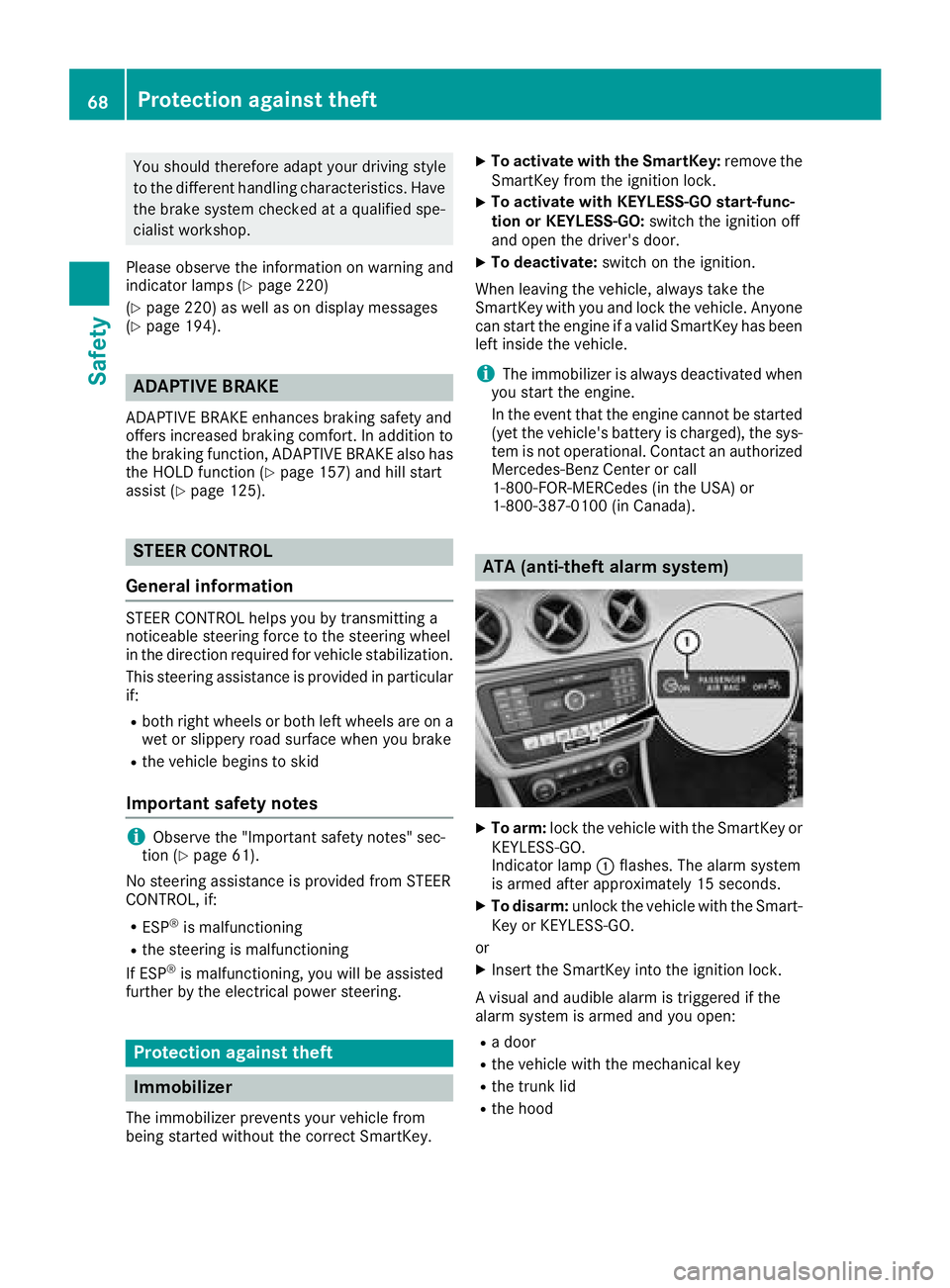
ATA (anti-theft alar ms ystem)
X
To arm: lock the vehicle with the SmartKe yo r
KEYLESS-GO.
Indicator lamp C flashes. The alarm system
is armed after approximately 15 seconds. X
To disarm: unlock the vehicle with the Smart-
Key or KEYLESS-GO.
or X
Insert the SmartKe yi nt ot he ignition lock.
Av isual and audible alarm is triggered if the
alarm system is armed and you open: R
ad oor R
the vehicle with the mechanical key R
the trun kl id R
the hood68
Protection against theft
Safety
Page 72 of 326
SmartKey
Important safety notes
G WARNING
If children are left unsupervised in the vehicle,
they could: R
open the doors, thus endangering other
people or road users. R
get out and disrupt traffic. R
operate the vehicle's equipment.
Additionally, children could set the vehicle in
motion if, for example, they: R
release the parking brake. R
shifting the automatic transmission out of
park position PR
Start the engine.
There is ar isk of an accident and injury.
When leaving the vehicle, always take the
SmartKey with you and lock the vehicle. Never
leave children or animals unattended in the
vehicle. Always keep the SmartKey out of
reach of children.
G WARNING
If you attach heavy or large object stot he
SmartKey, the SmartKey could be uninten-
tionally turned in the ignition lock. This could
cause the engine to be switched off. There is a
risk of an accident.
Do not attach any heavy or large object stot he
SmartKey. Remove any bulky key rings before
insertin gt he SmartKey into the ignition lock.
! Keep the SmartKey away from stron gm ag-
netic fields. Otherwise, the remote control
function could be affected.
Strong magnetic fields can occur in the vicin-
ity of powerful electrical installations.
Do not keep the SmartKey: R
with electronic devices, e.g. am obile phone
or another SmartKey. R
with metallic objects, e.g. coins or metal foil. R
inside metallic objects, e.g. am etal case
Vehicles with KEYLESS-GO star tf unction: do
not keep the SmartKey in the trunk .O therwise, the SmartKey may not be detected, e.g. when
startin gt he engine using the Start/Stop button.
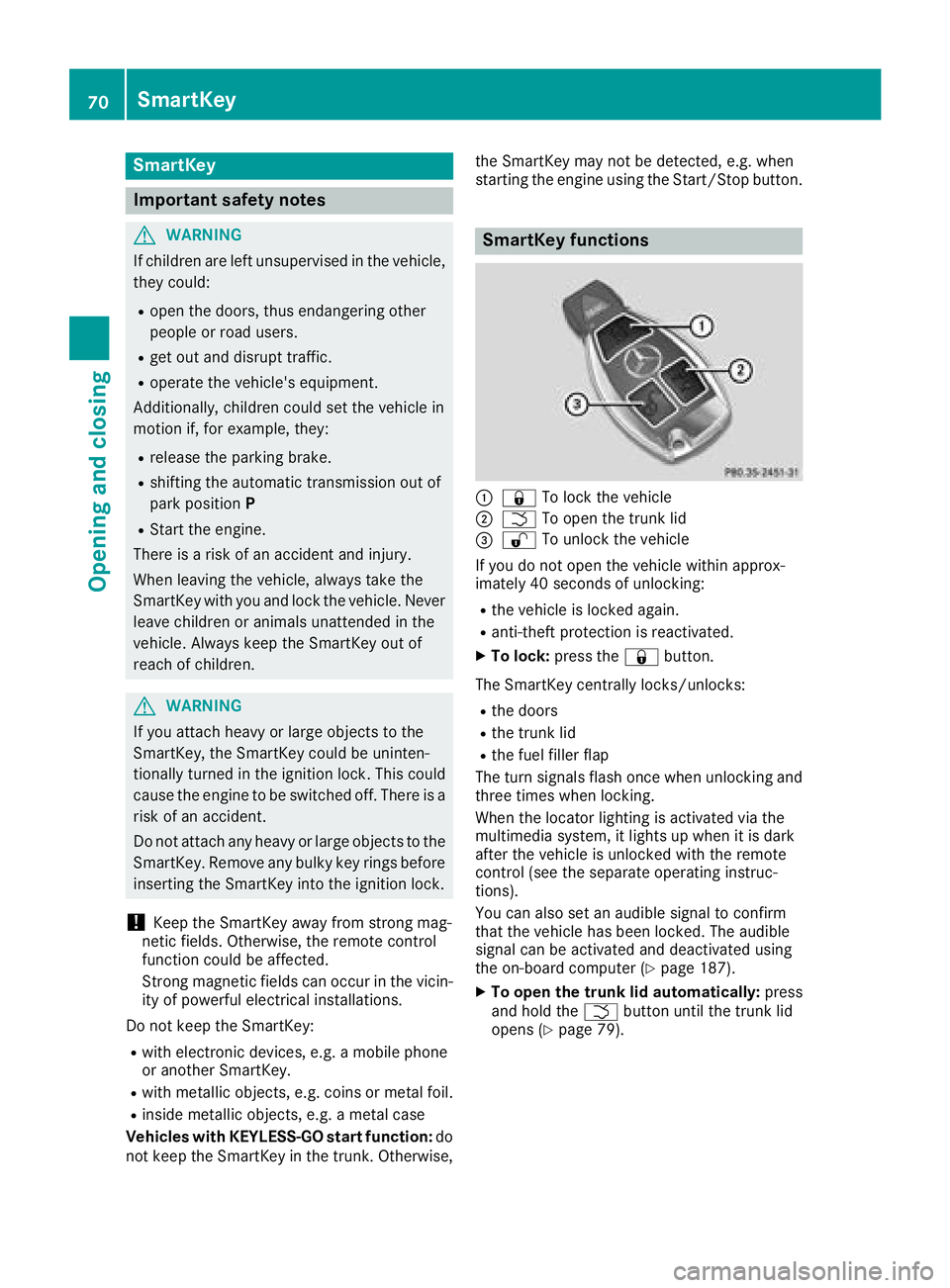
SmartKey functions
C
7 To lock the vehicleD
T To open the trunk lid
Page 77 of 326

Problem
Possible causes/consequences and P Solutions
KEYLESS-GO is malfunctioning. X
Lock/unlock the vehicle using the remote control function of the
SmartKey. X
Have the vehicle and SmartKey checked at aq ualified specialist
workshop.
If the vehicle can also not be locked/unlocked using the remote con-
trol function: X
Unlock ( Y
page 77) or lock ( Y
page 77) the vehicle using the
mechanical key. X
Have the vehicle and SmartKey checked at aq ualified specialist
workshop.
The engine cannot be
started using the Smart-
Key. The on-board voltage is too low. X
Switch off non-essential consumers, e.g. seat heating or interior
lighting, and try to start the engine again.
If this does not work: X
Check the starter battery and charge it if necessary ( Y
page 278).
or X
Jump-start the vehicle ( Y
page 278).
or X
Consult aq ualified specialist workshop.
The engine cannot be
started using the Start/
Stop button. The Smart-
Key is in the vehicle. The vehicle is locked. X
Unlock the vehicle and try to start the vehicle again.
The SmartKey battery is discharged or nearly discharged. X
Check the SmartKey battery ( Y
page 73) and replace it if necessary
( Y
page 73).
If this does not work: X
Start your vehicle with the SmartKey in the ignition lock.
There is interference from ap owerful source of radio waves.X
Start your vehicle with the SmartKey in the ignition lock.
You have lost aS mart-
Key. X
Have the SmartKey deactivated at aq ualified specialist workshop.X
Report the loss immediately to the vehicle insurers. X
If necessary, have the locks changed as well.
You have lost the
mechanical key. X
Report the loss immediately to the vehicle insurers. X
If necessary, have the locks changed as well. SmartKey 75
Opening and closing Z
Page 80 of 326
X
Press the lockin gb utton on the driver’s door
( Y
page 76).X
Check whether the lockin gk nobs on the
front-passenger door and the rear doors are
still visible. Press down the lockin gk nobs by
hand, if necessary. X
Close the driver's door. X
Take the mechanical key out of the SmartKey
( Y
page 72).X
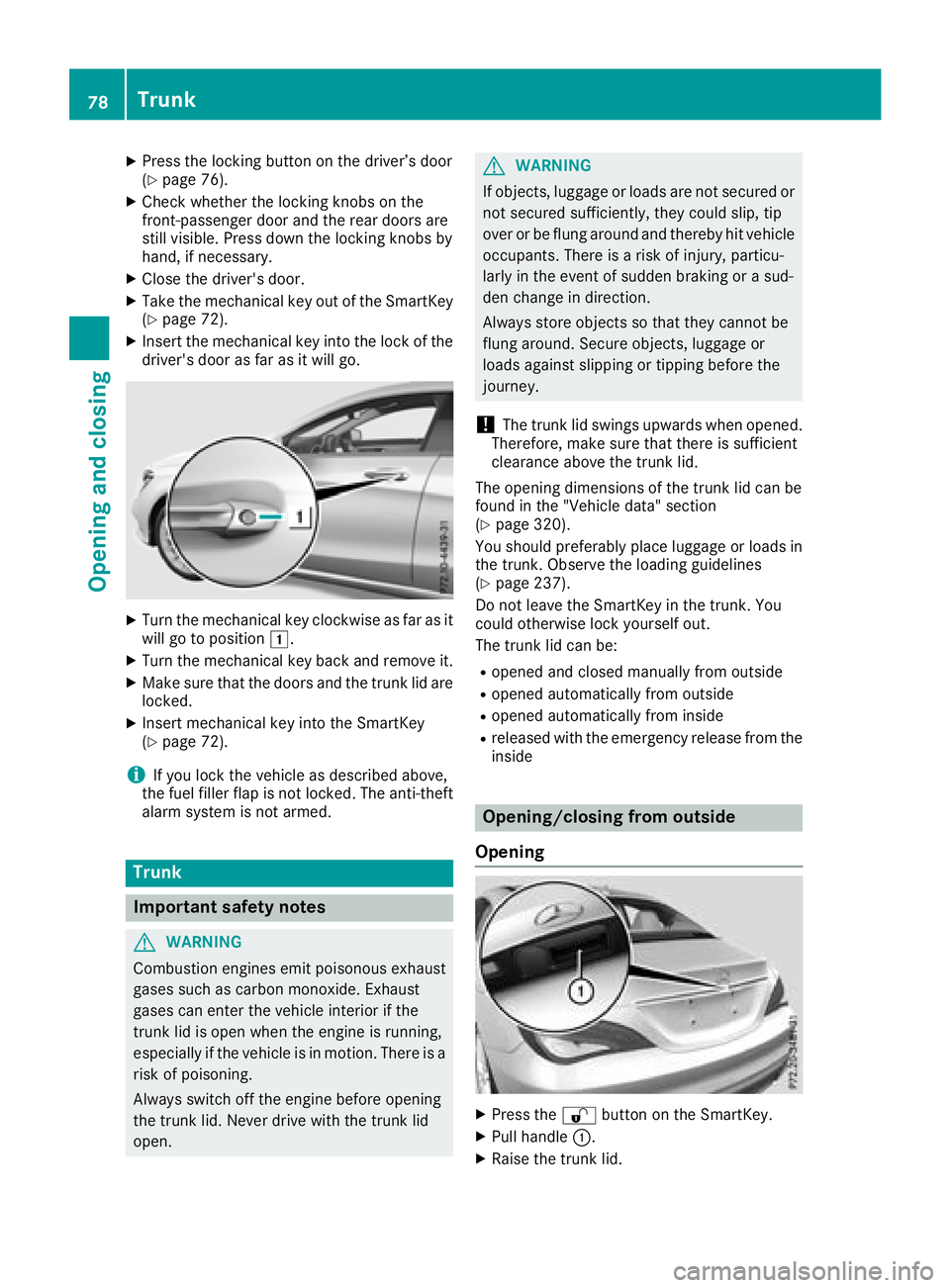
Insert the mechanical key into the lock of the
driver's door as far as it will go.
X
Turn the mechanical key clockwise as far as it
will go to position G .X
Turn the mechanical key back and remove it. X
Make sure that the doors and the trunk lid are
locked. X
Insert mechanical key into the SmartKey
( Y
page 72).
i If you lock the vehicle as described above,
the fuel filler flap is not locked. The anti-theft
alarm system is not armed.
Trunk
Important safety notes
G WARNING
Combustion engines emit poisonous exhaust
gases such as carbon monoxide. Exhaust
gases can enter the vehicle interior if the
trunk lid is open when the engine is running,
especially if the vehicle is in motion .T here is a
risk of poisoning.
Always switch off the engine before opening
the trunk lid. Never drive with the trunk lid
open. G WARNING
If objects, luggage or loads are not secured or
not secured sufficiently, they could slip, tip
over or be flung around and thereby hit vehicle
occupants. There is ar isk of injury, particu-
larly in the event of sudden braking or as ud-
den change in direction.
Always store object ssot hat they cannot be
flung around. Secure objects, luggage or
loads against slipping or tipping before the
journey.
! The trunk lid swings upwards when opened.
Therefore, make sure that there is sufficient
clearance above the trunk lid.
The opening dimensions of the trunk lid can be
found in the "Vehicle data" section
( Y
page 320).
You should preferably place luggage or loads in
the trunk .O bserve the loading guidelines
( Y
page 237).
Do not leave the SmartKey in the trunk .Y ou
could otherwise lock yourself out.
The trunk lid can be: R
opened and closed manually from outside R
opened automatically from outside R
opened automatically from inside R
released with the emergenc yr elease from the
inside
Opening/closing from outside
Opening
X
Press the 6 button on the SmartKey. X
Pull handle C . X
Raise the trunk lid.78
Trunk
Opening and closing
Page 81 of 326

Closing X
Pull down th et ru nk lid usin gh andle C .X
Let th et ru nk lid dro pi nt ot he lock.X
If necessary, loc kt he vehicle wit ht he 7
butto nont he SmartKey or wit hK EY LESS-GO.
Opening automatically from outside
Important safety notes
G WARNING
Combustion engines emit poisonous exhaust
gases suc hasc arbon monoxide. Exhaust
gases can ente rt he vehicle interio rift he
trunk lid is open when th ee ng in eisr unning,
especiall yift he vehicle is in motion .T her eisa
ris kofp oisoning.
Always switch off th ee ng in eb efore opening
th et ru nk lid. Never driv ew it ht he trunk lid
open.
! The trunk lid swings upward sw hen opened.
Therefore, mak es ure that there is sufficient
clearance abov et he trunk lid.
i The opening dimension soft he trunk lid can
be foun du nde r" Vehicle data" ( Y
page 320).
Opening automatically
You can open th et ru nk lid automaticall yu sing
th eS ma rtKey or th eh andle in th et ru nk lid.X
Press and hold the T butto nont he Smart-
Key until th et ru nk lid opens.
or X
If th et ru nk lid is unlocked, pull th et ru nk lid
handle and let it go again immediately. HANDS-FREE ACCESS
Important safety notes
G WARNING
The vehicle's exhaust system may be ver yh ot.
You coul db urn yourself by touching the
exhaust system if you use HANDS-FREE
ACCESS .T her eisar is kofi njury. Always
ensure that you only mak et he kickin gm ove-
men tw ithin th ed etection range of sensors.
! If th eS ma rtKey is within th er ear detection
range of KEYLESS-GO ,t he followin gs itua-
tions ,f or example ,c oul dl ead to th eu ninten-
tional opening of th et ru nk:R
usin gac ar wash R
usin gap ower washer
Mak es ure that th eS ma rtKey is at least 10 ft
(3 m) away from th ev ehicle.
i You can also deactivate KEYLESS-GO .F ur-
ther informatio nond eactivatin ga nd activat-
ing KEYLESS-GO ( Y
page 71).
General notes Wit hK EY LESS-GO and HANDS-FRE EA CCESS,
you can open th et ru nk lid without usin gy our
hands. This is useful if you have your hands full.
To do this, mak eak ickin gm ovement unde rt he
bumpe rw it hy our foot.
Observ et he followin gp oints:R
Carr yy our KEYLESS-GO ke ya bout your per-
son .T he KEYLESS-GO ke ym ust be in th er ear
detection range of th ev ehicle.R
When making th ek ickin gm ovement ,m ake
sure that you are standing firmly on the
ground and that there is sufficient clearance
to th er ear of th ev ehicle .Y ou coul do th erwise
lose your balance, for example on ice. Trunk 79
Opening and closing Z