2018 MERCEDES-BENZ CLA ESP
[x] Cancel search: ESPPage 50 of 326
Requirements To be classifie dc orrectly ,t he front passenger
mus ts it:R
with the sea tb el tf astened correctlyR
in an almost upright position with thei rb ac k
against the sea tb ac krestR
with thei rf ee tr esting on the floor, if possible
If the front passenger doe sn ot observe these
conditions ,O CS may produce af alse classifica-
tion, e.g. because the front passenger: R
transfers thei rw eigh tb ys uppo rting them-
selves on av ehicl ea rmrestR
sits in such aw ay that thei rw eigh tisr aised
from the sea tc ushion
If it is absolutely necessary to install ac hild
restraint system on the front-passenger seat, be
sure to observe the correct positioning of the
child restraint system. Neve rp la ce objects
under or behind the child restraint system, e.g. a
cushion. The entir eb as eoft he child restraint
system mus ta lway sr es tont he sea tc ushio no f
the front-passenger seat. The backrest of the
forward-facing child restraint system mus tl ie as
fla ta sp ossible against the backrest of the front-
passenger seat.
The child restraint system mus tn ot touch the
roo forbes ub jecte dtoal oa dbyt he head
restraint. Adjust the angle of the sea tb ac krest
and the hea dr estraint position accordingly.
Only then can OC Sbeg ua ranteed to function
correctly .A lway so bserve the child restraint sys-
tem manufacturer' si nstallation and o perating
i
nstructions.
Operatio nofO cc upant Classification
System (OCS)
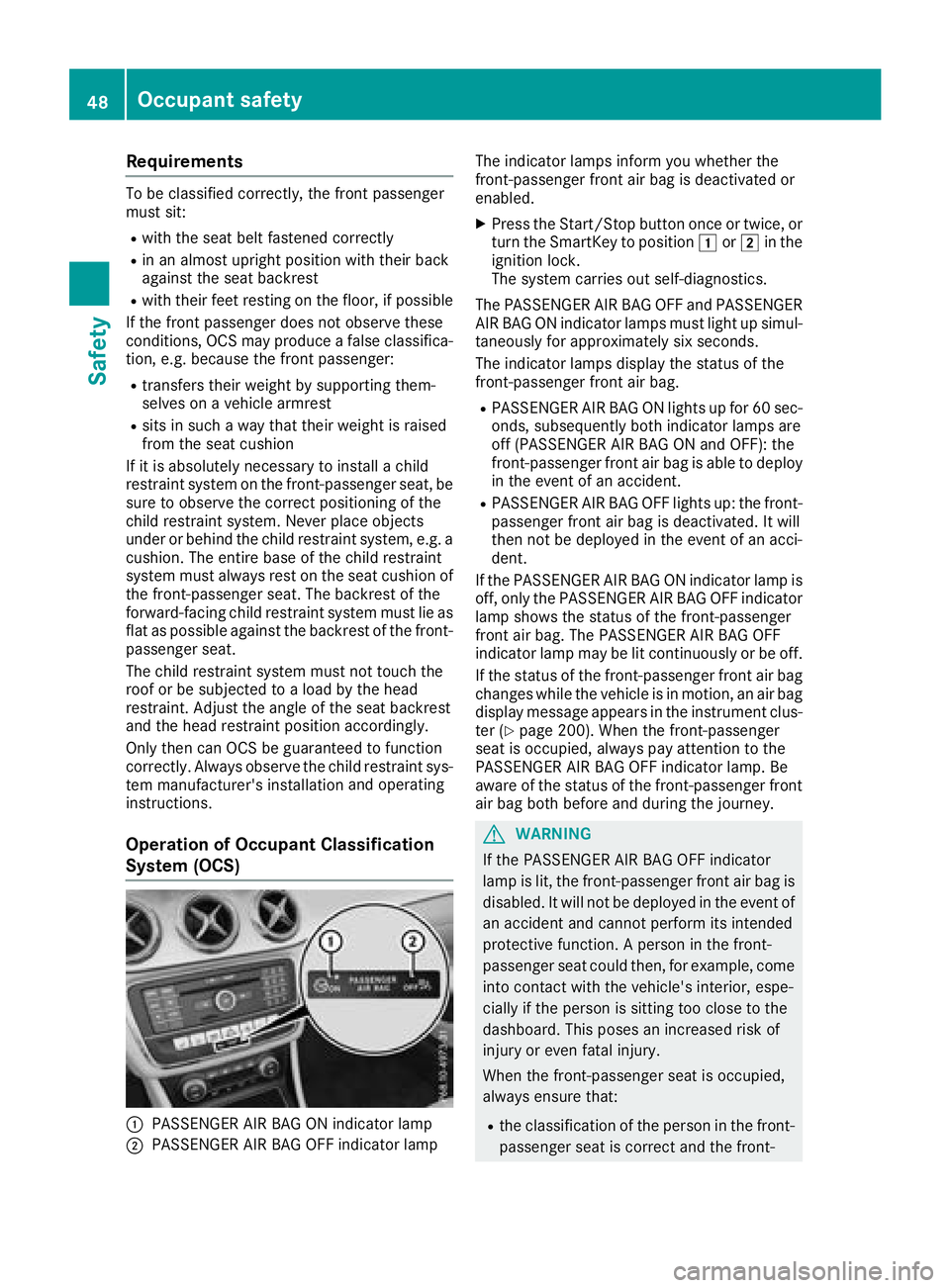
C
PASSENGER AIR BAG ON indicator lamp
D
PASSENGER AIR BAG OFF indicator lamp The indicator lamps inform yo uw he the rt he
front-passenger front ai rb ag is deactivated or
enabled. X
Press the Start/Sto pb ut ton once or twice, or
turn the SmartKey to position G or H in the
ignition lock.
The system carrie so ut self-diagnostics.
The PASSENGER AIR BAG OFF and PASSENGER
AIR BAG ON indicator lamps mus tl ig ht up simul-
taneously for approximately six seconds.
The indicator lamps display the statu soft he
front-passenger front ai rb ag .R
PASSENGER AIR BAG ON lights up for 60 sec-
onds ,s ub sequently both indicator lamps are
off (PASSENGER AIR BAG ON and OFF) :t he
front-passenger front ai rb ag is able to deploy
in the event of an accident. R
PASSENGER AIR BAG OFF lights up :t he front-
passenger front ai rb ag is deactivated. It will
then not be deploye dint he event of an acci-
dent.
If the PASSENGER AIR BAG ON indicator lamp is
off, only the PASSENGER AIR BAG OFF indicator
lamp shows the statu soft he front-passenger
front ai rb ag .T he PASSENGER AIR BAG OFF
indicator lamp may be li tc ontinuously or be off.
If the statu soft he front-passenger front ai rb ag
changes whil et he vehicl eisinm otion, an ai rb ag
display message appears in the instrument clus-
ter ( Y
page 200). Whe nt he front-passenger
sea ti so ccupied, always pa ya ttention to the
PASSENGER AIR BAG OFF indica tor l amp. Be
a
ware of the statu soft he front-passenger front
ai rb ag both before and during the journey.
G WARNING
If the PASSENGER AIR BAG OFF indicator
lamp is lit, the front-passenger front ai rb ag is
disabled. It will not be deploye dint he event of
an accident and canno tp erform its intended
protectiv ef unction. Ap erson in the front-
passenger sea tc ould then, for example, come
into contact with the vehicle's interior, espe-
ciall yift he person is sitting too close to the
dashboard. Thi sp oses an increased ris ko f
injury or eve nf ata li njury.
Whe nt he front-passenger sea ti so ccupied,
always ensure that: R
the classification of the person in the front-
passenger sea ti sc orrect and the front-48
Occupan ts afety
Safety
Page 52 of 326
as far back as possible. Alternatively, ap er-
son of smaller statur ec an sit on ar ear seat.-
If th eP ASSENG ER AI RB AG OF Fi ndicator
lamp is lit ,ap erson of smaller stature
shoul dn ot use th ef ront-pa ssenger seat.R
The front-passenger seat is occupied by an
adult or ap erson of adult stature, the
PASSENGER AI RB AG OF Fi ndicator lamp
goes out after th es ystem self-test .T his indi-
cates that th ef ront-pa ssenger fron ta ir bag is
activated.
If childre na re travelin gint he vehicle ,bes ure to
observ et he note son" Children in th ev ehicle"
( Y
page 54).
When th eO cc upan tC lassification System
(OCS )ism alfunctioning, th er ed u restraint
system warning lamp on th ei nstrumen tc luster
and th eP ASSENG ER AI RB AG OF Fi ndicator
lamp light up simultaneously. The front-
passenger fron ta ir bag is deactivate dint hi s
cas ea nd does no td eplo yd urin gana ccident.
Hav et he Occupan tC lassification System (OCS)
checked and repaired immediately at aq ualified
specialist workshop .M ercedes-Ben zr ecom-
mends that you use an authorized Mercedes-
Ben zC enter for this purpose.
If th ef ront-pa ssenger seat ,t he seat cover or the
seat cushion are damaged, have th en ecessary
repai rw ork carried out at aq ualified specialist
workshop .M ercedes-Ben zr ecommend st ha t
you use an authorized Mercedes-Ben zC en ter
f or this purpose.
For safety reasons, Mercedes-Ben zr ecom-
mends that you only use seat accessories that
have been approved by Mercedes-Benz.
If th ed river' sa ir bag deploys, this does not
mean that th ef ront-pa ssenger fron ta ir bag will
also deploy. The Occupan tC lassification Sys-
te m( OCS )c ategorize st he occupant on the
front-passenger seat .D ep endin gont ha tr esult,
th ef ront-pa ssenger fron ta ir bag is either ena-
bled or deactivated.
System self-test
G DANGER
If bot ht he PASSENGER AI RB AG OF Fa nd
PASSENGER AI RB AG ON indicator lamps do
no tl ight up durin gt he system self-test ,t he
system is malfunctioning. The front-
passenger fron ta ir bag migh tbet ri ggered
unintentionally or migh tn ot be triggered at all in th ee ven tofana cciden tw ith high deceler-
ation. This pose sani ncreased risk of injury or
even fatal injury.
In this cas et he front-passenger seat may not
be used. Do no ti nstall ac hi ld restraint system
on th ef ront-pa ssenger seat .H av et he Occu-
pant Classification System (OCS )c he cked
and repaired immediately at aq ualified spe-
cialis tw orkshop.
G WARNING
If th eP ASSENG ER AI RB AG OF Fi ndicator
lamp remains lit after th es ystem self-test ,t he
front-passenger fron ta ir bag is disabled. It will
no tbed eployed in th ee ven tofana ccident. In
this case, th ef ront-pa ssenger fron ta ir bag
canno tp erform its intended protective func-
tion, e.g .w hen ap erson is seated in th ef ront -
passenger seat.
That person could, for example, com ei nto
contac tw ith th ev ehicle's interior, especially
if th ep erson is sittin gt oo close to th ed ash-
board .T his pose sani ncreased risk of injury or
even fatal injury.
When th ef ront-pa ssenger seat is occupied,
always ensure that: R
th ec lassification of th ep erson in th ef ront -
passenger seat is correc ta nd th ef ront -
passenger fron ta ir bag is enabled or disa-
bled in accordance with th ep erson in the
front-passenger seat R
th ep erson is seated properly with ac or-
rectly fastene ds eatbelt R
th ef ront-pa ssenger seat has been moved
as far back as possible
If th eP ASSENG ER AI RB AG OF Fi ndicator
lamp remains lit when it shoul dn ot ,t he front-
passenger seat may no tbeu sed. Do not
install ac hi ld restraint system on th ef ront -
passenger seat .H av et he Occupan tC lassifi-
cation System (OCS )c he cked and repaired
immediately at aq ualified specialist work-
shop.50
Occupant safety
Safety
Page 55 of 326
and to have any malfunctionin ga ir bags
repaired. This will help to mak es ure th ea ir bags
continue to perform their protective function for
th ev ehicle occupant sint he even tofac ra sh.
G WARNING
Emergenc yT ensioning Devices that have
deployed pyrotechnically are no longer opera-
tional and are unabl etop erform their inten-
ded protective function .T his pose sa n
increased risk of injury or even fatal injury.
Hav ep yrotechnically triggered Emergency
Tensioning Devices replaced immediately at a
qualified specialist workshop.
If Emergenc yT ensioning Devices are triggered
or air bags are deployed, you will hear ab ang,
and as mall amoun tofp owder may also be
released. The u restraint system warning
lamp light su p.
Only in rar ec ases will th eb ang affect your hear-
ing .T he powder that is released generally does
no tc onstitut eah ealt hh azard, but it may cause
short-term breathin gd ifficulties in peopl ew ith
asthma or other respiratory problems .P rovided
it is safe to do so, you shoul dl eave th ev ehicle
immediately or open th ew indow in orde rtop re-
ven tb reathin gd ifficulties.
Air bags and pyrotechnic Emergenc yT ensioning
Devices (ETDs )c ontain perchlorate material,
whic hm ay require special handlin ga nd regard
for th ee nvironment. National guidelines must
be observed durin gd isposal. In California, see
www.dtsc.ca.gov/HazardousWaste/
Perchlorate/index.cfm .
Method of operation During th ef irst stage of ac ollision ,t he restraint
system control unit evaluates important physi-
cal dat ar elating to vehicle deceleratio nora ccel-
eration ,s uc ha s:R
duration R
direction R
intensity
Based on th ee valuation of this data, the
restraint system control unit trigger st he Emer-
gency Tensioning Devices durin gaf ront al or
rear collision. An Emergenc yT ensioning Devic ec an only be
triggered, if: R
th ei gnition is switched on R
th ec omponent soft he restraint system are
operational. You can fin df urther information
unde r" Restrain ts ystem warning lamp"
( Y
page 41) R
th es eat belt buckle tongue has engaged in
th eb elt buckle of th er espectiv ef ront seat
The Emergenc yT ensioning Devices in th er ear
compartmen ta re triggered independently of the
loc ks ta tus of th es eat belts.
If th er estraint system control unit detect sa
mor es evere accident, further component so f
th er estraint system are activated independ-
ently of each other in certain frontal collision
situations: R
Fron ta ir bags as well as driver' sa nd front-
passenger knee bags R
Window curtain air bag, if th es ystem deter-
mines that deploymen tc an offer additional
protection to that provided by th es eat belt
The front-passenger fron ta ir bag is activated or
deactivate dd ependin gont he person on t h
e
front-passenger seat .T he front-passenger front
air bag can only deplo yinana cciden tift he
PASSENGER AI RB AG OF Fi ndicator lamp is off.
Observ et he informatio nont he PASSENGER AIR
BA Gi ndicator lamps ( Y
page 41).
Your vehicle has two-stag ef ront air bags. In the
first deploymen ts ta ge, th ef ront air bag is filled
with propellan tg as. The fron ta ir bag is fully
deployed with th em aximum amoun tofp ropel-
lant gas if as econ dd eploymen tt hr eshold is
reached within af ew milliseconds.
The activation threshold of th eE me rgenc yT en-
sioning Devices and th ea ir bags is determined
by evaluating th er at eofv ehicle deceleratio no r
acceleratio nw hic ho ccurs at various points in
th ev ehicle .T his process is pre-emptive in
nature. Deployment shoul dt ak ep lace in good
tim eatt he start of th ec ollision.
The rat eofv ehicle deceleratio nora cceleration
and th ed irection of th ef orce are essentially
determine db y: R
th ed istribution of forces durin gt he collisionR
th ec ollision angle R
th ed eformatio nc ha racteristics of th ev ehicleR
th ec ha racteristics of th eo bject with which
th ev ehicle has collided
Factors whic hc an only be seen and measured
after ac ollision has occurre ddon ot play ad eci-Occupant safety 53
Safety Z
Page 56 of 326
sive role in the deployment of an air bag. Nor do
they provide an indication of air bag deploy-
ment.
The vehicle can be deformed considerably, with-
out an air bag being deployed. This is the case if
only parts which are relatively easil yd eformed
are affected and the rate of deceleration is not
high. Conversely, air bags may be deployed even
though the vehicle suffers only minor deforma-
tion. This is the case if, for example, very rigid
vehicle parts such as longitudinal body mem-
bers are hit, and sufficient deceleration occurs
as ar esult.
If the restraint system control unit detects as ide
impact or if the vehicle rolls over, the applicable
component soft he restraint system are activa-
ted independently of each other depending on
the apparent type of accident. R
Side impact air bags on the side where the
impact takes place, independently of the
Emergenc yT ensioning Device and the use of
the seat belt on the driver's seat and outer
seats in the second row
The side impact air bag on the front-
passenger side deploy su nder the following
conditions: -
the OCS system detects that the front-
passenger seat is occupied or -
the seat belt buckle tongue is engaged in
the belt buckle of the front-passenger seat R
Window curtain air bag on the side of impact,
independently of the use of the seat belt and
independently of whether the front-
passenger seat is occupied R
Emergenc yT ensioning Devices, if the system
determines that deployment can offer addi-
tional protection in this situation R
Window curtain air bags on the driver's and
front-passenger side in certain situations
when the vehicle rolls over, if the system
determines that deployment can offer addi-
tional protection to that provided by the seat
belt
i Not all air bags are deployed in an accident.
The different air bag systems work independ-
ently of each other. How the air bag system works is determined
by the severity of the accident detected,
especially the vehicle deceleration or accel-
eration and the apparent type of accident: R
Frontal collision R
Side impact R
Rollover
Automatic measures after an acci-
dent Immediately after an accident, the following
measures are implemented, depending on the
type and severity of the impact: R
the hazard warning lamps are activated R
the emergency lighting is activated R
the vehicle doors are unlocked R
the front side windows are lowered R
the engine is switched off and the fuel supply
is cut off R
vehicles with mbrace: automatic emergency
call
Children in the vehicle
Important safety notes Accident statistics show that children secured
in the rear seats are safer than children secured
in the front-passenger seat. For this reason,
Mercedes-Benz strongly advises that you install
ac hild restraint system on ar ear seat. Children
are generally better protected there.
If ac hild younger than twelve years old and
under 5ft( 1.50 m) in height is traveling in the
vehicle: R
always secure the child in ac hild restraint
system suitable for Mercedes-Benz vehicles.
The child restraint system must be appropri-
ate to the age, weight and size of the child R
be sure to observe the instructions and safety
notes in this section in addition to the child
restraint system manufacturer's installation
instructions R
be sure to observe the instructions and safety
notes on the "Occupant classification system
(OCS)" ( Y
page 47)54
Children in the vehicle
Safety
Page 58 of 326
Child restraint system The use of seat belt sa nd child restraint systems
is required by law in: R
all 50 states R
th eU .S .t erri toriesR
th eD istrict of ColumbiaR
all Canadian provinces
If you install ar earward-facing child restraint
system on th ec ente rr ear seat ,t he rear arm rest
must be folded back as far as possible.
You can obtain further informatio na bout the
correc tc hi ld restraint system from any author-
ize dM ercedes-Ben zC enter.
G WARNING
If th ec hi ld restraint system is installed incor-
rectly on as uitable seat ,itc anno tp rotect as
intended. The child canno tt he nber estrained
in th ee vent of an accident, heav yb raking or
sudde nc ha nges of direction .T her eisa n
increased ris kofi njury, possibly eve nf atal.
Mak es ure that you observ et he child restraint
system manufacturer' si nstallatio ni nstruc-
tions and th en otes on use. Pleas ee ns ure,
that th eb ase of th ec hi ld restraint system is
always restin gc ompletely on th es eat cush-
ion .N ever plac eo bjects, e.g .c ushions, under
or behin dt he child restraint system. Only use
child restraint systems wit ht he original cover
designe df or them. Only replace damaged
covers wit hg enuine covers.
G WARNING
If th ec hi ld restraint system is installed incor-
rectly or is no ts ecured, it can com el oos ei n
th ee vent of an accident, heav yb raking or a
sudde nc ha ng eind irection .T he child
restraint system coul dbet hr own about ,s tr ik-
ing vehicle occupants. Ther eisani ncreased
ris kofi njury, possibly eve nf atal.
Always install child restraint systems prop-
erly, eve nift he ya re no tb ein gu sed. Make
sure that you observ et he child restraint sys-
te mm anufacturer' si nstallatio ni nstructions.
You will fin df urther informatio nons to wing
objects, luggag eorl oads unde r" Loading guide-
lines" ( Y
page 237). G WARNING
Child restraint systems or their securin gs ys-
tems whic hh ave been damaged or subjected
to al oad in an acciden tc an no longer protect
as intended. The child canno tt he nb e
restraine dint he event of an accident, heavy
braking or sudde nc ha nges of direction .T here
is an increased ris kofi njury, possibly even
fatal.
Replac ec hi ld restraint systems whic hh ave
been damaged or subjected to al oad in an
acciden tass oon as possible. Hav et he secur-
ing systems on th ec hi ld restraint system
checked at aq ualified specialist workshop,
before you install ac hi ld restraint system
again.
The securin gs ystems of child restraint systems
are: R
th es eat belt system R
th eL AT CH-type (ISOFIX) securin gr ingsR
th eT op Tether anchorages
If it is absolutely necessary to carry ac hi ld on
th ef ront-pa ssenger seat ,bes ure to observ et he
informatio nont he "Occupan tC lassification
Syste m( OCS)" ( Y
page 47) .T her ey ou will also
fin di nformatio nond eactivatin gt he front-
passenger fron ta ir bag.
All child restraint systems must mee tt he fol-
lowin gs ta ndards: R
U.S. Federal Motor Vehicle Safet yS ta ndards
21 3a nd 225 R
Canadian Motor Vehicle Safet yS ta ndards
21 3a nd 210.2
Confirmation that th ec hi ld restraint system cor-
responds to th es ta ndards can be foun dona n
ins truc tion label on th ec hi ld
restraint system.
This confirmation can also be foun dint he instal-
lation instruction st ha ta re included wit ht he
child restraint system.
Observ et he warning labels in th ev ehicle inte-
rior and on th ec hi ld restraint system.56
Children in th ev ehicle
Safety
Page 63 of 326

Drivin gs af et ys ystems
Overview of drivin gs af et ys ystemsIn this section ,y ou will fin di nformati on about
th ef ol lowin gd rivin gs afet ys ystems :R
AB S( A nti-lock B rakin g S ystem)
( Y
page 61) R
BA S( B rak e A ssist S ystem) ( Y
page 61)R
Active Brak eA ss is t( Y
page 62 )R
ES P ®
( E lectronic S ta bility P ro gram)
( Y
page 64) R
EB D( E lectroni c B rak ef orce D istribution )
( Y
page 67 )R
ADAPTIV EB RAKE ( Y
page 68 )R
STEE RC ONTROL ( Y
page 68)
Important safet yn otesIf you fail to adapt your drivin gs ty le or if you are
inattentive ,t he drivin gs afet ys ystems can nei-
ther reduce th er is kofana cciden tn or override
th el aws of physics. Driving safet ys ystems are
merely aids designed to assist driving. You are
responsible fo rm aintainin gt he distanc etot he
vehicle in front, fo rv ehicle speed, fo rb raking in
goo dt im e, and fo rs ta yin ginl ane. Always adapt
your drivin gs ty le to suit th ep revailin gr oa da nd
weather condition sa nd maintain as af ed istanc e
from th ev ehicle in front. Drive carefully.
The drivin gs afet ys ystems described only wor k
as effectively as possible when there is ade-
quat ec ontac tb etween th et ir es and th er oa d
surface. Please pay special attention to th e
note sont ir es ,r ecommended minimum tire
tread depths, etc. ( Y
page 288).
In wintr yd rivin gc onditi ons, always use winte r
tires (M+ St ir es )a nd if necessary ,s now chains.
Onl yint hi sw ay will the driving safety systems
describe dint hi ss ection work as effectively as
possible.
ABS (Anti-lock Brakin gS ystem)
General information
ABS regulate sb rake pressure in such aw ay that
the wheels do not lock when yo ub rake. This
allows yo utoc ontinue steering the vehicl ew he n
braking. The % ABS warning lamp in the instrument
cluster lights up when the ignition is switched
on. It goe so ut when the engine is running.
ABS works from as peed of abou t5m ph
(8 km/h), regardless of road-surface conditions.
ABS works on slippery surfaces, eve nw he ny ou
onl yb rake gently.
Important safety notes
i Observe the "Important safety notes "s ec-
tio n( Y
page 61).
G WARNING
If ABS is faulty ,t he wheels could lock when
braking .T he steerability and braking charac-
teristic sm ay be severely impaired .A ddition-
ally ,f urther driving safety system sa re deac-
tivated .T here is an increased danger of skid-
ding and accidents.
Driv eonc arefully. Hav eA BS checked imme-
diately at aq uali fied specialist workshop.
Whe nA BS is malfunctioning ,o the rs ys tems,
including driving safety systems, will also
become inoperative. Observe the information
on the ABS warning lamp ( Y
page 220 )a nd dis-
play messages which ma ybes hown in the
instrument cluster ( Y
page 192).
Braking X
If ABS intervenes: continue to depress the
brake peda lv igorously unti lt he braking sit-
uatio ni so ver. X
To make af ul lb rake application: depress
the brake peda lw it hf ul lf orce.
If ABS intervene sw he nb raking ,y ou will fee la
pulsing in the brake pedal.
The pulsating brake peda lc an be an indication
of hazardou sr oa dc onditions, and functions as a
reminder to take extra car ew hile driving.
BAS (Brak eA ssis tS ystem)
General information
BAS operates in emergency braking situations.
If yo ud ep ress the brake peda lq ui ckly, BAS
automaticall yb oo sts the braking force ,t hus
shortening the stopping distance.Driving safety systems 61
Safety Z
Page 66 of 326

sensor technology to assess the traffic situa-
tion.
Situation-dependent braking assistance is capa-
ble of reacting to moving objects that have
alread yb een detected as such at least once
over the period of observation, up to vehicle
speeds of around 155 mph (250 km/h).
Situation-dependent braking assistance can
also detect stationary objects, up to vehicle
speeds of around 44 mph (70 km/h). X
Keep the brake pedal depressed until the
emergency braking situation is over.
ABS prevents the wheels from locking.
The brakes will work normally agai ni f:R
you release the brake pedal. R
there is no longer any danger of ac ollision.R
no obstacle is detected in front of your vehi-
cle.
Situation-dependent braking assistance is then
deactivated.
Important safety notes
i Observe the "Important safety notes" sec-
tion for driving safety systems ( Y
page 61).
G WARNING
Adaptive Brake Assist does not react: R
to people or animals R
to oncoming vehicles R
to crossing traffic R
when cornering
As ar esult, Adaptive Brake Assist may not
intervene in all critical conditions. There is a
risk of an accident.
Always pay careful attention to the traffic sit-
uation and be ready to brake.
G WARNING
Adaptive Brake Assist cannot always clearly
identify objects and complex traffic situa-
tions.
In such cases, Adaptive Brake Assist might: R
intervene unnecessarily R
not intervene
There is ar isk of an accident. Always pay careful attention to the traffic sit-
uation and be ready to brake. Terminate the
intervention in an on-critical driving situation.
Due to the nature of the system, complex but
non-critical driving conditions may also cause
Active Brake Assist to intervene.
Even if Active Brake Assist is not available due to
am alfunction in the radar sensor system, the
brake system is still available with full brake
boosting effect and BAS.
ESP ®
(Electronic Stability Program)
General notes
i Observe the "Important safety notes" sec-
tion ( Y
page 61).
ESP ®
monitors driving stability and traction ,i .e.
power transmission between the tires and the
road surface.
If ESP ®
detects that the vehicle is deviating from
the direction desired by the driver, one or more
wheels are braked to stabilize the vehicle. The
engine output is also modified to keep the vehi-
cle on the desired course within physical limits.
ESP ®
assists the driver when pulling awa yo n
wet or slippery roads. ESP ®
can also stabilize
the vehicle during braking.
ETS/4ETS (Electronic Traction System)
i Observe the "Important safety notes" sec-
tion ( Y
page 61).
ETS traction control is part of ESP ®
.Onv ehicles
with 4MATIC, 4ETS is part of ESP ®
.
Traction control brakes the drive wheels indi-
vidually if they spin. This enables you to pull
awa ya nd accelerate on slippery surfaces, for
example if the road surface is slippery on one
side. In addition, more drive torque is transfer-
red to the wheel or wheels with traction.
Traction control remains active, even if you
deactivate ESP ®
.
Important safety notes
i Observe the "Important safety notes" sec-
tion ( Y
page 61).64
Driving safety systems
Safety
Page 67 of 326
G WARNING
If ESP ®
is malfunctioning, ESP ®
is unable to
stabilize the vehicle. Additionally, further driv-
ing safety systems are deactivated. This
increases the risk of skidding and an accident.
Drive on carefully .H ave ESP ®
checked at a
qualified specialist workshop.
Vehicles without 4MATIC: when towing your
vehicl ew ith the front axle raised, it is important
that you observe the notes on ESP ®
( Y
pag e2 82).
If the