2018 LINCOLN NAVIGATOR light
[x] Cancel search: lightPage 44 of 649
•Height adjuster at the front outboardseating positions.
•Seatbelt pretensioner at the frontoutboard seating positions.
•Belt tension sensor at the front outboardpassenger seating position.
•Seatbelt warning light and chime.
•Crash sensors and monitoring systemwith readiness indicator.
The seatbelt pretensioners and rearinflatable seatbelts are designed to activatein frontal, near-frontal and side crashes, andin rollovers. The seatbelt pretensioners atthe front seating positions are designed totighten the seatbelts firmly against the
occupant’s body when activated. This helpsincrease the effectiveness of the seatbelts.In frontal crashes, the seatbelt pretensionerscan be activated alone or, if the crash is ofsufficient severity, together with the frontairbags.
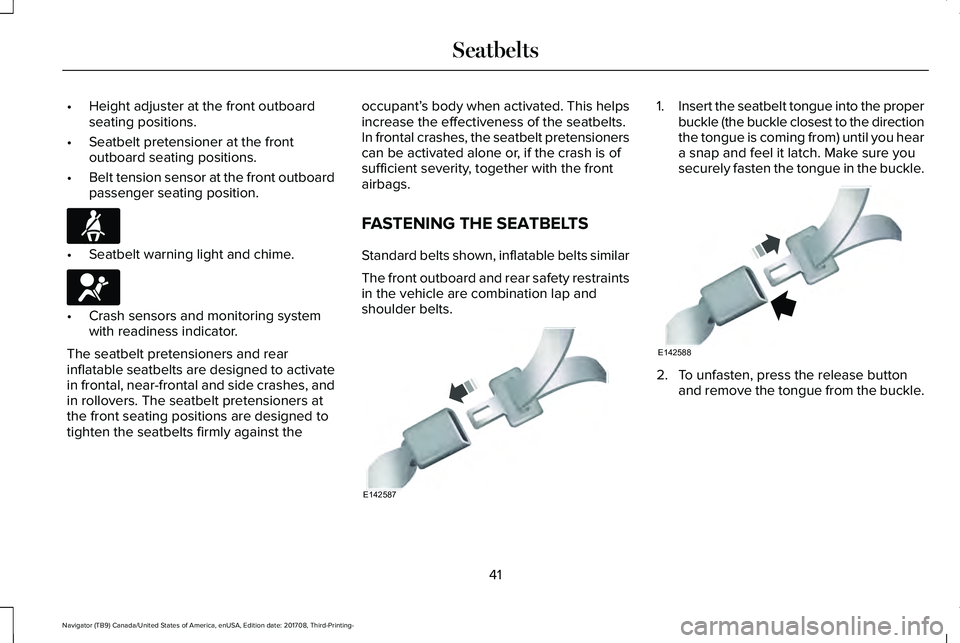
FASTENING THE SEATBELTS
Standard belts shown, inflatable belts similar
The front outboard and rear safety restraintsin the vehicle are combination lap andshoulder belts.
1.Insert the seatbelt tongue into the properbuckle (the buckle closest to the directionthe tongue is coming from) until you heara snap and feel it latch. Make sure yousecurely fasten the tongue in the buckle.
2. To unfasten, press the release buttonand remove the tongue from the buckle.
41
Navigator (TB9) Canada/United States of America, enUSA, Edition date: 201708, Third-Printing-
SeatbeltsE71880 E67017 E142587 E142588
Page 48 of 649

How to Disengage the Automatic LockingMode
Unbuckle the combination lap and shoulderbelt and allow it to retract completely todisengage the automatic locking mode andactivate the vehicle sensitive (emergency)locking mode.
Rear Inflatable Seatbelt (If Equipped)
WARNING: Do not attempt to service,repair, or modify the supplementaryrestraint system or associated components.Failure to follow this instruction could resultin personal injury or death.
The rear inflatable seatbelts are in theshoulder portion of the seatbelts of thesecond-row outermost seating positions.
Note:The rear inflatable seatbelts arecompatible with most infant and child safetycar seats and belt positioning booster seatswhen you properly install them. This isbecause they are designed to fill with acooled gas at a lower pressure and at aslower rate than traditional airbags. Afterinflation, the shoulder portion of the seatbeltremains cool to the touch.
The rear inflatable seatbelt consists of thefollowing:
•An inflatable bag in the shoulder seatbeltwebbing.
•Lap seatbelt webbing with automaticlocking mode.
•The same warning light, electroniccontrol and diagnostic unit as used forthe front seatbelts.
•Impact sensors in various parts of thevehicle.
How does the rear inflatable seatbeltsystem work?
WARNING: If a supplementaryrestraint system component has deployed,it will not function again. Have the systemand associated components inspected assoon as possible. Failure to follow thisinstruction could result in personal injuryor death.
The rear inflatable seatbelts function likestandard restraints in everyday usage.
45
Navigator (TB9) Canada/United States of America, enUSA, Edition date: 201708, Third-Printing-
SeatbeltsE146364
Page 50 of 649

Conditions of operation
ThenIf
The seatbelt warning lamp illuminates and the indicator chime soundsfor a few seconds.The driver seatbelt is not buckled before the ignition switch is turnedto the on position...
The seatbelt warning lamp and indicator chime turn off.The driver seatbelt is buckled while the warning lamp is illuminatedand the indicator chime is sounding...
The seatbelt warning lamp and indicator chime remain off.The driver seatbelt is buckled before the ignition switch is turned tothe on position...
SEATBELT REMINDER
Belt-Minder™
This feature supplements the seatbeltwarning function by providing additionalreminders that intermittently sound a toneand illuminate the seatbelt warning lightwhen you are in the driver seat or you havea front seat passenger and a seatbelt isunbuckled.
The system uses information from the frontpassenger sensing system to determine if afront seat passenger is present and thereforepotentially in need of a warning. To avoidactivating the Belt-Minder feature for objectsyou place in the front passenger seat, onlythe front seat passengers receive warningsas determined by the front passengersensing system.
If the Belt-Minder warnings expire (warningsfor about five minutes) for one passenger(driver or front passenger), the otherpassenger can still cause the Belt-Minderfeature to turn on.
47
Navigator (TB9) Canada/United States of America, enUSA, Edition date: 201708, Third-Printing-
Seatbelts
Page 51 of 649

Then...If...
The Belt-Minder feature will not activate.You and the front seat passenger buckle your seatbelts before youswitch the ignition on or less than 1-2 minutes elapse after you switchthe ignition on...
The Belt-Minder feature activates, the seatbelt warning light illuminatesand a warning tone sounds for 6 seconds every 25 seconds, repeatingfor about 5 minutes or until you and the front seat passenger buckleyour seatbelts.
You or the front seat passenger do not buckle your seatbelts beforeyour vehicle reaches at least 6 mph (9.7 km/h) and 1-2 minutes elapseafter you switch the ignition on...
The Belt-Minder feature activates, the seatbelt warning light illuminatesand a warning tone sounds for 6 seconds every 25 seconds, repeatingfor about 5 minutes or until you and the front seat passenger buckleyour seatbelts.
The seatbelt for the driver or front passenger is unbuckled for about1 minute while the vehicle is traveling at least 6 mph (9.7 km/h) andmore than 1-2 minutes elapse after you switch the ignition on...
48
Navigator (TB9) Canada/United States of America, enUSA, Edition date: 201708, Third-Printing-
Seatbelts
Page 52 of 649

Deactivating and Activating the Belt-MinderFeature
WARNING: While the system allowsyou to deactivate it, this system is designedto improve your chances of being safelybelted and surviving an accident. Werecommend you leave the systemactivated for yourself and others who mayuse the vehicle.
Note:The driver and front passengerwarnings switch on and off independently.When you perform this procedure for oneseating position, do not buckle the otherposition as this will terminate the process.
Read Steps 1 - 4 thoroughly beforeproceeding with the programmingprocedure.
Before following the procedure, make surethat:
•The parking brake is set.
•The transmission is in park (P).
•The ignition is off.
•All vehicle doors are closed.
•The driver and front passenger seatbeltsare unbuckled.
1. Switch the ignition on. Do not start theengine.
2.Wait until the seatbelt warning light turnsoff (about one minute). After Step 2, waitan additional 5 seconds beforeproceeding with Step 3. Once you startStep 3, you must complete the procedurewithin 60 seconds.
3.For the seating position you are switchingoff, buckle then unbuckle the seatbeltthree times at a moderate speed, endingin the unbuckled state. After Step 3, theseatbelt warning light turns on.
4. While the seatbelt warning light is on,buckle then unbuckle the seatbelt. AfterStep 4, the seatbelt warning light flashesfor confirmation.
•This will switch the feature off for thatseating position if it is currently on.
•This will switch the feature on for thatseating position if it is currently off.
CHILD RESTRAINT AND SEATBELT
MAINTENANCE
Inspect the vehicle seatbelts and child safetyseat systems periodically to make sure theywork properly and are not damaged. Inspectthe vehicle and child restraint seatbelts tomake sure there are no nicks, tears or cuts.Replace if necessary. All vehicle seatbeltassemblies, including retractors, buckles,front seatbelt buckle assemblies, bucklesupport assemblies (slide bar-if equipped),shoulder belt height adjusters (if equipped),shoulder belt guide on seat backrest (ifequipped), child safety seat LATCH andtether anchors, and attaching hardware,should be inspected after a crash. Read thechild restraint manufacturer's instructions foradditional inspection and maintenanceinformation specific to the child restraint.
49
Navigator (TB9) Canada/United States of America, enUSA, Edition date: 201708, Third-Printing-
Seatbelts
Page 57 of 649

The driver and passenger front airbag systemconsists of:
•Driver and passenger airbag modules.
•Front passenger sensing system.
· Crash sensors and monitoringsystem with readiness indicator.See Crash Sensors and AirbagIndicator (page 60).
Proper Driver and Front PassengerSeating Adjustment
WARNING: National Highway TrafficSafety Administration (NHTSA)recommends a minimum distance of atleast 10 in (25 cm) between an occupant'schest and the driver airbag module.
To properly position yourself away from theairbag:
•Move your seat to the rear as far as youcan while still reaching the pedalscomfortably.
•Recline the seat slightly (one or twodegrees) from the upright position.
After all occupants have adjusted their seatsand put on seatbelts, it is very important thatthey continue to sit properly. Properly seatedoccupants sit upright, lean against the seatback, and center themselves on the seatcushion, with their feet comfortably extendedon the floor. Sitting improperly can increasethe chance of injury in a crash event. Forexample, if an occupant slouches, lies down,turns sideways, sits forward, leans forwardor sideways, or puts one or both feet up, thechance of injury during a crash greatlyincreases.
Children and Airbags
WARNING: Airbags can kill or injurea child in a child restraint. Never place arear-facing child restraint in front of anactive airbag. If you must use aforward-facing child restraint in the frontseat, move the seat upon which the childrestraint is installed all the way back.
Children must always be properly restrained.Accident statistics suggest that children aresafer when properly restrained in the rearseating positions than in the front seatingposition. Failure to follow these instructionsmay increase the risk of injury in a crash.
54
Navigator (TB9) Canada/United States of America, enUSA, Edition date: 201708, Third-Printing-
Supplementary Restraints SystemE67017 E142846
Page 59 of 649

The front passenger sensing system workswith sensors that are part of the frontpassenger seat and seatbelt. The sensorsare designed to detect the presence of aproperly seated occupant and determine ifthe front passenger frontal airbag should beenabled.
•When the front passenger sensingsystem enables the front passengerfrontal airbag (may inflate), the passengerairbag status indicator illuminates the onlamp and remains illuminated.
If a person of adult size is sitting in the frontpassenger seat, but the passenger airbagstatus indicator off lamp is lit, it is possiblethat the person is not sitting properly in theseat. If this happens:
•Switch your vehicle off and ask theperson to place the seatback in anupright position.
•Have the person sit upright in the seat,centered on the seat cushion, with theperson's legs comfortably extended.
•Restart your vehicle and have the personremain in this position for about twominutes. This allows the system to detectthat person and enable the passengerfrontal airbag.
•If the indicator off lamp remains lit evenafter this, you should advise the personto ride in the rear seat.
Note:When the passenger airbag statusindicator off lamp illuminates, the passengerside airbag (seat mounted) may be disabledto avoid the risk of airbag deploymentissues.
After all occupants have adjusted their seatsand put on seatbelts, it is very important thatthey continue to sit properly. A properlyseated occupant sits upright, leaning againstthe seatback, and centered on the seatcushion, with their feet comfortably extendedon the floor. Sitting improperly can increasethe chance of injury in a crash event. Forexample, if an occupant slouches, lies down,turns sideways, sits forward, leans forwardor sideways, or puts one or both feet up, thechance of injury during a crash greatlyincreases.
If you think that the state of the passengerairbag status indicator lamp is incorrect,check for the following:
•Objects lodged underneath the seat.
•Objects between the seat cushion andthe center console.
•Objects hanging off the seat backrest.
•Objects stowed in the seat backrest mappocket.
•Objects placed on the occupant's lap.
•Cargo interference with the seat
•Other passengers pushing or pulling onthe seat.
•Rear passenger feet and knees restingor pushing on the seat.
The conditions listed above may cause theweight of a properly seated occupant to beincorrectly interpreted by the front passengersensing system. The person in the frontpassenger seat may appear heavier or lighterdue to the conditions described in theprevious list.
56
Navigator (TB9) Canada/United States of America, enUSA, Edition date: 201708, Third-Printing-
Supplementary Restraints System
Page 60 of 649

Make sure the front passengersensing system is operatingproperly. See Crash Sensors andAirbag Indicator (page 60).
If the airbag readiness light is lit, do thefollowing:
The driver and adult passengers shouldcheck for objects lodged underneath thefront passenger seat or cargo interfering withthe seat.
If objects are lodged or cargo is interferingwith the seat, please take the following stepsto remove the obstruction:
•Pull your vehicle over.
•Switch your vehicle off.
•Driver or adult passengers should checkfor any objects lodged underneath thefront passenger seat or cargo interferingwith the seat.
•Remove the obstruction(s) (if found).
•Restart your vehicle.
•Wait at least two minutes and verify thatthe airbag readiness light in theinstrument cluster is no longerilluminated.
•If the airbag readiness light in theinstrument cluster remains illuminated,this may or may not be a problem due tothe front passenger sensing system.
Do not attempt to repair or service thesystem. Take your vehicle immediately to anauthorized dealer.
If it is necessary to modify an advanced frontairbag system to accommodate a personwith disabilities, contact your CustomerRelationship Center.
SIDE AIRBAGS
WARNING: Do not place objects ormount equipment on or near the airbagcover, on the side of the seatbacks (of thefront seats), or in front seat areas that maycome into contact with a deploying airbag.Failure to follow these instructions mayincrease the risk of personal injury in theevent of a crash.
WARNING: Do not use accessoryseat covers. The use of accessory seatcovers may prevent the deployment of theside airbags and increase the risk of injuryin an accident.
WARNING: Do not lean your headon the door. The side airbag could injureyou as it deploys from the side of theseatback.
57
Navigator (TB9) Canada/United States of America, enUSA, Edition date: 201708, Third-Printing-
Supplementary Restraints SystemE67017