2018 LEXUS LS500 lights
[x] Cancel search: lightsPage 346 of 514
346 5-6. Using the other interior features
LS500_OM_OM50F54U_(U)
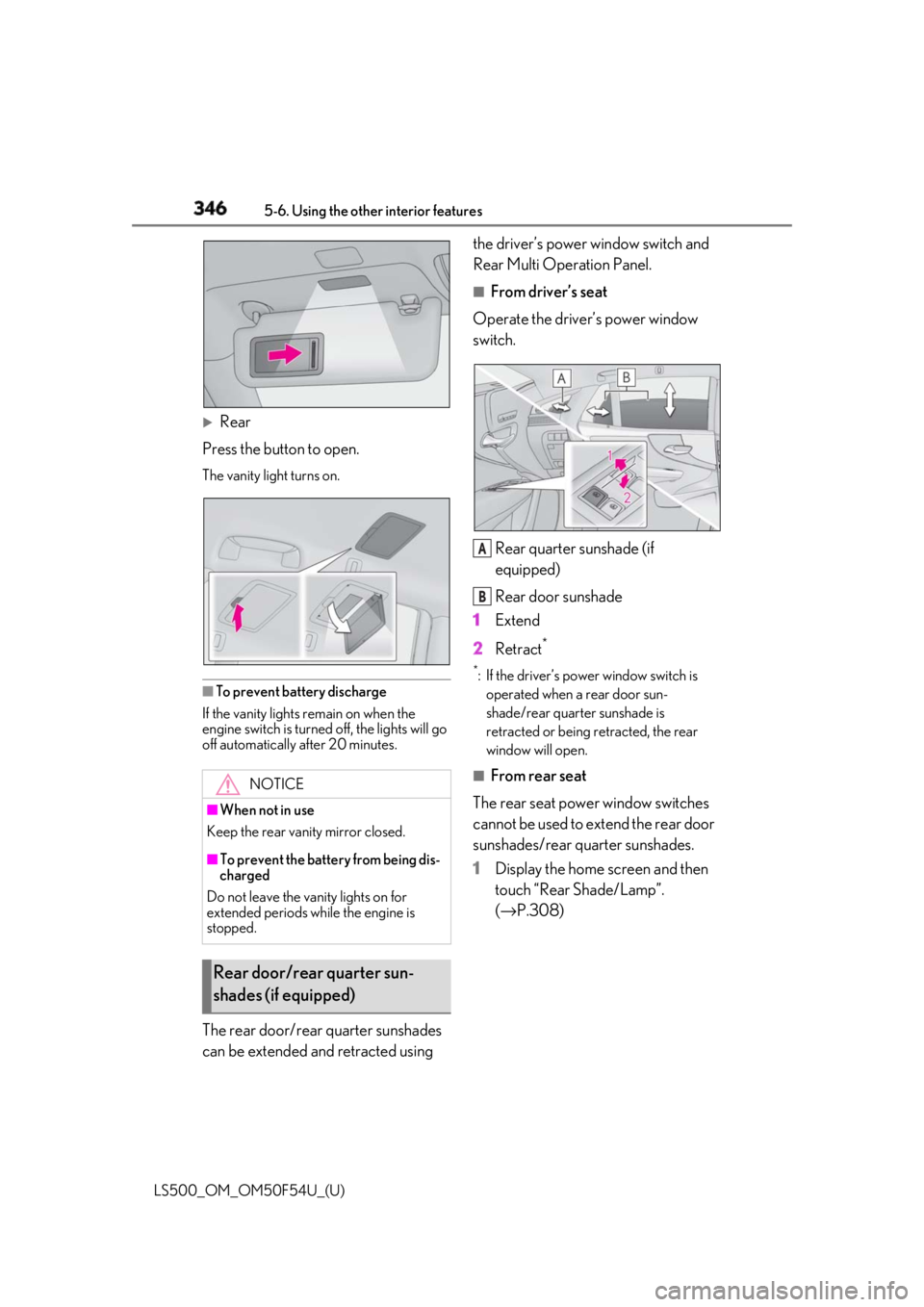
Rear
Press the button to open. The vanity light turns on.
■
To prevent battery discharge
If the vanity lights remain on when the
engine switch is turned off, the lights will go
off automatically after 20 minutes.
The rear door/rear quarter sunshades
can be extended and retracted using the driver’s power window switch and
Rear Multi Operation Panel. ■
From driver’s seat
Operate the driver’s power window
switch.
Rear quarter sunshade (if
equipped)
Rear door sunshade
1 Extend
2 Retract **
: If the driver’s power window switch is
operated when a rear door sun-
shade/rear quarter sunshade is
retracted or being retracted, the rear
window will open. ■
From rear seat
The rear seat power window switches
cannot be used to extend the rear door
sunshades/rear quarter sunshades.
1 Display the home screen and then
touch “Rear Shade/Lamp”.
( → P.308)NOTICE
■
When not in use
Keep the rear vani ty mirror closed.
■
To prevent the battery from being dis-
charged
Do not leave the vanity lights on for
extended periods while the engine is
stopped.
Rear door/rear quarter sun-
shades (if equipped) A
B
Page 364 of 514

364 6-1. Maintenance and care
LS500_OM_OM50F54U_(U) WARNING■
Precaution regarding the front
bumper (vehicles with Lexus Safety
System+A)
If the paint of the fr ont bumper is chipped
or scratched, the Lexus Safety System+A
may not function correctly. If this occurs,
consult your Lexus dealer. ■
Precaution regarding the rear
bumper
If the paint of the rear bumper is chipped
or scratched, the fo llowing systems may
not function correctly. If this occurs, con-
sult your Lexus dealer. ●
Lexus Safety System+A (if equipped)●
BSM (if equipped)●
RCTA (if equipped)●
PKSB (if equipped)
NOTICE■
To prevent paint deterioration and
corrosion on the body and compo-
nents (aluminum wheels, etc.)●
Wash the vehicle immediately in the
following cases:
• After driving near the sea coast
• After driving on salted roads
• If coal tar or tree sap is present on the
paint surface
• If dead insects, in sect droppings or
bird droppings are present on the
paint surface
• After driving in an area contaminated
with soot, oily smoke, mine dust, iron
powder or chemical substances
• If the vehicle becomes heavily soiled
with dust or mud
• If liquids such as benzene and gasoline
are spilled on the paint surface ●
If the paint is chipped or scratched,
have it repaired immediately. ●
To prevent the wheels from corroding,
remove any dirt and store in a place
with low humidity when storing the
wheels. ■
Cleaning the exterior lights ●
Wash carefully. Do not use organic
substances or scrub with a hard brush.
This may damage the surfaces of the
lights. ●
Do not apply wax to the surfaces of the
lights.
Wax may cause damage to the lenses. ■
When using an automatic car wash
Set the wiper switch to the off position.
If the wiper switch is in “AUTO”, the wip-
ers may operate and the wiper blades
may be damaged. ■
When using a high pressure car wash ●
When washing the vehicle, do not
spray the camera or its surrounding
area directly with a high pressure
washer. Shock applied from high pres-
sure water may cause the device to not
operate normally. ●
Do not bring the nozzle tip close to
boots (rubber or re sin manufactured
cover), connectors or the following
parts. The parts may be damaged if
they come into contact with high-pres-
sure water.
• Traction related parts
•Steering parts
• Suspension parts
• Brake parts
Page 370 of 514
370 6-2. Maintenance
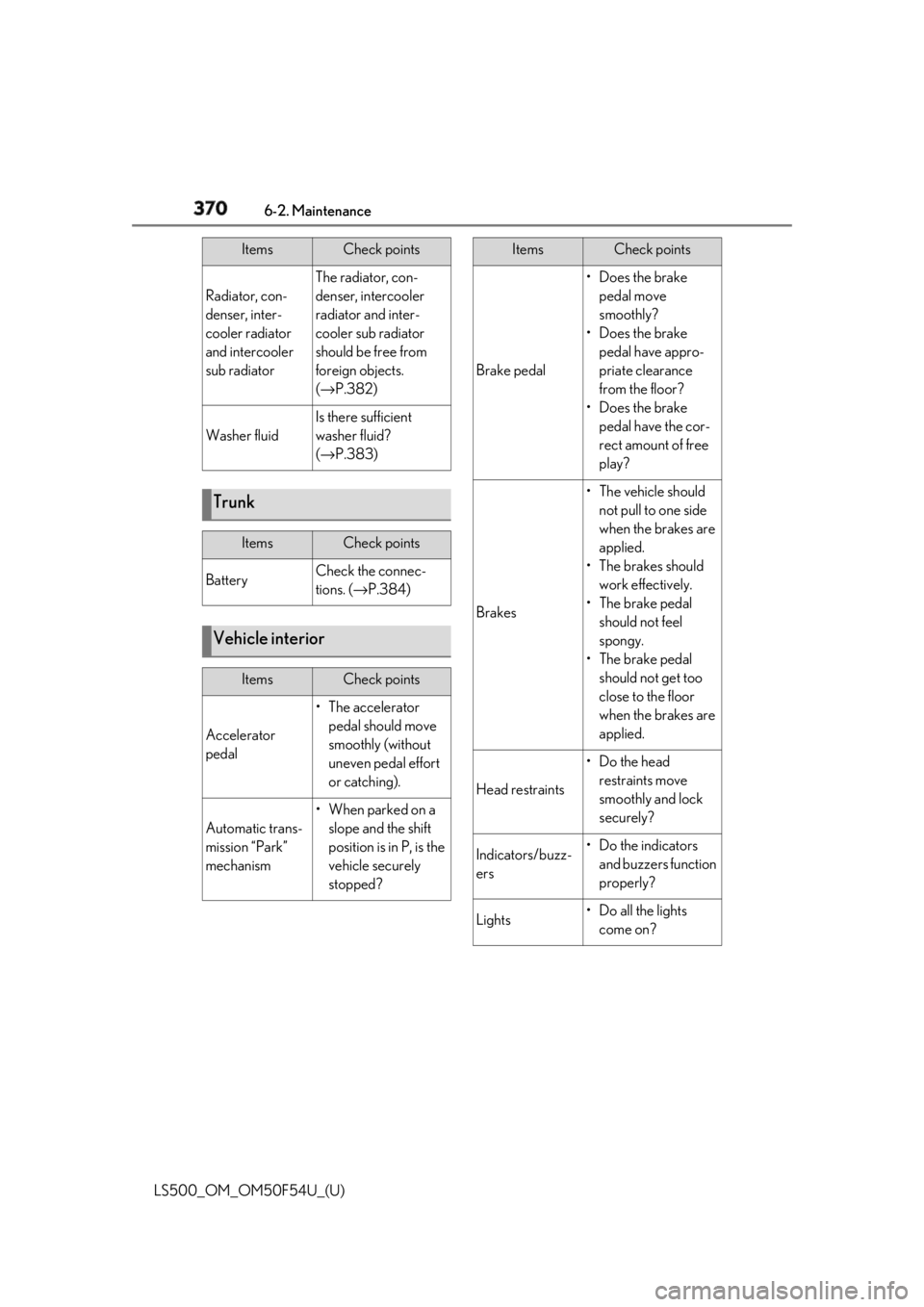
LS500_OM_OM50F54U_(U) Radiator, con-
denser, inter-
cooler radiator
and intercooler
sub radiator The radiator, con-
denser, intercooler
radiator and inter-
cooler sub radiator
should be free from
foreign objects.
( → P.382)
Washer fluid Is there sufficient
washer fluid?
( → P.383)
Trunk Items Check points
Battery Check the connec-
tions. ( → P.384)
Vehicle interior Items Check points
Accelerator
pedal • The accelerator
pedal should move
smoothly (without
uneven pedal effort
or catching).
Automatic trans-
mission “Park”
mechanism •When parked on a
slope and the shift
position is in P, is the
vehicle securely
stopped?Items Check points
Brake pedal •Does the brake
pedal move
smoothly?
•Does the brake
pedal have appro-
priate clearance
from the floor?
•Does the brake
pedal have the cor-
rect amount of free
play?
Brakes • The vehicle should
not pull to one side
when the brakes are
applied.
•The brakes should
work effectively.
• The brake pedal
should not feel
spongy.
• The brake pedal
should not get too
close to the floor
when the brakes are
applied.
Head restraints •Do the head
restraints move
smoothly and lock
securely?
Indicators/buzz-
ers •Do the indicators
and buzzers function
properly?
Lights • Do all the lights
come on?Items Check points
Page 393 of 514

3936-3. Do-it-yourself maintenance
LS500_OM_OM50F54U_(U) 6
Maintenance and care 5 Press or to select “Vehicle
Settings” and then press .
6 Press or to select “TPWS”
and then press .
7 Press or to select “Set
Pressure”. Then press and hold
until the tire pressure warning light
blinks 3 times.Then a message will be displayed on the
multi-information display.
“--” will be displayed on the multiinforma-
tion display for the inflation pressure of
each tire while initia lization is being per-
formed.
8 Drive straight (with occasional left
and right turns) at approximately
25 mph (40 km/h) or more for
approximately 10 to 30 minutes.Initialization is complete when the position
of each tire is determined and the inflation
pressure of each tire is displayed on the
multi-information display.
Initialization may take longer than approxi-
mately 1 hour in certain situations, such as
when the vehicle is stopped for a long time
at traffic lights, etc. ( → P.393)
■
Initialization procedure
●
Make sure to perform the initialization
procedure after adjusting the tire inflation
pressure.
Also, make sure the tires are cold before performing the initia lization procedure or
adjusting the tire inflation pressure. ●
If the engine switch is turned off during
initialization, it is no t necessary to restart
the initialization procedure from the
beginning as it will begin automatically
when the engine switch is turned back to
IGNITION ON mode. ●
If initialization has accidentally been
started when it is not necessary, adjust
the tire inflation pressure to the specified
level when the tires are cold and then
perform the initiali zation procedure
again. ●
While the position of each tire is being
determined and the inflation pressures
are not being displayed on the
multi-information display, if the inflation
pressure of a tire drops, the tire pressure
warning light will come on. ■
If the tire pressure warning system is not
initialized properly ●
In the following situations, initialization
may take longer than usual to be com-
pleted or may not be possible. (Usually,
the vehicle will need to be driven for
approximately 10 to 30 minutes to com-
plete initialization.) If initialization is not
complete after drivin g approximately 30
minutes, continue driving for a while.
• If the vehicle is driven on an unpaved
road, it may take longer to complete ini-
tialization.
• If the vehicle is backed up while perform-
ing initialization, data collected during ini-
tialization will be cleared and it will take
longer than normal to complete.
• If the vehicle is driven in heavy traffic or
another situation where other vehicles
are driven close by, it may take time for
the system to recognize the tire pressure
warning valve and transmitters of your
vehicle over those of other vehicles.
If initialization is not complete after driving
for approximately 1 hour, park the vehicle in
a safe place for approximately 20 minutes
and then drive the vehicle again.
●
In the following situations, initialization
will not be started or was not completed
properly and the system will not operate
properly. Perform the initialization proce-
Page 394 of 514

394 6-3. Do-it-yourself maintenance
LS500_OM_OM50F54U_(U) dure again.
• If, when attempting to start initialization,
the tire pressure warning light does not
blink 3 times.
• If, when the vehicle has been driven for
about 20 minutes after performing ini-
tialization, the tire pressure warning light
blinks for approximately 1 minute and
then illuminates.●
If initialization cannot be completed after
performing the above procedure, con-
tact your Lexus dealer.
Every tire pressure warning valve and
transmitter has a unique ID code.
When replacing a tire pressure warn-
ing valve and transmitter, it is necessary
to register the ID codes.
The ID codes can be registered on
of the multi-information display.
1 Press or of the meter con-
trol switch to select .
2 Press or to select “Vehicle
Settings” and then press .
3 Press or to select “TPWS”
and then press . 4 Press or to select “Change
Wheel Set”. Then press and hold
until the tire pressure warning
light blinks slowly 3 times. Then a message will be displayed on the
multi-information display.
When registration is being performed, the
tire pressure warning light will blink for
approximately 1 minute then illuminate and
“--” will be displayed for the inflation pres-
sure of each tire on the multi-information
display.
5 Drive straight (with occasional left
and right turns) at approximately
25 mph (40 km/h) or more for
approximately 10 to 30 minutes. Registration is complete when the tire
pressure warning light turns off and the
inflation pressure of ea ch tire is displayed
on the multiinformation display.
Registration may take longer than approxi-
mately 1 hour in certain situations, such as
when the vehicle is stopped for a long time
at traffic lights, etc. ( → P.395)
After registering the ID codes, make sure
to initialize the tire pressure warning sys-
tem. ( → P.392)
■
When registering ID codes
●
Before performing ID code registration,
make sure that no wheels with tire pres-
sure warning valve and transmitters
installed are near the vehicle.
●
Make sure to initializ e the tire pressure
warning system after registering the ID WARNING■
When initializing the tire pressure
warning system
Do not initialize the tire pressure warning
system without first adjusting the tire
inflation pressure to the specified level.
Otherwise, the tire pressure warning
light may not come on even if the tire
inflation pressure is low, or it may come
on when the tire inflation pressure is
actually normal.
Registering ID codes
Page 407 of 514

4076-3. Do-it-yourself maintenance
LS500_OM_OM50F54U_(U) 6
Maintenance and care
Type D
Normal fuse
Blown fuse ■
After a fuse is replaced●
When installing the lid, make sure that the
tab is installed securely.●
If the lights do not turn on even after the
fuse has been replaced, a bulb may need
replacement.●
If the replaced fuse blows again, have the
vehicle inspected by your Lexus dealer.■
If there is an overload in a circuit
The fuses are designed to blow, protecting
the wiring harness from damage.
WARNING■
To prevent system breakdowns and
vehicle fire
Observe the following precautions.
Failure to do so may cause damage to
the vehicle, and possibly a fire or injury.
●
Never use a fuse of a higher amperage
rating than that indicated, or use any
other object in place of a fuse.
●
Always use a genuine Lexus fuse or
equivalent.
Never replace a fuse with a wire, even
as a temporary fix.
●
Do not modify the fuses or fuse boxes. A
B NOTICE■
Before replacing fuses
Have the cause of electrical overload
determined and repaired by your Lexus
dealer as soon as possible.
Page 408 of 514

408 6-3. Do-it-yourself maintenance
LS500_OM_OM50F54U_(U) ■
LED Lights
The lights consist of a number of LEDs. If
any of the LEDs burn out, take your vehicle
to your Lexus dealer to have the light
replaced. ■
Condensation build-up on the inside of
the lens
Temporary condensation build-up on the
inside of the headlight lens does not indi-
cate a malfunction. Contact your Lexus
dealer for more information in the following
situations: ●
Large drops of water ha ve built up on the
inside of the lens.●
Water has built up inside the headlight.Light bulbs If any lights burn out, have it
replaced by your Lexus dealer.
Page 410 of 514
410 7-1. Essential information
LS500_OM_OM50F54U_(U) 7-1.Essential information
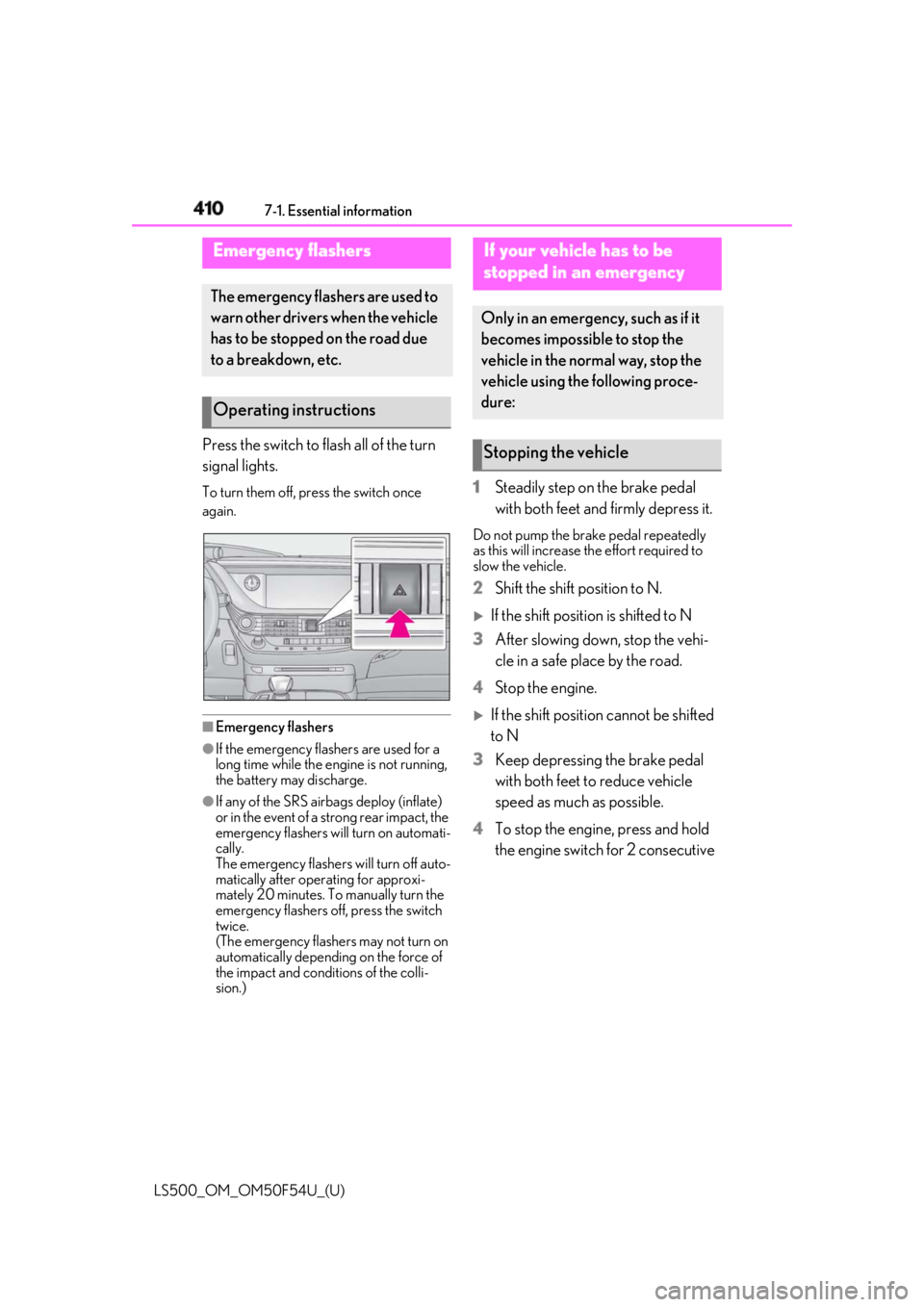
Press the switch to flash all of the turn
signal lights. To turn them off, press the switch once
again.
■
Emergency flashers●
If the emergency flashers are used for a
long time while the engine is not running,
the battery may discharge.●
If any of the SRS airbags deploy (inflate)
or in the event of a strong rear impact, the
emergency flashers will turn on automati-
cally.
The emergency flashers will turn off auto-
matically after operating for approxi-
mately 20 minutes. To manually turn the
emergency flashers off, press the switch
twice.
(The emergency flashers may not turn on
automatically depending on the force of
the impact and conditions of the colli-
sion.) 1 Steadily step on the brake pedal
with both feet and firmly depress it. Do not pump the brake pedal repeatedly
as this will increase the effort required to
slow the vehicle.
2 Shift the shift position to N.
If the shift position is shifted to N
3 After slowing down, stop the vehi-
cle in a safe place by the road.
4 Stop the engine.
If the shift position cannot be shifted
to N
3 Keep depressing the brake pedal
with both feet to reduce vehicle
speed as much as possible.
4 To stop the engine, press and hold
the engine switch for 2 consecutive Emergency flashers The emergency flashers are used to
warn other drivers when the vehicle
has to be stopped on the road due
to a breakdown, etc.
Operating instructions If your vehicle has to be
stopped in an emergency Only in an emergency, such as if it
becomes impossible to stop the
vehicle in the normal way, stop the
vehicle using the following proce-
dure:
Stopping the vehicle