2018 KIA SPORTAGE engine
[x] Cancel search: enginePage 583 of 605
99
Specifications, Consumer information, Reporting safety defects
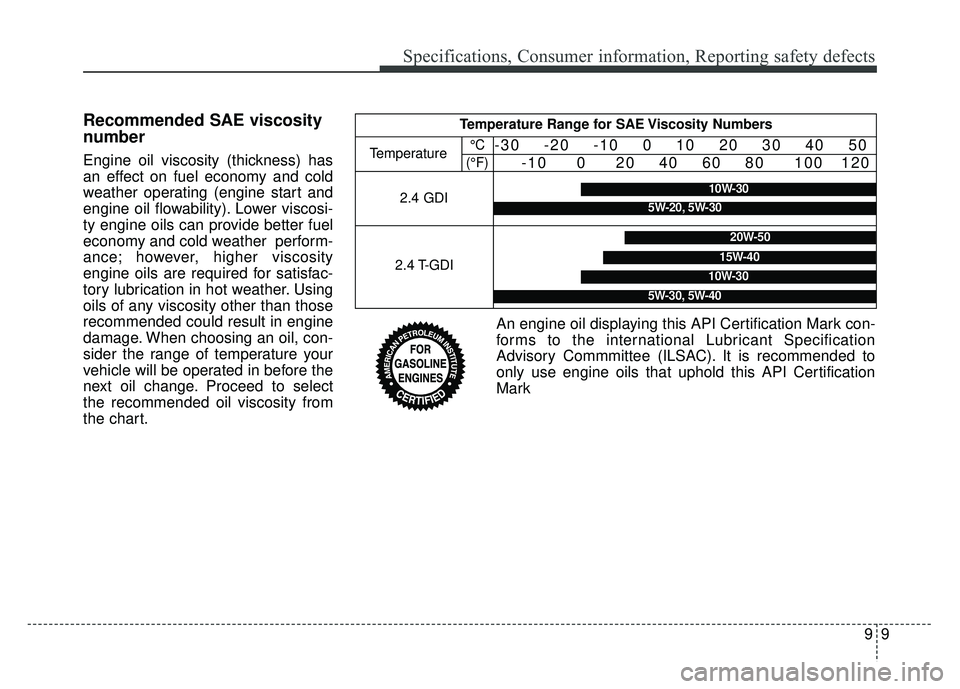
Recommended SAE viscosity
number
Engine oil viscosity (thickness) has
an effect on fuel economy and cold
weather operating (engine start and
engine oil flowability). Lower viscosi-
ty engine oils can provide better fuel
economy and cold weather perform-
ance; however, higher viscosity
engine oils are required for satisfac-
tory lubrication in hot weather. Using
oils of any viscosity other than those
recommended could result in engine
damage. When choosing an oil, con-
sider the range of temperature your
vehicle will be operated in before the
next oil change. Proceed to select
the recommended oil viscosity from
the chart.
Temperature Range for SAE Viscosity Numbers
Temperature°C
(°F)-30 -20 -10 0 10 20 30 40 50 -10 0 20 40 60 80 100 120
2.4 T-GDI
20W-50
10W-30
15W-40
5W-30, 5W-40
2.4 GDI10W-30
5W-20, 5W-30
An engine oil displaying this API Certification Mark con-
forms to the international Lubricant Specification
Advisory Commmittee (ILSAC). It is recommended to
only use engine oils that uphold this API Certification
Mark
Page 584 of 605
Specifications, Consumer information, Reporting safety defects
10
9
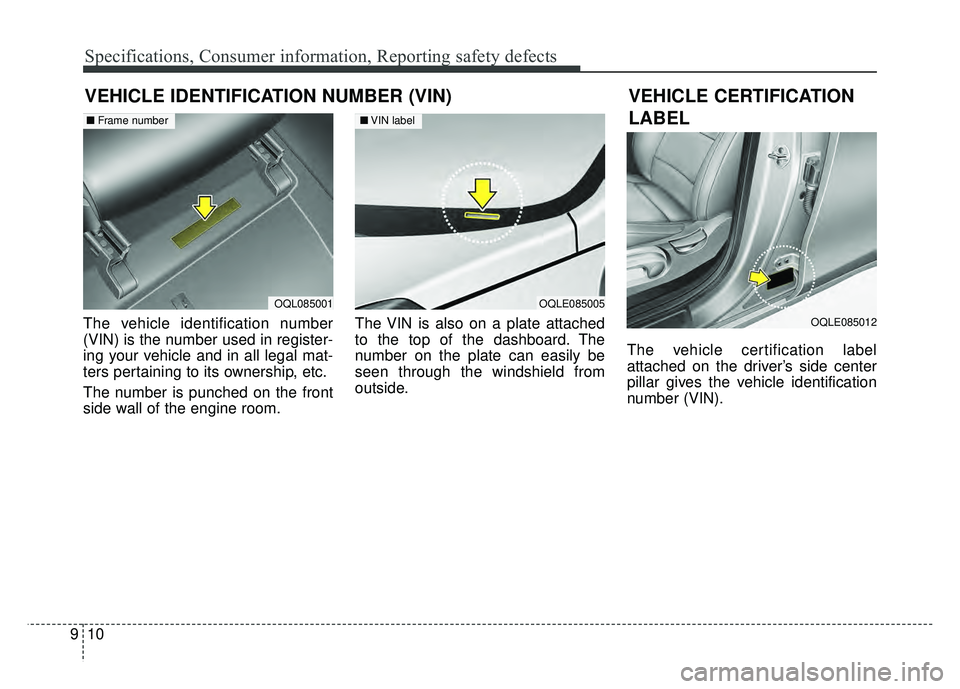
VEHICLE IDENTIFICATION NUMBER (VIN)
The vehicle identification number
(VIN) is the number used in register-
ing your vehicle and in all legal mat-
ters pertaining to its ownership, etc.
The number is punched on the front
side wall of the engine room. The VIN is also on a plate attached
to the top of the dashboard. The
number on the plate can easily be
seen through the windshield from
outside.
The vehicle certification label
attached on the driver’s side center
pillar gives the vehicle identification
number (VIN).
VEHICLE CERTIFICATION
LABEL
OQL085001
■
Frame number
OQLE085005
■VIN label
OQLE085012
Page 585 of 605
911
Specifications, Consumer information, Reporting safety defects
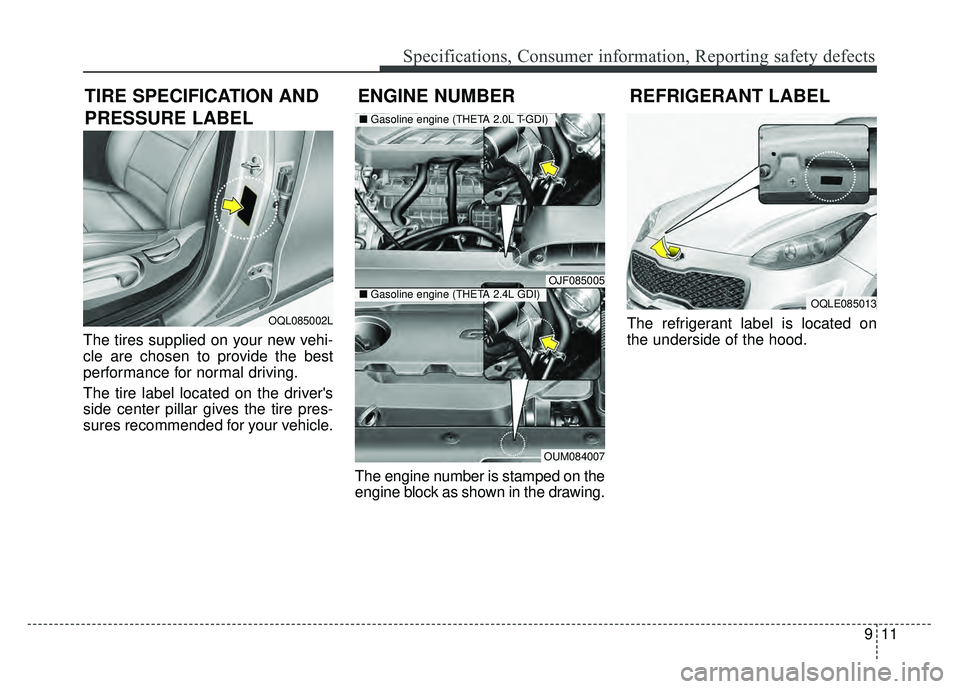
The tires supplied on your new vehi-
cle are chosen to provide the best
performance for normal driving.
The tire label located on the driver's
side center pillar gives the tire pres-
sures recommended for your vehicle.The engine number is stamped on the
engine block as shown in the drawing.The refrigerant label is located on
the underside of the hood.
ENGINE NUMBER
TIRE SPECIFICATION AND
PRESSURE LABELREFRIGERANT LABEL
OQL085002L
OQLE085013
OJF085005
OUM084007
■ Gasoline engine (THETA 2.0L T-GDI)
■Gasoline engine (THETA 2.4L GDI)
Page 588 of 605
Specifications, Consumer information, Reporting safety defects
14
9
Registering your vehicle in a foreign country
If you plan to register your vehicle in a foreign country,
you should confirm that it conforms to the regulations in
that country. Even if you successfully register the vehicle
in a foreign country, you may experience the following
problems and should therefore consider the possibility of
having to deal with them:
1. The fuel specified for your vehicle may be unavailable.
If other than the specified fuel is used, it could cause
damage to the engine, the fuel injection system, and
other fuel-related parts which may not be covered
under your New Vehicle Emissions Limited Warranty.
2. We must, therefore, clearly state that when you leave the country in which you purchased your Kia new and
register it in another country, problems arising from the
use of fuel other than the specified fuel are not subject
to manufacturer’s warranty. Because vehicles like
yours may not be marketed in the new country of reg-
istration, parts, servicing techniques and tools neces-
sary to maintain and repair your vehicle may be
unavailable.
Even if vehicles like yours are sold there, mechanical
specifications required by the government may vary
enough from the country of purchase to cause addi-
tional problems. 3. There may not be an Authorized Kia Dealer in the area
in which you plan to register your vehicle. You may
additionally experience difficulty in obtaining services
in a foreign country for any number of reasons.
Further, we cannot assume any responsibility for prob-
lems that result from unsatisfactory service or lack of
service outside of the United States.
Page 589 of 605
915
Specifications, Consumer information, Reporting safety defects
The electrical system of your vehicle is designed to per-
form under all reasonably expected operating conditions.
However, before any additional electrical equipment is
installed in your vehicle, consult an Authorized Kia
Dealer, in order to ensure that you do not void your war-
ranty.
Certain electrical equipment, or the way in which it is
installed, may adversely affect the operation of your vehi-
cle, including such systems as the engine control system,
the audio system and the electrical charging system and
thus potentially void all or part of your warranty.
We assume no responsibility for any expense you may
incur or for any malfunction of your vehicle or any of its
components or systems that may result from the installa-
tion of additional electrical equipment that is not supplied,
or recommended for installation by, Kia.Installation of a mobile two-way radio system
If a mobile two-way radio system is installed improperly,
or if an excessively powerful type of system is used, other
electronic systems may be adversely affected. To avoid
damage to your vehicle, consult an Authorized Kia Dealer
concerning the proper equipment and installation.
Kia motor vehicles are designed and manufactured to
meet or exceed all applicable safety standards.
For your safety, however, we strongly urge you to read
and follow all directions in this Owner's Manual, particu-
larly the information under the headings "NOTICE",
"CAUTION" and "WARNING".
If, after reading this manual, you have any questions
regarding the operation of your vehicle, safety issues and
defects please contact your Kia's toll-free Consumer
Assistance hot line as below:
National Consumer Affairs Manager
Kia Motors America, Inc.
P.O. Box 52410
Irvine, CA 92619-2410
1-800-333-4Kia (4542)
ELECTRICAL EQUIPMENT (U.S. ONLY)
Page 590 of 605
If you believe that your vehicle has a defect which could
cause a crash or could cause injury or death, you should
immediately inform the National Highway Traffic Safety
Administration (NHTSA) in addition to notifying Kia
Motors America, Inc.
If NHTSA receives similar complaints, it may open an
investigation, and if it finds that a safety defect exists in a
group of vehicles, it may order a recall and remedy cam-
paign. However, NHTSA cannot become involved in indi-
vidual problems between you, your dealer, or Kia Motors
America, Inc.
To contact NHTSA, you may call the Vehicle Safety
Hotline toll-free at 1-888-327-4236 (TTY: 1-800-424-
9153); go to http://www.safercar.gov; download the
SaferCar mobile application; or write to: Administrator,
NHTSA, 1200 New Jersey Ave., SE., West Building,
Washington, DC 20590. You can also obtain other infor-
mation about motor vehicle safety from http://www.safer-
car.gov.The following publications are available on
www.KiaTechinfo.com
Service manual:
This manual covers maintenance and recommended pro-
cedures for repair to engine and chassis components. It
is written for the Journeyman mechanic, but is simple
enough for most mechanically inclined owners to under-
stand.
Electrical troubleshooting manual:
This manual complements the Service Manual by provid-
ing indepth troubleshooting information for each electrical
circuit in your vehicle.
Owner's manual:
This manual describes the overall features and operating
procedures for the vehicle.
REPORTING SAFETY DEFECTS
(U.S. ONLY)
ONLINE FACTORY AUTHORIZED MANUALS
(U.S. ONLY)
916
Specifications, Consumer information, Reporting safety defects
Page 593 of 605
I3
Index
Sensor to detect the distance from the vehiclein front (front radar)..................................................6-56
System malfunction ....................................................6-57
Limitation of the system ............................................6-58
Recognizing pedestrians ............................................6-61
Back-up lamp and Rear turn signal lamp bulb replacement..........................................................8-87
Battery........................................................................\
....8-42 For best battery service ..............................................8-42
Recharging the battery ................................................8-43
Reset items ..................................................................8-44
Battery replacement (folding key) ..................................4-8
Battery replacement (smart key)....................................4-17
Battery saver function ..................................................4-118
Before driving ..................................................................6-4
Blind Spot Detection System (BSD) ............................6-72 BSD (Blind Spot Detection)/LCA (Lane Change Assist)......................................6-73
RCTA (Rear cross traffic alert) ..................................6-76
Bonnet see the hood ......................................................4-43
Brake system..................................................................6-28 Power brakes ..............................................................6-28
Parking brake ..............................................................6-30
Electric parking brake (EPB) ......................................6-31
Auto hold ....................................................................6-38\
Anti-lock brake system (ABS)....................................6-42
Electronic stability control (ESC) ..............................6-44
Vehicle stability management (VSM) ........................6-48
Hill-start assist control (HAC) ....................................6-49
Brakes fluid....................................................................8-32\
Checking the brake fluid level ....................................8-32
Bulb replacement ..........................................................8-78
Bulb wattage ....................................................................9-3
Button start/stop, see engine start/stop button ................6-9
California Perchlorate notice ......................................8-103
Camera (Rear view) ....................................................4-117
Capacities (Lubricants) ....................................................9-7
Care Care of seat belts ........................................................3-31
SRS Care ....................................................................3-68\
Tire care ......................................................................8-\
44
Exterior care ................................................................8-93
Interior care ................................................................8-98
Care of seat belts ..........................................................3-31
Center console storage ................................................4-161
Central door lock switch................................................4-24
Chains - Tire ..................................................................6-91
Checking fluid levels ....................................................8-25
Checking tire inflation pressure ....................................8-46
Child restraint system ....................................................3-32
B
C
Page 594 of 605
Index
4I
Children Always in the Rear ......................................3-32
Selecting a Child Restraint System (CRS) ................3-33
Installing a Child Restraint System (CRS) ................3-36
Securing a child restraint withthe LATCH anchors system ..........................................................3-38
Securing a child restraint seatwith Tether Anchor system ..............................................3-39
Child-protector rear door lock ......................................4-26
Climate control air filter ................................................8-37 Filter inspection ..........................................................8-37
Climate control system ................................................4-134 Manual climate control system ................................4-134
Automatic climate control system ............................4-144
Automatic heating and air conditioning ..................4-145
Closing the sunroof........................................................4-52
Clothes hanger ............................................................4-172
Combined instrument, see instrument cluster ..............4-68
Compact spare tire ........................................................7-21
Components of the Tire Mobility Kit ............................7-26
Consumer assistance (U.S. only) ..................................9-12 Toll free consumer assistance ....................................9-12
Emergency roadside assistance ..................................9-12
Trip interruption ..........................................................9-13
Registering your vehicle in a foreign country ............9-14
Coolant ........................................................................\
..8-28
Cooling fluid, see engine coolant ..................................8-28
Crankcase emission control system ............................8-101
Cruise control system ....................................................6-66 Cruise control switch ..................................................6-66
To set cruise control speed..........................................6-67
To increase cruise control set speed ..........................6-67
To decrease the cruising speed ..................................6-68
To temporarily accelerate with the cruise control on 6-68
To cancel cruise control ..............................................6-68
To resume cruising speed at more than approximately 20mph (30 km/h) ..............................6-69
To turn cruise control off ............................................6-69
Cup holder ..................................................................4-164
Curtain air bag ..............................................................3-61
Dashboard illumination, see instrument panel illumination ........................................................4-69
Dashboard, see instrument cluster ................................4-68
Day/night rearview mirror ............................................4-58
Declaration of Conformity ............................................5-64 FCC ........................................................................\
....5-64
Defogging (Windshield) ..............................................4-156
Defroster (Rear window) ............................................4-133
Defrosting (Windshield) ..............................................4-156
Dimensions ......................................................................9-\
2
Disarmed stage ..............................................................4-20
Display illumination, see instrument panel illumination..................................................................4-69
Displays, see instrument cluster ....................................4-68
D