Page 564 of 605
Maintenance
94
8
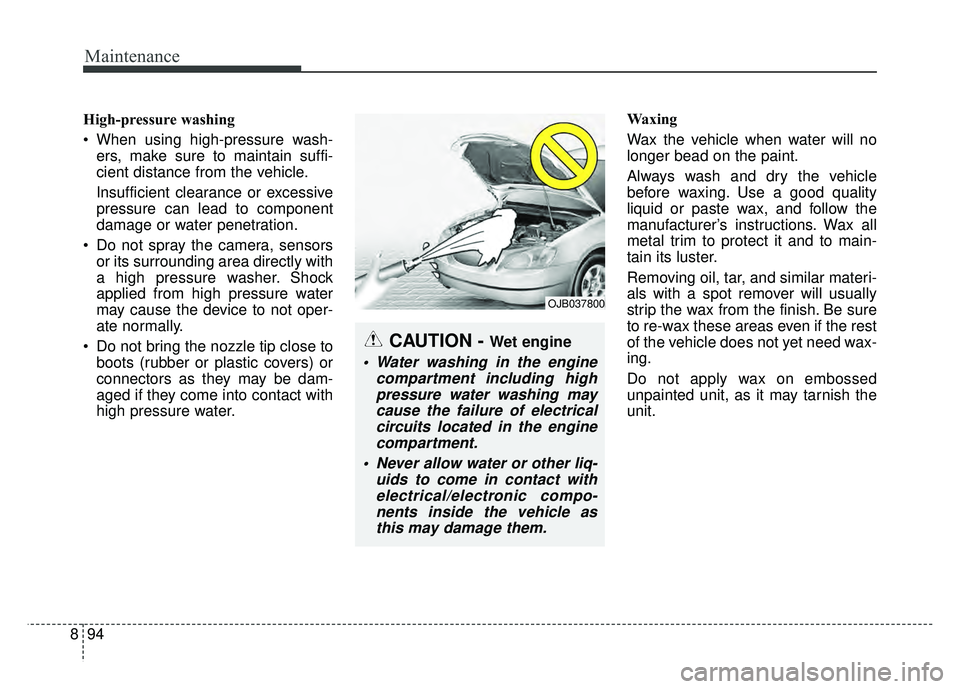
High-pressure washing
When using high-pressure wash-
ers, make sure to maintain suffi-
cient distance from the vehicle.
Insufficient clearance or excessive
pressure can lead to component
damage or water penetration.
Do not spray the camera, sensors or its surrounding area directly with
a high pressure washer. Shock
applied from high pressure water
may cause the device to not oper-
ate normally.
Do not bring the nozzle tip close to boots (rubber or plastic covers) or
connectors as they may be dam-
aged if they come into contact with
high pressure water. Waxing
Wax the vehicle when water will no
longer bead on the paint.
Always wash and dry the vehicle
before waxing. Use a good quality
liquid or paste wax, and follow the
manufacturer’s instructions. Wax all
metal trim to protect it and to main-
tain its luster.
Removing oil, tar, and similar materi-
als with a spot remover will usually
strip the wax from the finish. Be sure
to re-wax these areas even if the rest
of the vehicle does not yet need wax-
ing.
Do not apply wax on embossed
unpainted unit, as it may tarnish the
unit.
OJB037800
CAUTION - Wet engine
Water washing in the engine
compartment including highpressure water washing maycause the failure of electricalcircuits located in the enginecompartment.
Never allow water or other liq- uids to come in contact withelectrical/electronic compo-nents inside the vehicle asthis may damage them.
Page 572 of 605
Maintenance
102
8
Canister
Fuel vapors generated inside the fuel
tank are absorbed and stored in the
onboard canister. When the engine is
running, the fuel vapors absorbed in
the canister are drawn into the surge
tank through the purge control sole-
noid valve.
Purge Control Solenoid Valve
(PCSV)
The purge control solenoid valve is
controlled by the Engine Control
Module (ECM); when the engine
coolant temperature is low during
idling, the PCSV closes so that evap-
orated fuel is not taken into the
engine. After the engine warms up
during ordinary driving, the PCSV
opens to introduce evaporated fuel to
the engine.
3. Exhaust emission control system
The Exhaust Emission Control
System is a highly effective system
which controls exhaust emissions
while maintaining good vehicle per-
formance.
Vehicle modifications
This vehicle should not be modified.
Modification of your vehicle could
affect its performance, safety or
durability and may even violate gov-
ernmental safety and emissions reg-
ulations.
In addition, damage or performance
problems resulting from any modifi-
cation may not be covered under
warranty.
If you use unauthorized electronic
devices, it may cause the vehicle to
operate abnormally, wire damage,
battery discharge and fire. For your
safety, do not use unauthorized
electronic devices.
Engine exhaust gas precautions
(carbon monoxide)
Carbon monoxide can be present with other exhaust fumes.
Therefore, if you smell exhaust
fumes of any kind inside your vehi-
cle, have it inspected and repaired
immediately. If you ever suspect
exhaust fumes are coming into
your vehicle, drive it only with all
the windows fully open. Have your
vehicle checked and repaired
immediately.
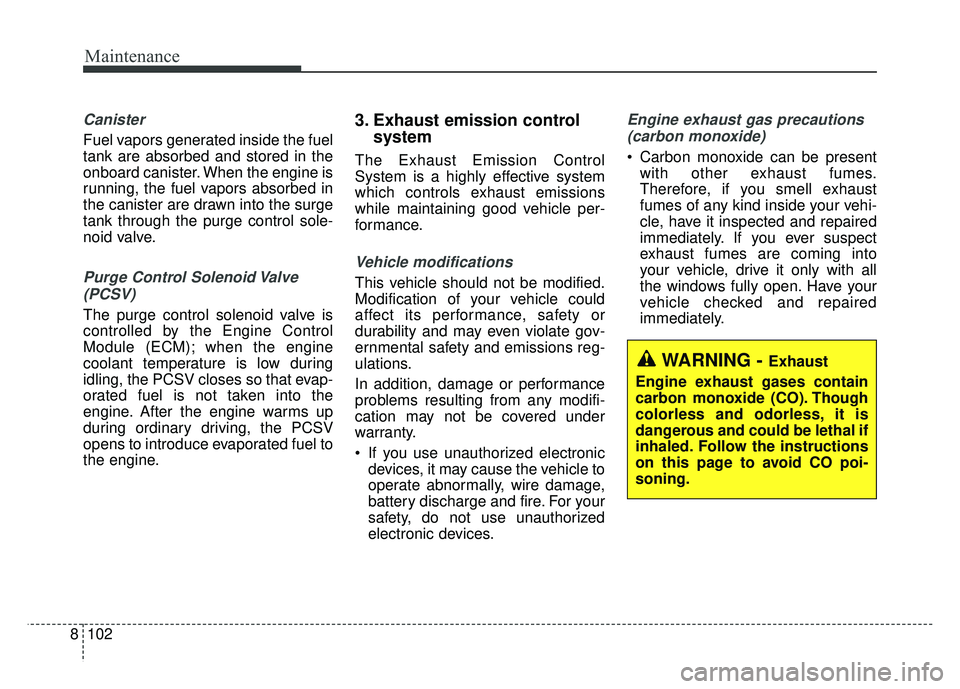
WARNING - Exhaust
Engine exhaust gases contain
carbon monoxide (CO). Though
colorless and odorless, it is
dangerous and could be lethal if
inhaled. Follow the instructions
on this page to avoid CO poi-
soning.
Page 573 of 605
8103
Maintenance
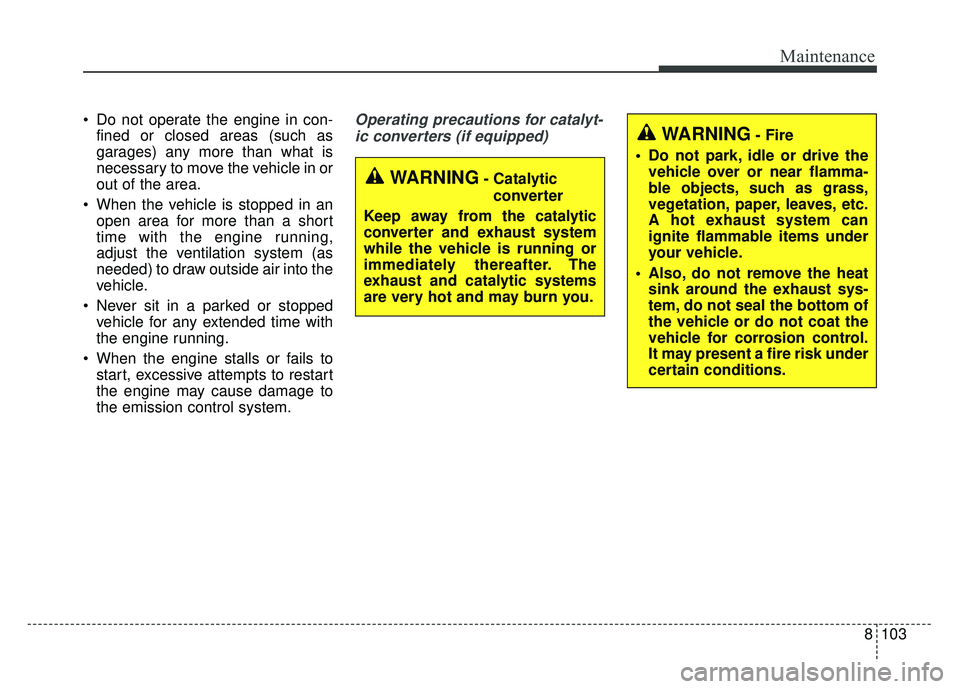
Do not operate the engine in con-fined or closed areas (such as
garages) any more than what is
necessary to move the vehicle in or
out of the area.
When the vehicle is stopped in an open area for more than a short
time with the engine running,
adjust the ventilation system (as
needed) to draw outside air into the
vehicle.
Never sit in a parked or stopped vehicle for any extended time with
the engine running.
When the engine stalls or fails to start, excessive attempts to restart
the engine may cause damage to
the emission control system.Operating precautions for catalyt-
ic converters (if equipped)
WARNING- Catalytic converter
Keep away from the catalytic
converter and exhaust system
while the vehicle is running or
immediately thereafter. The
exhaust and catalytic systems
are very hot and may burn you.
WARNING- Fire
Do not park, idle or drive the vehicle over or near flamma-
ble objects, such as grass,
vegetation, paper, leaves, etc.
A hot exhaust system can
ignite flammable items under
your vehicle.
Also, do not remove the heat sink around the exhaust sys-
tem, do not seal the bottom of
the vehicle or do not coat the
vehicle for corrosion control.
It may present a fire risk under
certain conditions.
Page 574 of 605
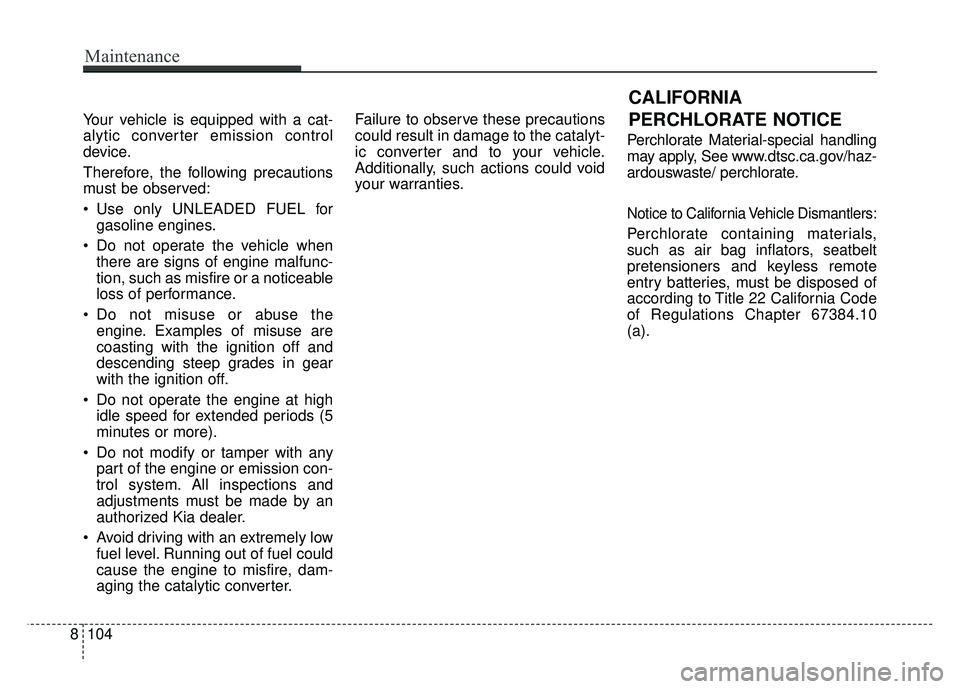
Your vehicle is equipped with a cat-
alytic converter emission control
device.
Therefore, the following precautions
must be observed:
Use only UNLEADED FUEL forgasoline engines.
Do not operate the vehicle when there are signs of engine malfunc-
tion, such as misfire or a noticeable
loss of performance.
Do not misuse or abuse the engine. Examples of misuse are
coasting with the ignition off and
descending steep grades in gear
with the ignition off.
Do not operate the engine at high idle speed for extended periods (5
minutes or more).
Do not modify or tamper with any part of the engine or emission con-
trol system. All inspections and
adjustments must be made by an
authorized Kia dealer.
Avoid driving with an extremely low fuel level. Running out of fuel could
cause the engine to misfire, dam-
aging the catalytic converter. Failure to observe these precautions
could result in damage to the catalyt-
ic converter and to your vehicle.
Additionally, such actions could void
your warranties.
Perchlorate Material-special handling
may apply, See www.dtsc.ca.gov/haz-
ardouswaste/ perchlorate.
Notice to California Vehicle Dismantlers:
Perchlorate containing materials,
such as air bag inflators, seatbelt
pretensioners and keyless remote
entry batteries, must be disposed of
according to Title 22 California Code
of Regulations Chapter 67384.10
(a).
CALIFORNIA
PERCHLORATE NOTICE
8104
Maintenance
Page 575 of 605

Specifications, Consumer information and Reporting safety defects
Engine . . . . . . . . . . . . . . . . . . . . . . . . . . . . . . . . . . . . \
9-2
Dimensions . . . . . . . . . . . . . . . . . . . . . . . . . . . . . . . . 9-2
Bulb wattage . . . . . . . . . . . . . . . . . . . . . . . . . . . . . . . 9-3
Tires and wheels . . . . . . . . . . . . . . . . . . . . . . . . . . . . 9-4
Luggage volume . . . . . . . . . . . . . . . . . . . . . . . . . . . . 9-6
Air conditioning system . . . . . . . . . . . . . . . . . . . . . . 9-6
Gross vehicle weight. . . . . . . . . . . . . . . . . . . . . . . . . 9-6
Recommended lubricants and capacities . . . . . . . . 9-7
• Recommended SAE viscosity number. . . . . . . . . . . . . 9-9
Vehicle certification label. . . . . . . . . . . . . . . . . . . . 9-10
Vehicle identification number (VIN) . . . . . . . . . . 9-10
Refrigerant label. . . . . . . . . . . . . . . . . . . . . . . . . . . 9-11
Tire specification and pressure label . . . . . . . . . . 9-11
Engine number . . . . . . . . . . . . . . . . . . . . . . . . . . . . 9-11
Consumer assistance (U.S. only) . . . . . . . . . . . . . . 9-12
. . . . . . . . . . . . . . . . . . . 9-12
. . . . . . . . . . . . . . . . . 9-12
. . . . . . . . . . . . . . . . . . . . . . . . . . . . . 9-13
. . . . . 9-14
Electrical Equipment (U.S. only) . . . . . . . . . . . . . 9-15
. . . . . 9-15
Reporting Safety Defects (U.S. only) . . . . . . . . . . 9-16
Online factory authorized manuals (U.S. only) . . 9-16
. . . . . . . . . . . . . . . . . . . . . . . . . . . . . . 9-16
. . . . . . . . . . . . . . 9-16
. . . . . . . . . . . . . . . . . . . . . . . . . . . . . 9-16
9
Page 576 of 605
Specifications, Consumer information, Reporting safety defects
29
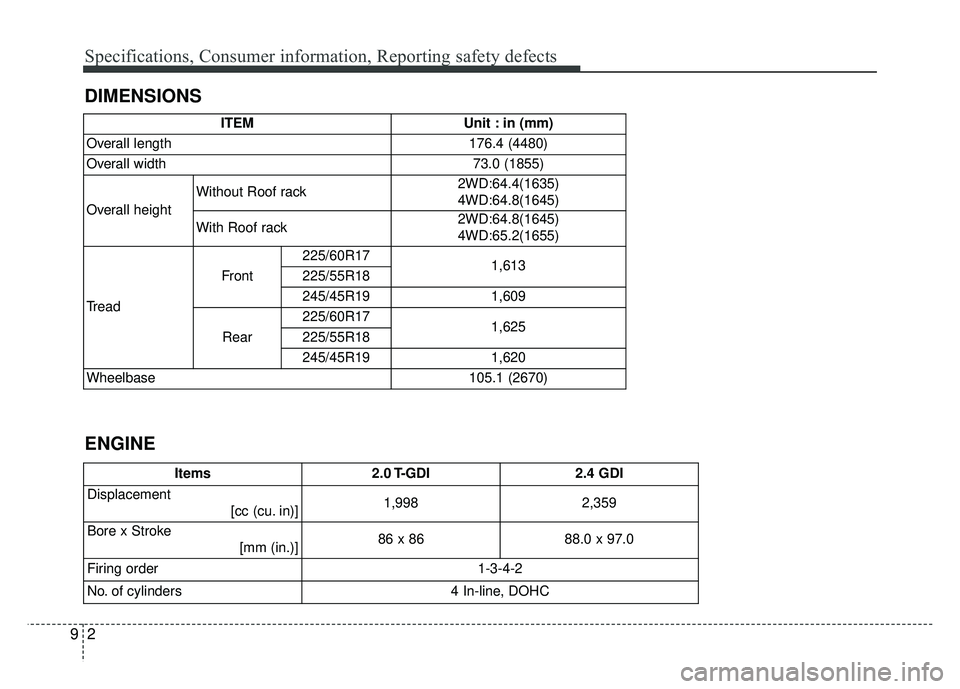
DIMENSIONS
ENGINE
ITEMUnit : in (mm)
Overall length176.4 (4480)
Overall width73.0 (1855)
Overall height
Without Roof rack2WD:64.4(1635)
4WD:64.8(1645)
With Roof rack2WD:64.8(1645)
4WD:65.2(1655)
Tread
Front
225/60R171,613225/55R18
245/45R191,609
Rear
225/60R171,625225/55R18
245/45R191,620
Wheelbase105.1 (2670)
Items 2.0 T-GDI2.4 GDI
Displacement[cc (cu. in)]1,9982,359
Bore x Stroke [mm (in.)]86 x 8688.0 x 97.0
Firing order1-3-4-2
No. of cylinders4 In-line, DOHC
Page 581 of 605
97
Specifications, Consumer information, Reporting safety defects
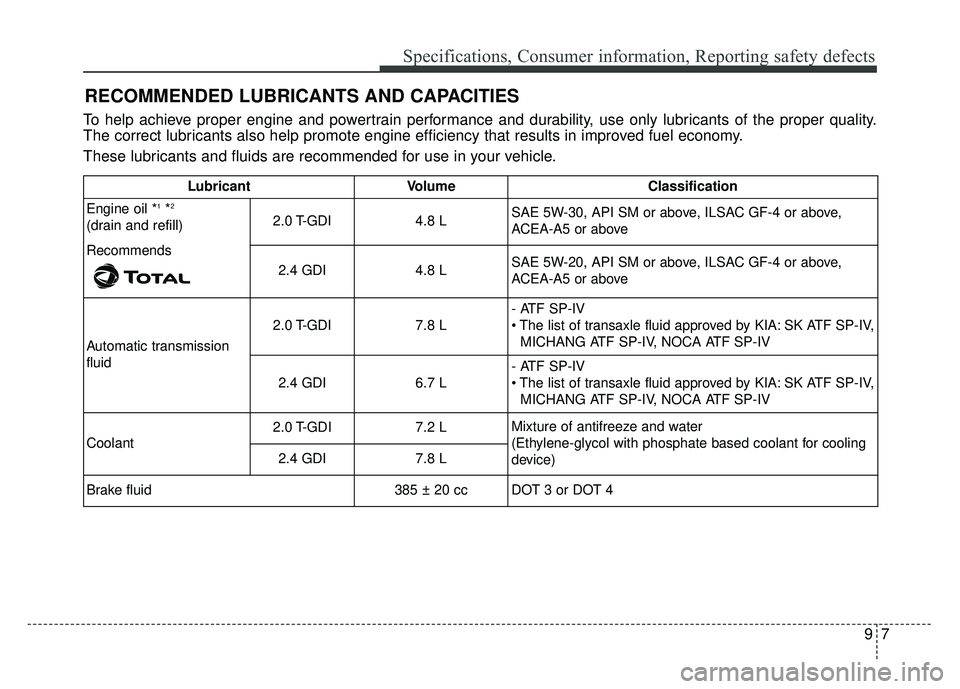
RECOMMENDED LUBRICANTS AND CAPACITIES
To help achieve proper engine and powertrain performance and durability, use only lubricants of the proper quality.
The correct lubricants also help promote engine efficiency that results in improved fuel economy.
These lubricants and fluids are recommended for use in your vehicle.
LubricantVolumeClassification
Engine oil *
1*2
(drain and refill)
Recommends 2.0 T-GDI4.8 L
SAE 5W-30, API SM or above, ILSAC GF-4 or above,
ACEA-A5 or above
2.4 GDI
4.8 L SAE 5W-20, API SM or above, ILSAC GF-4 or above,
ACEA-A5 or above
Automatic transmission
fluid 2.0 T-GDI
7.8 L
- ATF SP-IV
• The list of transaxle fluid approved by KIA: SK ATF SP-IV,
MICHANG ATF SP-IV, NOCA ATF SP-IV
2.4 GDI
6.7 L - ATF SP-IV
SK ATF SP-IV,
MICHANG ATF SP-IV, NOCA ATF SP-IV
Coolant 2.0 T-GDI
7.2 L
Mixture of antifreeze and water
(Ethylene-glycol with phosphate based coolant for cooling
device)
2.4 GDI
7.8 L
Brake fluid
385 ± 20 cc DOT 3 or DOT 4
Page 582 of 605
Specifications, Consumer information, Reporting safety defects
89
*1Refer to the recommended SAE viscosity numbers on the next page.
*2Engine oils labeled Energy Conserving Oil are now available. Along with other additional benefits, they contribute to fuel econo my by reducing
the amount of fuel necessary to overcome engine friction. Often, these improvements are difficult to measure in everyday driving, but in a year’s
time, they can offer significant cost and energy savings.
*
3If the API service SM engine oil is not available in your country, you are able to use API service SL.
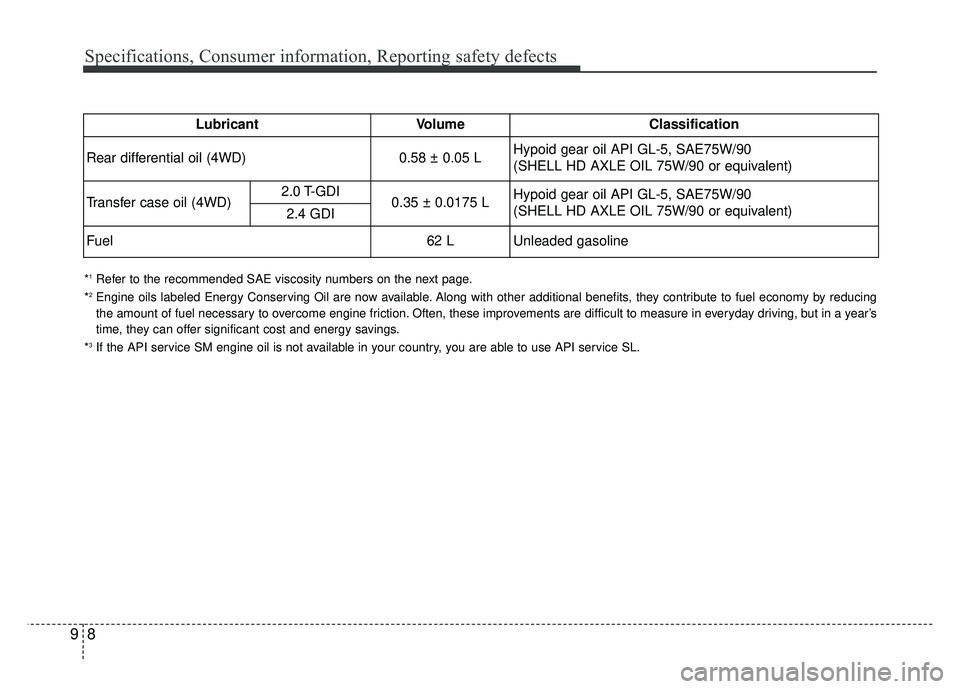
LubricantVolume Classification
Rear differential oil (4WD)
0.58 ± 0.05 L Hypoid gear oil API GL-5, SAE75W/90
(SHELL HD AXLE OIL 75W/90 or equivalent)
Transfer case oil (4WD) 2.0 T-GDI
0.35 ± 0.0175 L
Hypoid gear oil API GL-5, SAE75W/90
(SHELL HD AXLE OIL 75W/90 or equivalent)
2.4 GDI
Fuel
62 L Unleaded gasoline