Page 475 of 620
What to do in an emergency
36
7
Emergency towing precautions
Turn the ignition switch to ACC so
the steering wheel isn’t locked.
Place the transaxle shift lever in N (Neutral).
Release the parking bake.
Press the brake pedal with more force than usual since you will have
reduced brake performance.
More steering effort will be required because the power steer-
ing system will be disabled.
If you are driving down a long hill, the brakes may overheat and brake
performance will be reduced. Stop
often and let the brakes cool off.
If the car is being towed with all four wheels on the ground, it can
be towed only from the front. Be
sure that the transaxle is in neutral.
Be sure the steering is unlocked by
placing the ignition switch in the
ACC position. A driver must be in
the towed vehicle to operate the
steering and brakes.
✽ ✽ NOTICE
Before towing, check the automatic
transaxle for fluid leaks under your
vehicle. If the automatic transaxle
fluid is leaking, a flatbed equipment
or towing dolly must be used.
CAUTION- Automatic
transaxle
To avoid serious damage to theautomatic transaxle, limit thevehicle speed to 10 mph (15km/h) and drive less than 1 mile(1.5 km) when towing.
Page 485 of 620
Maintenance
10
8
SCHEDULED MAINTENANCE SERVICE
Follow the Normal Maintenance
Schedule if the vehicle is usually
operated where none of the following
conditions apply. If any of the follow-
ing conditions apply, follow the
Maintenance Under Severe Usage
Conditions.
Repeated driving short distance of
less than 5 miles (8 km) in normal
temperature or less than 10 miles
(16 km)in freezing temperature
Extensive engine idling or low speed driving for long distances
Driving on rough, dusty, muddy, unpaved, graveled or salt-spread
roads
Driving in areas using salt or other corrosive materials or in very cold
weather
Driving in heavy dust condition
Driving in heavy traffic area
Driving on uphill, downhill, or mountain road repeatedly Towing a trailer or using a camper,
or roof rack
Driving as a patrol car, taxi, other commercial use of vehicle towing
Driving over 106 mile/h(170 km/h)
Frequently driving in stop-and-go conditionIf your vehicle is operated under theabove conditions, you shouldinspect, replace or refill more fre-quently than the following NormalMaintenance Schedule. After 120months or 150,000 miles continue tofollow the prescribed maintenanceintervals.
Page 508 of 620
833
Maintenance
SEVERE DRIVING CONDITIONS
A - Repeatedly driving shorts distanse of less than 5miles innormal temperature or less than 10miles in freezing tem-
perature
B - Extensive engine idling or low speed driving for long dis- tances
C - Driving on rough, dusty, muddy, unpaved, graveled or salt- spread roads
D - Driving in areas using salt or other corrosive materials or in very cold weather E - Driving in heavy dust condition
F - Driving in heavy traffic area
G - Driving on uphill, downhill, or mountain road
H - Towing a Trailer, or using a camper, or roof rack
I - Driving as a patrol car, taxi, other commercial use or vehicle
towing
J - Driving over 106 MPH
K - Frequently driving in stop-and-go conditions
Page 517 of 620
Maintenance
42
8
ENGINE COOLANT
The high-pressure cooling system
has a reservoir filled with year round
antifreeze coolant. The reservoir is
filled at the factory.
Check the antifreeze protection and
coolant level at least once a year, at
the beginning of the winter season,
and before traveling to a colder cli-
mate.Checking the coolant level
Turn the engine off and wait until it
cools down. Use extreme care when
removing the radiator cap. Wrap a
thick towel around it, and turn it
counterclockwise slowly to the first
stop. Step back while the pressure is
released from the cooling system.
When you are sure all the pressure
has been released, press down on
the cap, using a thick towel, and con-
tinue turning counterclockwise to
remove it.
CAUTION- Radiator Cap
Never attempt to remove the
radiator cap while the engine isoperating or hot. Doing somight lead to cooling systemand engine damage.
WARNING- Cooling fan
Use caution when
working near the
blade of the cooling
fan. The electric
motor (cooling fan) is
controlled by engine coolant
temperature, refrigerant pres-
sure and vehicle speed. it may
sometimes operate even when
the engine is not running.
Page 617 of 620
I9
Index
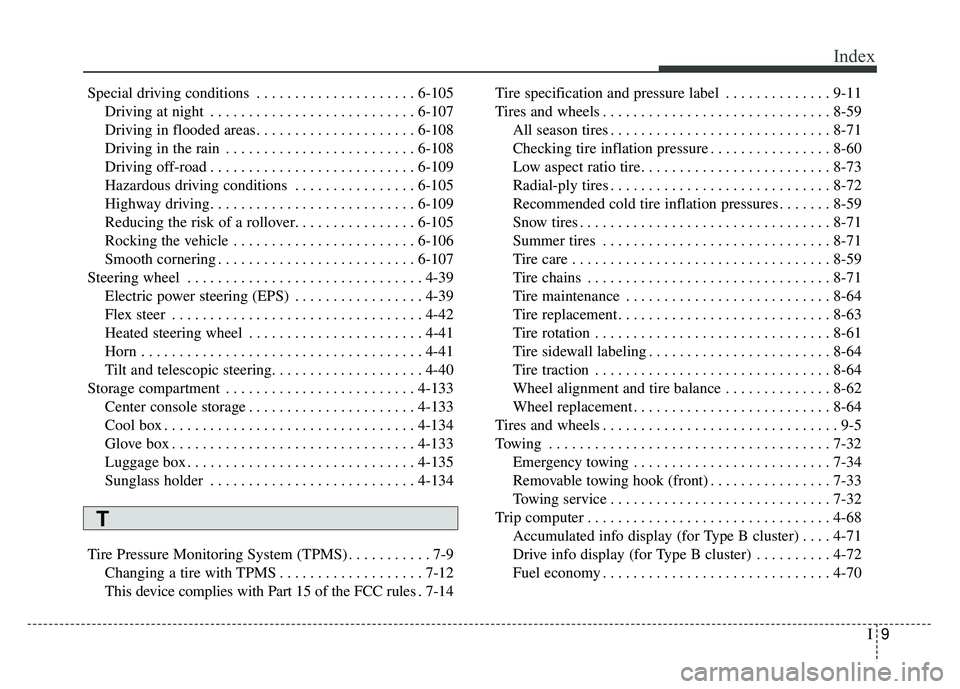
Special driving conditions . . . . . . . . . . . . . . . . . . . . . 6-105Driving at night . . . . . . . . . . . . . . . . . . . . . . . . . . . 6-107
Driving in flooded areas. . . . . . . . . . . . . . . . . . . . . 6-108
Driving in the rain . . . . . . . . . . . . . . . . . . . . . . . . . 6-108
Driving off-road . . . . . . . . . . . . . . . . . . . . . . . . . . . 6-109
Hazardous driving conditions . . . . . . . . . . . . . . . . 6-105
Highway driving . . . . . . . . . . . . . . . . . . . . . . . . . . . 6-109
Reducing the risk of a rollover. . . . . . . . . . . . . . . . 6-105
Rocking the vehicle . . . . . . . . . . . . . . . . . . . . . . . . 6-106
Smooth cornering . . . . . . . . . . . . . . . . . . . . . . . . . . 6-107
Steering wheel . . . . . . . . . . . . . . . . . . . . . . . . . . . . . . . 4-39 Electric power steering (EPS) . . . . . . . . . . . . . . . . . 4-39
Flex steer . . . . . . . . . . . . . . . . . . . . . . . . . . . . . . . . . 4-42
Heated steering wheel . . . . . . . . . . . . . . . . . . . . . . . 4-41
Horn . . . . . . . . . . . . . . . . . . . . . . . . . . . . . . . . . . . . \
. 4-41
Tilt and telescopic steering. . . . . . . . . . . . . . . . . . . . 4-40
Storage compartment . . . . . . . . . . . . . . . . . . . . . . . . . 4-133 Center console storage . . . . . . . . . . . . . . . . . . . . . . 4-133
Cool box . . . . . . . . . . . . . . . . . . . . . . . . . . . . . . . . . 4-134
Glove box . . . . . . . . . . . . . . . . . . . . . . . . . . . . . . . . 4-133
Luggage box . . . . . . . . . . . . . . . . . . . . . . . . . . . . . . 4-135
Sunglass holder . . . . . . . . . . . . . . . . . . . . . . . . . . . 4-134
Tire Pressure Monitoring System (TPMS) . . . . . . . . . . . 7-9 Changing a tire with TPMS . . . . . . . . . . . . . . . . . . . 7-12
This device complies with Part 15 of the FCC rules. 7-14 Tire specification and pressure label . . . . . . . . . . . . . . 9-11
Tires and wheels . . . . . . . . . . . . . . . . . . . . . . . . . . . . . . 8-59
All season tires . . . . . . . . . . . . . . . . . . . . . . . . . . . . . 8-71
Checking tire inflation pressure . . . . . . . . . . . . . . . . 8-60
Low aspect ratio tire. . . . . . . . . . . . . . . . . . . . . . . . . 8-73
Radial-ply tires . . . . . . . . . . . . . . . . . . . . . . . . . . . . . 8-72
Recommended cold tire inflation pressures . . . . . . . 8-59
Snow tires . . . . . . . . . . . . . . . . . . . . . . . . . . . . . . . . . 8-71
Summer tires . . . . . . . . . . . . . . . . . . . . . . . . . . . . . . 8-71
Tire care . . . . . . . . . . . . . . . . . . . . . . . . . . . . . . . . . . 8-59\
Tire chains . . . . . . . . . . . . . . . . . . . . . . . . . . . . . . . . 8-71
Tire maintenance . . . . . . . . . . . . . . . . . . . . . . . . . . . 8-64
Tire replacement . . . . . . . . . . . . . . . . . . . . . . . . . . . . 8-63
Tire rotation . . . . . . . . . . . . . . . . . . . . . . . . . . . . . . . 8-61
Tire sidewall labeling . . . . . . . . . . . . . . . . . . . . . . . . 8-64
Tire traction . . . . . . . . . . . . . . . . . . . . . . . . . . . . . . . 8-64
Wheel alignment and tire balance . . . . . . . . . . . . . . 8-62
Wheel replacement . . . . . . . . . . . . . . . . . . . . . . . . . . 8-64
Tires and wheels . . . . . . . . . . . . . . . . . . . . . . . . . . . . . . . 9-5
Towing . . . . . . . . . . . . . . . . . . . . . . . . . . . . . . . . . . . . \
. 7-32 Emergency towing . . . . . . . . . . . . . . . . . . . . . . . . . . 7-34
Removable towing hook (front) . . . . . . . . . . . . . . . . 7-33
Towing service . . . . . . . . . . . . . . . . . . . . . . . . . . . . . 7-32
Trip computer . . . . . . . . . . . . . . . . . . . . . . . . . . . . . . . . 4-68 Accumulated info display (for Type B cluster) . . . . 4-71
Drive info display (for Type B cluster) . . . . . . . . . . 4-72
Fuel economy . . . . . . . . . . . . . . . . . . . . . . . . . . . . . . 4-70
T