Page 402 of 496
Maintenance
12
7
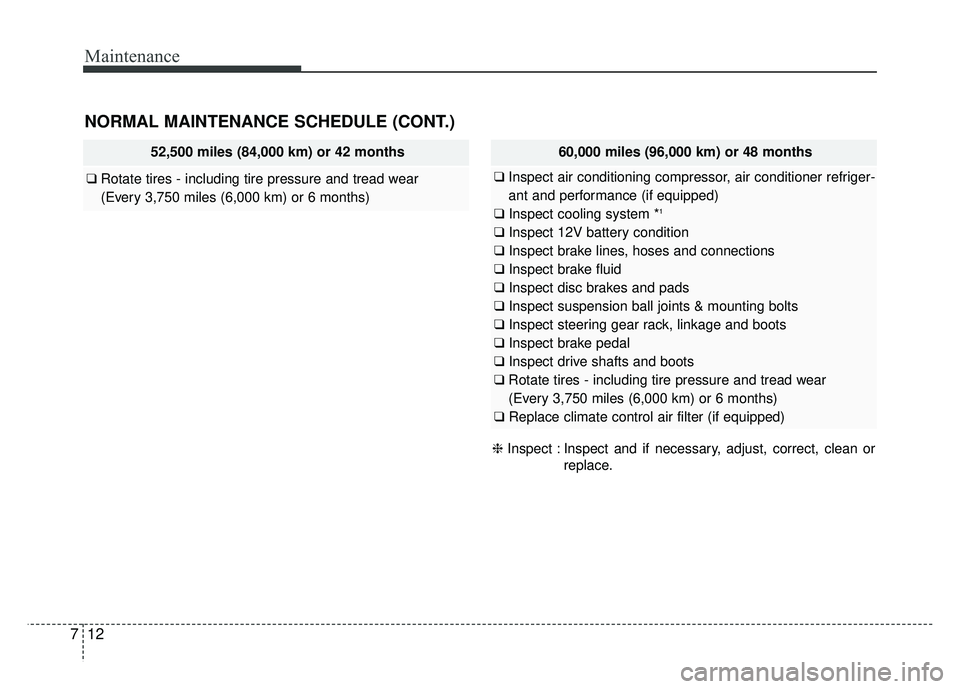
NORMAL MAINTENANCE SCHEDULE (CONT.)
52,500 miles (84,000 km) or 42 months
❑ Rotate tires - including tire pressure and tread wear
(Every 3,750 miles (6,000 km) or 6 months)
60,000 miles (96,000 km) or 48 months
❑Inspect air conditioning compressor, air conditioner refriger-
ant and performance (if equipped)
❑ Inspect cooling system *
1
❑Inspect 12V battery condition
❑ Inspect brake lines, hoses and connections
❑ Inspect brake fluid
❑ Inspect disc brakes and pads
❑ Inspect suspension ball joints & mounting bolts
❑ Inspect steering gear rack, linkage and boots
❑ Inspect brake pedal
❑ Inspect drive shafts and boots
❑ Rotate tires - including tire pressure and tread wear
(Every 3,750 miles (6,000 km) or 6 months)
❑ Replace climate control air filter (if equipped)
❈ Inspect : Inspect and if necessary, adjust, correct, clean or
replace.
Page 403 of 496
713
Maintenance
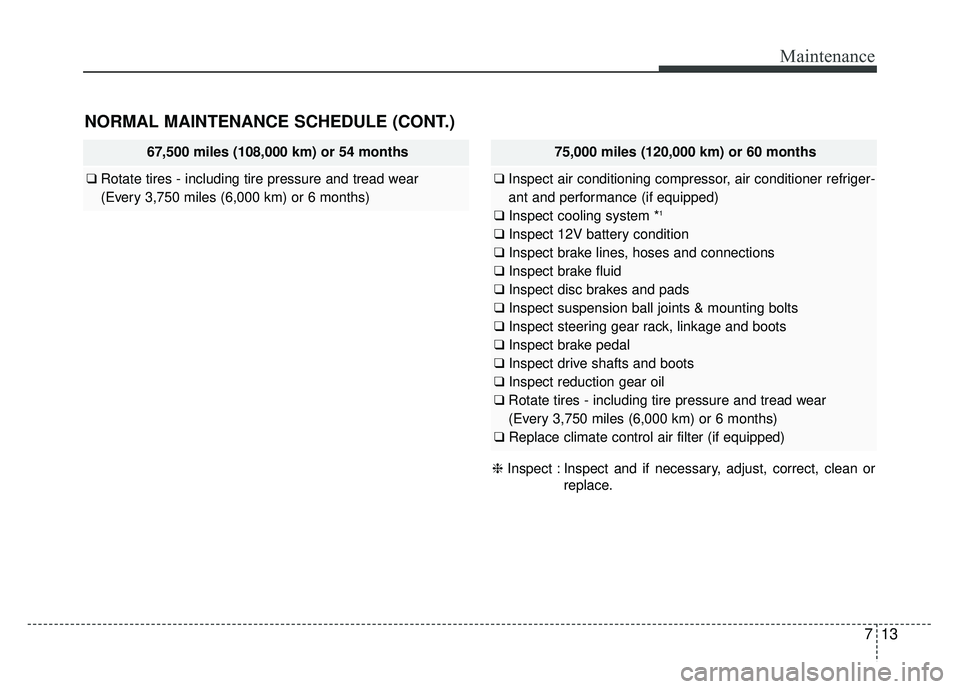
NORMAL MAINTENANCE SCHEDULE (CONT.)
67,500 miles (108,000 km) or 54 months
❑Rotate tires - including tire pressure and tread wear
(Every 3,750 miles (6,000 km) or 6 months)
75,000 miles (120,000 km) or 60 months
❑Inspect air conditioning compressor, air conditioner refriger-
ant and performance (if equipped)
❑ Inspect cooling system *
1
❑Inspect 12V battery condition
❑ Inspect brake lines, hoses and connections
❑ Inspect brake fluid
❑ Inspect disc brakes and pads
❑ Inspect suspension ball joints & mounting bolts
❑ Inspect steering gear rack, linkage and boots
❑ Inspect brake pedal
❑ Inspect drive shafts and boots
❑ Inspect reduction gear oil
❑ Rotate tires - including tire pressure and tread wear
(Every 3,750 miles (6,000 km) or 6 months)
❑ Replace climate control air filter (if equipped)
❈ Inspect : Inspect and if necessary, adjust, correct, clean or
replace.
Page 404 of 496
Maintenance
14
7
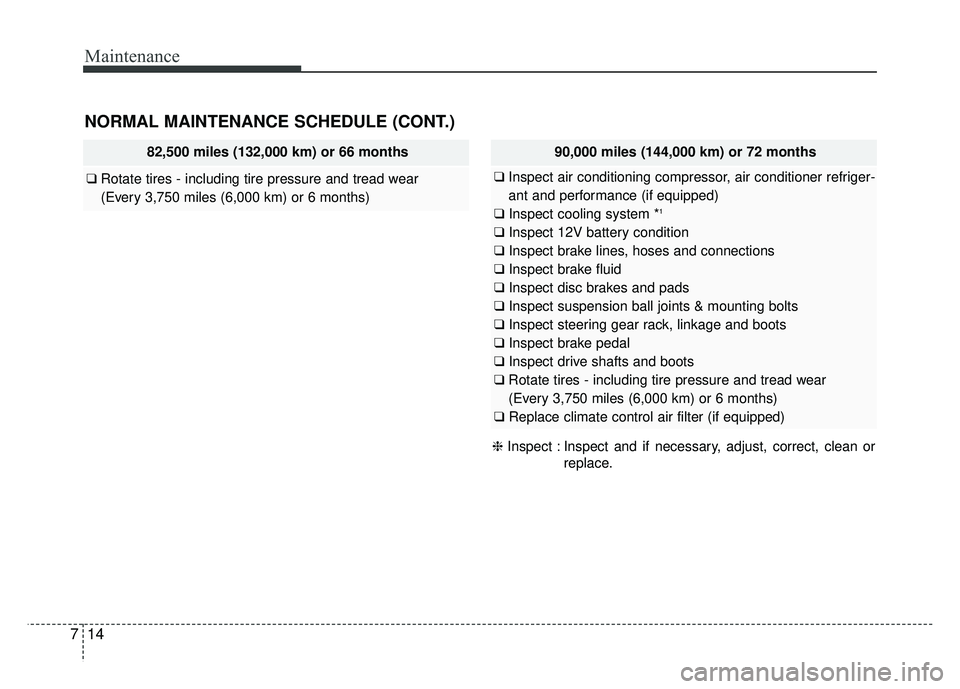
NORMAL MAINTENANCE SCHEDULE (CONT.)
82,500 miles (132,000 km) or 66 months
❑ Rotate tires - including tire pressure and tread wear
(Every 3,750 miles (6,000 km) or 6 months)
90,000 miles (144,000 km) or 72 months
❑Inspect air conditioning compressor, air conditioner refriger-
ant and performance (if equipped)
❑ Inspect cooling system *
1
❑Inspect 12V battery condition
❑ Inspect brake lines, hoses and connections
❑ Inspect brake fluid
❑ Inspect disc brakes and pads
❑ Inspect suspension ball joints & mounting bolts
❑ Inspect steering gear rack, linkage and boots
❑ Inspect brake pedal
❑ Inspect drive shafts and boots
❑ Rotate tires - including tire pressure and tread wear
(Every 3,750 miles (6,000 km) or 6 months)
❑ Replace climate control air filter (if equipped)
❈ Inspect : Inspect and if necessary, adjust, correct, clean or
replace.
Page 405 of 496
715
Maintenance
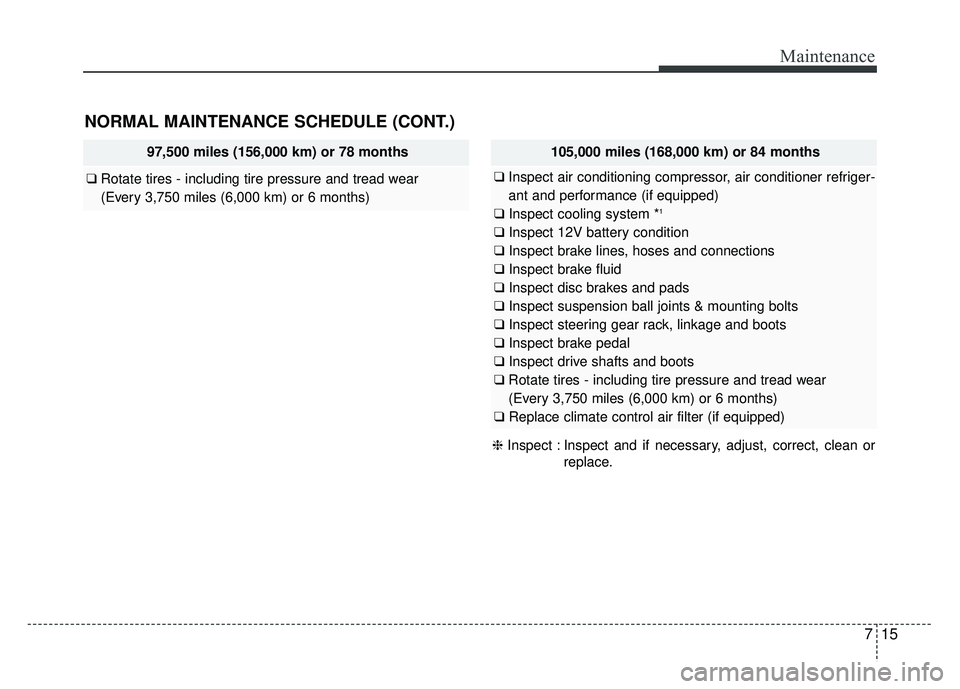
97,500 miles (156,000 km) or 78 months
❑Rotate tires - including tire pressure and tread wear
(Every 3,750 miles (6,000 km) or 6 months)
NORMAL MAINTENANCE SCHEDULE (CONT.)
105,000 miles (168,000 km) or 84 months
❑Inspect air conditioning compressor, air conditioner refriger-
ant and performance (if equipped)
❑ Inspect cooling system *
1
❑Inspect 12V battery condition
❑ Inspect brake lines, hoses and connections
❑ Inspect brake fluid
❑ Inspect disc brakes and pads
❑ Inspect suspension ball joints & mounting bolts
❑ Inspect steering gear rack, linkage and boots
❑ Inspect brake pedal
❑ Inspect drive shafts and boots
❑ Rotate tires - including tire pressure and tread wear
(Every 3,750 miles (6,000 km) or 6 months)
❑ Replace climate control air filter (if equipped)
❈ Inspect : Inspect and if necessary, adjust, correct, clean or
replace.
Page 406 of 496
Maintenance
16
7
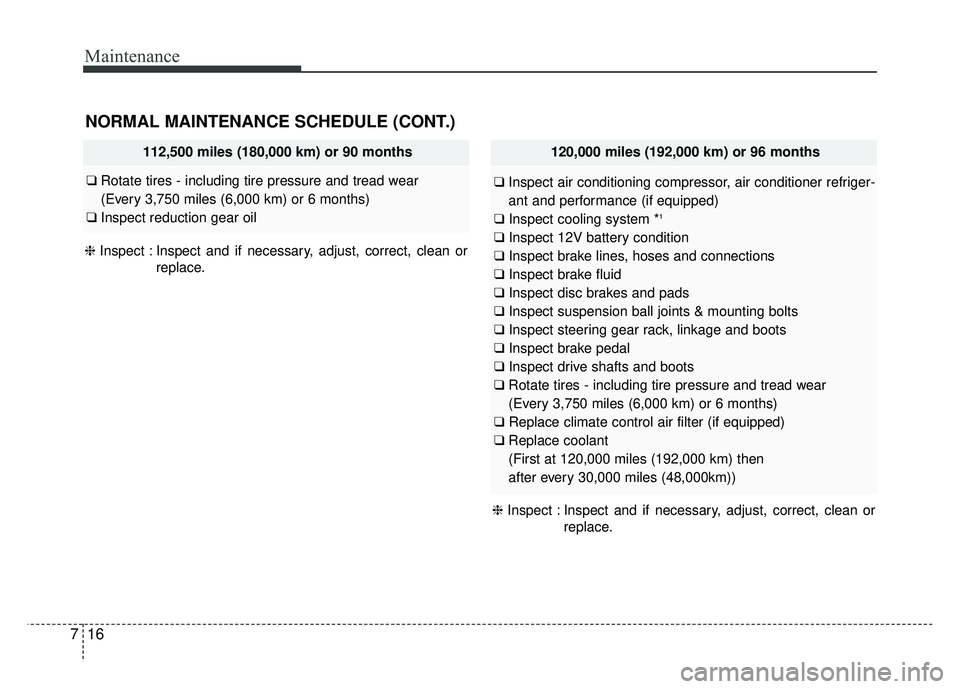
NORMAL MAINTENANCE SCHEDULE (CONT.)
❈ Inspect : Inspect and if necessary, adjust, correct, clean or
replace.
112,500 miles (180,000 km) or 90 months
❑Rotate tires - including tire pressure and tread wear
(Every 3,750 miles (6,000 km) or 6 months)
❑ Inspect reduction gear oil
120,000 miles (192,000 km) or 96 months
❑Inspect air conditioning compressor, air conditioner refriger-
ant and performance (if equipped)
❑ Inspect cooling system *
1
❑Inspect 12V battery condition
❑ Inspect brake lines, hoses and connections
❑ Inspect brake fluid
❑ Inspect disc brakes and pads
❑ Inspect suspension ball joints & mounting bolts
❑ Inspect steering gear rack, linkage and boots
❑ Inspect brake pedal
❑ Inspect drive shafts and boots
❑ Rotate tires - including tire pressure and tread wear
(Every 3,750 miles (6,000 km) or 6 months)
❑ Replace climate control air filter (if equipped)
❑ Replace coolant
(First at 120,000 miles (192,000 km) then
after every 30,000 miles (48,000km))
❈ Inspect : Inspect and if necessary, adjust, correct, clean or
replace.
Page 409 of 496
719
Maintenance
EXPLANATION OF SCHEDULED MAINTENANCE ITEMS
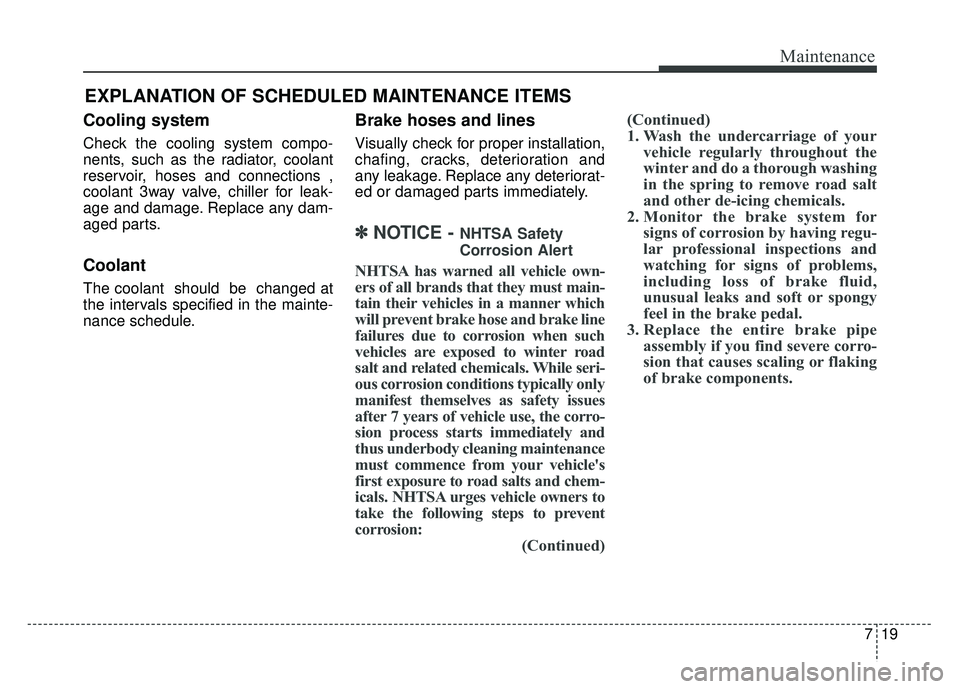
Cooling system
Check the cooling system compo-
nents, such as the radiator, coolant
reservoir, hoses and connections ,
coolant 3way valve, chiller for leak-
age and damage. Replace any dam-
aged parts.
Coolant
The coolant should be changed at
the intervals specified in the mainte-
nance schedule.
Brake hoses and lines
Visually check for proper installation,
chafing, cracks, deterioration and
any leakage. Replace any deteriorat-
ed or damaged parts immediately.
✽ ✽NOTICE - NHTSA Safety
Corrosion Alert
NHTSA has warned all vehicle own-
ers of all brands that they must main-
tain their vehicles in a manner which
will prevent brake hose and brake line
failures due to corrosion when such
vehicles are exposed to winter road
salt and related chemicals. While seri-
ous corrosion conditions typically only
manifest themselves as safety issues
after 7 years of vehicle use, the corro-
sion process starts immediately and
thus underbody cleaning maintenance
must commence from your vehicle's
first exposure to road salts and chem-
icals. NHTSA urges vehicle owners to
take the following steps to prevent
corrosion:
(Continued)(Continued)
1. Wash the undercarriage of your
vehicle regularly throughout the
winter and do a thorough washing
in the spring to remove road salt
and other de-icing chemicals.
2. Monitor the brake system for signs of corrosion by having regu-
lar professional inspections and
watching for signs of problems,
including loss of brake fluid,
unusual leaks and soft or spongy
feel in the brake pedal.
3. Replace the entire brake pipe assembly if you find severe corro-
sion that causes scaling or flaking
of brake components.
Page 411 of 496
721
Maintenance
COOLANT
The high-pressure cooling system
has a reservoir filled with year round
antifreeze coolant. The reservoir is
filled at the factory.
Check the antifreeze protection and
coolant level at least once a year, at the
beginning of the winter season, and
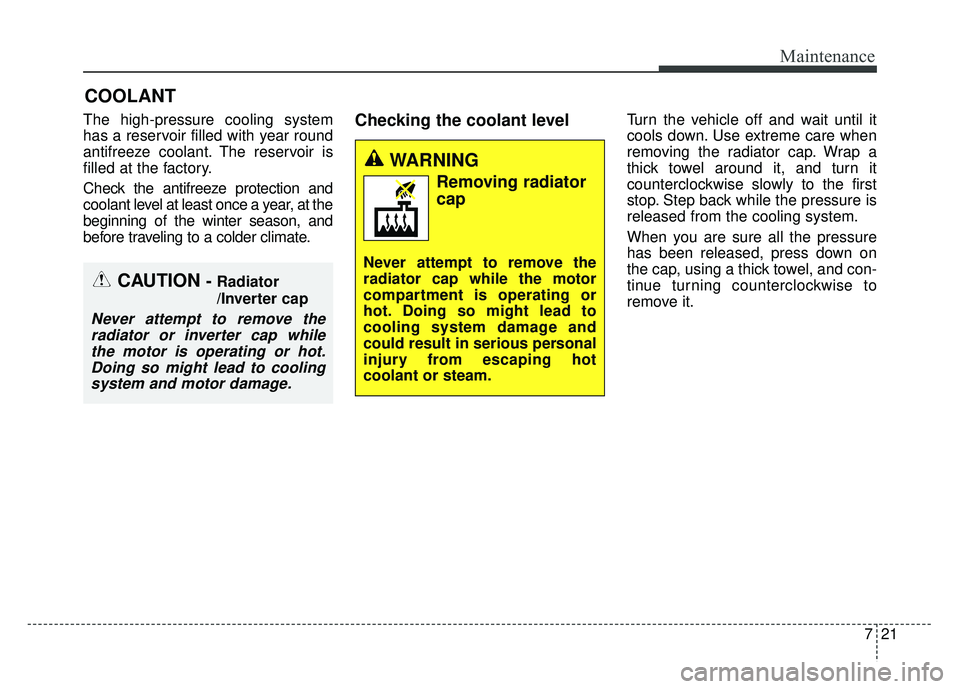
before traveling to a colder climate.Checking the coolant levelTurn the vehicle off and wait until it
cools down. Use extreme care when
removing the radiator cap. Wrap a
thick towel around it, and turn it
counterclockwise slowly to the first
stop. Step back while the pressure is
released from the cooling system.
When you are sure all the pressure
has been released, press down on
the cap, using a thick towel, and con-
tinue turning counterclockwise to
remove it.
WARNING
Removing radiator
cap
Never attempt to remove the
radiator cap while the motor
compartment is operating or
hot. Doing so might lead to
cooling system damage and
could result in serious personal
injury from escaping hot
coolant or steam.
CAUTION - Radiator
/Inverter cap
Never attempt to remove theradiator or inverter cap whilethe motor is operating or hot.Doing so might lead to coolingsystem and motor damage.
Page 412 of 496
Maintenance
22
7
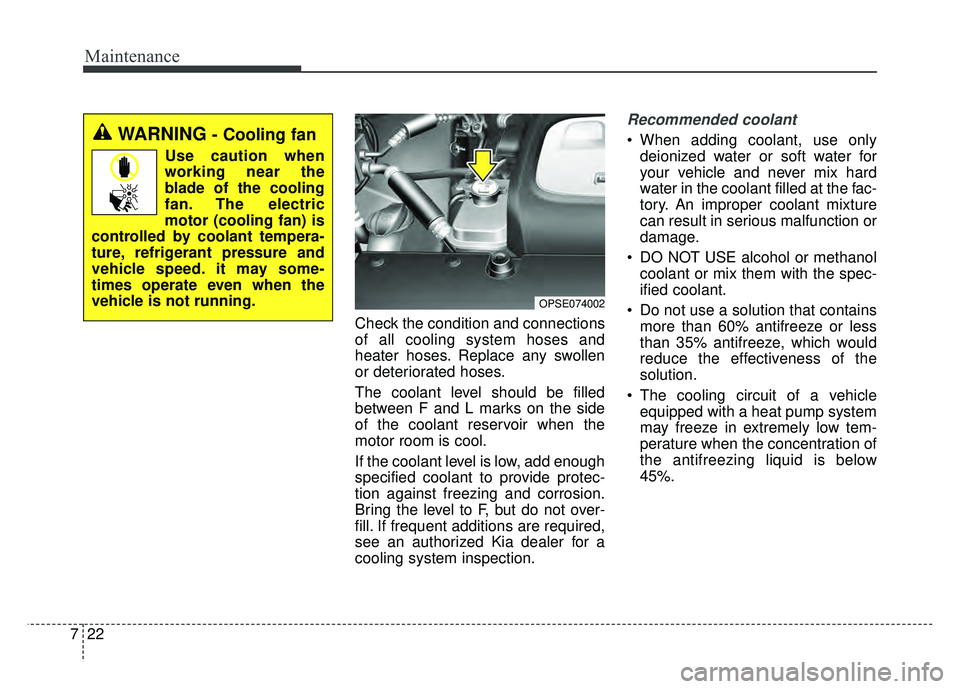
Check the condition and connections
of all cooling system hoses and
heater hoses. Replace any swollen
or deteriorated hoses.
The coolant level should be filled
between F and L marks on the side
of the coolant reservoir when the
motor room is cool.
If the coolant level is low, add enough
specified coolant to provide protec-
tion against freezing and corrosion.
Bring the level to F, but do not over-
fill. If frequent additions are required,
see an authorized Kia dealer for a
cooling system inspection.
Recommended coolant
When adding coolant, use only
deionized water or soft water for
your vehicle and never mix hard
water in the coolant filled at the fac-
tory. An improper coolant mixture
can result in serious malfunction or
damage.
DO NOT USE alcohol or methanol coolant or mix them with the spec-
ified coolant.
Do not use a solution that contains more than 60% antifreeze or less
than 35% antifreeze, which would
reduce the effectiveness of the
solution.
The cooling circuit of a vehicle equipped with a heat pump system
may freeze in extremely low tem-
perature when the concentration of
the antifreezing liquid is below
45%.
OPSE074002
WARNING- Cooling fan
Use caution when
working near the
blade of the cooling
fan. The electric
motor (cooling fan) is
controlled by coolant tempera-
ture, refrigerant pressure and
vehicle speed. it may some-
times operate even when the
vehicle is not running.