2018 KIA SORENTO lubricants
[x] Cancel search: lubricantsPage 419 of 536

Maintenance
87
OWNER MAINTENANCE
The following lists are vehicle checks
and inspections that should be per-
formed by the owner or an author-
ized Kia dealer at the frequencies
indicated to help ensure safe,
dependable operation of your vehi-
cle.
Any adverse conditions should be
brought to the attention of your deal-
er as soon as possible.
These Owner Maintenance Checks
are generally not covered by war-
ranties and you may be charged for
labor, parts and lubricants used.Owner maintenance schedule
When you stop for fuel:
Check the engine oil level.
Check the coolant level in thecoolant reservoir.
Check the windshield washer fluid level.
Look for low or under-inflated tires.
While operating your vehicle:
Note any changes in the sound of the exhaust or any smell of
exhaust fumes in the vehicle.
Check for vibrations in the steering wheel. Notice any increased steer-
ing effort or looseness in the steer-
ing wheel, or change in its straight-
ahead position.
Notice if your vehicle constantly turns slightly or “pulls” to one side
when traveling on smooth, level
road.
When stopping, listen and check for unusual sounds, pulling to one
side, increased brake pedal travel
or “hard-to-push” brake pedal.
If any slipping or changes in the operation of your transaxle occurs,
check the transaxle fluid level.
Check the automatic transaxle P (Park) function.
Check the parking brake.
Check for fluid leaks under your vehicle (water dripping from the air
conditioning system during or after
use is normal).
WARNING - Hot coolant
Be careful when checking your
engine coolant level when the
engine is hot. Scalding hot
coolant and steam may blow
out under pressure.
Page 442 of 536
731
Maintenance
Automatic transaxle fluid
Automatic transaxle fluid should not
be checked under normal usage
conditions.
But in severe conditions, the fluid
should be changed at an authorized
Kia dealer in accordance to the
scheduled maintenance at the begin-
ning of this section.
✽ ✽NOTICE
Automatic transaxle fluid color is
basically red.
As the vehicle is driven, the auto-
matic transaxle fluid will begin to
look darker.
It is the normal condition and you
should not judge the need to replace
the fluid based upon the changed
color.
Brake hoses and lines
Visually check for proper installation,
chafing, cracks, deterioration and
any leakage. Replace any deteriorat-
ed or damaged parts immediately.
Brake fluid
Check the brake fluid level in the
brake fluid reservoir. The level should
be between “MIN” and “MAX” marks
on the side of the reservoir. Use only
hydraulic brake fluid conforming to
DOT 3 or DOT 4 specification.
CAUTION
Use only specified automatic
transaxle fluid. The use of a non-specified fluid could result in atransaxle malfunction and fail-ure. (Refer to "Recommendedlubricants and capacities" insection 8.)
Page 446 of 536
735
Maintenance
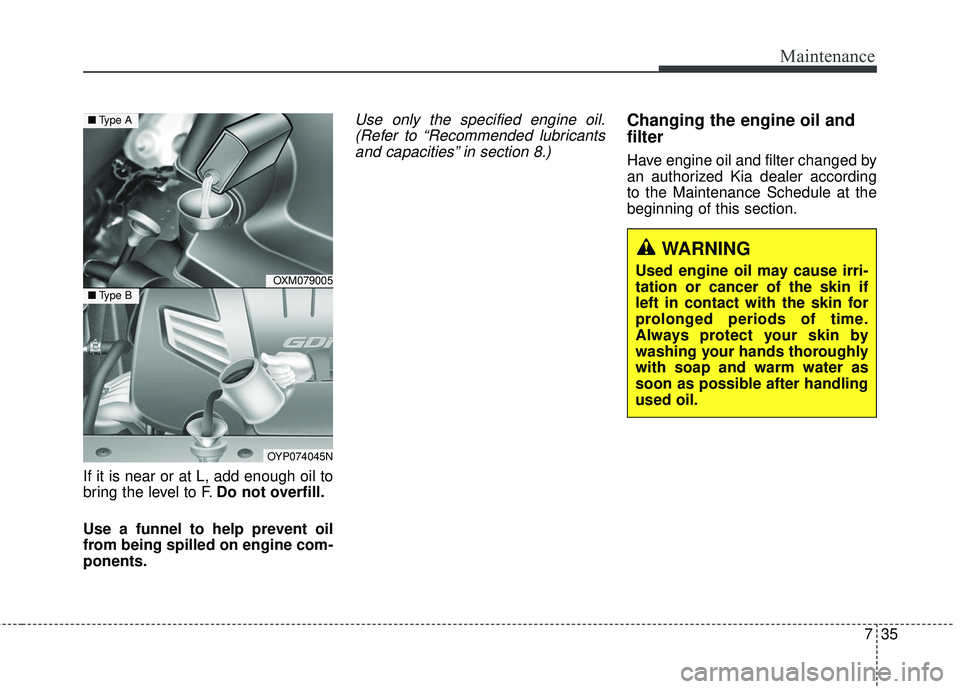
If it is near or at L, add enough oil to
bring the level to F.Do not overfill.
Use a funnel to help prevent oil
from being spilled on engine com-
ponents.
Use only the specified engine oil. (Refer to “Recommended lubricantsand capacities” in section 8.)Changing the engine oil and
filter
Have engine oil and filter changed by
an authorized Kia dealer according
to the Maintenance Schedule at the
beginning of this section.
WARNING
Used engine oil may cause irri-
tation or cancer of the skin if
left in contact with the skin for
prolonged periods of time.
Always protect your skin by
washing your hands thoroughly
with soap and warm water as
soon as possible after handling
used oil.OXM079005
OYP074045N
■ Type A
■Type B
Page 450 of 536

739
Maintenance
BRAKE FLUID
Checking the brake fluid level
Check the fluid level in the reservoir
periodically. The fluid level should be
between MAX (Maximum) and MIN
(Minimum) marks on the side of the
reservoir.
Before removing the reservoir cap
and adding brake fluid, clean the
area around the reservoir cap thor-
oughly to prevent brake fluid contam-
ination.If the level is low, add fluid to the
MAX (Maximum) level. The level will
fall with accumulated mileage. This is
a normal condition associated with
the wear of brake linings. If the fluid
level is excessively low, have the
brake system checked by an author-
ized Kia dealer.
Use only the specified brake fluid.
(Refer to “Recommended lubricantsor capacities” in chapter 8.)
Never mix different types of fluid.
In the event the brake system
requires frequent additions of fluid,
the vehicle should be inspected by
an authorized Kia dealer.
When changing and adding brake
fluid, handle it carefully. Do not let it
come in contact with your eyes. If
brake fluid should come in contact
with your eyes, immediately flush
them with a large quantity of fresh
tap water. Have your eyes examined
by a doctor as soon as possible.
Brake fluid, which has been exposed
to open air for an extended time
should never be used as its quality
cannot be guaranteed. It should be
disposed of properly.
OYP074048K
CAUTION - Proper fluid
Only use brake fluid in brakesystem. Small amounts ofimproper fluids (such as engineoil) can cause damage to thebrake system.
CAUTION - Brake fluid
Do not allow brake fluid to con-tact the vehicle's body paint, aspaint damage will result.
Page 516 of 536

Specifications & Consumer information
Dimensions . . . . . . . . . . . . . . . . . . . . . . . . . . . . . . . . 8-2
Engine . . . . . . . . . . . . . . . . . . . . . . . . . . . . . . . . . . . . \
8-2
Bulb wattage . . . . . . . . . . . . . . . . . . . . . . . . . . . . . . . 8-3
Tires and wheels . . . . . . . . . . . . . . . . . . . . . . . . . . . . 8-5
Gross vehicle weight. . . . . . . . . . . . . . . . . . . . . . . . . 8-6
Luggage volume . . . . . . . . . . . . . . . . . . . . . . . . . . . . 8-6
Air conditioning system . . . . . . . . . . . . . . . . . . . . . . 8-6
Recommended lubricants and capacities . . . . . . . 8-7
• Recommended SAE viscosity number. . . . . . . . . . . . . 8-9
Vehicle identification number (VIN) . . . . . . . . . . 8-10
Vehicle certification label. . . . . . . . . . . . . . . . . . . . 8-10
Tire specification and pressure label . . . . . . . . . . 8-11
Engine number . . . . . . . . . . . . . . . . . . . . . . . . . . . . 8-11
8
Page 522 of 536
87
Specifications & Consumer information
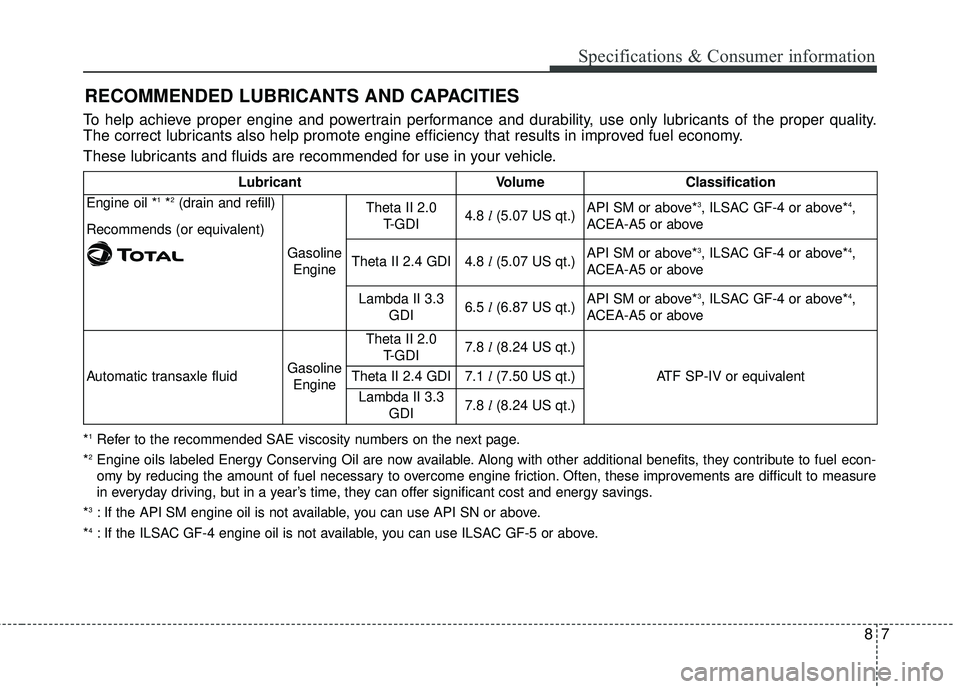
RECOMMENDED LUBRICANTS AND CAPACITIES
To help achieve proper engine and powertrain performance and durability, use only lubricants of the proper quality.
The correct lubricants also help promote engine efficiency that results in improved fuel economy.
These lubricants and fluids are recommended for use in your vehicle.
Lubricant VolumeClassification
Engine oil *1*2(drain and refill)
Recommends (or equivalent)
Gasoline Engine
Theta II 2.0 T-GDI4.8 l(5.07 US qt.)API SM or above*3, ILSAC GF-4 or above*4,
ACEA-A5 or above
Theta II 2.4 GDI4.8 l(5.07 US qt.)API SM or above*3, ILSAC GF-4 or above*4,
ACEA-A5 or above
Lambda II 3.3 GDI6.5 l(6.87 US qt.)API SM or above*3, ILSAC GF-4 or above*4,
ACEA-A5 or above
Automatic transaxle fluidGasoline Engine
Theta II 2.0 T-GDI7.8 l(8.24 US qt.)
ATF SP-IV or equivalentTheta II 2.4 GDI7.1 l(7.50 US qt.)
Lambda II 3.3
GDI7.8 l(8.24 US qt.)
*1Refer to the recommended SAE viscosity numbers on the next page.
*
2Engine oils labeled Energy Conserving Oil are now available. Along with other additional benefits, they contribute to fuel econ-
omy by reducing the amount of fuel necessary to overcome engine friction. Often, these improvements are difficult to measure
in everyday driving, but in a year’s time, they can offer significant cost and energy savings.
*
3: If the API SM engine oil is not available, you can use API SN or above.
*
4: If the ILSAC GF-4 engine oil is not available, you can use ILSAC GF-5 or above.
Page 533 of 536

I7
Index
Heating and air conditioning . . . . . . . . . . . . . . . . . 4-131
System operation . . . . . . . . . . . . . . . . . . . . . . . . . . 4-137
Mirrors . . . . . . . . . . . . . . . . . . . . . . . . . . . . . . . . . . . . \
. 4-59 Inside rearview mirror . . . . . . . . . . . . . . . . . . . . . . . 4-59
Outside rearview mirror . . . . . . . . . . . . . . . . . . . . . . 4-69
Owner maintenance . . . . . . . . . . . . . . . . . . . . . . . . . . . . 7-8 Owner maintenance schedule. . . . . . . . . . . . . . . . . . . 7-8
Panoramic sunroof . . . . . . . . . . . . . . . . . . . . . . . . . . . . 4-49 Closing the sunroof . . . . . . . . . . . . . . . . . . . . . . . . . 4-54
Resetting the sunroof . . . . . . . . . . . . . . . . . . . . . . . . 4-54
Sliding the sunroof . . . . . . . . . . . . . . . . . . . . . . . . . 4-52
Sunroof open warning . . . . . . . . . . . . . . . . . . . . . . . 4-50
Sunshade. . . . . . . . . . . . . . . . . . . . . . . . . . . . . . . . . . 4-51\
Tilting the sunroof . . . . . . . . . . . . . . . . . . . . . . . . . . 4-53
Parking brake . . . . . . . . . . . . . . . . . . . . . . . . . . . . . . . . 7-40 Checking the parking brake . . . . . . . . . . . . . . . . . . . 7-40
Power liftgate . . . . . . . . . . . . . . . . . . . . . . . . . . . . . . . . 4-28 Closing the liftgate . . . . . . . . . . . . . . . . . . . . . . . . . . 4-30
Emergency liftgate safety release . . . . . . . . . . . . . . 4-38
Opening the liftgate . . . . . . . . . . . . . . . . . . . . . . . . . 4-29
Smart power liftgate . . . . . . . . . . . . . . . . . . . . . . . . . 4-34 Rear parking assist system . . . . . . . . . . . . . . . . . . . . . 4-109
Non-operational conditions of rearparking assist system . . . . . . . . . . . . . . . . . . . . . . 4-110
Operation of the rear parking assist system . . . . . . 4-109
Rear parking assist system precautions . . . . . . . . . 4-111
Self-diagnosis . . . . . . . . . . . . . . . . . . . . . . . . . . . . . 4-112
Rearview camera. . . . . . . . . . . . . . . . . . . . . . . . . . . . . 4-113
Recommended lubricants and capacities . . . . . . . . . . . . 8-7 Recommended SAE viscosity number. . . . . . . . . . . . 8-9
Road warning . . . . . . . . . . . . . . . . . . . . . . . . . . . . . . . . . 6-2 Hazard warning flasher . . . . . . . . . . . . . . . . . . . . . . . 6-2
Scheduled maintenance service . . . . . . . . . . . . . . . . . . 7-10
Seat belts . . . . . . . . . . . . . . . . . . . . . . . . . . . . . . . . . . . . \
3-25 Care of seat belts . . . . . . . . . . . . . . . . . . . . . . . . . . . 3-35
Pre-tensioner seat belt . . . . . . . . . . . . . . . . . . . . . . . 3-31
Seat belt precautions . . . . . . . . . . . . . . . . . . . . . . . . 3-33
Seat belt restraint system . . . . . . . . . . . . . . . . . . . . . 3-25
Seats . . . . . . . . . . . . . . . . . . . . . . . . . . . . . . . . . . . . \
. . . . 3-2 Driver position memory system (for power seat) . . . 3-9
Front seat adjustment - manual . . . . . . . . . . . . . . . . . 3-5
Front seat adjustment - power . . . . . . . . . . . . . . . . . . 3-6
Headrest (for front seat) . . . . . . . . . . . . . . . . . . . . . . 3-11
Headrest (for rear seat) . . . . . . . . . . . . . . . . . . . . . . 3-22
P
R
S
O