Page 262 of 490
Driving your vehicle
14
6
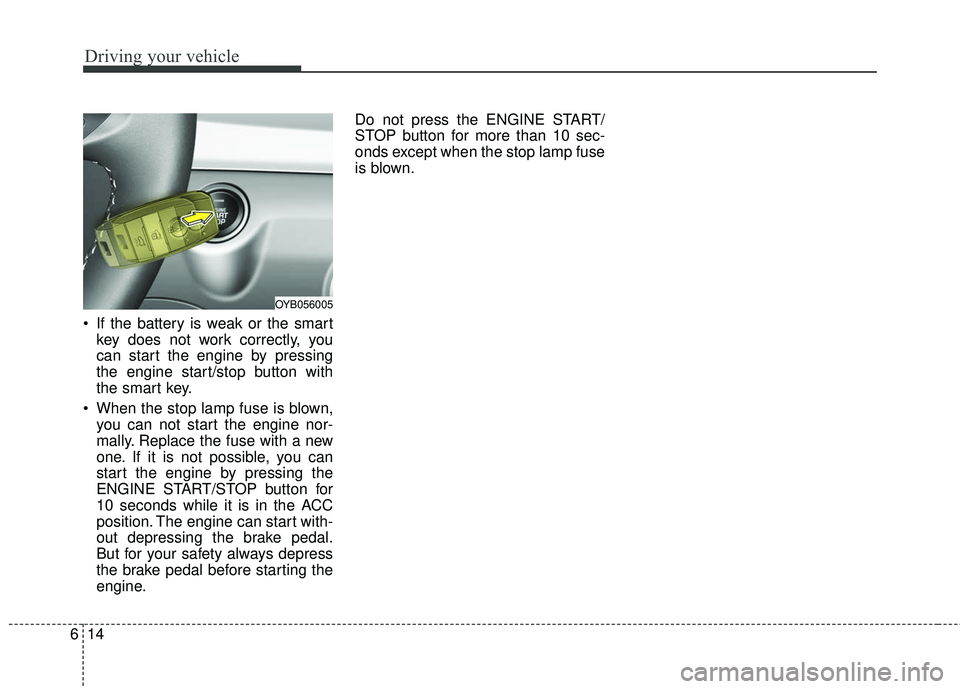
If the battery is weak or the smart
key does not work correctly, you
can start the engine by pressing
the engine start/stop button with
the smart key.
When the stop lamp fuse is blown, you can not start the engine nor-
mally. Replace the fuse with a new
one. If it is not possible, you can
start the engine by pressing the
ENGINE START/STOP button for
10 seconds while it is in the ACC
position. The engine can start with-
out depressing the brake pedal.
But for your safety always depress
the brake pedal before starting the
engine. Do not press the ENGINE START/
STOP button for more than 10 sec-
onds except when the stop lamp fuse
is blown.
OYB056005
Page 311 of 490

663
Driving your vehicle
Use high quality ethylene gly-
col coolant
Your vehicle is delivered with high
quality ethylene glycol coolant in the
cooling system. It is the only type of
coolant that should be used because
it helps prevent corrosion in the cool-
ing system, lubricates the water
pump and prevents freezing. Be sure
to replace or replenish your coolant
in accordance with the maintenance
schedule in section 8. Before winter,
have your coolant tested to assure
that its freezing point is sufficient for
the temperatures anticipated during
the winter.
Check battery and cables
Winter puts additional burdens on
the battery system. Visually inspect
the battery and cables as described
in section 8. The level of charge in
your battery can be checked by an
authorized Kia dealer or a service
station.
Change to "winter weight" oil
if necessary
In some climates it is recommended
that a lower viscosity "winter weight"
oil be used during cold weather. See
section 9 for recommendations. If
you aren't sure what weight oil you
should use, consult an authorized
Kia dealer.
Check spark plugs and igni-
tion system
Inspect your spark plugs as
described in section 8 and replace
them if necessary. Also check all
ignition wiring and components to be
sure they are not cracked, worn or
damaged in any way.
To keep locks from freezing
To keep the locks from freezing,
squirt an approved de-icer fluid or
glycerine into the key opening. If a
lock is covered with ice, squirt it with
an approved de-icing fluid to remove
the ice. If the lock is frozen internally,
you may be able to thaw it out by
using a heated key. Handle the heat-
ed key with care to avoid injury.
Use approved window washer
anti-freeze in system
To keep the water in the window
washer system from freezing, add an
approved window washer anti-freeze
solution in accordance with instruc-
tions on the container. Window wash-
er anti-freeze is available from an
authorized Kia dealer and most auto
parts outlets. Do not use engine
coolant or other types of anti-freeze
as these may damage the paint fin-
ish.
Page 430 of 490
873
Maintenance
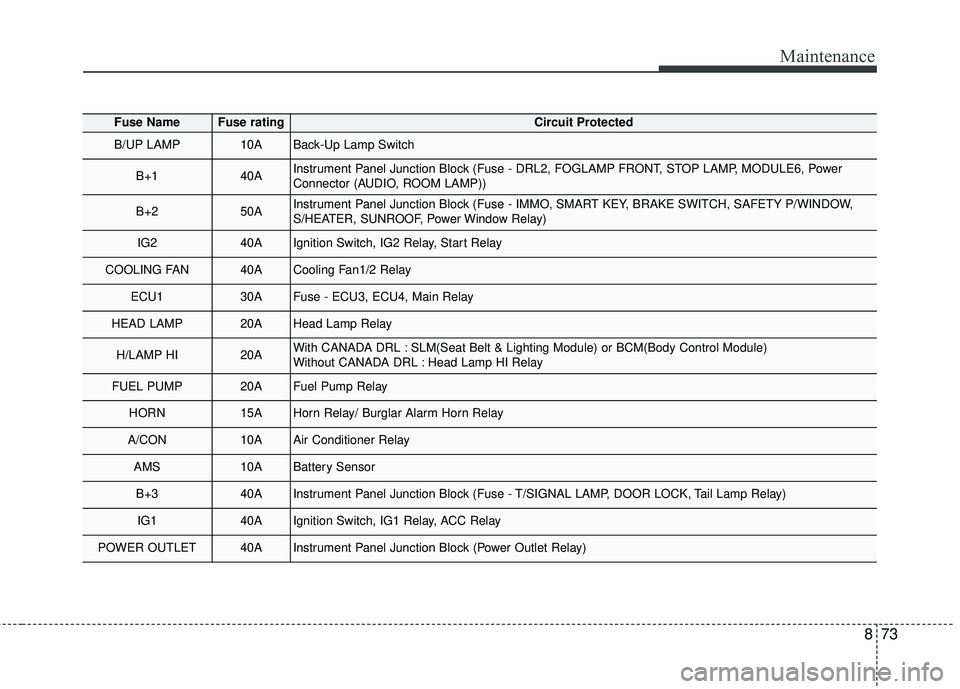
Fuse NameFuse ratingCircuit Protected
B/UP LAMP10ABack-Up Lamp Switch
B+140AInstrument Panel Junction Block (Fuse - DRL2, FOGLAMP FRONT, STOP LAMP, MODULE6, Power
Connector (AUDIO, ROOM LAMP))
B+250AInstrument Panel Junction Block (Fuse - IMMO, SMART KEY, BRAKE SWITCH, SAFETY P/WINDOW,
S/HEATER, SUNROOF, Power Window Relay)
IG240AIgnition Switch, IG2 Relay, Start Relay
COOLING FAN40ACooling Fan1/2 Relay
ECU130AFuse - ECU3, ECU4, Main Relay
HEAD LAMP20AHead Lamp Relay
H/LAMP HI20AWith CANADA DRL : SLM(Seat Belt & Lighting Module) or BCM(Body Control Module)
Without CANADA DRL : Head Lamp HI Relay
FUEL PUMP20AFuel Pump Relay
HORN15AHorn Relay/ Burglar Alarm Horn Relay
A/CON10AAir Conditioner Relay
AMS10ABattery Sensor
B+340AInstrument Panel Junction Block (Fuse - T/SIGNAL LAMP, DOOR LOCK, Tail Lamp Relay)
IG140AIgnition Switch, IG1 Relay, ACC Relay
POWER OUTLET40AInstrument Panel Junction Block (Power Outlet Relay)
Page 487 of 490
I7
Index
Owner maintenance ........................................................8-7Owner maintenance schedule ......................................8-7
Parking brake ................................................................8-34 Checking the parking brake ........................................8-34
Radar type autonomous emergency braking ................6-37 AEB warning message and system control ................6-39
Brake operation ..........................................................6-40
Limitation of the system ............................................6-43
System malfunction ....................................................6-42
System setting and activation ....................................6-37
Rearview camera ..........................................................4-86
Recommended lubricants and capacities ........................9-7 Recommended SAE viscosity number ........................9-9
Remote keyless entry ......................................................4-9 Battery replacement ....................................................4-11
Immobilizer system ....................................................4-13
Remote keyless entry system operations ......................4-9
Transmitter precautions ..............................................4-10
Road warning ..................................................................7-2 Hazard warning flasher ................................................7-2 Scheduled maintenance service ......................................8-9
Seat ........................................................................\
..........3-2
Driver’s seat ..................................................................3-2
Front passenger’s seat ..................................................3-2
Front seat adjustment ....................................................3-4
Headrest (for front seat) ................................................3-6
Rear seat ........................................................................\
3-2
Rear seat adjustment ....................................................3-9
Seatback pocket ............................................................3-8
Seat belts ........................................................................\
3-12 Care of seat belts ........................................................3-22
Pre-tensioner seat belt ................................................3-17
Seat belt precautions ..................................................3-20
Seat belt restraint system ............................................3-12
Smart key ........................................................................\
4-6 Smart key functions ......................................................4-6
Smart key precautions ..................................................4-7
Smart trunk (for 4 door) ................................................4-24
Special driving conditions ............................................6-57 Driving at night ..........................................................6-59
Driving in flooded areas ............................................6-60
Driving in the rain ......................................................6-59
Driving off-road ..........................................................6-60
Hazardous driving conditions ....................................6-57
Highway driving ........................................................6-60
O
P
S
R