2018 KIA RIO check oil
[x] Cancel search: check oilPage 358 of 490
Maintenance
Engine compartment . . . . . . . . . . . . . . . . . . . . . . . . 8-4
Maintenance services . . . . . . . . . . . . . . . . . . . . . . . . 8-5
• Owner’s responsibility . . . . . . . . . . . . . . . . . . . . . . . . . 8-5
• Owner maintenance precautions . . . . . . . . . . . . . . . . . 8-6
Owner maintenance . . . . . . . . . . . . . . . . . . . . . . . . . 8-7
• Owner maintenance schedule . . . . . . . . . . . . . . . . . . . 8-7
Scheduled maintenance service. . . . . . . . . . . . . . . . 8-9
Explanation of scheduled maintenance items . . . 8-22
Checking fluid levels . . . . . . . . . . . . . . . . . . . . . . . 8-26
Engine oil. . . . . . . . . . . . . . . . . . . . . . . . . . . . . . . . . 8-27
• Checking the engine oil level . . . . . . . . . . . . . . . . . . . 8-27
• Changing the engine oil and filter . . . . . . . . . . . . . . . 8-28
Engine coolant . . . . . . . . . . . . . . . . . . . . . . . . . . . . 8-29
• Checking the coolant level . . . . . . . . . . . . . . . . . . . . . 8-29
• Changing the coolant . . . . . . . . . . . . . . . . . . . . . . . . . 8-31
Brake/clutch fluid . . . . . . . . . . . . . . . . . . . . . . . . . . 8-32
• Checking the brake/clutch fluid level . . . . . . . . . . . . 8-32
Washer fluid . . . . . . . . . . . . . . . . . . . . . . . . . . . . . . 8-33
• Checking the washer fluid level . . . . . . . . . . . . . . . . . 8-33
Parking brake . . . . . . . . . . . . . . . . . . . . . . . . . . . . . 8-34
• Checking the parking brake. . . . . . . . . . . . . . . . . . . . 8-34
Air cleaner. . . . . . . . . . . . . . . . . . . . . . . . . . . . . . . . 8-35
• Filter replacement . . . . . . . . . . . . . . . . . . . . . . . . . . . . 8-35
Climate control air filter . . . . . . . . . . . . . . . . . . . . 8-37
• Filter inspection . . . . . . . . . . . . . . . . . . . . . . . . . . . . . . 8-37
Wiper blades . . . . . . . . . . . . . . . . . . . . . . . . . . . . . . 8-39
• Blade inspection . . . . . . . . . . . . . . . . . . . . . . . . . . . . . . 8-39
• Blade replacement . . . . . . . . . . . . . . . . . . . . . . . . . . . . 8-39
Battery . . . . . . . . . . . . . . . . . . . . . . . . . . . . . . . . . . . 8-\
42
• For best battery service . . . . . . . . . . . . . . . . . . . . . . . 8-42
• Recharging the battery . . . . . . . . . . . . . . . . . . . . . . . . 8-43
• Reset items . . . . . . . . . . . . . . . . . . . . . . . . . . . . . . . . . . 8-44\
Tires and wheels . . . . . . . . . . . . . . . . . . . . . . . . . . . 8-45
• Tire care . . . . . . . . . . . . . . . . . . . . . . . . . . . . . . . . . . . . \
8-45
• Recommended cold tire inflation pressures . . . . . . . 8-45
• Tire pressure . . . . . . . . . . . . . . . . . . . . . . . . . . . . . . . . 8-46
• Checking tire inflation pressure. . . . . . . . . . . . . . . . . 8-46
• Tire rotation . . . . . . . . . . . . . . . . . . . . . . . . . . . . . . . . . 8-47
• Wheel alignment and tire balance . . . . . . . . . . . . . . . 8-48
• Tire replacement . . . . . . . . . . . . . . . . . . . . . . . . . . . . . 8-49
• Wheel replacement . . . . . . . . . . . . . . . . . . . . . . . . . . . 8-50
• Tire traction . . . . . . . . . . . . . . . . . . . . . . . . . . . . . . . . . 8-50
• Tire maintenance . . . . . . . . . . . . . . . . . . . . . . . . . . . . 8-50
• Tire sidewall labeling . . . . . . . . . . . . . . . . . . . . . . . . . 8-50
• All season tires . . . . . . . . . . . . . . . . . . . . . . . . . . . . . . 8-57
• Summer tires . . . . . . . . . . . . . . . . . . . . . . . . . . . . . . . . 8-57
• Snow tires . . . . . . . . . . . . . . . . . . . . . . . . . . . . . . . . . . . 8-\
57
8
Page 364 of 490
87
Maintenance
OWNER MAINTENANCE
The following lists are vehicle checks
and inspections that should be per-
formed by the owner or an author-
ized Kia dealer at the frequencies
indicated to help ensure safe,
dependable operation of your vehi-
cle.
Any adverse conditions should be
brought to the attention of your deal-
er as soon as possible.
These Owner Maintenance Checks
are generally not covered by war-
ranties and you may be charged for
labor, parts and lubricants used.Owner maintenance schedule
When you stop for fuel:
Check the engine oil level.
Check the coolant level in coolantreservoir.
Check the windshield washer fluid level.
Look for low or under-inflated tires.
While operating your vehicle:
Note any changes in the sound of the exhaust or any smell of
exhaust fumes in the vehicle.
Check for vibrations in the steering wheel. Notice any increased steer-
ing effort or looseness in the steer-
ing wheel, or change in its straight-
ahead position.
Notice if your vehicle constantly turns slightly or “pulls” to one side
when traveling on smooth, level
road.
When stopping, listen and check for unusual sounds, pulling to one
side, increased brake pedal travel
or “hard-to-push” brake pedal.
If any slipping or changes in the operation of your transaxle occurs,
check the transaxle fluid level.
Check the automatic transaxle P (Park) function.
Check the parking brake.
Check for fluid leaks under your vehicle (water dripping from the air
conditioning system during or after
use is normal).
WARNING- Hot coolant
Be careful when checking your
engine coolant level when the
engine is hot. Scalding hot
coolant and steam may blow
out under pressure.
Page 377 of 490
Maintenance
20
8
Normal Maintenance Schedule (CONT.)
240,000 km (150,000 miles) or 120 months
❑ Inspect vacuum hose
❑Inspect air conditioning refrigerant
❑Inspect brake hoses/lines and connections including booster
❑Inspect drive shafts and boots
❑Inspect exhaust pipe and muffler
❑Inspect front brake disc/pads, calipers
❑Inspect rear brake disc /pads, parking brake
❑Inspect steering gear box, linkage & boots/lower arm ball joint,
upper arm ball joint
❑ Inspect suspension mounting bolts
❑IInspect brake/clutch (if equipped) fluid
❑Inspect fuel lines, fuel hoses and connections
❑Inspect fuel tank air filter (if equipped) *1
❑Inspect fuel tank, fuel filler cap, canister, vapor hose, fuel line, fuel
hoses and connections of each part
❑ Inspect manual transaxle fluid (if equipped)
❑Inspect drive belts
(First, 96,000 km (60,000 miles) or 72 months
after every 24,000 km (15,000 miles) or 24 months)
❑ Replace climate control air filter (for evaporator and blower unit)
❑Replace air cleaner filter
(Continued)
(Continued)
❑Replace engine oil and filter
(240,000 km (150,000 miles) or 240 months)
❑Replace coolant
(First, 192,000 km (120,000 miles) or 120 months after that,
every 48,000 km (30,000 miles) or 24 months)
❑ Add fuel additive *3 (240,000 km (150,000 miles) or 240 months)
❑Rotate tire position (Every 12,000 km (7,500 miles))
❑Inspect battery condition
❑Inspect cooling system hoses and connections
❑Inspect clutch (if equipped) and brake pedal free play
❑Inspect all latch, hinges and locks
No check, No service required
❑Automatic transmission fluid (if equipped)
*1Fuel tank air filter is considered to be maintenance free but periodic inspec-
tion is recommended for this maintenance schedule depends on fuel quality.
*
3If TOP TIER Detergent Gasoline is not available, one bottle of additive is rec-
ommended. Additives are available from your authorized Kia dealer along with
information on how to use them. Do not mix other additives.
❈ Inspect : Inspect and if necessary, adjust, correct, clean or replace.
Page 379 of 490
Maintenance
22
8
EXPLANATION OF SCHEDULED MAINTENANCE ITEMS
Engine oil and filter
The engine oil and filter should be
changed at the intervals specified in
the maintenance schedule. If the
vehicle is being driven in severe con-
ditions, more frequent oil and filter
changes are required.
Drive belts
Inspect all drive belts for evidence of
cuts, cracks, excessive wear or oil
saturation and replace if necessary.
Drive belts should be checked peri-
odically for proper tension and
adjusted as necessary.
Fuel filter (for gasoline)
Kia gasoline vehicle is equipped a
lifetime fuel filter that integrated with
the fuel tank. Regular maintenance
or replacement is not needed but
depends on fuel quality. If there are
some important safety matters like
fuel flow restriction, surging, loss of
power, hard starting problem etc, fuel
filter inspection or replace is needed.
The fuel filter be Inspected or
replaced by an authorized Kia dealer.
Fuel lines, fuel hoses and con-
nections
Check the fuel lines, fuel hoses and
connections for leakage and dam-
age. Have an authorized Kia dealer
replace any damaged or leaking
parts immediately.
Vapor hose and fuel filler cap
The vapor hose and fuel filler cap
should be inspected at those inter-
vals specified in the maintenance
schedule. Make sure that a new
vapor hose or fuel filler cap is cor-
rectly replaced.
Page 383 of 490
Maintenance
26
8
CHECKING FLUID LEVELS
When checking engine oil, engine
coolant, brake fluid, and washer fluid,
always be sure to clean the area
around any filler plug, drain plug, or
dipstick before checking or draining
any lubricant or fluid. This is espe-
cially important in dusty or sandy
areas and when the vehicle is used
on unpaved roads. Cleaning the plug
and dipstick areas will prevent dirt
and grit from entering the engine and
other mechanisms that could be
damaged.
Page 384 of 490
827
Maintenance
ENGINE OIL
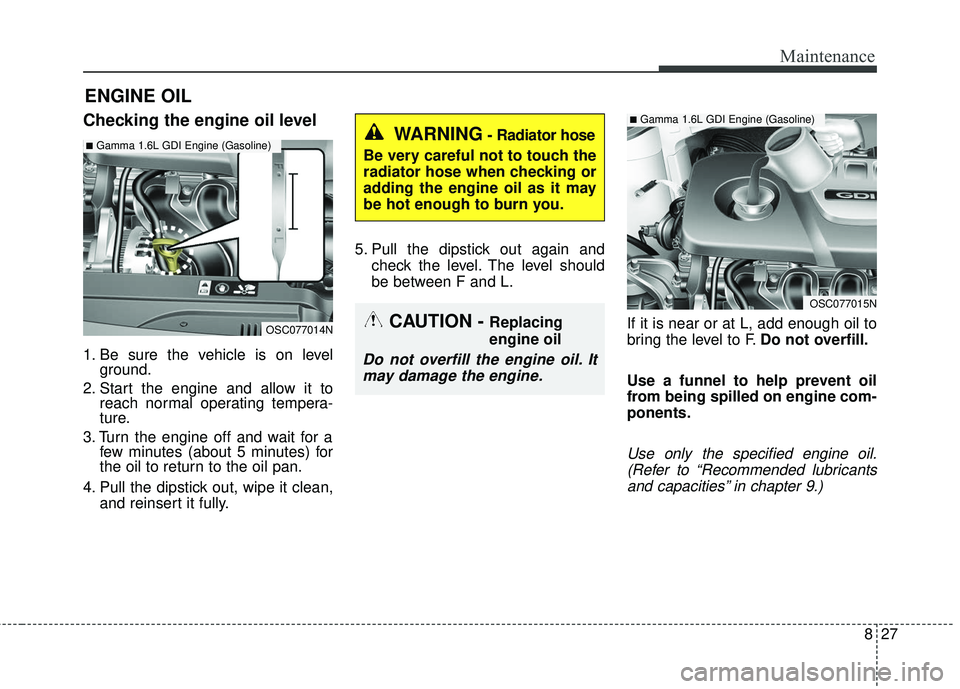
Checking the engine oil level
1. Be sure the vehicle is on levelground.
2. Start the engine and allow it to reach normal operating tempera-
ture.
3. Turn the engine off and wait for a few minutes (about 5 minutes) for
the oil to return to the oil pan.
4. Pull the dipstick out, wipe it clean, and reinsert it fully. 5. Pull the dipstick out again and
check the level. The level should
be between F and L.
If it is near or at L, add enough oil to
bring the level to F.Do not overfill.
Use a funnel to help prevent oil
from being spilled on engine com-
ponents.
Use only the specified engine oil. (Refer to “Recommended lubricantsand capacities” in chapter 9.)
CAUTION - Replacing
engine oil
Do not overfill the engine oil. Itmay damage the engine.
WARNING- Radiator hose
Be very careful not to touch the
radiator hose when checking or
adding the engine oil as it may
be hot enough to burn you.
OSC077014N
■Gamma 1.6L GDI Engine (Gasoline)
OSC077015N
■Gamma 1.6L GDI Engine (Gasoline)
Page 389 of 490
Maintenance
32
8
BRAKE/CLUTCH FLUID (IF EQUIPPED)
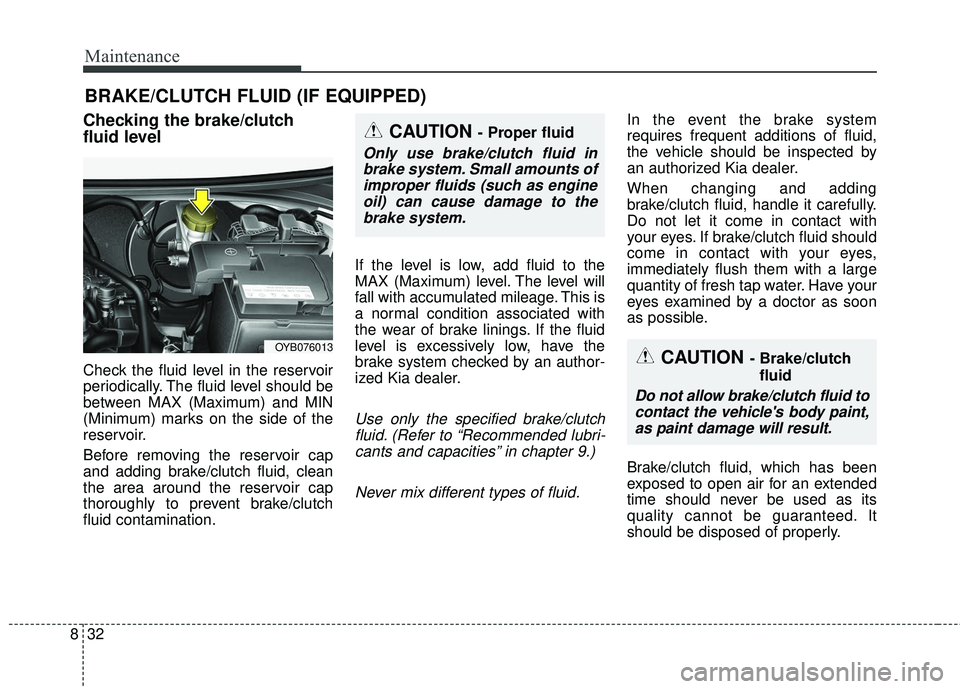
Checking the brake/clutch
fluid level
Check the fluid level in the reservoir
periodically. The fluid level should be
between MAX (Maximum) and MIN
(Minimum) marks on the side of the
reservoir.
Before removing the reservoir cap
and adding brake/clutch fluid, clean
the area around the reservoir cap
thoroughly to prevent brake/clutch
fluid contamination. If the level is low, add fluid to the
MAX (Maximum) level. The level will
fall with accumulated mileage. This is
a normal condition associated with
the wear of brake linings. If the fluid
level is excessively low, have the
brake system checked by an author-
ized Kia dealer.
Use only the specified brake/clutch
fluid. (Refer to “Recommended lubri-cants and capacities” in chapter 9.)
Never mix different types of fluid.
In the event the brake system
requires frequent additions of fluid,
the vehicle should be inspected by
an authorized Kia dealer.
When changing and adding
brake/clutch fluid, handle it carefully.
Do not let it come in contact with
your eyes. If brake/clutch fluid should
come in contact with your eyes,
immediately flush them with a large
quantity of fresh tap water. Have your
eyes examined by a doctor as soon
as possible.
Brake/clutch fluid, which has been
exposed to open air for an extended
time should never be used as its
quality cannot be guaranteed. It
should be disposed of properly.
OYB076013CAUTION - Brake/clutch fluid
Do not allow brake/clutch fluid tocontact the vehicle's body paint,as paint damage will result.
CAUTION - Proper fluid
Only use brake/clutch fluid inbrake system. Small amounts ofimproper fluids (such as engineoil) can cause damage to thebrake system.
Page 400 of 490
843
Maintenance
✽ ✽NOTICE
If you connect unauthorized elec-
tronic devices to the battery, the bat-
tery may be discharged. Never use
unauthorized devices.
Recharging the battery
Your vehicle has a maintenance-free,
calcium-based battery.
If the battery becomes discharged
in a short time (because, for exam-
ple, the headlamps or interior
lamps were left on while the vehi-
cle was not in use), recharge it by
slow charging (trickle) for 10 hours.
If the battery gradually discharges because of high electric load while
the vehicle is being used, recharge
it at 20-30A for two hours. When recharging the battery,
observe the following precautions:
The battery must be removed from
the vehicle and placed in an area
with good ventilation.
Do not allow cigarettes, sparks, or flame near the battery.
Watch the battery during charging, and stop or reduce the charging
rate if the battery cells begin
gassing (boiling) violently or if the
temperature of the electrolyte of
any cell exceeds 49°C (120°F).
Wear eye protection when check- ing the battery during charging.
Disconnect the battery charger in the following order.
1. Turn off the battery charger main switch.
2. Unhook the negative clamp from the negative battery terminal.
3. Unhook the positive clamp from the positive battery terminal.WARNING- Risk of elec-
trocution
Never touch the electrical igni-
tion system while the vehicle is
running. This system works
with high voltage which can
shock you.
WARNING- Recharging Battery
Never attempt to recharge the
battery when the battery cables
are connected.