2018 KIA RIO HATCHBACK power steering
[x] Cancel search: power steeringPage 288 of 492
Driving your vehicle
40
6
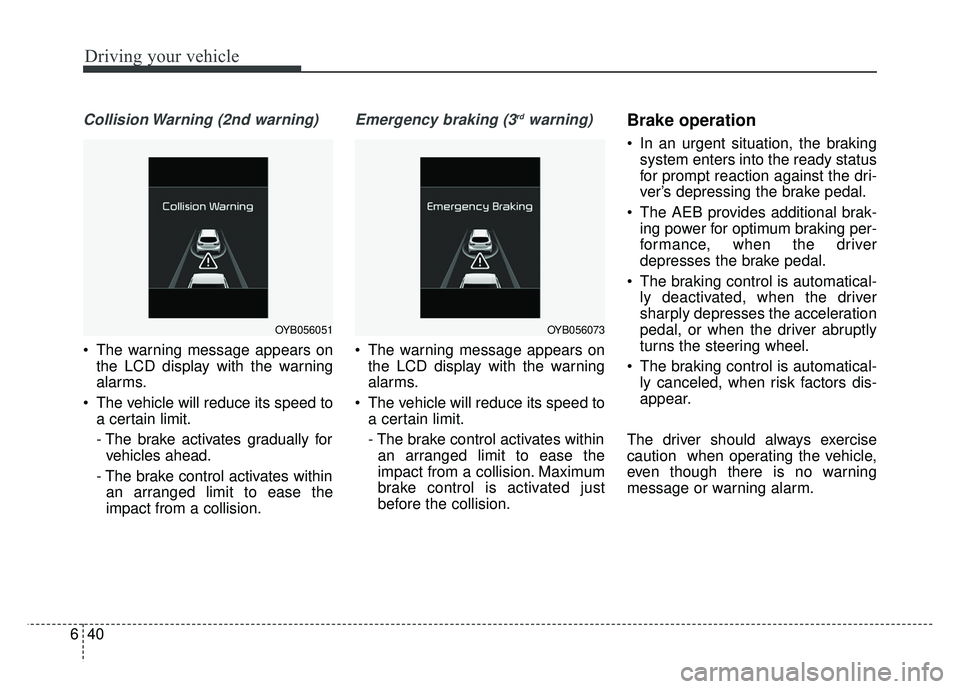
Collision Warning (2nd warning)
The warning message appears on
the LCD display with the warning
alarms.
The vehicle will reduce its speed to a certain limit.
- The brake activates gradually forvehicles ahead.
- The brake control activates within an arranged limit to ease the
impact from a collision.
Emergency braking (3rdwarning)
The warning message appears on the LCD display with the warning
alarms.
The vehicle will reduce its speed to a certain limit.
- The brake control activates withinan arranged limit to ease the
impact from a collision. Maximum
brake control is activated just
before the collision.
Brake operation
In an urgent situation, the braking system enters into the ready status
for prompt reaction against the dri-
ver’s depressing the brake pedal.
The AEB provides additional brak- ing power for optimum braking per-
formance, when the driver
depresses the brake pedal.
The braking control is automatical- ly deactivated, when the driver
sharply depresses the acceleration
pedal, or when the driver abruptly
turns the steering wheel.
The braking control is automatical- ly canceled, when risk factors dis-
appear.
The driver should always exercise
caution when operating the vehicle,
even though there is no warning
message or warning alarm.
OYB056051OYB056073
Page 304 of 492
Driving your vehicle
56
6
Remember, your vehicle does not
require extended warm-up. After
the engine has started, allow the
engine to run for 10 to 20 seconds
prior to placing the vehicle in gear.
In very cold weather, however, give
your engine a slightly longer warm-
up period.
Don't “lug” or “over-rev” the engine. Lugging is driving too slowly in a
very high gear resulting in engine
bucking. If this happens, shift to a
lower gear. Over-revving is racing
the engine beyond its safe limit.
This can be avoided by shifting at
the recommended speed. Use your air conditioning sparingly.
The air conditioning system is
operated by engine power so your
fuel economy is reduced when you
use it.
Open windows at high speeds can reduce fuel economy.
Fuel economy is reduced by cross- winds and headwinds. To help off-
set some of this loss, slow down
when driving in these conditions.
Keeping a vehicle in good operating
condition is important both for econ-
omy and safety. Therefore, have an
authorized Kia dealer perform
scheduled inspections and mainte-
nance.
WARNING- Engine off during
motion
Never turn the engine off to
coast down hills or anytime the
vehicle is in motion. The power
steering and power brakes will
not function properly without
the engine running. In addition,
turning off the ignition while
driving could engage the steer-
ing wheel lock resulting in loss
of vehicle steering. Keep the
engine on and downshift to an
appropriate gear for engine
braking effect.
Page 349 of 492
What to do in an emergency
30
7
If towing is necessary, we recom-
mend you have it done by an
authorized Kia dealer or a com-
mercial tow truck service.
If towing service is not available in an
emergency, your vehicle may be
temporarily towed using a cable or
chain secured to the emergency tow-
ing hook under the front (or rear) of
the vehicle. Use extreme caution
when towing the vehicle. A driver
must be in the vehicle to steer it and
operate the brakes.
Towing in this manner may be done
only on hard-surfaced roads for a
short distance and at low speeds.
Also, the wheels, axles, power train,
steering and brakes must all be in
good condition.
Do not use the towing hooks to pull
a vehicle out of mud, sand or other
conditions from which the vehicle
cannot be driven out under its own
power.
Avoid towing a vehicle heavier than the vehicle doing the towing. The drivers of both vehicles should
communicate with each other fre-
quently.
Attach a towing strap to the towing hook.
Using a portion of the vehicle other than the tow hooks for towing may
damage the body of your vehicle.
Use only a cable or chain specifical- ly intended for use in towing vehi-
cles. Securely fasten the cable or
chain to the towing hook provided.
Before emergency towing, check that the hook is not broken or dam-
aged.
Fasten the towing cable or chain securely to the hook.
Do not jerk the hook. Apply it steadily with even force.
To avoid damaging the hook, do not pull from the side or at a vertical
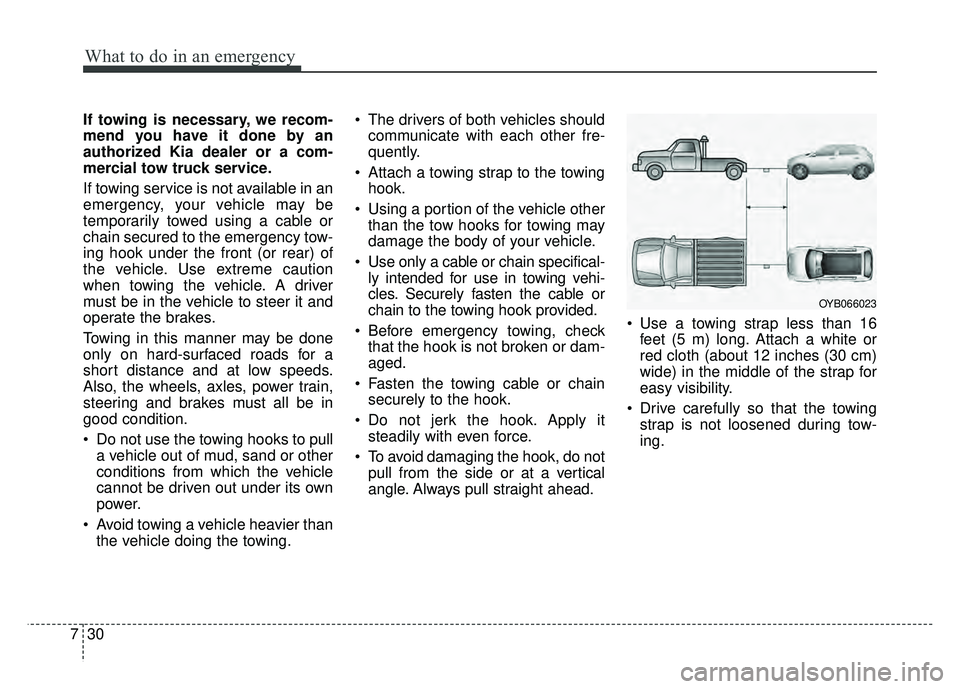
angle. Always pull straight ahead. Use a towing strap less than 16
feet (5 m) long. Attach a white or
red cloth (about 12 inches (30 cm)
wide) in the middle of the strap for
easy visibility.
Drive carefully so that the towing strap is not loosened during tow-
ing.
OYB066023
Page 350 of 492
731
What to do in an emergency
Emergency towing precautions
Turn the ignition switch to ACC sothe steering wheel isn’t locked.
Place the transaxle shift lever in N (Neutral).
Release the parking brake.
Press the brake pedal with more force than normal since you will
have reduced brake performance.
More steering effort will be required because the power steer-
ing system will be disabled.
If you are driving down a long hill, the brakes may overheat and brake
performance will be reduced. Stop
often and let the brakes cool off. If the car is being towed with all four
wheels on the ground, it can be
towed only from the front. Be sure
that the transmission is in neutral. Be
sure the steering is unlocked by plac-
ing the ignition switch in the ACC
position. A driver must be in the
towed vehicle to operate the steering
and brakes.
CAUTION- Automatic
transaxle
To avoid serious damage to the Automatic transaxle, limitthe vehicle speed to 10mph(15km/h) and drive less than1mile (1.5km/h) when towing.
Before towing, check for an Automatic transaxle fluid leakunder your vehicle. If theAutomatic transaxle fluid isleaking, a flatbed equipmentor towing dolly must be used.
Page 418 of 492

Maintenance
68
8
Fuse NameFuse ratingCircuit Protected
TCU15AEngine Room Junction Block(Back-Up Lamp Switch), Auto Transmission Shift Lever, Transaxle Range
Switch, Stop Lamp Switch
P/WINDOW LH25APower Window Main Switch
SPARE125ASpare
FOG LAMP REAR10A-
HEATED STEERING15AClock Spring
TAIL LAMP LH7.5AHead Lamp Left Handle side, License Lamp Left Handle side, Rear Combination Lamp (OUT) Left
Handle side, Rear Combination Lamp (IN) Left Handle side, Glove Box Lamp
MODULE37.5AFront Seat Warmer Control Module, Audio, Electro Chromic Mirror, Air Conditioner Control Module,
Audio/Video & Navigation Head Unit, Clock Spring, Auto Transmission Shift Lever Indicator
ABS7.5AEngine Room Junction Block(Multipurpose Check Connector), ESC (Electronic Stability Control) Module
BRAKE SWITCH10ASmart Key Control Module, Stop Lamp Switch
SPARE415ASpare
FOG LAMP FRONT15AFront Fog Lamp Relay
A/CON17.5AEngine Room Junction Block(Blower Relay), Air Conditioner Control Module
MODULE510AEngine Room Junction Block(Head Lamp Relay, Head Lamp Hi Relay), Rain Sensor, Sunroof Motor,
Front Seat Warmer Control Module, Driver Safety Power Window Module
MODULE710ATPMS (Tire Pressure Monitoring System) Unit
ECU10AECM (Engine Control Module)/PCM (Power train Control Module), Immobilizer Module, Smart Key
Control Module
Page 420 of 492

Maintenance
70
8
Fuse NameFuse ratingCircuit Protected
SPARE320ASpare
A/BAG IND7.5AInstrument Cluster
CLUSTER7.5AInstrument Cluster
MDPS7.5AMDPS (Motor Driven Power Steering) Unit
AUDIO20AAudio, Audio/Video & Navigation Head Unit
ROOM LP10ARoom Lamp Relay, Glove Box Lamp, Air Conditioner Control Module, SLM (Seat Belt & Lighting Module),
BCM (Body Control Module), Auto Light & Photo Sensor, TPMS (Tire Pressure Monitoring System) Unit,
Instrument Cluster, Data Link Connector, Room Lamp, Trunk Room Lamp
Page 422 of 492

Maintenance
72
8
Engine room compartment fuse panel
Fuse NameFuse ratingCircuit Protected
MDPS80AMDPS (Motor Driven Power Steering) Unit
ALT150AFuse - ABS1, BAS2, BLOWER, REAR HEATED
REAR HEATED40AInstrument Panel Junction Block (Rear Defogger Relay)
ABS140AESC (Electronic Stability Control) Module, Multipurpose Check Connector
ABS240AESC (Electronic Stability Control) Module
BLOWER40ABlower Relay
WIPER10AFront Wiper Motor, Multifunction Switch, Wiper Low Relay
ECU415AECM (Engine Control Module)/PCM (Power train Control Module)
SENSOR10AOil Control Valve #1/#2, Cooling Fan1/2 Relay, Oxygen Sensor (Up), Oxygen Sensor (Down), Variable
Intake Solenoid Valve, Air Conditioner Relay, Purge Control Solenoid Valve, Canister Close Valve
ECU215AECM (Engine Control Module)/PCM (Power train Control Module)
ECU320AECM (Engine Control Module)/PCM (Power train Control Module)
HEAD LAMP RH10AHead Lamp Right Handle side
HEAD LAMP LH10AHead Lamp Left Handle side
IGN COIL20AIgnition Coil #1~#4, Condenser
ECU515AECM (Engine Control Module)/PCM (Power train Control Module), Fuel Pump Relay
Page 482 of 492

Index
4I
To cancel cruise control ..............................................6-51
To resume cruising speed at more than approximately 20 mph (3 0km/h) ....................................................6-51
To turn cruise control off ............................................6-52
Cup holder ..................................................................4-131
Curtain air bag ..............................................................3-48
Dashboard illumination, see instrument panel illumination..................................................................4-53
Dashboard, see instrument cluster ................................4-52
Day/night rearview mirror ............................................4-49
Declaration of Conformity ............................................5-39
Defogging (Windshield) ..............................................4-123
Defroster (Rear window) ............................................4-103
Defrosting (Windshield) ..............................................4-123
Dimensions ......................................................................9-\
2
Display illumination, see instrument panel illumination ..4-53
Displays, see instrument cluster ....................................4-52
Door locks......................................................................4-\
17 from outside the vehicle..............................................4-17
from inside the vehicle................................................4-18
Central door lock switch ............................................4-18
Child-protector rear door lock ....................................4-20
Driver's and passenger's front air bag ............................3-44
Driving at night ..............................................................6-58
Driving in flooded areas ................................................6-59 Driving in the rain..........................................................6-59
Driving off-road ............................................................6-60
DRL (Bulb type) bulb replacement ..............................8-85
Economical operation ....................................................6-55
Electric power steering ..................................................4-46
Electrical equipment (U.S. ONLY) ..............................9-15
Electronic stability control (ESC) ................................6-29
Emergency starting ..........................................................7-5
Jump starting ................................................................7-5
Emergency while driving ................................................7-3
Emission control system ..............................................8-109 Crankcase emission control system ..........................8-109
Evaporative emission control (including ORVR: Onboard Refueling Vapor Recovery) system ........8-109
Exhaust emission control system ..............................8-110
Engine ........................................................................\
......9-2
Engine compartment ........................................................8-4
Engine coolant ..............................................................8-28 Checking the coolant level..........................................8-28
Changing the coolant ..................................................8-30
Engine coolant temperature gauge ................................4-55
Engine number ..............................................................9-11
Engine oil ......................................................................8-\
26 Checking the engine oil level ....................................8-26
Changing the engine oil and filter ..............................8-27
D
E