2018 KIA NIRO PHEV Distance
[x] Cancel search: DistancePage 450 of 616

What to do in an emergency
14
7
✽
✽
NOTICE
If the TPMS, Low Tire Pressure
indicator does not illuminate for 3
seconds when the ignition switch is
turned to the ON position or engine
is running, or if they remain illumi-
nated after coming on for approxi-
mately 3 seconds, take your vehicle
to your nearest authorized Kia deal-
er and have the system checked.
Low tire pressure
telltale
Low tire pressure position tell-
tale
When the tire pressure monitoring
system warning indicators are illumi-
nated, one or more of your tires is
significantly under-inflated.
If the telltale illuminates, immediately
reduce your speed, avoid hard cor-
nering and anticipate increased stop-
ping distances. You should stop and
check your tires as soon as possible. Inflate the tires to the proper pres-
sure as indicated on the vehicle’s
placard or tire inflation pressure label
located on the driver’s side center pil-
lar outer panel. If you cannot reach a
service station or if the tire cannot
hold the newly added air, replace the
low pressure tire with the spare tire.
Then the TPMS malfunction indicator
and the Low Tire Pressure telltale
may turn on and illuminate after
restarting and about 20 minutes of
continuous driving before you have
the low pressure tire repaired and
replaced on the vehicle.
In winter or cold weather, the low tire
pressure telltale may be illuminated if
the tire pressure was adjusted to the
recommended tire inflation pressure
in warm weather. It does not mean
your TPMS is malfunctioning
because the decreased temperature
leads to a proportional lowering of
tire pressure.
ODE067053N
Page 451 of 616

715
What to do in an emergency
When you drive your vehicle from a
warm area to a cold area or from a
cold area to a warm area, or the out-
side temperature is greatly higher or
lower, you should check the tire infla-
tion pressure and adjust the tires to
the recommended tire inflation pres-
sure.TPMS (Tire PressureMonitoring System)malfunction indicator
The low tire pressure telltale will illu-
minate after it blinks for approximate-
ly one minute when there is a prob-
lem with the Tire Pressure
Monitoring System. If the system is
able to correctly detect an underinfla-
tion warning at the same time as sys-
tem failure then it will illuminate both
the TPMS malfunction and low tire
pressure position telltales e.g. if
Front Left sensor fails, the TPMS
malfunction indicator illuminates, but
if the Front Right, Rear Left, or Rear
Right tire is under-inflated, the low
tire pressure position telltales may
illuminate together with the TPMS
malfunction indicator.
Have the system checked by an
authorized Kia dealer as soon as
possible to determine the cause of
the problem. The TPMS malfunction indicator
may be illuminated if the vehicle is
moving around electric power sup-
ply cables or radios transmitters
such as at police stations, govern-
ment and public offices, broadcast-
ing stations, military installations,
airports, or transmitting towers,
etc. This can interfere with normal
operation of the Tire Pressure
Monitoring System (TPMS).
The TPMS malfunction indicator may be illuminated if snow chains
are used or some separate elec-
tronic devices such as notebook
computer, mobile charger, remote
starter or navigation etc., are used
in the vehicle. This can interfere
with normal operation of the Tire
Pressure Monitoring System
(TPMS).
WARNING- Low pressure
damage
Do not drive on low pressure
tires. Significantly low tire pres-
sure can cause the tires to over-
heat and fail making the vehicle
unstable resulting in increased
braking distances and a loss of
vehicle control.
Page 466 of 616

What to do in an emergency
30
7
3. Install the towing hook by turning it
clockwise into the hole until it is
fully secured.
4. Remove the towing hook and install the cover after use.Emergency towing
If towing is necessary, have it
done by an authorized Kia dealer
or a commercial tow truck service. If towing service is not available in an
emergency, your vehicle may be
temporarily towed using a cable or
chain secured to the emergency tow-
ing hook under the front (or rear) of
the vehicle. Use extreme caution
when towing the vehicle. A driver
must be in the vehicle to steer it and
operate the brakes.
Towing in this manner may be done
only on hard-surfaced roads for a
short distance and at low speed.
Also, the wheels, axles, power train,
steering and brakes must all be in
good condition.
Do not use the tow hooks to pull a
vehicle out of mud, sand or other
conditions from which the vehicle
cannot be driven out under its own
power.
Avoid towing a vehicle heavier than the vehicle doing the towing.
The drivers of both vehicles should communicate with each other fre-
quently.
ODE066016
ODE066017
■Front
■ Rear
Page 469 of 616

733
What to do in an emergency
IF AN ACCIDENT OCCURS
✽
✽ NOTICE
Any gas or electrolyte leakage from
your vehicle is not only poisonous
but also flammable. Upon witness-
ing one of those, open the windows,
and remain a safe distance from the
vehicle out of the road. Immediately
contact an authorized Kia dealer
and advise them that a hybrid vehi-
cle is involved.
If you need towing, refer to
"Towing" in the previous pages.
When the vehicle is severely dam- aged, remain a safe distance of 50
feet (15 meter) or more between
your vehicle and other
vehicles/flammables.
If a fire occurs :
Immediately call emergency services
(911) and advise the emergency
responders that a hybrid vehicle is
involved.
WARNING - High voltage components
For your safety, do not touch high voltage cables, connec-
tors and package modules.
High voltage components are
orange in color.
Exposed cables or wires may be visible inside or outside of
the vehicle. Never touch the
wires or cables, because an
electrical shock, an injury, or a
death may occur.WARNING- Submersion
in water
Do not touch your vehicle if it
has been submerged in water.
The high-voltage battery may
cause shock or may catch fire.
Immediately contact the author-
ities and advise them of the
condition of your vehicle and
that a hybrid vehicle is involved.
Page 478 of 616

89
Maintenance
SCHEDULED MAINTENANCE SERVICE
Follow the Normal Maintenance
Schedule if the vehicle is usually
operated where none of the following
conditions apply. If any of the following
conditions apply, follow the
Maintenance Under Severe Usage
Conditions.
Repeatedly driving short distanceof less than 5miles (8 km) in nor-
mal temperature or less than 10
miles (16 km) in freezing tempera-
ture.
Extensive engine idling or low speed driving for long distances.
Driving on rough, dusty, muddy, unpaved, graveled or salt-spread
roads.
Driving in areas using salt or other corrosive materials or in very cold
weather.
Driving in heavy dust condition.
Driving in heavy traffic area. Driving on uphill, downhill, or
mountain roads repeatedly.
Towing a trailer or using a camper on roof rack.
Driving for patrol car, taxi, other commercial use of vehicle towing.
Driving over 106 mph (170 km/h).
Frequently driving in stop-and-go conditions.If your vehicle is operated under theabove conditions, you shouldinspect, replace or refill more fre-quently than the following NormalMaintenance Schedule. After 120months or 150,000 miles continue tofollow the prescribed maintenanceintervals.
Page 490 of 616

821
Maintenance
Maintenance Under Severe Usage Conditions
Severe Driving Conditions
A - Repeatedly driving short distance of less than 5 miles (8 km) in nor-mal temperature or less than 10 miles (16 km) in freezing temperature
B - Extensive engine idling or low speed driving for long distances
C - Driving on rough, dusty, muddy, unpaved, graveled or salt- spread roads
D - Driving in areas using salt or other corrosive materials or in very cold weather E - Driving in heavy dust condition.
F - Driving in heavy traffic area.
G - Driving on uphill, downhill, or mountain roads repeatedly.
H - Towing a trailer or using a camper on roof rack.
I - Driving for patrol car, taxi, other commercial use of vehicle towing.
J - Driving over 106 mph (170 km/h).
K - Frequently driving in stop-and-go conditions.
The following items must be serviced more frequently on cars normally used under severe driving conditions. Refer
to the chart below for the appropriate maintenance intervals.
R : Replace I : Inspect and, after inspection, clean, adjust, repair or replace if neces\
sary
MAINTENANCE ITEMMAINTENANCE
OPERATIONMAINTENANCE INTERVALSDRIVING CONDITION
Engine oil and filter REvery 3,750 miles (6,000 km) or 6 monthsA, B, C, D, E, F, G,
H, I, J, K
Air cleaner filterRMore frequentlyC, E
Spark plugsRMore frequentlyB, H
Dual clutch transmission fluid REvery 75,000 miles (120,000 km)C, D, E, F, G, H, I, J
HSG (Hybrid Starter & Generator) beltREvery 30,000 miles (48,000 km) or 24 monthsC, D, E, K
IEvery 3,750 miles (6,000 km) or 6 monthsC, D, E, K
Front brake disc/pads, calipersIMore frequentlyC, D, G, H
Rear brake disc/padsIMore frequentlyC, D, G, F
Parking brakeIMore frequentlyC, D, G, H
Steering gear box, linkage & boots/lower arm ball
joint, upper arm ball jointIMore frequentlyC, D, E, F, G, H, I
Drive shafts and bootsIEvery 7,500 miles (12,000 km) or 6 monthsC, D, E, F, G, H, I, J
Climate control air filter
(for evaporator and blower unit)RMore frequentlyC, E
Suspension mounting boltsIMore frequentlyC, D, E, F, G, H, I
Page 575 of 616

Maintenance
106
8
High-pressure washing
When using high-pressure wash-
ers, make sure to maintain suffi-
cient distance from the vehicle.
Insufficient clearance or excessive
pressure can lead to component
damage or water penetration.
Do not spray the camera, sensors or its surrounding area directly with
a high pressure washer. Shock
applied from high pressure water
may cause the device to not oper-
ate normally.
Do not bring the nozzle tip close to boots (rubber or plastic covers) or
connectors as they may be dam-
aged if they come into contact with
high pressure water. Waxing
Wax the vehicle when water will no
longer bead on the paint.
Always wash and dry the vehicle
before waxing. Use a good quality
liquid or paste wax, and follow the
manufacturer’s instructions. Wax all
metal trim to protect it and to main-
tain its luster.
Removing oil, tar, and similar materi-
als with a spot remover will usually
strip the wax from the finish. Be sure
to re-wax these areas even if the rest
of the vehicle does not yet need wax-
ing.
Do not apply wax on embossed
unpainted unit, as it may tarnish the
unit.
ODEP077071L
CAUTION - Wet engine
Water washing in the engine
compartment including highpressure water washing maycause the failure of electricalcircuits located in the enginecompartment.
Never allow water or other liq- uids to come in contact withelectrical/electronic compo-nents inside the vehicle asthis may damage them.
Page 603 of 616
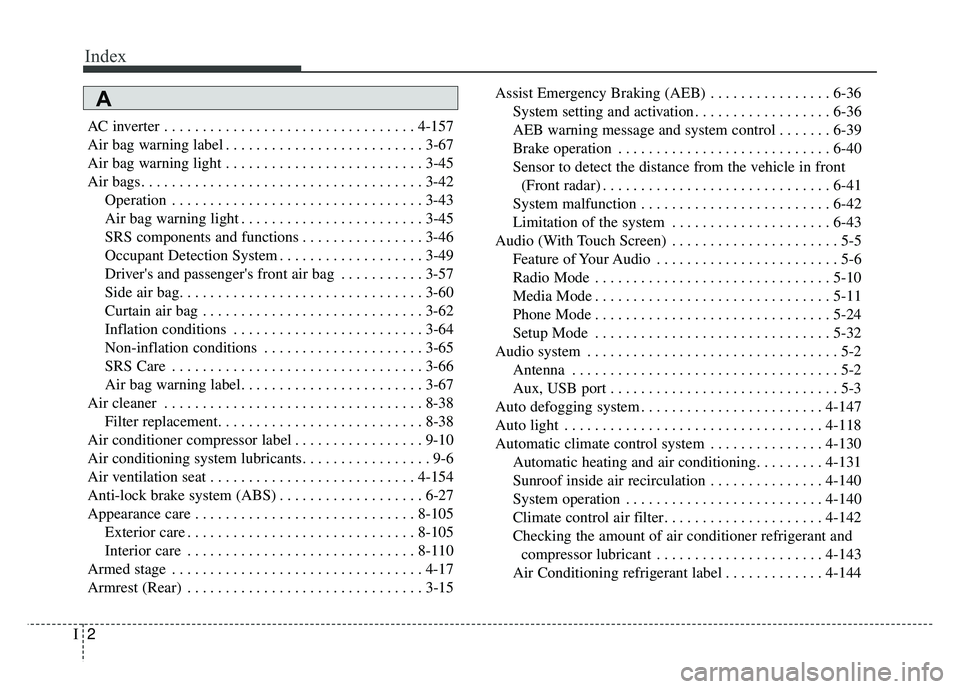
Index
2I
AC inverter . . . . . . . . . . . . . . . . . . . . . . . . . . . . . . . . . 4-157
Air bag warning label . . . . . . . . . . . . . . . . . . . . . . . . . . 3-67
Air bag warning light . . . . . . . . . . . . . . . . . . . . . . . . . . 3-45
Air bags. . . . . . . . . . . . . . . . . . . . . . . . . . . . . . . . . . . . \
. 3-42Operation . . . . . . . . . . . . . . . . . . . . . . . . . . . . . . . . . 3-43
Air bag warning light . . . . . . . . . . . . . . . . . . . . . . . . 3-45
SRS components and functions . . . . . . . . . . . . . . . . 3-46
Occupant Detection System . . . . . . . . . . . . . . . . . . . 3-49
Driver's and passenger's front air bag . . . . . . . . . . . 3-57
Side air bag. . . . . . . . . . . . . . . . . . . . . . . . . . . . . . . . 3-60
Curtain air bag . . . . . . . . . . . . . . . . . . . . . . . . . . . . . 3-62
Inflation conditions . . . . . . . . . . . . . . . . . . . . . . . . . 3-64
Non-inflation conditions . . . . . . . . . . . . . . . . . . . . . 3-65
SRS Care . . . . . . . . . . . . . . . . . . . . . . . . . . . . . . . . . 3-66
Air bag warning label. . . . . . . . . . . . . . . . . . . . . . . . 3-67
Air cleaner . . . . . . . . . . . . . . . . . . . . . . . . . . . . . . . . . . 8-38\
Filter replacement. . . . . . . . . . . . . . . . . . . . . . . . . . . 8-38
Air conditioner compressor label . . . . . . . . . . . . . . . . . 9-10
Air conditioning system lubricants. . . . . . . . . . . . . . . . . 9-6
Air ventilation seat . . . . . . . . . . . . . . . . . . . . . . . . . . . 4-154
Anti-lock brake system (ABS) . . . . . . . . . . . . . . . . . . . 6-27
Appearance care . . . . . . . . . . . . . . . . . . . . . . . . . . . . . 8-105 Exterior care . . . . . . . . . . . . . . . . . . . . . . . . . . . . . . 8-105
Interior care . . . . . . . . . . . . . . . . . . . . . . . . . . . . . . 8-110
Armed stage . . . . . . . . . . . . . . . . . . . . . . . . . . . . . . . . . 4-17
Armrest (Rear) . . . . . . . . . . . . . . . . . . . . . . . . . . . . . . . 3-15 Assist Emergency Braking (AEB) . . . . . . . . . . . . . . . . 6-36
System setting and activation . . . . . . . . . . . . . . . . . . 6-36
AEB warning message and system control . . . . . . . 6-39
Brake operation . . . . . . . . . . . . . . . . . . . . . . . . . . . . 6-40
Sensor to detect the distance from the vehicle in front (Front radar) . . . . . . . . . . . . . . . . . . . . . . . . . . . . . . 6-41
System malfunction . . . . . . . . . . . . . . . . . . . . . . . . . 6-42
Limitation of the system . . . . . . . . . . . . . . . . . . . . . 6-43
Audio (With Touch Screen) . . . . . . . . . . . . . . . . . . . . . . 5-5 Feature of Your Audio . . . . . . . . . . . . . . . . . . . . . . . . 5-6
Radio Mode . . . . . . . . . . . . . . . . . . . . . . . . . . . . . . . 5-10
Media Mode . . . . . . . . . . . . . . . . . . . . . . . . . . . . . . . 5-11
Phone Mode . . . . . . . . . . . . . . . . . . . . . . . . . . . . . . . 5-24
Setup Mode . . . . . . . . . . . . . . . . . . . . . . . . . . . . . . . 5-32
Audio system . . . . . . . . . . . . . . . . . . . . . . . . . . . . . . . . . 5-2 Antenna . . . . . . . . . . . . . . . . . . . . . . . . . . . . . . . . . . . 5-\
2
Aux, USB port . . . . . . . . . . . . . . . . . . . . . . . . . . . . . . 5-3
Auto defogging system . . . . . . . . . . . . . . . . . . . . . . . . 4-147
Auto light . . . . . . . . . . . . . . . . . . . . . . . . . . . . . . . . . . 4-11\
8
Automatic climate control system . . . . . . . . . . . . . . . 4-130 Automatic heating and air conditioning. . . . . . . . . 4-131
Sunroof inside air recirculation . . . . . . . . . . . . . . . 4-140
System operation . . . . . . . . . . . . . . . . . . . . . . . . . . 4-140
Climate control air filter. . . . . . . . . . . . . . . . . . . . . 4-142
Checking the amount of air conditioner refrigerant and compressor lubricant . . . . . . . . . . . . . . . . . . . . . . 4-143
Air Conditioning refrigerant label . . . . . . . . . . . . . 4-144
A