2018 Hyundai Kona check engine
[x] Cancel search: check enginePage 435 of 523
7-23
7
Maintenance
Checking the engine oil and filter
We recommend that the engine oil
and filter be replaced by an author-
ized HYUNDAI dealer.The high-pressure cooling system
has a reservoir filled with year-round
antifreeze coolant. The reservoir is
filled at the factory.
Check the antifreeze protection and
coolant concentration level at least
once a year, at the beginning of the
winter season, and before traveling
to a colder climate.
When the engine overheats from
low engine coolant, suddenly
adding engine coolant may cause
cracks in the engine. To prevent
damage, add engine coolant
slowly in small quantities.
Do not drive with no engine coolant. It may cause water pump
failure and engine seizure, etc.
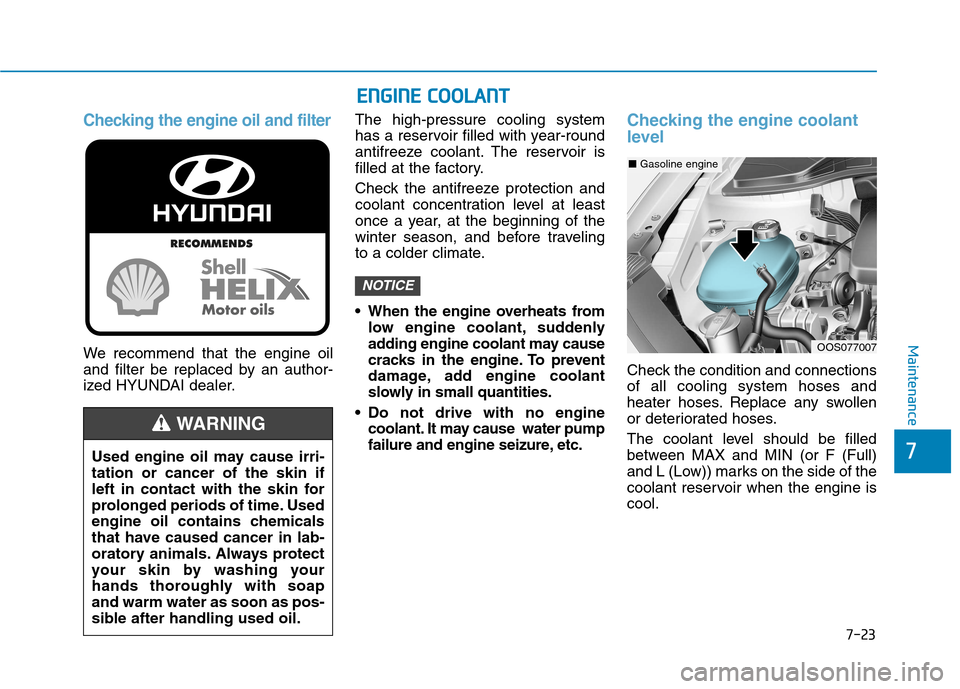
Checking the engine coolant
level
Check the condition and connections of all cooling system hoses and
heater hoses. Replace any swollen
or deteriorated hoses.
The coolant level should be filled
between MAX and MIN (or F (Full)
and L (Low)) marks on the side of the
coolant reservoir when the engine iscool.
NOTICE
Used engine oil may cause irri- tation or cancer of the skin if
left in contact with the skin for
prolonged periods of time. Used
engine oil contains chemicals
that have caused cancer in lab-
oratory animals. Always protect
your skin by washing your
hands thoroughly with soapand warm water as soon as pos-
sible after handling used oil.
WARNING
EENN GGIINN EE CC OO OOLLAA NN TT
OOS077007
■Gasoline engine
Page 438 of 523
7-26
MaintenanceB
B RRAA KKEE//CC LLUU TTCCHH FF LLUU IIDD (( IIFF EE QQ UUIIPP PPEEDD ))
Checking the brake/clutch
fluid level
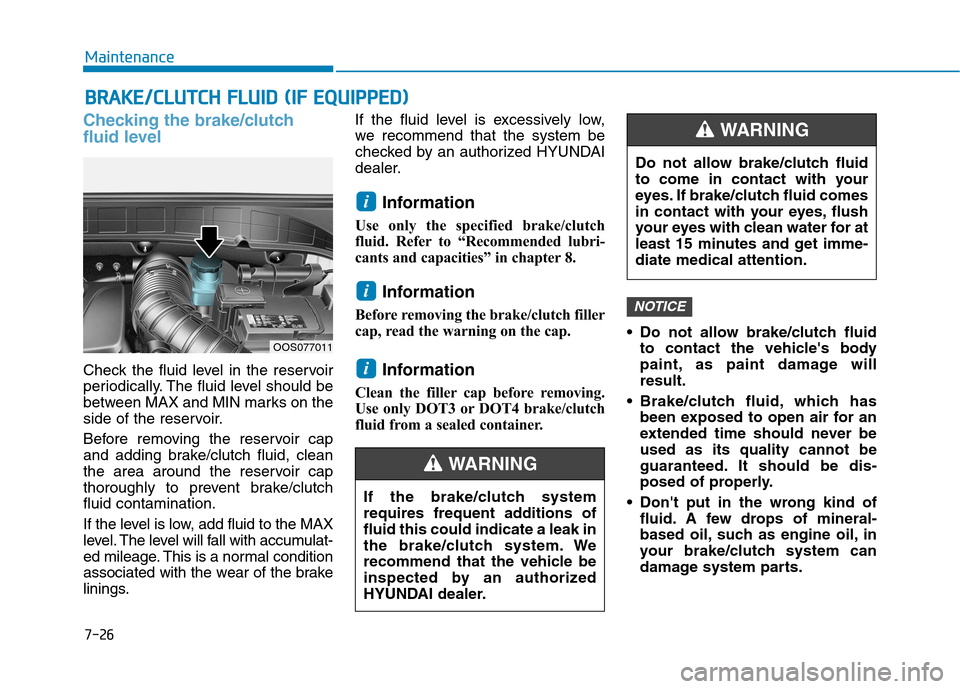
Check the fluid level in the reservoir
periodically. The fluid level should be
between MAX and MIN marks on the
side of the reservoir.
Before removing the reservoir cap
and adding brake/clutch fluid, clean
the area around the reservoir cap
thoroughly to prevent brake/clutchfluid contamination.
If the level is low, add fluid to the MAX
level. The level will fall with accumulat-
ed mileage. This is a normal condition
associated with the wear of the brake
linings. If the fluid level is excessively low,
we recommend that the system be
checked by an authorized HYUNDAI
dealer.
Information
Use only the specified brake/clutch
fluid. Refer to “Recommended lubri-
cants and capacities” in chapter 8.
Information
Before removing the brake/clutch filler
cap, read the warning on the cap.
Information
Clean the filler cap before removing.
Use only DOT3 or DOT4 brake/clutch
fluid from a sealed container. Do not allow brake/clutch fluid
to contact the vehicle's body
paint, as paint damage willresult.
Brake/clutch fluid, which has been exposed to open air for an
extended time should never beused as its quality cannot be
guaranteed. It should be dis-
posed of properly.
Don't put in the wrong kind of fluid. A few drops of mineral-
based oil, such as engine oil, in
your brake/clutch system can
damage system parts.
NOTICE
i
i
i
Do not allow brake/clutch fluid
to come in contact with your
eyes. If brake/clutch fluid comes
in contact with your eyes, flush
your eyes with clean water for at
least 15 minutes and get imme-diate medical attention.
WARNING
If the brake/clutch system
requires frequent additions offluid this could indicate a leak in
the brake/clutch system. We
recommend that the vehicle be
inspected by an authorized
HYUNDAI dealer.
WARNING
OOS077011
Page 439 of 523
7-27
7
Maintenance
WWAASSHH EERR FF LLUU IIDD
Checking the washer fluid
level
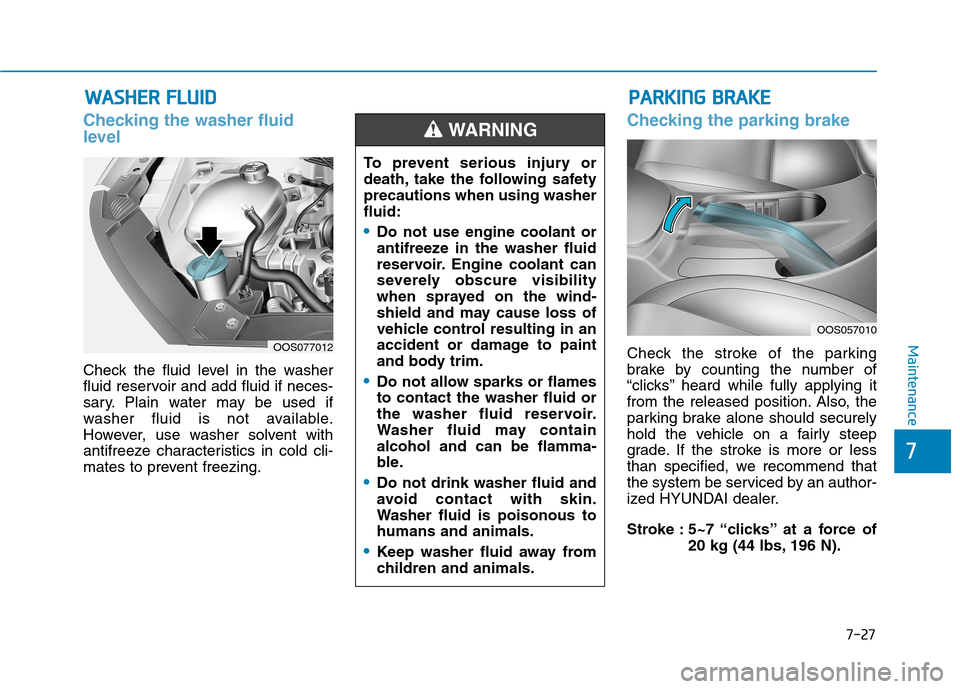
Check the fluid level in the washer
fluid reservoir and add fluid if neces-
sary. Plain water may be used if
washer fluid is not available.
However, use washer solvent with
antifreeze characteristics in cold cli-
mates to prevent freezing.
Checking the parking brake
Check the stroke of the parking
brake by counting the number of
“clicks’’ heard while fully applying it
from the released position. Also, the
parking brake alone should securely
hold the vehicle on a fairly steep
grade. If the stroke is more or less
than specified, we recommend that
the system be serviced by an author-
ized HYUNDAI dealer.
Stroke : 5~7 “clicks’’ at a force of
20 kg (44 lbs, 196 N).OOS077012
PPAA RRKK IINN GG BB RRAA KKEE
OOS057010
To prevent serious injury or
death, take the following safetyprecautions when using washerfluid:
Do not use engine coolant or
antifreeze in the washer fluid
reservoir. Engine coolant can
severely obscure visibility
when sprayed on the wind-
shield and may cause loss of
vehicle control resulting in an
accident or damage to paint
and body trim.
Do not allow sparks or flames to contact the washer fluid or
the washer fluid reservoir.
Washer fluid may containalcohol and can be flamma-
ble.
Do not drink washer fluid and
avoid contact with skin.
Washer fluid is poisonous tohumans and animals.
Keep washer fluid away from
children and animals.
WARNING
Page 440 of 523

7-28
MaintenanceA
A IIRR CC LLEE AA NN EERR
Filter replacement
The air cleaner filter can be cleaned
for inspection using compressed air.
Do not attempt to wash or to rinse it,
as water will damage the filter.
If soiled, the air cleaner filter must be replaced. 1. Loosen the air cleaner cover
attaching clips and open the cover.
2. Wipe the inside of the air cleaner.
3. Replace the air cleaner filter. 4. Lock the cover with the cover
attaching clips.
5. Check that the cover is firmly installed.
Information
If the vehicle is operated in extremely
dusty or sandy areas, replace the element
more often than the usual recommended
intervals (refer to “Maintenance Under
Severe Usage Conditions” in this chap-
ter).
Do not drive with the air cleaner filter removed. This will result in
excessive engine wear.
When removing the air cleaner filter, be careful that dust or dirt
does not enter the air intake, or
damage may result.
Use HYUNDAI genuine parts. Use of non-genuine parts could
damage the air flow sensor.
NOTICE
i
OOS077013
OOS077015
OOS077016
Page 446 of 523
7-34
Maintenance
Battery capacity label
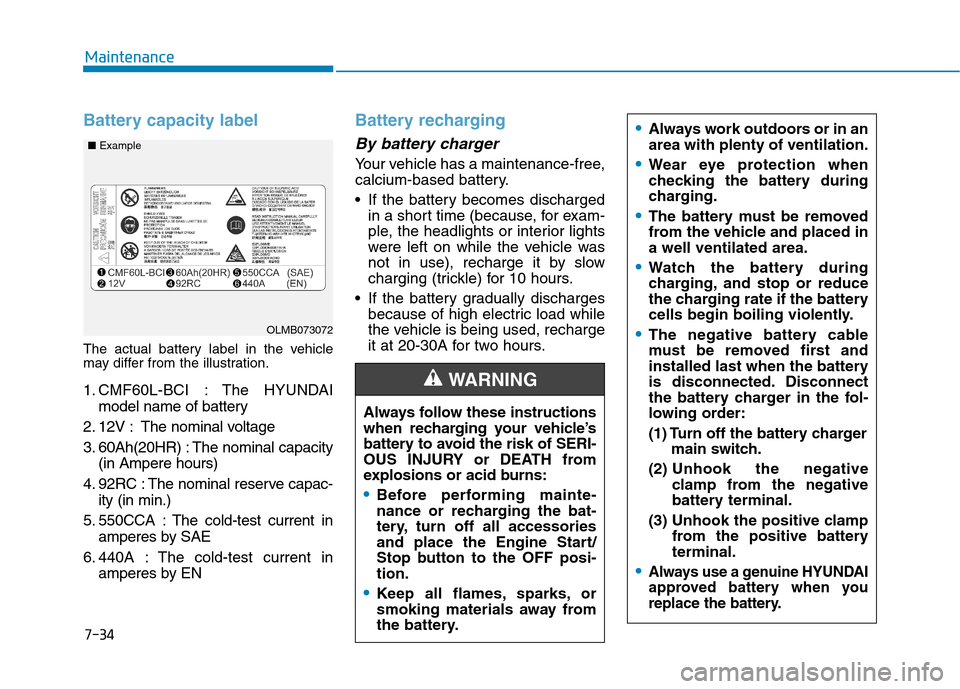
The actual battery label in the vehicle
may differ from the illustration.
1. CMF60L-BCI : The HYUNDAImodel name of battery
2. 12V : The nominal voltage
3. 60Ah(20HR) : The nominal capacity (in Ampere hours)
4. 92RC : The nominal reserve capac- ity (in min.)
5. 550CCA : The cold-test current in amperes by SAE
6. 440A : The cold-test current in amperes by EN
Battery recharging
By battery charger
Your vehicle has a maintenance-free,
calcium-based battery.
If the battery becomes dischargedin a short time (because, for exam-
ple, the headlights or interior lights
were left on while the vehicle was
not in use), recharge it by slow
charging (trickle) for 10 hours.
If the battery gradually discharges because of high electric load while
the vehicle is being used, recharge
it at 20-30A for two hours.
OLMB073072
■
Example
Always follow these instructions
when recharging your vehicle’s
battery to avoid the risk of SERI-
OUS INJURY or DEATH from
explosions or acid burns:
Before performing mainte-
nance or recharging the bat-
tery, turn off all accessories
and place the Engine Start/
Stop button to the OFF posi-tion.
Keep all flames, sparks, or
smoking materials away from
the battery.
WARNING
Always work outdoors or in an area with plenty of ventilation.
Wear eye protection when
checking the battery during
charging.
The battery must be removed
from the vehicle and placed ina well ventilated area.
Watch the battery during
charging, and stop or reduce
the charging rate if the battery
cells begin boiling violently.
The negative battery cable
must be removed first and
installed last when the battery
is disconnected. Disconnect
the battery charger in the fol-
lowing order:
(1) Turn off the battery chargermain switch.
(2) Unhook the negative
clamp from the negative
battery terminal.
(3) Unhook the positive clamp from the positive batteryterminal.
Always use a genuine HYUNDAI
approved battery when you
replace the battery.
Page 458 of 523
7-46
MaintenanceF
F UU SSEE SS
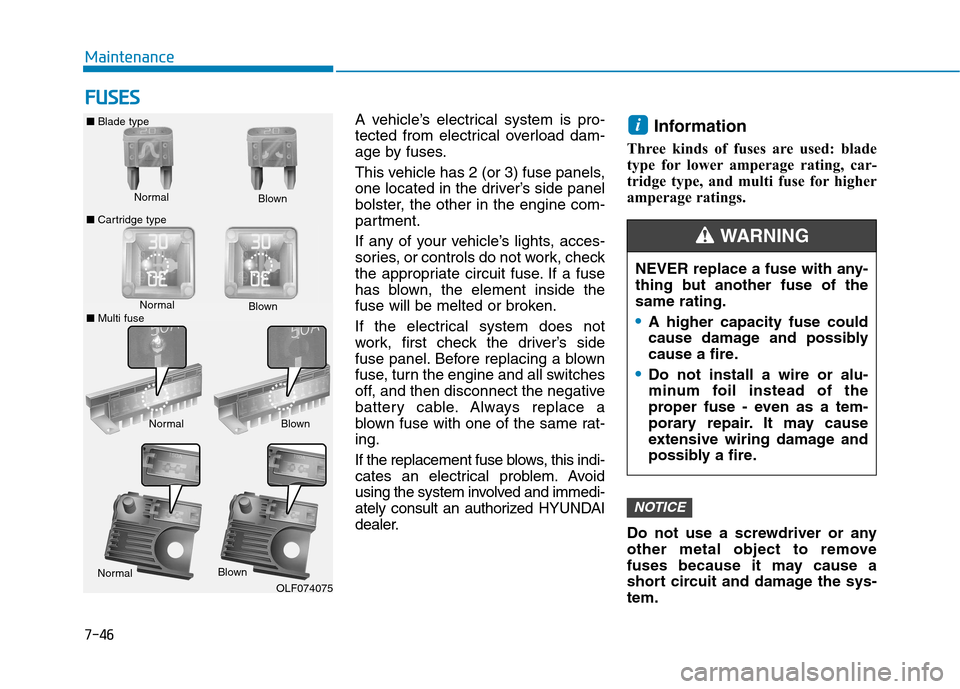
A vehicle’s electrical system is pro-
tected from electrical overload dam-
age by fuses.
This vehicle has 2 (or 3) fuse panels,
one located in the driver’s side panel
bolster, the other in the engine com-
partment.
If any of your vehicle’s lights, acces-
sories, or controls do not work, check
the appropriate circuit fuse. If a fuse
has blown, the element inside the
fuse will be melted or broken.
If the electrical system does not
work, first check the driver’s side
fuse panel. Before replacing a blown
fuse, turn the engine and all switches
off, and then disconnect the negative
battery cable. Always replace a
blown fuse with one of the same rat-ing.
If the replacement fuse blows, this indi-
cates an electrical problem. Avoid
using the system involved and immedi-
ately consult an authorized HYUNDAI
dealer. Information
Three kinds of fuses are used: blade
type for lower amperage rating, car-
tridge type, and multi fuse for higher
amperage ratings.
Do not use a screwdriver or any
other metal object to remove
fuses because it may cause a
short circuit and damage the sys-tem.
NOTICE
i
Normal
■
Blade type
■ Cartridge type Blown
Normal Blown
Normal Blown
OLF074075 NEVER replace a fuse with any-
thing but another fuse of thesame rating.
A higher capacity fuse could
cause damage and possibly
cause a fire.
Do not install a wire or alu-
minum foil instead of the
proper fuse - even as a tem-
porary repair. It may cause
extensive wiring damage and
possibly a fire.
WARNING
Normal
Blown
■ Multi fuse
Page 459 of 523
7-47
7
Maintenance
Instrument panel fuse replace- ment
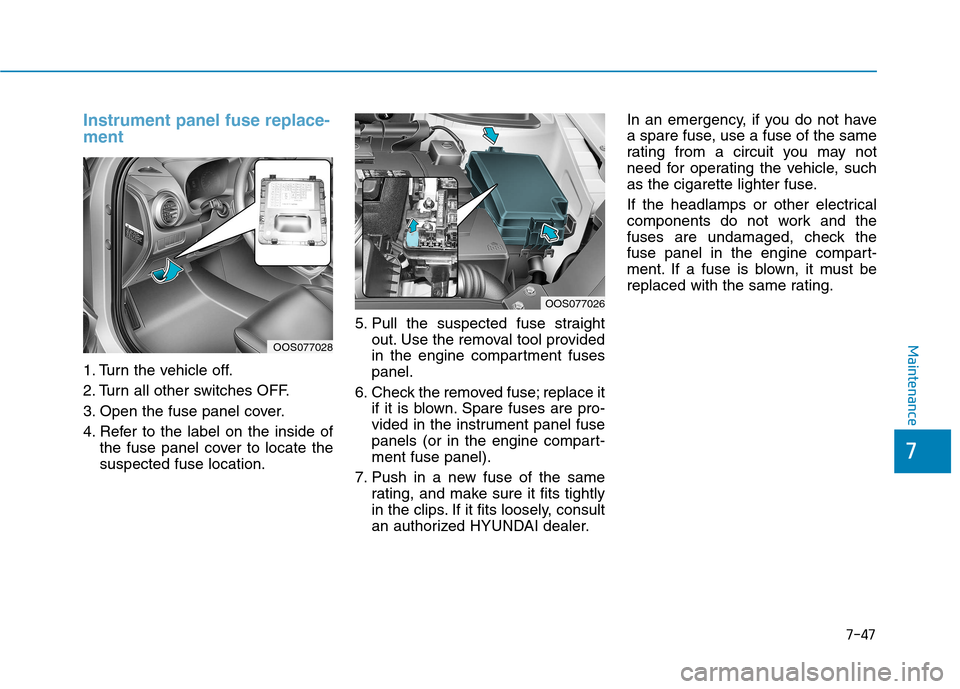
1. Turn the vehicle off.
2. Turn all other switches OFF.
3. Open the fuse panel cover.
4. Refer to the label on the inside ofthe fuse panel cover to locate the suspected fuse location. 5. Pull the suspected fuse straight
out. Use the removal tool provided
in the engine compartment fusespanel.
6. Check the removed fuse; replace it if it is blown. Spare fuses are pro-
vided in the instrument panel fuse
panels (or in the engine compart-ment fuse panel).
7. Push in a new fuse of the same rating, and make sure it fits tightly
in the clips. If it fits loosely, consult
an authorized HYUNDAI dealer. In an emergency, if you do not have
a spare fuse, use a fuse of the same
rating from a circuit you may not
need for operating the vehicle, such
as the cigarette lighter fuse.
If the headlamps or other electrical
components do not work and the
fuses are undamaged, check the
fuse panel in the engine compart-
ment. If a fuse is blown, it must be
replaced with the same rating.
OOS077028
OOS077026
Page 461 of 523
7-49
7
Maintenance
4. Check the removed fuse; replace itif it is blown. To remove or insert
the fuse, use the fuse puller in the
engine compartment fuse panel.
5. Push in a new fuse of the same rating, and make sure it fits tightly
in the clips. If it fits loosely, consult
an authorized HYUNDAI dealer.
After checking the fuse panel in
the engine compartment, securely
install the fuse panel cover. You
may hear a clicking sound if the
cover is securely latched. If it is
not securely latched, electrical
failure may occur from water con-tact.Main fuse
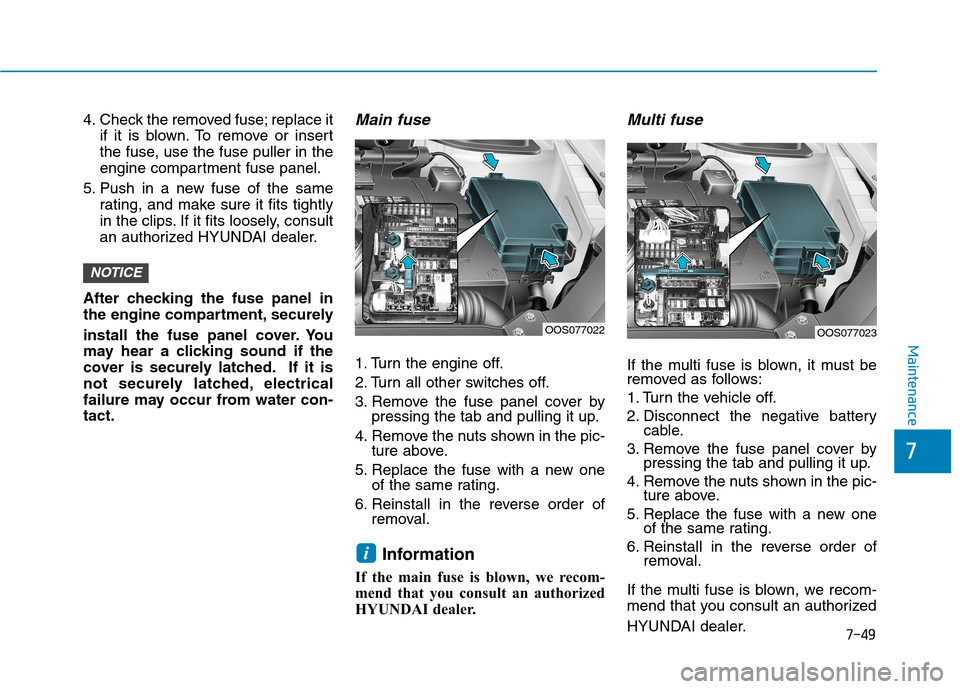
1. Turn the engine off.
2. Turn all other switches off.
3. Remove the fuse panel cover by pressing the tab and pulling it up.
4. Remove the nuts shown in the pic- ture above.
5. Replace the fuse with a new one of the same rating.
6. Reinstall in the reverse order of removal.
Information
If the main fuse is blown, we recom-
mend that you consult an authorized
HYUNDAI dealer.
Multi fuse
If the multi fuse is blown, it must be
removed as follows:
1. Turn the vehicle off.
2. Disconnect the negative battery cable.
3. Remove the fuse panel cover by pressing the tab and pulling it up.
4. Remove the nuts shown in the pic- ture above.
5. Replace the fuse with a new one of the same rating.
6. Reinstall in the reverse order of removal.
If the multi fuse is blown, we recom-
mend that you consult an authorized
HYUNDAI dealer.
i
NOTICE
OOS077022OOS077023