2018 Hyundai Elantra remove
[x] Cancel search: removePage 416 of 526

6-35
What to do in an emergency
6
When towing your vehicle in an emer-
gency without wheel dollies:
1. Place the ignition switch in the ACCposition.
2. Place the shift lever in N (Neutral).
3. Release the parking brake.
Removable Towing Hook 1. Open the trunk, and remove the tow- ing hook from the tool case.
2. Remove the hole cover pressing the lower part of the cover on the front or
rear bumper.
3. Install the towing hook by turning it clockwise into the hole until it is fully
secured.
4. Remove the towing hook and install the cover after use.
If your vehicle is equipped with a
rollover sensor, place the ignition
switch in the LOCK/OFF or ACC
position when the vehicle is being
towed. The side impact and curtain
air bag may deploy if the sensor
detects the situation as a rollover.WARNING
Failure to place the shift lever in N
(Neutral) when being towed with
the front wheels on the ground can
cause internal damage to the
transaxle.
CAUTION
OLF064024
OAD065018
OAD066018
■Front
■Rear (if equipped)
Page 422 of 526

7-4
Maintenance
M
MA
AI
IN
N T
TE
EN
N A
AN
N C
CE
E
S
S E
E R
R V
V I
IC
C E
E S
S
You should exercise the utmost care to
prevent damage to your vehicle and
injury to yourself whenever performing
any maintenance or inspection proce-
dures.
We recommend you have your vehicle
maintained and repaired by an author-
ized HYUNDAI dealer. An authorized
HYUNDAI dealer meets HYUNDAI’s high
service quality standards and receives
technical support from HYUNDAI in
order to provide you with a high level of
service satisfaction.
Owner's Responsibility
Maintenance service and record reten-
tion are the owner's responsibility.
You should retain documents that show
proper maintenance has been performed
on your vehicle in accordance with the
scheduled maintenance service charts
shown on the following pages. You need
this information to establish your compli-
ance with the servicing and maintenance
requirements of your vehicle warranties.
Detailed warranty information is provided
in your Owner's Handbook & Warranty
Information booklet.
Repairs and adjustments required as a
result of improper maintenance or a lack
of required maintenance are not covered.
Owner Maintenance
Precautions
Inadequate, incomplete or insufficient
servicing may result in operational prob-
lems with your vehicle that could lead to
vehicle damage, an accident, or person-
al injury. This chapter provides instruc-
tions only for the maintenance items that
are easy to perform. Several procedures
can be done only by an authorized
HYUNDAI dealer with special tools.
Your vehicle should not be modified in
any way. Such modifications may
adversely affect the performance, safety
or durability of your vehicle and may, in
addition, violate conditions of the limited
warranties covering the vehicle.
Certain modifications may also be in vio-
lation of regulations established by the
U.S. Department of Transportation and
other federal or state agencies.
Improper owner maintenance during
the warranty period may affect war-
ranty coverage. For details, read the
separate Owner's Handbook &
Warranty Information booklet provid-
ed with the vehicle. If you're unsure
about any service or maintenance
procedure, have it done by an author-
ized HYUNDAI dealer.
NOTICE
O O W
W N
NE
ER
R
M
M A
AI
IN
N T
TE
EN
N A
AN
N C
CE
E
Performing maintenance work on a
vehicle can be dangerous. If you
lack sufficient knowledge and
experience or the proper tools and
equipment to do the work, have it
done by an authorized HYUNDAI
dealer.
ALWAYS follow these precautions
for performing maintenance work:
•Park your vehicle on level
ground, move the shift lever into
the P (Park, for automatic trans-
mission vehicle) position or neu-
tral (for manual transmission
vehicle), apply the parking brake,
place the ignition switch in the
LOCK/OFF position.
Block the tires (front and back) to
prevent the vehicle from moving.
Remove loose clothing or jewelry
that can become entangled in
moving parts.
If you must run the engine during
maintenance, do so out doors or
in an area with plenty of ventila-
tion.
Keep flames, sparks, or smoking
materials away from the battery
and fuel-related parts.
WARNING
Page 440 of 526
7-22
Maintenance
For mixing percentage, refer to the fol-
lowing table:
Information
If in doubt about the mix ratio, a 50%
water and 50% antifreeze mix is the easi-
est to mix together as it will be the same
quantity of each. It is suitable to use for
most temperature ranges of
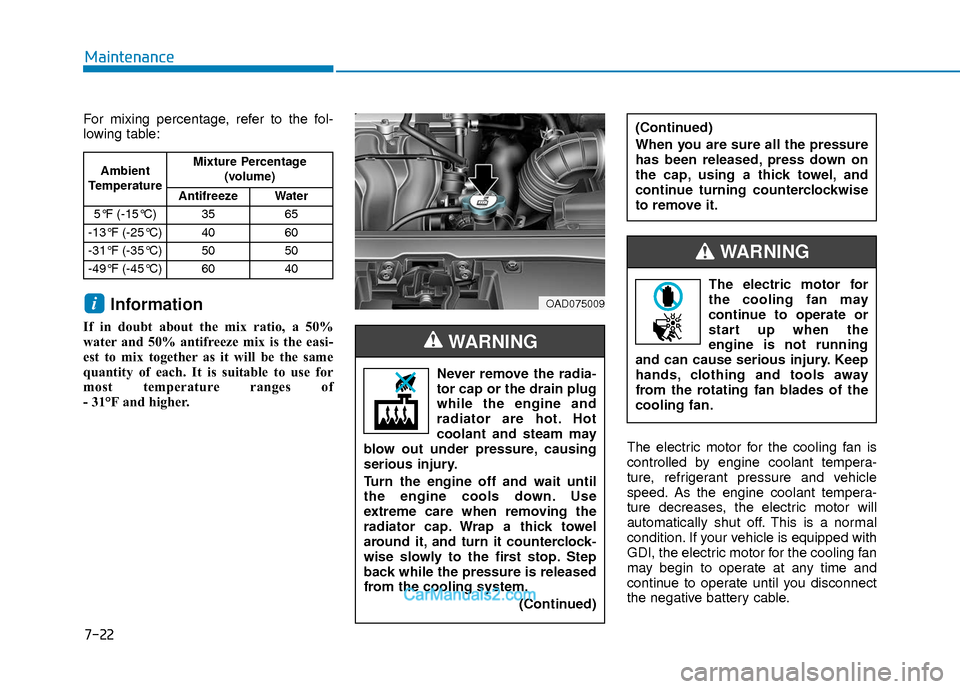
- 31°F and higher.The electric motor for the cooling fan is
controlled by engine coolant tempera-
ture, refrigerant pressure and vehicle
speed. As the engine coolant tempera-
ture decreases, the electric motor will
automatically shut off. This is a normal
condition. If your vehicle is equipped with
GDI, the electric motor for the cooling fan
may begin to operate at any time and
continue to operate until you disconnect
the negative battery cable.
i
Ambient
Temperature Mixture Percentage
(volume)
Antifreeze Water
5°F (-15°C) 35 65
-13°F (-25°C) 40 60
-31°F (-35°C) 50 50
-49°F (-45°C) 60 40
Never remove the radia-
tor cap or the drain plug
while the engine and
radiator are hot. Hot
coolant and steam may
blow out under pressure, causing
serious injury.
Turn the engine off and wait until
the engine cools down. Use
extreme care when removing the
radiator cap. Wrap a thick towel
around it, and turn it counterclock-
wise slowly to the first stop. Step
back while the pressure is released
from the cooling system.
(Continued)
WARNING
(Continued)
When you are sure all the pressure
has been released, press down on
the cap, using a thick towel, and
continue turning counterclockwise
to remove it.
OAD075009
The electric motor for
the cooling fan may
continue to operate or
start up when the
engine is not running
and can cause serious injury. Keep
hands, clothing and tools away
from the rotating fan blades of the
cooling fan.
WARNING
Page 444 of 526
7-26
Maintenance
4. Lock the cover with the cover attach-ing clips.
Information
If the vehicle is operated in extremely
dusty or sandy areas, replace the element
more often than the usual recommended
intervals (refer to "Maintenance Under
Severe Usage Conditions" in this chapter).
Do not drive with the air cleaner fil-ter removed. This will result in
excessive engine wear.
When removing the air cleaner filter, be careful that dust or dirt does not
enter the air intake, or damage may
result.
Use HYUNDAI genuine parts, use of non-genuine parts could damage
the air flow sensor.
Filter Inspection
The climate control air filter should be
replaced according to the Maintenance
Schedule. If the vehicle is operated in
severely air-polluted cities or on dusty
rough roads for a long period, it should
be inspected more frequently and
replaced earlier. When you replace the
climate control air filter, replace it per-
forming the following procedure, and be
careful to avoid damaging other compo-
nents.
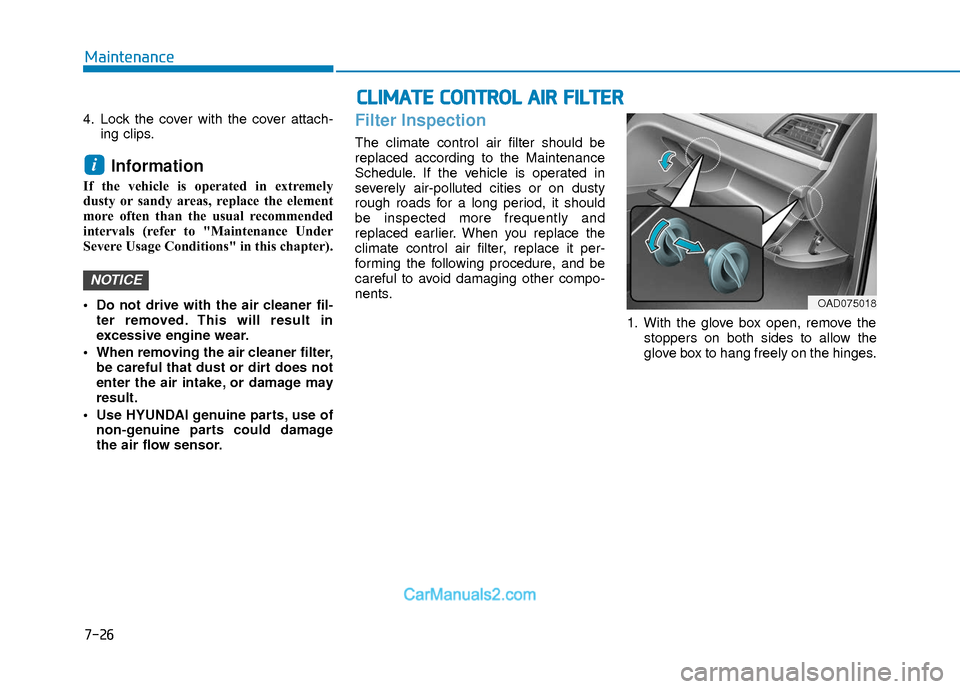
1. With the glove box open, remove thestoppers on both sides to allow the
glove box to hang freely on the hinges.
NOTICE
i
C CL
LI
IM
M A
AT
TE
E
C
C O
O N
NT
TR
R O
O L
L
A
A I
IR
R
F
F I
IL
L T
T E
ER
R
OAD075018
Page 445 of 526
7-27
7
Maintenance
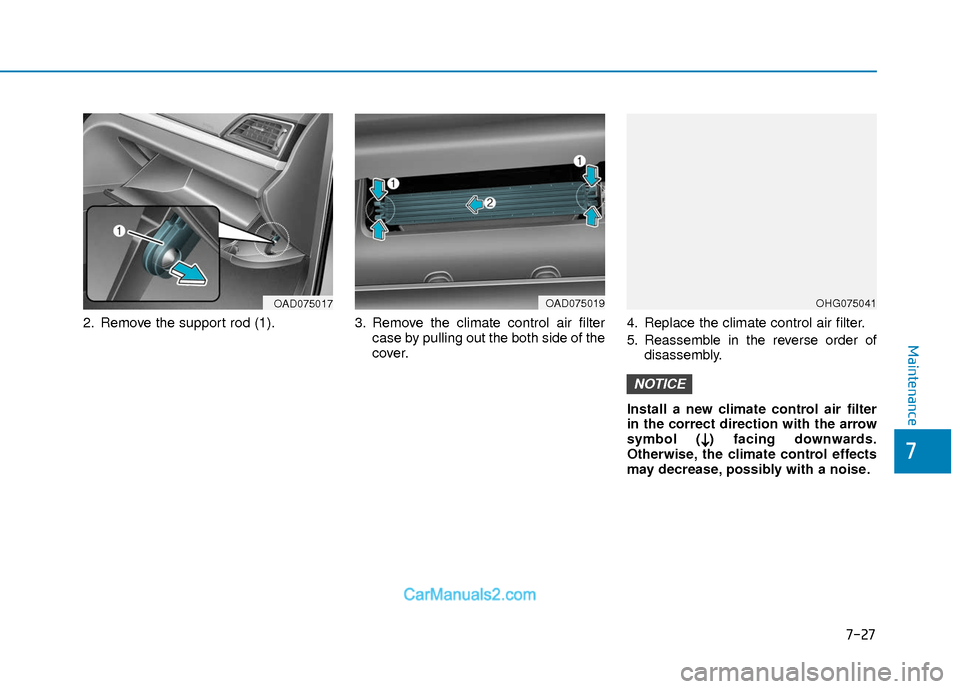
2. Remove the support rod (1).3. Remove the climate control air filter
case by pulling out the both side of the
cover. 4. Replace the climate control air filter.
5. Reassemble in the reverse order of
disassembly.
Install a new climate control air filter
in the correct direction with the arrow
symbol ( ↓ ↓) facing downwards.
Otherwise, the climate control effects
may decrease, possibly with a noise.
NOTICE
OAD075019OHG075041OAD075017
Page 449 of 526
7-31
7
Maintenance
When you do not use the vehicle fora long time in a low temperature
area, disconnect the battery and
keep it indoors.
Always charge the battery fully to prevent battery case damage in low
temperature areas.
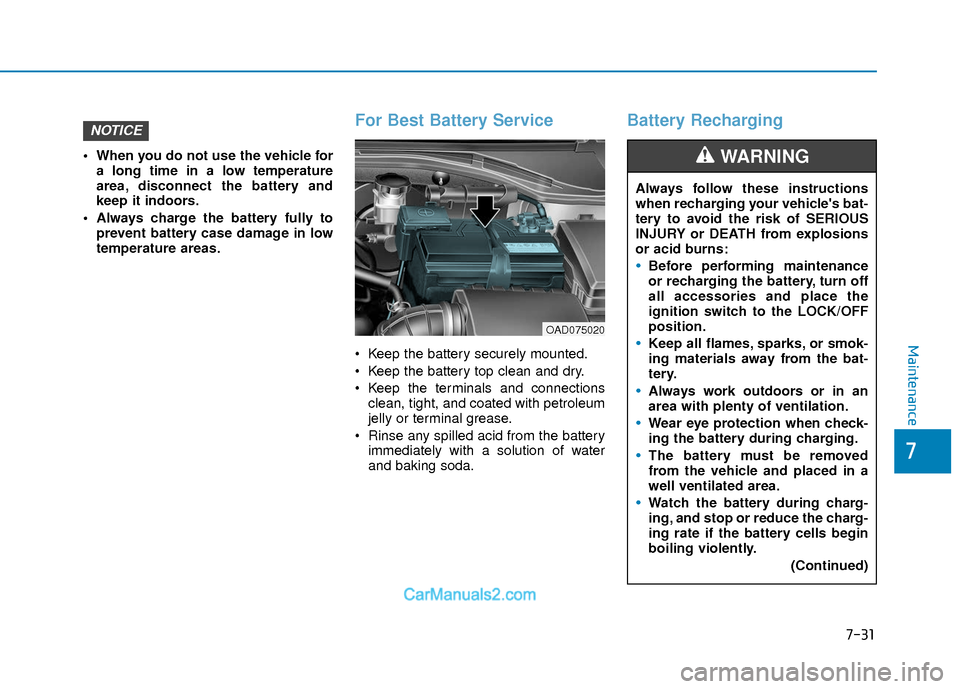
For Best Battery Service
Keep the battery securely mounted.
Keep the battery top clean and dry.
Keep the terminals and connectionsclean, tight, and coated with petroleum
jelly or terminal grease.
Rinse any spilled acid from the battery immediately with a solution of water
and baking soda.
Battery RechargingNOTICE
Always follow these instructions
when recharging your vehicle's bat-
tery to avoid the risk of SERIOUS
INJURY or DEATH from explosions
or acid burns:
Before performing maintenance
or recharging the battery, turn off
all accessories and place the
ignition switch to the LOCK/OFF
position.
Keep all flames, sparks, or smok-
ing materials away from the bat-
tery.
Always work outdoors or in an
area with plenty of ventilation.
Wear eye protection when check-
ing the battery during charging.
The battery must be removed
from the vehicle and placed in a
well ventilated area.
Watch the battery during charg-
ing, and stop or reduce the charg-
ing rate if the battery cells begin
boiling violently.
(Continued)
WARNING
OAD075020
Page 450 of 526
7-32
Maintenance
By jump starting
After a jump start from a good battery,
drive the vehicle for 20-30 minutes before
it is shutoff. The vehicle may not restart if
you shut it off before the battery had a
chance to adequately recharge. See
"Jump Starting" in chapter 6 for more
information on jump starting procedures.
Information
An inappropriately disposedbattery can be harmful to the
environment and human
health.
Dispose the battery according to your local
law(s) or regulation.
Reset Features
The following items may need to be reset
after the battery has been discharged or
the battery has been disconnected.
Power Windows
Trip Computer
Climate Control System
Clock
Audio System
Sunroof
i
(Continued)
The negative battery cable must
be removed first and installed
last when the battery is discon-
nected. Disconnect the battery
charger in the following order:
(1) Turn off the battery charger main switch.
(2) Unhook the negative clamp
from the negative battery ter-
minal.
(3) Unhook the positive clamp
from the positive battery ter-
minal.
Always use a genuine HYUNDAI
approved battery when you
replace the battery.
Page 453 of 526
7-35
7
Maintenance
Check Tire Inflation Pressure
Check your tires, including the spare
tire, once a month or more.
How to check
Use a good quality tire pressure
gauge to check tire pressure. You
can not tell if your tires are properly
inflated simply by looking at them.
Radial tires may look properly inflat-
ed when they are under-inflated.
Remove the valve cap from the tire
valve stem. Press the tire gauge firm-
ly onto the valve to get a pressure
measurement. If the cold tire inflation
pressure matches the recommended
pressure on the tire label located on
the driver's side center pillar or in this
manual. No further adjustment is
necessary. If the pressure is low, add
air until you reach the recommended
pressure. Make sure to put the valve
caps back on the valve stems.
Without the valve cap, dirt or mois-
ture could get into the valve core and
cause air leakage. If a valve cap is
missing, install a new one as soon as
possible.If you overfill the tire, release air by
pushing on the metal stem in the
center of the tire valve. Recheck the
tire pressure with the tire gauge. Be
sure to put the valve caps back on
the valve stems. Without the valve
cap, dirt or moisture could get into
the valve core and cause air leakage.
If a valve cap is missing, install a new
one as soon as possible.
A cold tire means the vehicle has
been sitting for 3 hours and driven for
less than 1 mile (1.6 km) in that 3
hour period.
Allow the tire to cool before measur-
ing the inflation pressure. Always be
sure the tire is cold before inflating to
the recommended pressure.
Under-inflation results in
excessive wear, poor handling
and reduced fuel economy.
Wheel deformation is also
possible. Keep your tire pres-
sures at the proper levels. If a
tire frequently needs refilling,
have it checked by an author-
ized HYUNDAI dealer.
Over-inflation produces a
harsh ride, excessive wear at
the center of the tire tread,
and a greater possibility of
damage from road hazards.
CAUTION