2018 Hyundai Elantra Warning
[x] Cancel search: WarningPage 486 of 526

7-68
Maintenance
Side marker
1. Open the hood.
2. Disconnect the negative battery cable.
3. Remove the socket from the assemblyby turning the socket counterclock-
wise until the tabs on the socket align
with the slots on the assembly.
4. Remove the bulb from the socket by pulling out the bulb.
5. Insert a new bulb.
Parking lamp/Daytime running
lamp (LED type)
Your vehicle is equipped with LED lamps.
LED lamps do not have replaceable
bulbs. If the LED lamp does not operate,
have the vehicle checked by an author-
ized HYUNDAI dealer.
Type D - HID headlamp type (LED side marker)
(1) Headlamp (Low/High)
(2) Turn signal lamp
(3) Side marker
(4) Daytime running lamp (DRL) &
Parking lamp
Headlamp (Low/High, HID type)
If the light bulb does not operate, have
the vehicle checked by an authorized
HYUNDAI dealer.
Information
If your vehicle is equipped with High
Intensity Discharge (HID) headlamps,
these headlamps contain mercury. So if
you need to have your vehicle disposed,
you should remove the HID Headlamps
before disposal. The removed HID head-
lamps should be recycled, re-used or dis-
posed as hazardous waste.
i
OAD075082N
HID Headlamp low beam
Do not attempt to replace or
inspect the low beam (XENON bulb)
due to electric shock danger. If the
low beam (XENON bulb) is not
working, have your vehicle checked
by an authorized HYUNDAI Dealer.
WARNING
OAD076123
Page 493 of 526
7-75
7
Maintenance
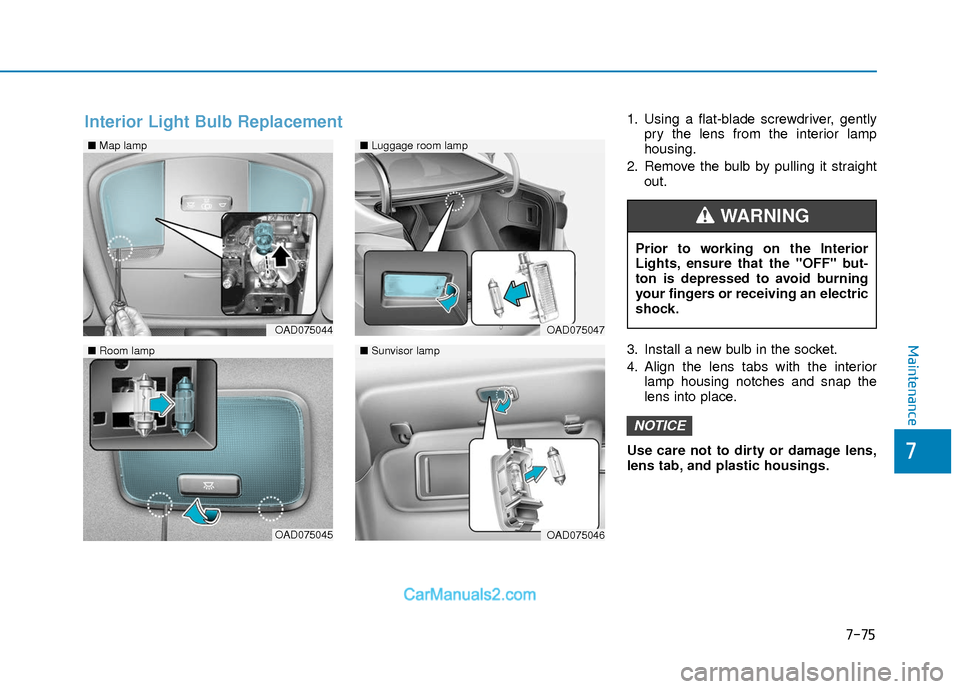
1. Using a flat-blade screwdriver, gentlypry the lens from the interior lamp
housing.
2. Remove the bulb by pulling it straight out.
3. Install a new bulb in the socket.
4. Align the lens tabs with the interior lamp housing notches and snap the
lens into place.
Use care not to dirty or damage lens,
lens tab, and plastic housings.
NOTICE
■ Map lamp
OAD075044
OAD075045
■Luggage room lamp
■Sunvisor lamp
OAD075047
OAD075046
■Room lamp
Interior Light Bulb Replacement
Prior to working on the Interior
Lights, ensure that the "OFF" but-
ton is depressed to avoid burning
your fingers or receiving an electric
shock.
WARNING
Page 494 of 526
A
AP
PP
PE
EA
A R
RA
A N
N C
CE
E
C
C A
A R
RE
E
7-76
Maintenance
Exterior Care
Exterior general caution
It is very important to follow the label
directions when using any chemical
cleaner or polish. Read all warning and
caution statements that appear on the
label.
High-pressure washing
When using high-pressure washers,
make sure to maintain sufficient dis-
tance from the vehicle. Insufficient
clearance or excessive pressure can
lead to component damage or water
penetration.
Do not spray the camera, sensors or its surrounding area directly with a high
pressure washer. Shock applied from
high pressure water may cause the
device to not operate normally.
Do not bring the nozzle tip close to boots (rubber or plastic covers)or con-
nectors as they may be damaged if
they come into contact with high pres-
sure water.
Do not use any high-pressure nozzles, which induce either one-direct water
stream or water swirling.
Protecting your vehicle’s finish
Washing
To help protect your vehicle’s finish from
rust and deterioration, wash it thoroughly
and frequently at least once a month with
lukewarm or cold water.
If you use your vehicle for off-road driv-
ing, you should wash it after each off-
road trip. Pay special attention to the
removal of any accumulation of salt, dirt,
mud, and other foreign materials. Make
sure the drain holes in the lower edges of
the doors and rocker panels are kept
clear and clean.
Insects, tar, tree sap, bird droppings,
industrial pollution and similar deposits
can damage your vehicle’s finish if not
removed immediately.
Even prompt washing with plain water
may not completely remove all these
deposits. A mild soap, safe for use on
painted surfaces, should be used.
After washing, rinse the vehicle thor-
oughly with lukewarm or cold water. Do
not allow soap to dry on the finish. Do not use strong soap, chemical
detergents or hot water, and do not
wash the vehicle in direct sunlight
or when the body of the vehicle is
warm.
Be careful when washing the side windows of your vehicle.
Especially, with high-pressure
water, water may leak through the
windows and wet the interior.
To prevent damage to the plastic parts, do not clean with chemical
solvents or strong detergents.
NOTICE
After washing the vehicle, test the
brakes while driving slowly to see if
they have been affected by water
before getting on the road. If brak-
ing performance is impaired, dry
the brakes by applying them lightly
while maintaining a slow forward
speed.
WARNING
Page 496 of 526
7-78
Maintenance
Bright-metal maintenance
To remove road tar and insects, use atar remover, not a scraper or other
sharp object.
To protect the surfaces of bright-metal parts from corrosion, apply a coating of
wax or chrome preservative and rub to
a high luster.
During winter weather or in coastal areas, cover the bright metal parts with
a heavier coating of wax or preserva-
tive. If necessary, coat the parts with
non-corrosive petroleum jelly or other
protective compound.
Underbody maintenance
Corrosive materials used for ice and
snow removal and dust control may col-
lect on the underbody. If these materials
are not removed, accelerated rusting can
occur on underbody parts such as the
fuel lines, frame, floor pan and exhaust
system, even though they have been
treated with rust protection. Thoroughly flush the vehicle underbody
and wheel openings with lukewarm or
cold water once a month, after off-road
driving and at the end of each winter. Pay
special attention to these areas because
it is difficult to see all the mud and dirt. It
will do more harm than good to wet down
the road grime without removing it. The
lower edges of doors, rocker panels, and
frame members have drain holes that
should not be allowed to clog with dirt;
trapped water in these areas can cause
rusting.
Aluminum wheel maintenance
The aluminum wheels are coated with a
clear protective finish.
Do not use abrasive cleaner, polish-
ing compound, solvent, or wire
brushes on aluminum wheels.
Clean the wheel when it has cooled.
Use only a mild soap or neutral detergent, and rinse thoroughly with
water. Also, clean the wheels after
driving on salted roads.
Do not wash the wheels with high- speed car wash brushes.
Do not use any cleaners containing acid or alkaline detergents.
NOTICE
After washing the vehicle, test the
brakes while driving slowly to see if
they have been affected by water. If
braking performance is impaired,
dry the brakes by applying them
lightly while maintaining a slow for-
ward speed.
WARNING
Page 502 of 526

7-84
Maintenance
Canister
Fuel vapors generated inside the fuel
tank are absorbed and stored in the
onboard canister. When the engine is
running, the fuel vapors absorbed in the
canister are drawn into the surge tank
through the purge control solenoid valve.
Purge Control Solenoid Valve(PCSV)
The purge control solenoid valve is con-
trolled by the Engine Control Module
(ECM); when the engine coolant temper-
ature is low during idling, the PCSV clos-
es so that evaporated fuel is not taken
into the engine. After the engine warms-
up during ordinary driving, the PCSV
opens to introduce evaporated fuel to the
engine.
3. Exhaust Emission Control System
The Exhaust Emission Control System is
a highly effective system which controls
exhaust emissions while maintaining
good vehicle performance.
When the engine starts or fails to start,
excessive attempts to restart the engine
may cause damage to the emission sys-
tem.
Engine exhaust (carbon monox-
ide) precautions
Carbon monoxide can be present with
other exhaust fumes. If you smell
exhaust fumes of any kind in your vehi-
cle, drive with all the windows fully
open. Have your vehicle checked and
repaired immediately.
Engine exhaust gases contain car-
bon monoxide (CO). Though color-
less and odorless, it is dangerous
and could be lethal if inhaled.
Follow the instructions on this
page to avoid CO poisoning.
WARNING
CALIFORNIA PROPOSITION 65
WARNING
Engine exhaust and a wide variety
of automobile components and
parts, including components found
in the interior furnishings in a vehi-
cle, contain or emit chemicals
known to the State of California to
cause cancer and birth defects and
reproductive harm. In addition, cer-
tain fluids contained in vehicles
and certain products of component
wear contain or emit chemicals
known to the State of California to
cause cancer and birth defects or
other reproductive harm.
WARNING
Page 503 of 526

7-85
7
Maintenance
Do not operate the engine in confinedor closed areas (such as garages) any
more than what is necessary to move
the vehicle in or out of the area.
When the vehicle is stopped in an open area for more than a short time
with the engine running, adjust the
ventilation system (as needed) to draw
outside air into the vehicle.
Never sit in a parked or stopped vehi- cle for any extended time with the
engine running.
When the engine stalls or fails to start, excessive attempts to restart the
engine may cause damage to the
emission control system.Operating precautions for cat-alytic converters (if equipped)
Your vehicle is equipped with a catalytic
converter emission control device.
To prevent damage to the catalytic con-
verter and to your vehicle, take the fol-
lowing precautions: The exhaust system and catalytic
converter are very hot during and
immediately after the engine has
been running. To avoid SERIOUS
INJURY or DEATH:
Do not park, idle, or drive the
vehicle over or near flammable
objects, such as grass, vegeta-
tion, paper, leaves, etc. A hot
exhaust system can ignite flam-
mable items under your vehicle.
Keep away from the exhaust sys-
tem and catalytic converter or
you may get burned.
Also, Do not remove the heat sink
around the exhaust system, do
not seal the bottom of the vehi-
cle, and do not coat the vehicle
for corrosion control. It may pres-
ent a fire risk under certain con-
ditions.
WARNING Use only UNLEADED FUEL for
gasoline engines.
Do not operate the vehicle when
there are signs of engine mal-
function, such as misfire or a
noticeable loss of performance.
Do not misuse or abuse the
engine. Examples of misuse are
coasting with the engine off and
descending steep grades in gear
with the engine off.
Do not operate the engine at high
idle speed for extended periods
(5 minutes or more).
Do not modify or tamper with any
part of the engine or emission
control system. All inspections
and adjustments must be made
by an authorized HYUNDAI deal-
er.
Avoid driving with extremely low
fuel level. If you run out of gaso-
line, it could cause the engine to
misfire and result in excessive
loading of the catalytic converter.
CAUTION
Page 516 of 526
8-12
Specifications, Consumer information and Reporting safety defects
Eastern Region:
Connecticut, Delaware,
Maine, Massachusetts, New
Hampshire, New Jersey, New York,
Pennsylvania, Rhode Island,
Vermont.
Eastern Region
1122 Cranbury South River Road
Jamesburg, NJ 08831
(800) 633-5151
Southern Region:
Florida, Georgia, Maryland, North
Carolina, South Carolina, Virginia,
West Virginia.
Southern Region
3025 Chastain Meadows Parkway
Suite 100 Marietta, GA 30066
(800) 633-5151 South Central Region:
Alabama, Arkansas, Louisiana,
Mississippi, New Mexico, Oklahoma,
Tennessee, Texas.
South Central Region
1421 South Beltline Road, Suite 400
Coppell, TX 75019
(800) 633-5151
Central Region:
Illinois, Indiana, lowa, Kentucky,
Michigan, Minnesota, Nebraska,
North Dakota, South Dakota, Ohio,
Wisconsin, Kansas, Missouri.
Central Region
2 Trans Am Plaza Dr #500 Oakbrook
Terrace, IL 60181
(800) 633-5151
Western Region:
Alaska, Hawaii, Arizona, California,
Colorado, Idaho, Montana, Nevada,
Oregon, Utah, Washington,
Wyoming.
Western Region
10550 Talbert Avenue P.O.Box
20850 Fountain Valley, California
92728-0850
(800) 633-5151
C C
O
O N
NS
SU
U M
M E
ER
R
I
IN
N F
FO
O R
RM
M A
AT
TI
IO
O N
N
This consumer information has been prepared in accordance with regulations issued by the National Highway Traffic
Safety Administration of the U.S. Department of Transportation. Your HYUNDAI dealer will help answer any questions
you may have as you read this information.
HYUNDAI motor vehicles are designed and manufactured to meet or exceed all applicable safety standards.
For your safety, however, we strongly urge you to read and follow all directions in this Owner’s Manual, particularly
the information under the headings "NOTICE", "CAUTION" and "WARNING" .
If, after reading this manual, you have any questions regarding the operation of your vehicle, please contact your near-
est HYUNDAI Motor America Regional Office as listed in the following:
Page 519 of 526
I-2
Accessing Your Vehicle ....................................................3-3Immobilizer System ...................................................3-10
Remote Key ..................................................................3-3
Smart Key.....................................................................3-6\
Air bag - Advanced supplemental restraint system ........2-38 Additional Safety Precautions ....................................2-59
Air Bag Warning Labels.............................................2-60
How Does the Air Bag System Operate? ...................2-43
Occupant Classification System (OCS) .....................2-48
SRS Care ....................................................................2-58\
What to Expect After an Air Bag Inflates ..................2-47
Where Are the Air Bags? ...........................................2-40
Why Didn't My Air Bag Go Off in a Collision?........2-53
Air Cleaner......................................................................7-\
25 Filter Replacement .....................................................7-25
Air Conditioning System ..................................................8-6
Appearance Care .............................................................7-76 Exterior Care ..............................................................7-76
Interior Care ...............................................................7-80 Audio (Without Touch Screen) .......................................4-16
Features of Your Audio ..............................................4-17
Media Mode ...............................................................4-36
Phone Mode................................................................4-42
Radio Mode ................................................................4-32
Setup Mode ................................................................4-53
SiriusXM Radio Mode ...............................................4-34
Voice Recognition Mode ............................................4-46
Automatic Climate Control System..............................3-120 Automatic Heating and Air Conditioning ................3-121
Manual Heating and Air Conditioning .....................3-122
System Maintenance ................................................3-130
System Operation .....................................................3-128
Automatic Emergency Braking (AEB)...........................5-52 AEB Front Radar Sensor............................................5-56
AEB Warning Message and System Control .............5-54
Limitations of the System ..........................................5-58
System Malfunction ...................................................5-57
System Setting and Activation ...................................5-52
Automatic Transmission .................................................5-19 Automatic Transmission Operation............................5-19
Good Driving Practices ..............................................5-23
Index
A