2018 FORD TRANSIT belt
[x] Cancel search: beltPage 4 of 521

Introduction
About This Manual
..........................................7
Symbols Glossary ............................................
7
Data Recording .................................................
9
Perchlorate ........................................................
12
Ford Credit ........................................................
12
Replacement Parts Recommendation ........................................................................\
....
12
Special Notices ...............................................
13
Mobile Communications Equipment ........................................................................\
...
14
Export Unique Options ................................
15
Environment
Protecting the Environment .......................
16
Child Safety
General Information ......................................
17
Installing Child Restraints ...........................
18
Booster Seats .................................................
33
Child Restraint Positioning ........................
35
Child Safety Locks .........................................
37
Seatbelts
Principle of Operation .................................
39
Fastening the Seatbelts .............................
40
Seatbelt Height Adjustment .....................
42
Seatbelt Warning Lamp and Indicator Chime ............................................................
42
Seatbelt Reminder .......................................
43
Child Restraint and Seatbelt Maintenance ...............................................
44
Seatbelt Extension .......................................
45
Supplementary Restraints System
Principle of Operation .................................
46
Driver and Passenger Airbags ...................
47
Side Airbags ....................................................
52
Safety Canopy ™............................................
53 Crash Sensors and Airbag Indicator
.......
55
Airbag Disposal ..............................................
56
Automatic Crash Notification System
911 Assist ...........................................................
57
Keys and Remote Controls
Principle of Operation .................................
59
General Information on Radio Frequencies .................................................
59
Remote Control - Vehicles Without: Passive Anti-Theft System (PATS)
........................................................................\
..
60
Remote Control - Vehicles With: Passive Anti-Theft System (PATS) .....................
61
Replacing a Lost Key or Remote Control ........................................................................\
..
63
MyKey ™
Principle of Operation .................................
64
Creating a MyKey ..........................................
65
Clearing All MyKeys ......................................
66
Checking MyKey System Status .............
66
Using MyKey With Remote Start Systems ........................................................
68
MyKey Troubleshooting ..............................
68
Doors and Locks
Locking and Unlocking ................................
70
Security
Passive Anti-Theft System ........................
75
Anti-Theft Alarm ...........................................
76
Power Running Boards
Using Power Running Boards ....................
77
Steering Wheel
Adjusting the Steering Wheel ..................
80
Audio Control .................................................
80
1
2018 Transit (TTH) Canada/United States of America, JK3J 19A321 AA enUSA, Edition date: 201705, Third-Printing- Table of Contents
Page 7 of 521

The Better Business Bureau (BBB) Auto
Line Program (U.S. Only) ....................203
Utilizing the Mediation/Arbitration Program (Canada Only) ......................
204
Getting Assistance Outside the U.S. and Canada .......................................................
204
Ordering Additional Owner's Literature .......................................................................
206
Reporting Safety Defects (U.S. Only) .......................................................................
206
Reporting Safety Defects (Canada Only) .......................................................................
206
Fuses
Fuse Box Locations ...................................
208
Fuse Specification Chart - 3.2L Power Stroke Diesel ............................................
208
Fuse Specification Chart - 3.5L Ecoboost™/3.7L ......................................
217
Changing a Fuse ..........................................
227
Maintenance
General Information ..................................
229
Opening and Closing the Hood .............
229
Under Hood Overview - 3.2L Power Stroke Diesel ............................................
230
Under Hood Overview - 3.5L Ecoboost™ ........................................................................\
.
231
Under Hood Overview - 3.7L ...................
232
Engine Oil Dipstick - 3.2L Power Stroke Diesel ...........................................................
233
Engine Oil Dipstick - 3.5L Ecoboost™ ........................................................................\
234
Engine Oil Dipstick - 3.7L .........................
234
Engine Oil Check .........................................
234
Changing the Engine Oil and Oil Filter ........................................................................\
235
Oil Change Indicator Reset .....................
235
Engine Cooling Fan - Diesel ....................
236
Engine Cooling Fan - E85/Gasoline .....
236
Engine Coolant Check ..............................
236
Automatic Transmission Fluid Check ........................................................................\
240 Brake Fluid Check
........................................
241
Power Steering Fluid Check .....................
241
Washer Fluid Check ...................................
242
Draining the Fuel Filter Water Trap - 3.2L Power Stroke Diesel ..............................
242
Fuel Filter - Gasoline .................................
244
Changing the 12V Battery ........................
244
Checking the Wiper Blades ....................
246
Changing the Front Wiper Blades ........
246
Adjusting the Headlamps ........................
247
Removing a Headlamp ............................
248
Changing a Bulb .........................................
249
Bulb Specification Chart ..........................
253
Changing the Engine Air Filter - 3.2L Power Stroke Diesel ..............................
255
Changing the Engine Air Filter - 3.5L Ecoboost™ ...............................................
256
Changing the Engine Air Filter - 3.7L .....
257
Drive Belt Routing - 3.2L Power Stroke Diesel ..........................................................
258
Drive Belt Routing - 3.5L Ecoboost™/ 3.7L ...............................................................
258
Vehicle Care
Cleaning Products .....................................
260
Cleaning the Exterior ..................................
261
Waxing ............................................................
262
Cleaning the Engine ...................................
262
Cleaning the Windows and Wiper Blades ........................................................................\
263
Cleaning the Interior ..................................
263
Cleaning the Instrument Panel and Instrument Cluster Lens ......................
265
Repairing Minor Paint Damage .............
265
Cleaning the Wheels .................................
266
Vehicle Storage ...........................................
266
Wheels and Tires
General Information ..................................
268
Tire Care .........................................................
269
Using Winter Tires ......................................
286
4
2018 Transit (TTH) Canada/United States of America, JK3J 19A321 AA enUSA, Edition date: 201705, Third-Printing- Table of Contents
Page 11 of 521

Brake fluid - non petroleum
based
Brake system
Brake system
Cabin air filter
Check fuel cap
Child safety door lock or unlock
Child seat lower anchor
Child seat tether anchor
Cruise control
Do not open when hot
Engine air filter
Engine coolant
Engine coolant temperature
Engine oil
Explosive gas Fan warning
Fasten seatbelt
Flammable
Front airbag
Front fog lamps
Fuel pump reset
Fuse compartment
Hazard flashers
Heated rear window
Windshield defrosting system
Interior luggage compartment
release
Jack
Keep out of reach of children
Lighting control
Low tire pressure warning
8
2018 Transit (TTH) Canada/United States of America, JK3J 19A321 AA enUSA, Edition date: 201705, Third-Printing- Introduction E270480 E71340 E71880 E231160 E67017 E161353
Page 13 of 521

information for vehicle improvement or
with other information we may have about
you, (for example, your contact
information), to offer you products or
services that may interest you. Data may
be provided to our service providers such
as part suppliers that may help diagnose
malfunctions, and who are similarly
obligated to protect data. We retain this
data only as long as necessary to perform
these functions or to comply with law. We
may provide information where required
in response to official requests to law
enforcement or other government
authorities or third parties acting with
lawful authority or court order, and such
information may be used in legal
proceedings. For U.S. only (if equipped), if
you choose to use connected apps and
services, such as SYNC Vehicle Health
Report or MyFord Mobile App, you consent
that certain diagnostic information may
also be accessed electronically by Ford
Motor Company and Ford authorized
service facilities, and that the diagnostic
information may be used to provide
services to you, personalizing your
experience, troubleshoot, and to improve
products and services and offer you
products and services that may interest
you, where permitted by law. For Canada
only, for more information, please review
the Ford of Canada privacy policy at
www.ford.ca, including our U.S. data
storage and use of service providers in
other jurisdictions who may be subject to
legal requirements in Canada, the United
States and other countries applicable to
them, for example, lawful requirements to
disclose personal information to
governmental authorities in those
countries. See SYNC™ (page 349).
Event Data Recording
This vehicle is equipped with an event
data recorder. The main purpose of an
event data recorder is to record, in
certain crash or near crash-like
situations, such as an airbag
deployment or hitting a road obstacle;
this data will assist in understanding
how a vehicle
’s systems performed.
The event data recorder is designed to
record data related to vehicle dynamics
and safety systems for a short period
of time, typically 30 seconds or less.
The event data recorder in this vehicle
is designed to record such data as:
• How various systems in your vehicle
were operating;
• Whether or not the driver and
passenger safety belts were
buckled/fastened;
• How far (if at all) the driver was
depressing the accelerator and/or
the brake pedal; and
• How fast the vehicle was traveling;
and
• Where the driver was positioning
the steering wheel.
This data can help provide a better
understanding of the circumstances in
which crashes and injuries occur.
10
2018 Transit (TTH) Canada/United States of America, JK3J 19A321 AA enUSA, Edition date: 201705, Third-Printing- Introduction
Page 15 of 521
PERCHLORATE
Certain components in your vehicle such
as airbag modules, seatbelt pretensioners
and remote control batteries may contain
perchlorate material. Special handling
may apply for service or vehicle end of life
disposal.
For more information visit:
Web Address
www.dtsc.ca.gov/hazard- ouswaste/perchlorate
FORD CREDIT
US Only
Ford Credit offers a full range of financing
and lease plans to help you acquire your
vehicle. If you have financed or leased your
vehicle through Ford Credit, thank you for
your business.
We offer a number of convenient ways for
you to contact us, and to manage your
account.
Call 1-800-727-7000.
For more information about Ford Credit
and access to Account Manager, go to
www.ford.com/finance. REPLACEMENT PARTS
RECOMMENDATION
We have built your vehicle to the highest
standards using quality parts. We
recommend that you demand the use of
genuine Ford and Motorcraft parts
whenever your vehicle requires scheduled
maintenance or repair. You can clearly
identify genuine Ford and Motorcraft parts
by looking for the Ford, FoMoCo or
Motorcraft branding on the parts or their
packaging.
Scheduled Maintenance and
Mechanical Repairs
One of the best ways for you to make sure
that your vehicle provides years of service
is to have it maintained in line with our
recommendations using parts that
conform to the specifications detailed in
this Owner
’s Manual. Genuine Ford and
Motorcraft parts meet or exceed these
specifications.
Collision Repairs
We hope that you never experience a
collision, but accidents do happen.
Genuine Ford replacement collision parts
meet our stringent requirements for fit,
finish, structural integrity, corrosion
protection and dent resistance. During
vehicle development we validate that
these parts deliver the intended level of
protection as a whole system. A great way
to know for sure you are getting this level
of protection is to use genuine Ford
replacement collision parts.
12
2018 Transit (TTH) Canada/United States of America, JK3J 19A321 AA enUSA, Edition date: 201705, Third-Printing- Introduction
Page 21 of 521
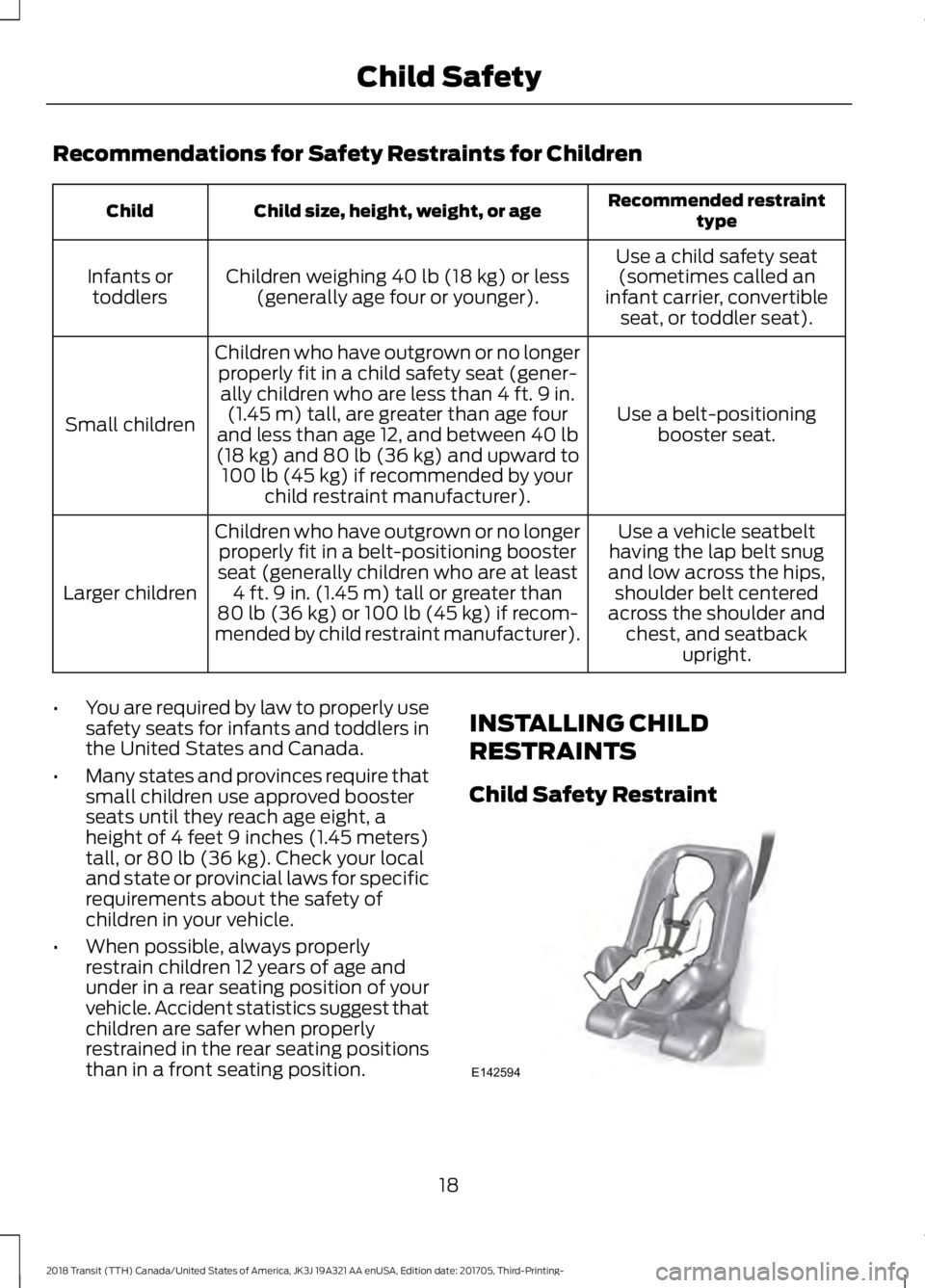
Recommendations for Safety Restraints for Children
Recommended restraint
type
Child size, height, weight, or age
Child
Use a child safety seat(sometimes called an
infant carrier, convertible seat, or toddler seat).
Children weighing 40 lb (18 kg) or less
(generally age four or younger).
Infants or
toddlers
Use a belt-positioningbooster seat.
Children who have outgrown or no longer
properly fit in a child safety seat (gener-ally children who are less than 4 ft. 9 in. (1.45 m) tall, are greater than age four
and less than age 12, and between
40 lb
(18 kg) and 80 lb (36 kg) and upward to
100 lb (45 kg) if recommended by your
child restraint manufacturer).
Small children
Use a vehicle seatbelt
having the lap belt snug
and low across the hips, shoulder belt centered
across the shoulder and chest, and seatback upright.
Children who have outgrown or no longer
properly fit in a belt-positioning booster
seat (generally children who are at least 4 ft. 9 in. (1.45 m) tall or greater than
80 lb (36 kg)
or 100 lb (45 kg) if recom-
mended by child restraint manufacturer).
Larger children
• You are required by law to properly use
safety seats for infants and toddlers in
the United States and Canada.
• Many states and provinces require that
small children use approved booster
seats until they reach age eight, a
height of 4 feet 9 inches (1.45 meters)
tall, or
80 lb (36 kg). Check your local
and state or provincial laws for specific
requirements about the safety of
children in your vehicle.
• When possible, always properly
restrain children 12 years of age and
under in a rear seating position of your
vehicle. Accident statistics suggest that
children are safer when properly
restrained in the rear seating positions
than in a front seating position. INSTALLING CHILD
RESTRAINTS
Child Safety Restraint
18
2018 Transit (TTH) Canada/United States of America, JK3J 19A321 AA enUSA, Edition date: 201705, Third-Printing- Child SafetyE142594
Page 22 of 521
Use a child safety restraint (sometimes
called an infant carrier, convertible seat,
or toddler seat) for infants, toddlers, or
children weighing 40 lb (18 kg) or less
(generally age four or younger).
Using Lap and Shoulder Belts WARNING:
Do not place a rearward
facing child restraint in front of an active
airbag. Failure to follow this instruction
could result in personal injury or death. WARNING:
Properly secure children
12 years old and under in a rear seating
position whenever possible. If you are
unable to properly secure all children in a
rear seating position, properly secure the
largest child on the front seat. If you must
use a forward facing child restraint on the
front seat, move the seat as far back as
possible. Failure to follow these
instructions could result in personal injury
or death. WARNING: Depending on where you
secure a child restraint, and depending on
the child restraint design, you may block
access to certain seatbelt buckle
assemblies and LATCH lower anchors,
rendering those features potentially
unusable. To avoid risk of injury, make sure
occupants only use seating positions
where they are able to be properly
restrained.
When installing a child safety restraint with
combination lap and shoulder belts:
• Use the correct seatbelt buckle for that
seating position.
• Insert the belt tongue into the correct
buckle until you hear a distinct click
and feel it latch. Make sure the tongue
is securely fastened in the buckle. •
Keep the buckle release button
pointing up and away from the safety
restraint, with the tongue between the
child restraint and the release button,
to prevent accidental unbuckling.
• Place the vehicle seat upon which the
child restraint will be installed in the
upright position.
• Put the seatbelt in the automatic
locking mode. See Step 5. Your vehicle
does not require the use of a locking
clip.
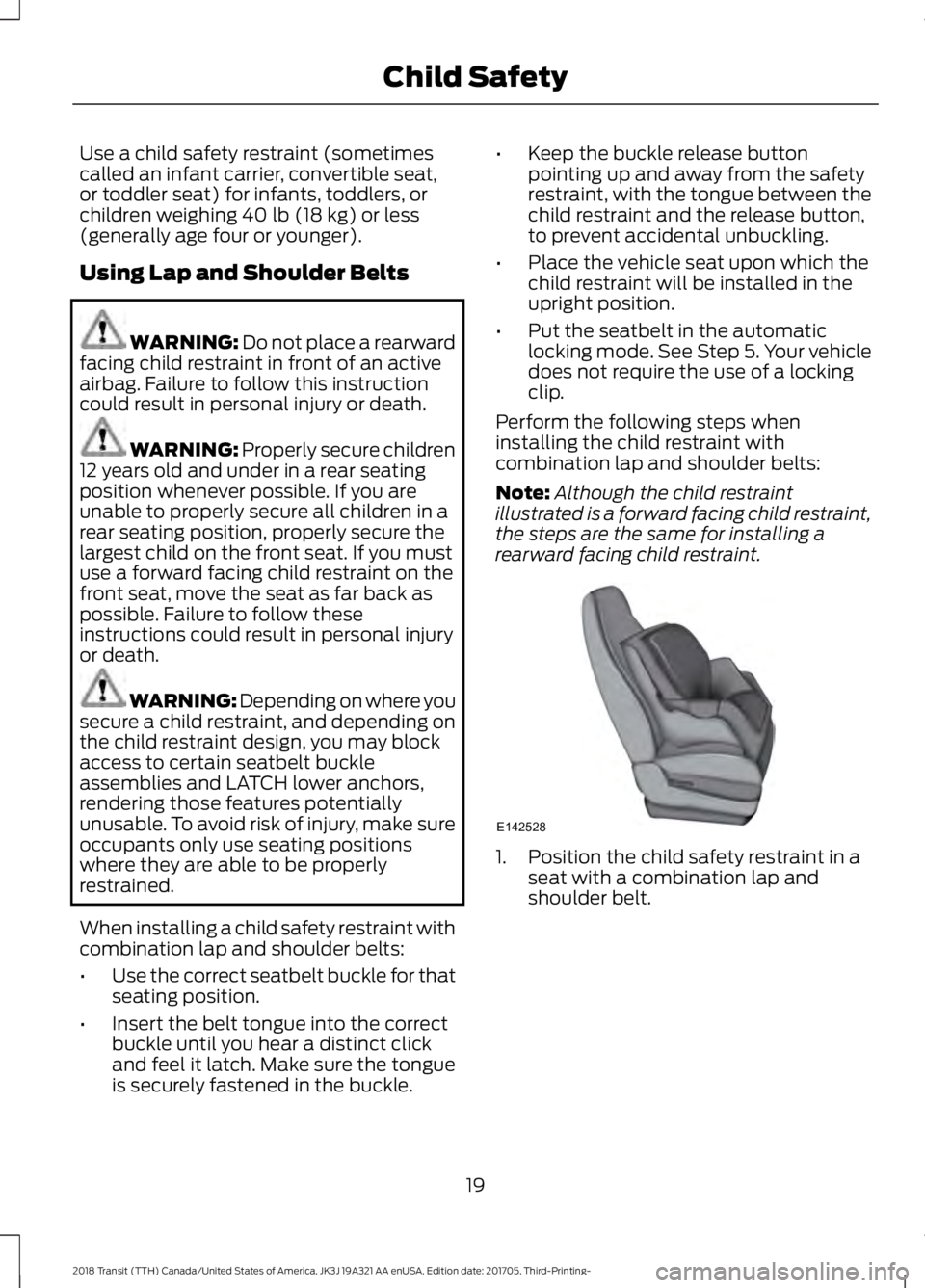
Perform the following steps when
installing the child restraint with
combination lap and shoulder belts:
Note: Although the child restraint
illustrated is a forward facing child restraint,
the steps are the same for installing a
rearward facing child restraint. 1. Position the child safety restraint in a
seat with a combination lap and
shoulder belt.
19
2018 Transit (TTH) Canada/United States of America, JK3J 19A321 AA enUSA, Edition date: 201705, Third-Printing- Child SafetyE142528
Page 23 of 521
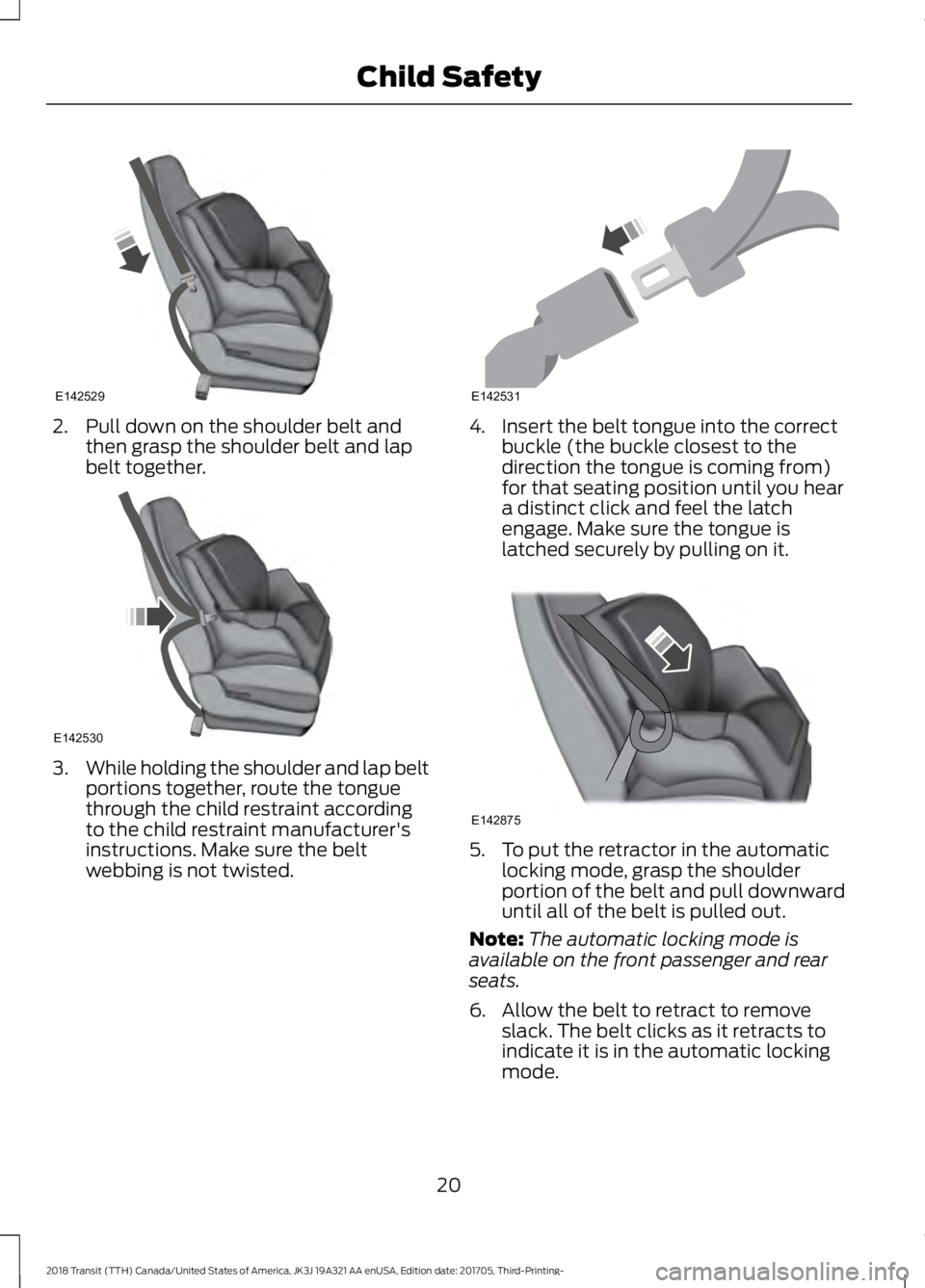
2. Pull down on the shoulder belt and
then grasp the shoulder belt and lap
belt together. 3.
While holding the shoulder and lap belt
portions together, route the tongue
through the child restraint according
to the child restraint manufacturer's
instructions. Make sure the belt
webbing is not twisted. 4. Insert the belt tongue into the correct
buckle (the buckle closest to the
direction the tongue is coming from)
for that seating position until you hear
a distinct click and feel the latch
engage. Make sure the tongue is
latched securely by pulling on it. 5. To put the retractor in the automatic
locking mode, grasp the shoulder
portion of the belt and pull downward
until all of the belt is pulled out.
Note: The automatic locking mode is
available on the front passenger and rear
seats.
6. Allow the belt to retract to remove slack. The belt clicks as it retracts to
indicate it is in the automatic locking
mode.
20
2018 Transit (TTH) Canada/United States of America, JK3J 19A321 AA enUSA, Edition date: 201705, Third-Printing- Child SafetyE142529 E142530 E142531 E142875