Page 123 of 521
2. While holding the handle in this
position, tilt the top of the seat forward
to release the seat frame rear catches
from the floor.
3. When the rear seat latches are clear of
the floor, release the handle.
4. Pull the seat backward to release the seat frame front catches.
5. Remove the seat from the vehicle.
Note: Two persons are required to release
the seat handles and remove the seat.
Note: You can only remove seats that have
integral release handles.
Note: The seatback does not fold forward.
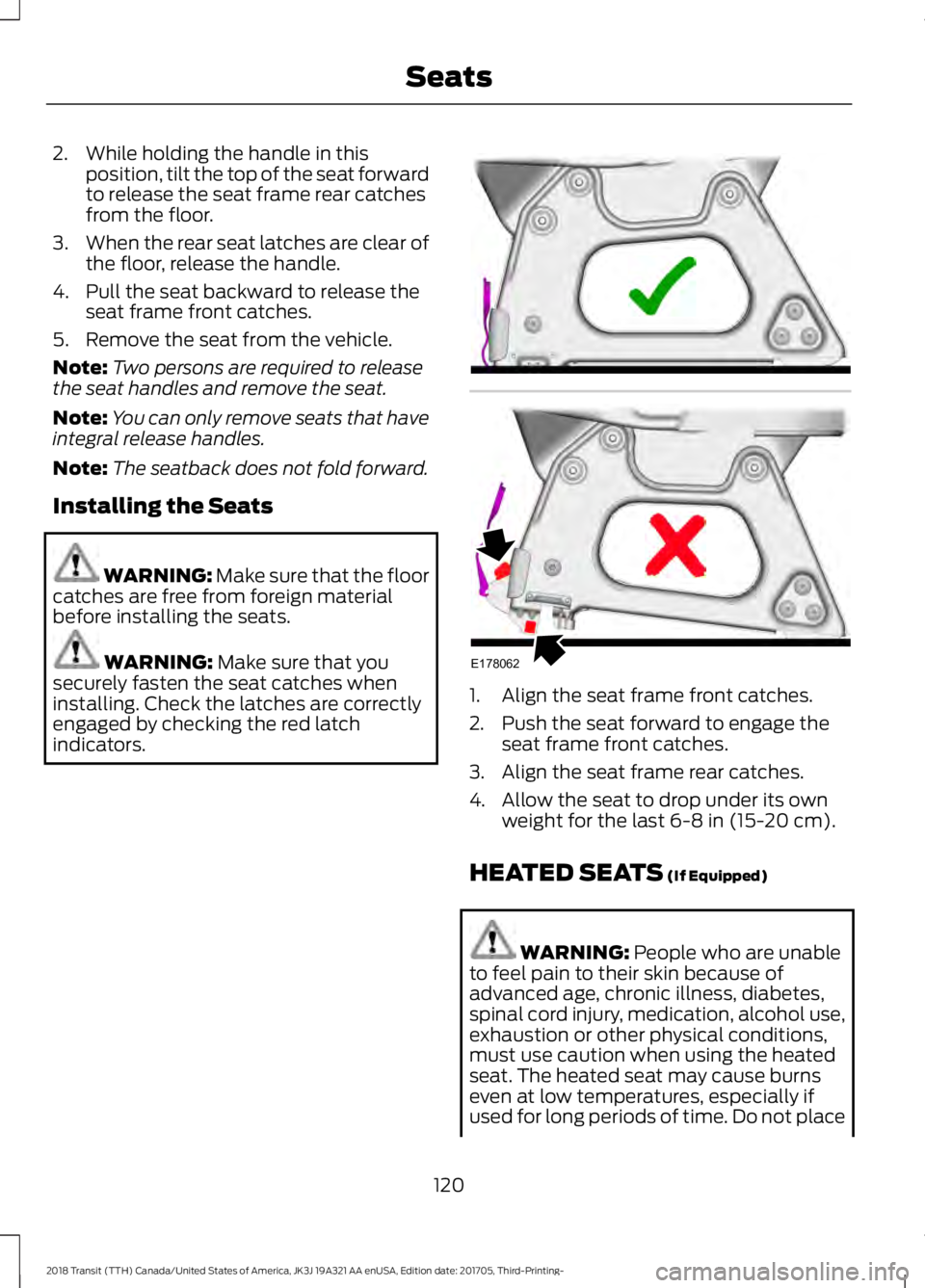
Installing the Seats WARNING: Make sure that the floor
catches are free from foreign material
before installing the seats. WARNING: Make sure that you
securely fasten the seat catches when
installing. Check the latches are correctly
engaged by checking the red latch
indicators. 1. Align the seat frame front catches.
2. Push the seat forward to engage the
seat frame front catches.
3. Align the seat frame rear catches.
4. Allow the seat to drop under its own weight for the last 6-8 in (15-20 cm).
HEATED SEATS
(If Equipped) WARNING:
People who are unable
to feel pain to their skin because of
advanced age, chronic illness, diabetes,
spinal cord injury, medication, alcohol use,
exhaustion or other physical conditions,
must use caution when using the heated
seat. The heated seat may cause burns
even at low temperatures, especially if
used for long periods of time. Do not place
120
2018 Transit (TTH) Canada/United States of America, JK3J 19A321 AA enUSA, Edition date: 201705, Third-Printing- SeatsE178062
Page 124 of 521
anything on the seat that may block the
heat, such as a blanket or cushion. This can
cause the heated seat to overheat. Do not
puncture the seat with pins, needles or
other pointed objects. This damages the
heating element and can cause the heated
seat to overheat. An overheated seat may
cause serious personal injury.
Note:
Do not place heavy objects on the
seat.
Note: If you spill water or any other liquid
onto the seat, allow the seat to dry
thoroughly before you switch the heated
seat on. The heated seat switch is on the seat base.
Press the button to switch the heated seat
on or off. The system reaches maximum
temperature after five or six minutes. It is
regulated automatically.
The heated seat remains on until you
switch it off. If the heated seat is on when
you switch the ignition off, it will be on
when you switch the ignition back on.
Note:
Do not switch the heated seat on
unless your vehicle is running. This prevents
the vehicle battery from running out of
charge.
121
2018 Transit (TTH) Canada/United States of America, JK3J 19A321 AA enUSA, Edition date: 201705, Third-Printing- SeatsE234067
Page 148 of 521
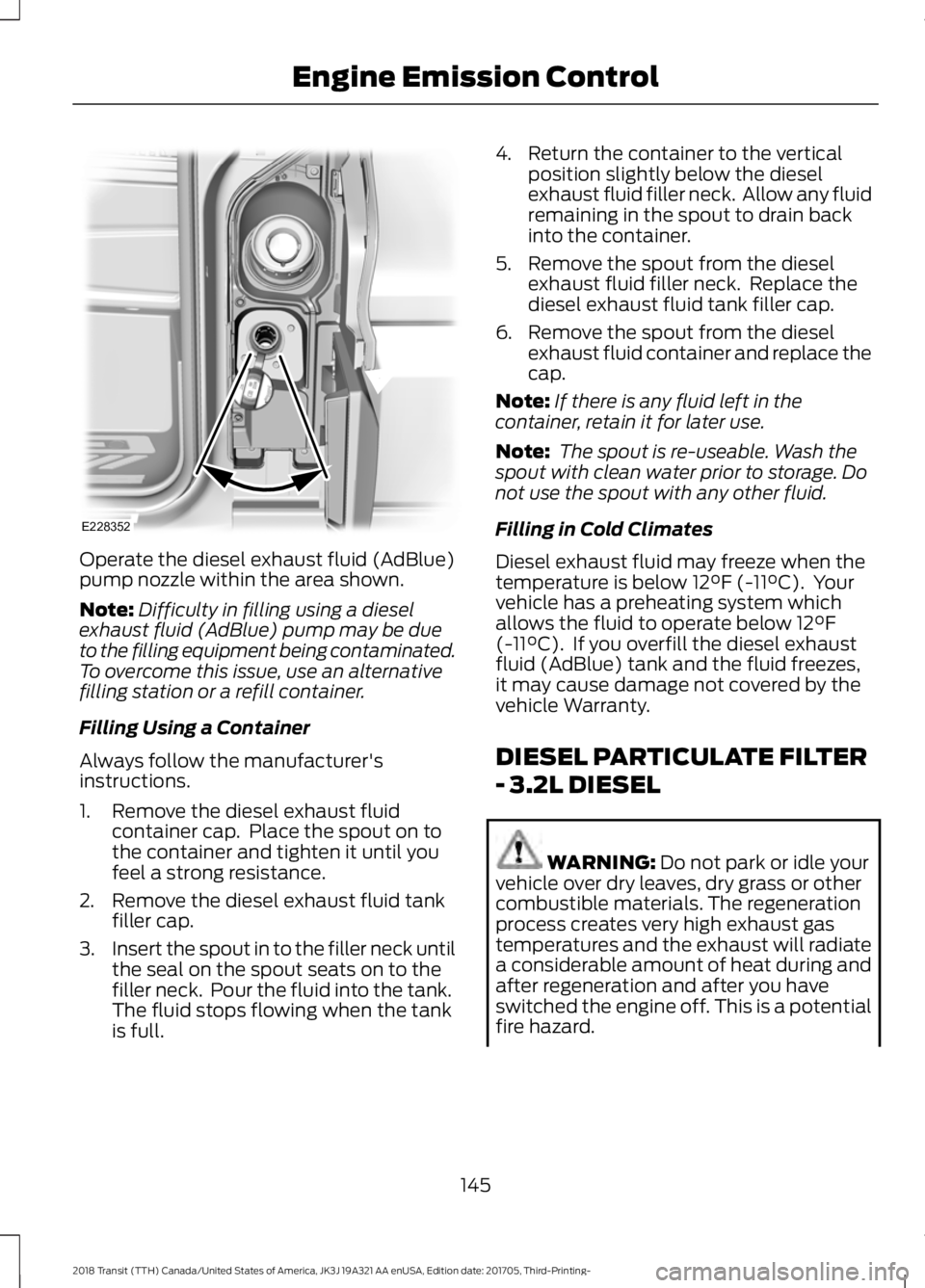
Operate the diesel exhaust fluid (AdBlue)
pump nozzle within the area shown.
Note:
Difficulty in filling using a diesel
exhaust fluid (AdBlue) pump may be due
to the filling equipment being contaminated.
To overcome this issue, use an alternative
filling station or a refill container.
Filling Using a Container
Always follow the manufacturer's
instructions.
1. Remove the diesel exhaust fluid container cap. Place the spout on to
the container and tighten it until you
feel a strong resistance.
2. Remove the diesel exhaust fluid tank filler cap.
3. Insert the spout in to the filler neck until
the seal on the spout seats on to the
filler neck. Pour the fluid into the tank.
The fluid stops flowing when the tank
is full. 4. Return the container to the vertical
position slightly below the diesel
exhaust fluid filler neck. Allow any fluid
remaining in the spout to drain back
into the container.
5. Remove the spout from the diesel exhaust fluid filler neck. Replace the
diesel exhaust fluid tank filler cap.
6. Remove the spout from the diesel exhaust fluid container and replace the
cap.
Note: If there is any fluid left in the
container, retain it for later use.
Note: The spout is re-useable. Wash the
spout with clean water prior to storage. Do
not use the spout with any other fluid.
Filling in Cold Climates
Diesel exhaust fluid may freeze when the
temperature is below 12°F (-11°C). Your
vehicle has a preheating system which
allows the fluid to operate below
12°F
(-11°C). If you overfill the diesel exhaust
fluid (AdBlue) tank and the fluid freezes,
it may cause damage not covered by the
vehicle Warranty.
DIESEL PARTICULATE FILTER
- 3.2L DIESEL WARNING:
Do not park or idle your
vehicle over dry leaves, dry grass or other
combustible materials. The regeneration
process creates very high exhaust gas
temperatures and the exhaust will radiate
a considerable amount of heat during and
after regeneration and after you have
switched the engine off. This is a potential
fire hazard.
145
2018 Transit (TTH) Canada/United States of America, JK3J 19A321 AA enUSA, Edition date: 201705, Third-Printing- Engine Emission ControlE228352
Page 164 of 521

PRINCIPLE OF OPERATION
WARNING: Vehicle modifications
involving braking system, aftermarket roof
racks, suspension, steering system, tire
construction and wheel and tire size may
change the handling characteristics of your
vehicle and may adversely affect the
performance of the electronic stability
control system. In addition, installing any
stereo loudspeakers may interfere with
and adversely affect the electronic stability
control system. Install any aftermarket
stereo loudspeaker as far as possible from
the front center console, the tunnel, and
the front seats in order to minimize the risk
of interfering with the electronic stability
control sensors. Reducing the
effectiveness of the electronic stability
control system could lead to an increased
risk of loss of vehicle control, vehicle
rollover, personal injury and death. WARNING:
Remember that even
advanced technology cannot defy the laws
of physics. It's always possible to lose
control of a vehicle due to inappropriate
driver input for the conditions. Aggressive
driving on any road condition can cause
you to lose control of your vehicle
increasing the risk of personal injury or
property damage. Activation of the
electronic stability control system is an
indication that at least some of the tires
have exceeded their ability to grip the road;
this could reduce the operator's ability to
control the vehicle potentially resulting in
a loss of vehicle control, vehicle rollover,
personal injury and death. If your electronic
stability control system activates, SLOW
DOWN.
The system automatically turns on each
time you switch the ignition on. If the stability control or traction control
system detects a fault, the following may
occur:
•
The stability and traction control light
illuminates steadily.
• The stability control and traction
control systems do not enhance your
vehicle's ability to maintain traction of
the wheels.
If the stability control or traction control
system activates, the following may occur:
• The stability and traction control light
flashes.
• Your vehicle slows down.
• Reduced engine power.
• A vibration in the brake pedal.
• The brake pedal is stiffer than usual.
• If the driving condition is severe and
your foot is not on the brake pedal, the
pedal may move as the system applies
higher brake force.
The stability control system has several
features built into it to help you maintain
control of your vehicle.
Electronic Stability Control
The system helps to prevent your vehicle
skidding or laterally sliding by individually
applying the brakes to one or more wheels
and, if necessary, reducing engine power.
Roll Stability Control
The system helps to prevent rollovers by
detecting your vehicle's roll motion, and
individually applying the brakes to one or
more wheels.
161
2018 Transit (TTH) Canada/United States of America, JK3J 19A321 AA enUSA, Edition date: 201705, Third-Printing- Stability Control
Page 213 of 521
Protected Component
Fuse Rating
Fuse Number
Diesel particulate filter vaporizer.
3 A
F5
Glow plug monitor.
Not used.
-
F6
Automatic transmission module.
7.5 A
F7
Not used.
-
F8
Not used.
-
F9
Power step.
30 A
F10
Heated seats.
Air conditioning clutch.
10 A
F11
Diesel particulate filter vaporizer glow plug.
20 A
F12
Not used.
-
F13
Selective catalytic reduction system.
3 A
F14
Not used.
-
F15
Fuel pump relay.
10 A
F16
Automatic transmission module.
15 A
F17
Fuel pump relay.
30 A
F18
Automatic transmission module.
Starter motor solenoid.
30 A
F19
Glow plugs.
60 A
F20
Ignition relay 3.
60 A
F21
Selective catalytic reduction system.
40 A
F22 Not used.
-
Spare.
10 A
F23
Not used.
-
F24
Spare.
10 A
F25
Spare.
20 A
F26
Not used.
-
F27
Crankcase pressure sensor.
7.5 A
F28
210
2018 Transit (TTH) Canada/United States of America, JK3J 19A321 AA enUSA, Edition date: 201705, Third-Printing- Fuses
Page 218 of 521
Protected Component
Fuse Rating
Fuse Number
Trailer tow module.
40 A
F45
Power windows.
30 A
F46
Cigar lighter socket.
20 A
F47
Rear auxiliary power points.
20 A
F48
Front auxiliary power points.
20 A
F49
Ignition relay 1.
60 A
F50
Power step.
60 A
F51
Heated seats.
Modified vehicle connections.
40 A
F52
Modified vehicle connections.
40 A
F53 Protected Component
Relay Number
Spare.
R1
Auxiliary power points.
R2
Trailer lamps.
R3
Not used.
R4
Power windows.
R5
Ignition relay 1.
R6
Horn.
R7
Trailer tow reversing lamp.
R8
Front blower motor.
R9
Rear blower motor.
R10
Heated rear window.
R11 Heated exterior mirrors.
Heated seats.
R12
Modified vehicle connections.
R13
215
2018 Transit (TTH) Canada/United States of America, JK3J 19A321 AA enUSA, Edition date: 201705, Third-Printing- Fuses
Page 222 of 521
Protected Component
Fuse Rating
Fuse Number
Not used.
-
F5
Not used.
-
F6
Automatic transmission module.
7.5 A
F7
Cooling fan.
30 A
F8
Not used.
-
F9
Power step.
30 A
F10
Heated seats.
Air conditioning clutch.
10 A
F11
Not used.
-
F12
Not used.
-
F13
Not used.
-
F14
Not used.
-
F15
Fuel pump relay.
20 A
F16
Not used.
-
F17
Anti-lock brake system.
30 A
F18
Fuel pump relay.
Starter motor solenoid.
30 A
F19
Not used.
-
F20
Ignition relay 3.
60 A
F21
Selective catalytic reduction system catalyst.
40 A
F22
Brake vacuum pump relay.
Spare.
10 A
F23
Not used.
-
F24
Spare.
10 A
F25
Spare.
20 A
F26
Not used.
-
F27
Not used.
-
F28
Audio unit.
3 A
F29
219
2018 Transit (TTH) Canada/United States of America, JK3J 19A321 AA enUSA, Edition date: 201705, Third-Printing- Fuses
Page 227 of 521
Protected Component
Fuse Rating
Fuse Number
Trailer tow module.
40 A
F45
Power windows.
30 A
F46
Cigar lighter socket.
20 A
F47
Rear auxiliary power points.
20 A
F48
Front auxiliary power points.
20 A
F49
Ignition relay 1.
60 A
F50
Power step.
60 A
F51
Heated seats.
Modified vehicle connections.
40 A
F52
Modified vehicle connections.
40 A
F53 Protected Component
Relay Number
Spare.
R1
Auxiliary power points.
R2
Trailer lamps.
R3
Not used.
R4
Power windows.
R5
Ignition relay 1.
R6
Horn.
R7
Trailer tow reversing lamp.
R8
Front blower motor.
R9
Rear blower motor.
R10
Heated rear window.
R11 Heated exterior mirrors.
Heated seats.
R12
Modified vehicle connections.
R13
224
2018 Transit (TTH) Canada/United States of America, JK3J 19A321 AA enUSA, Edition date: 201705, Third-Printing- Fuses


