2018 FORD TRANSIT child seat
[x] Cancel search: child seatPage 52 of 521

1. Insert the ignition key, turn the switch
to OFF and hold in OFF while removing
the key. 2.
When the ignition is turned on, the pass
airbag off light illuminates briefly,
momentarily shuts off and then turns
back on. This indicates that the
passenger airbag is deactivated.
Turning the Passenger Airbag Back On WARNING: The seatbelts for the
driver and right front passenger seating
positions have been specifically designed
to function together with the airbags in
certain types of crashes. When you turn off
your airbag, you not only lose the
protection of the airbag, you also may
reduce the effectiveness of your seatbelt
system, which was designed to work with
the airbag. If you are not a passenger who
meets the requirements stated in the
National Highway Traffic Safety
Administration or Transport Canada
deactivation criteria turning off the airbag
can increase the risk of serious injury or
death in a crash. WARNING:
If your vehicle has rear
seats, always transport children who are
12 years and under in the rear seat. Always
use seatbelts and child restraints correctly.
Do not place a child in a rear facing infant
seat in the front seat unless your vehicle is
equipped with an airbag on and off switch
and the passenger airbag is turned off. This
is because the back of the infant seat is
too close to the inflating airbag and the
risk of a fatal injury to the infant when the
airbag inflates is substantial. WARNING:
If the pass airbag off
light is illuminated when the passenger
airbag switch is on and the ignition is on,
have the passenger airbag switch serviced
at your authorized dealer immediately.
The passenger airbag remains off until you
turn it back on.
49
2018 Transit (TTH) Canada/United States of America, JK3J 19A321 AA enUSA, Edition date: 201705, Third-Printing- Supplementary Restraints SystemE181523 E181522
Page 53 of 521

1. Insert the ignition key and turn the
switch to ON.
2. The pass airbag off light will briefly illuminate when the ignition is turned
to on. This indicates that the passenger
airbag is operational.
The passenger side airbag should always
be on (the pass airbag off light should not
be illuminated) unless the passenger
meets the requirements stated either in
Category 1, 2 or 3 of the National Highway
Traffic Safety Administration or Transport
Canada deactivation criteria which follows.
The vast majority of drivers and passengers
are much safer with an airbag than
without. To do their job and reduce the risk
of life threatening injuries, airbags must
open with great force, and this force can
pose a potentially deadly risk in some
situations, particularly when a front seat
passenger is not using the seatbelt
correctly. The most effective way to reduce
the risk of unnecessary airbag injuries
without reducing the overall safety of your
vehicle is to make sure all passengers are
correctly restrained in the vehicle,
especially in the front seat. This provides
the protection of seatbelts and permits the
airbags to provide the additional protection
they were designed to provide. If you choose to deactivate your airbag, you are
losing the very significant risk reducing
benefits of the airbag and you are also
reducing the effectiveness of the seatbelts,
because seatbelts in modern vehicles are
designed to work as a safety system with
the airbags.
National Highway Traffic Safety
Administration Deactivation Criteria
(Excluding Canada)
WARNING: This vehicle has special
energy management seatbelts for the
driver and right front passenger. These
particular belts are specifically designed
to work with airbags to help reduce the risk
of injury in a crash. The energy
management seatbelt is designed to give
or release additional belt webbing in some
accidents to reduce concentration of force
on an occupant's chest and reduce the risk
of certain bone fractures and injuries to
underlying organs. In a crash, if the airbag
is turned off, this energy management
seatbelt might permit the person wearing
the belt to move forward enough to incur
a serious or fatal injury. The more severe
the crash, and the heavier the occupant,
the greater the risk is. Be sure the airbag is
turned on for any person who does not
qualify under the National Highway Traffic
Safety Administration deactivation criteria.
1. Infant.
An infant (less than 1 year old)
must ride in the front seat because:
• The vehicle has no rear seat;
• The vehicle has a rear seat too small
to accommodate a rear-facing infant
seat; or
• The infant has a medical condition
which, according to the infant's
physician, makes it necessary for the
infant to ride in the front so that the
driver can constantly monitor the
child's condition.
50
2018 Transit (TTH) Canada/United States of America, JK3J 19A321 AA enUSA, Edition date: 201705, Third-Printing- Supplementary Restraints SystemE181521
Page 54 of 521
2.
Child age 1 to 12. A child age 1 to 12 must
ride in the front seat because:
• The vehicle has no rear seat;
• Although children ages 1 to 12 ride in
the rear seat(s) whenever possible,
children ages 1 to 12 sometimes must
ride in the front because no space is
available in the rear seat(s) of the
vehicle; or
• The child has a medical condition
which, according to the child's
physician, makes it necessary for the
child to ride in the front seat so that the
driver can constantly monitor the
child's condition.
3. Medical condition. A passenger has a
medical condition which, according to his
or her physician:
• Causes the passenger airbag to pose
a special risk for the passenger;
• Makes the potential harm from the
passenger airbag in a crash greater
than the potential harm from turning
off the airbag and allowing the
passenger, even if belted, to hit the
dashboard or windshield in a crash.
Transport Canada Deactivation Criteria
(Canada Only) WARNING:
This vehicle has special
energy management seatbelts for the
driver and right front passenger. These
particular belts are specifically designed
to work with airbags to help reduce the risk
of injury in a crash. The energy
management seatbelt is designed to give
or release additional belt webbing in some
accidents to reduce concentration of force
on an occupant's chest and reduce the risk
of certain bone fractures and injuries to
underlying organs. In a crash, if the airbag
is turned off, this energy management
seatbelt might permit the person wearing the belt to move forward enough to incur
a serious or fatal injury. The more severe
the crash, and the heavier the occupant,
the greater the risk is. Be sure the airbag is
turned on for any person who does not
qualify under the National Highway Traffic
Safety Administration deactivation criteria.
1.
Infant:
An infant (less than 1 year old)
must ride in the front seat because:
• My vehicle has no rear seat;
• The rear seat in my vehicle cannot
accommodate a rear-facing infant
seat;
• The infant has a medical condition
which, according to the infant's
physician, makes it necessary for the
infant to ride in the front seat so that
the driver can monitor the infant's
condition.
2. Child age 12 or under: A child age 12 or
under must ride in the front seat because:
• My vehicle has no rear seat;
• Athough children age 12 and under ride
in the rear seat whenever possible,
children age 12 and under have no
option but to sometimes ride in the
front seat because rear seat space is
insufficient;
• The child has a medical condition that,
according to the child's physician,
makes it necessary for the child to ride
in the front seat so that the driver can
monitor the child's condition.
3. Medical condition:
A passenger has a
medical condition that, according to his or
her physician:
51
2018 Transit (TTH) Canada/United States of America, JK3J 19A321 AA enUSA, Edition date: 201705, Third-Printing- Supplementary Restraints System
Page 55 of 521
•
Poses a special risk for the passenger
if the airbag deploys; and
• Makes the potential harm from the
passenger airbag deployment greater
than the potential harm from turning
off the airbag and experiencing a crash
without the protection offered by the
airbag
Proper Driver and Front Passenger
Seating Adjustment WARNING: The National Highway
Traffic Safety Administration recommends
a minimum distance of at least 10 inches
(25 centimeters) between an occupant’ s
chest and the driver airbag module.
To properly position yourself away from
the airbag:
• Move your seat to the rear as far as you
can while still reaching the pedals
comfortably.
• Recline the seat slightly (one or two
degrees) from the upright position.
After all occupants have adjusted their
seats and put on seatbelts, it is very
important that they continue to sit
properly. Properly seated occupants sit
upright, lean against the seat back, and
center themselves on the seat cushion,
with their feet comfortably extended on
the floor. Sitting improperly can increase
the chance of injury in a crash event. For
example, if an occupant slouches, lies
down, turns sideways, sits forward, leans
forward or sideways, or puts one or both
feet up, the chance of injury during a crash
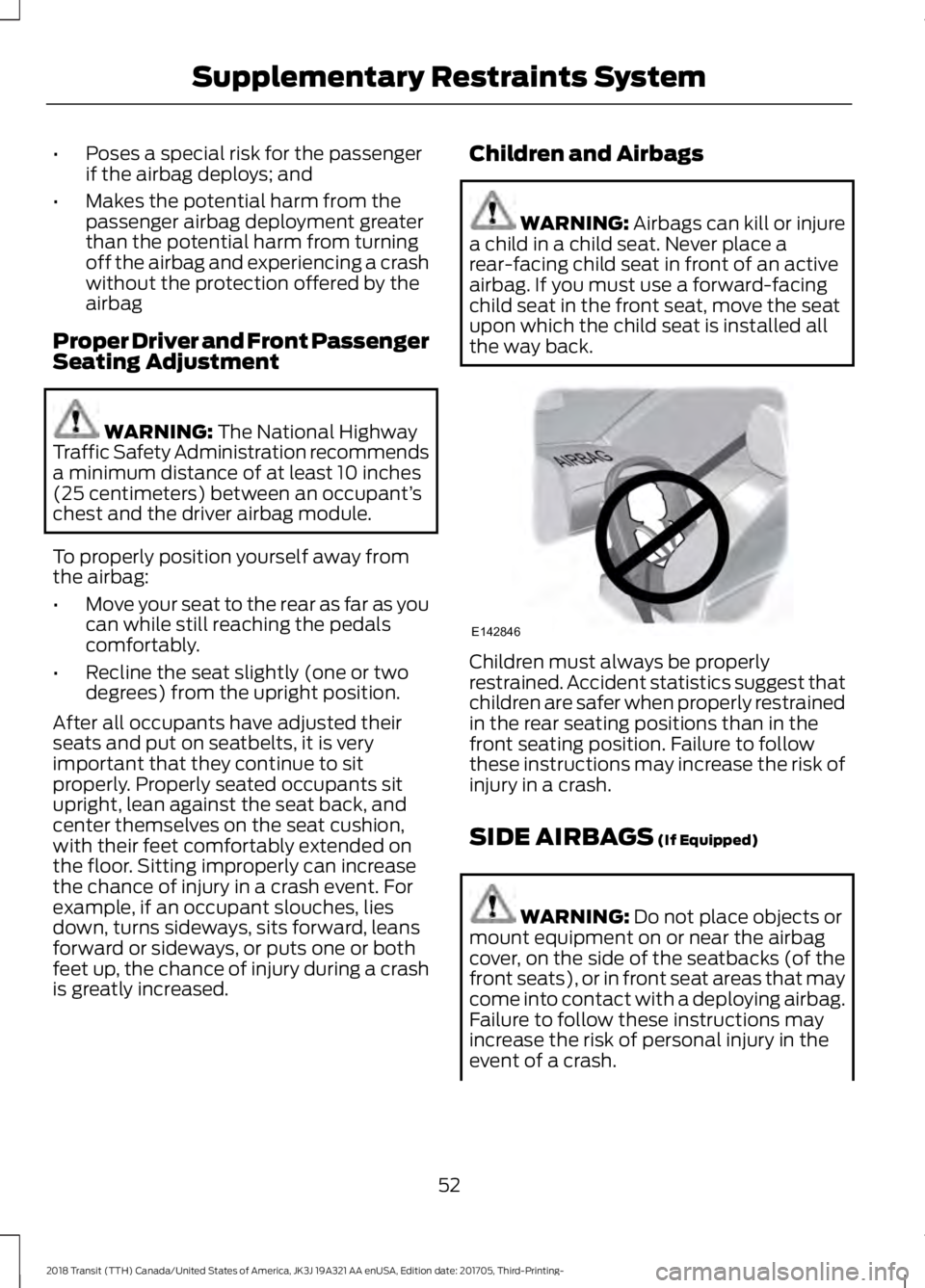
is greatly increased. Children and Airbags WARNING:
Airbags can kill or injure
a child in a child seat. Never place a
rear-facing child seat in front of an active
airbag. If you must use a forward-facing
child seat in the front seat, move the seat
upon which the child seat is installed all
the way back. Children must always be properly
restrained. Accident statistics suggest that
children are safer when properly restrained
in the rear seating positions than in the
front seating position. Failure to follow
these instructions may increase the risk of
injury in a crash.
SIDE AIRBAGS
(If Equipped)
WARNING:
Do not place objects or
mount equipment on or near the airbag
cover, on the side of the seatbacks (of the
front seats), or in front seat areas that may
come into contact with a deploying airbag.
Failure to follow these instructions may
increase the risk of personal injury in the
event of a crash.
52
2018 Transit (TTH) Canada/United States of America, JK3J 19A321 AA enUSA, Edition date: 201705, Third-Printing- Supplementary Restraints SystemE142846
Page 57 of 521

WARNING: Do not lean your head
on the door. The curtain airbag could injure
you as it deploys from the headliner. WARNING:
Do not attempt to
service, repair, or modify the
supplementary restraint system or
associated components. Failure to follow
this instruction could result in personal
injury or death. WARNING:
All occupants of your
vehicle, including the driver, should always
properly wear their seatbelts, even when
an airbag supplemental restraint system
is provided. Failure to properly wear your
seatbelt could seriously increase the risk
of injury or death. WARNING:
To reduce risk of injury,
do not obstruct or place objects in the
deployment path of the airbag. WARNING:
If a supplementary
restraint system component has deployed,
it will not function again. Have the system
and associated components inspected as
soon as possible. Failure to follow this
instruction could result in personal injury
or death.
The Safety Canopy deploys during
significant side crashes or when a certain
likelihood of a rollover event is detected
by the rollover sensor. The Safety Canopy
is mounted to the roof side rail sheet metal,
behind the headliner, above each row of
seats. In certain sideways crashes or
rollover events, the Safety Canopy will be
activated, regardless of which seats are
occupied. The Safety Canopy is designed
to inflate between the side window area
and occupants to further enhance
protection provided in side impact crashes
and rollover events. The system consists of the following:
•
Safety Canopy curtain airbags above
the trim panels over the front and rear
side windows identified by a label or
wording on the headliner or roof-pillar
trim.
• A flexible headliner which opens above
the side doors to allow air curtain
deployment · Crash sensors and monitoring
system with a readiness
indicator. See Crash Sensors
and Airbag Indicator (page 55).
Properly restrain children 12 years old and
under in the rear seats. The Safety Canopy
will not interfere with children restrained
using a properly installed child or booster
seat because it is designed to inflate
downward from the headliner above the
doors along the side window opening.
The design and development of the Safety
Canopy included recommended testing
procedures that were developed by a
group of automotive safety experts known
as the Side Airbag Technical Working
Group. These recommended testing
procedures help reduce the risk of injuries
related to the deployment of side airbags
(including the Safety Canopy).
54
2018 Transit (TTH) Canada/United States of America, JK3J 19A321 AA enUSA, Edition date: 201705, Third-Printing- Supplementary Restraints SystemE75004 E67017
Page 271 of 521
GENERAL INFORMATION
Notice to Utility Vehicle, Van and
Truck Owners
WARNING: Utility vehicles have a
significantly higher rollover rate than other
types of vehicles. To reduce the risk of
serious injury or death from a rollover or
other crash you must avoid sharp turns and
abrupt maneuvers, drive at safe speeds for
the conditions, keep tires properly inflated,
never overload or improperly load your
vehicle, and make sure every passenger is
properly restrained. WARNING:
In a rollover crash, an
unbelted person is significantly more likely
to die than a person wearing a seat belt.
All occupants must wear seat belts.
Children and infants must use appropriate
restraints to minimize the risk of injury or
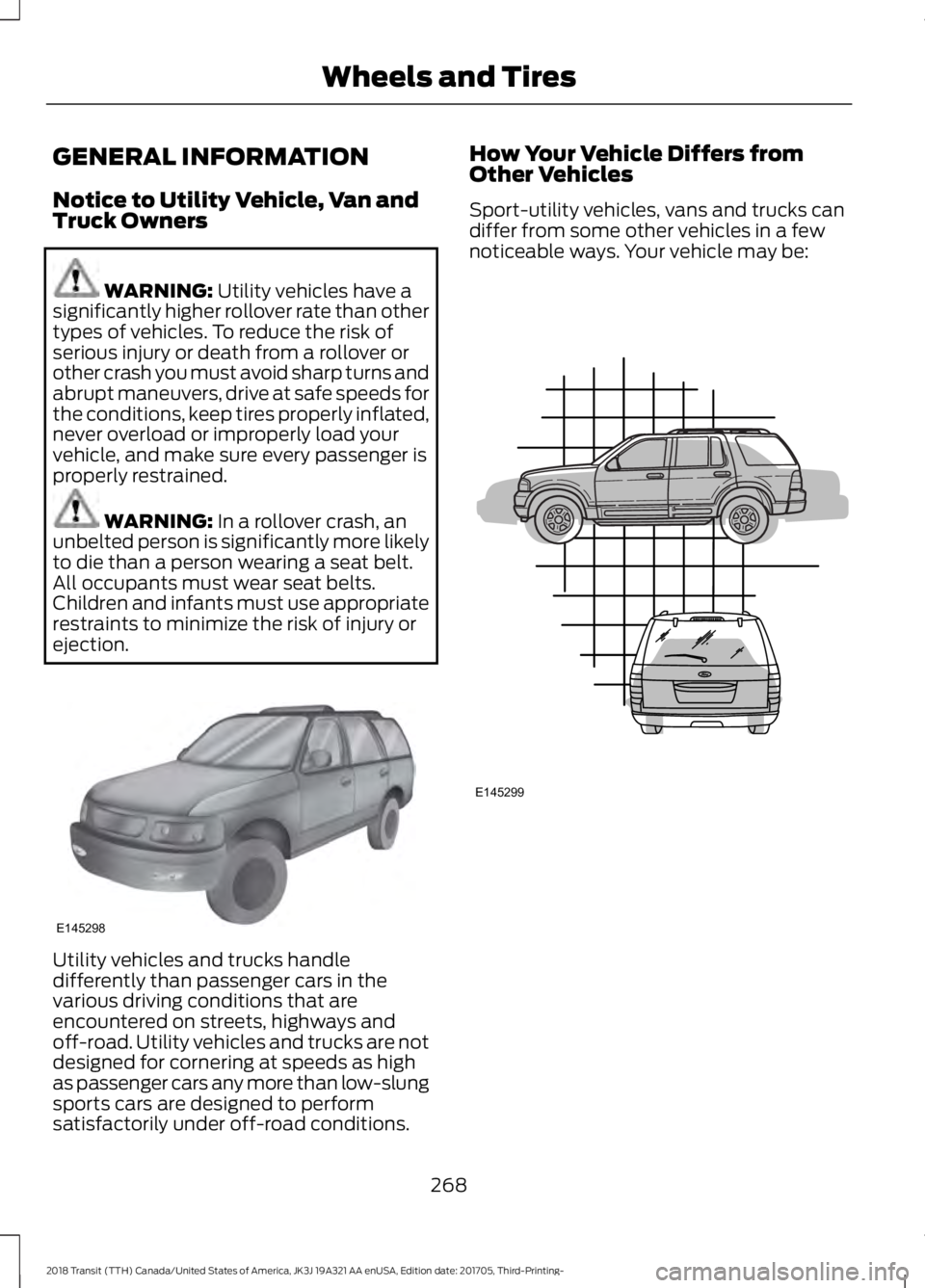
ejection. Utility vehicles and trucks handle
differently than passenger cars in the
various driving conditions that are
encountered on streets, highways and
off-road. Utility vehicles and trucks are not
designed for cornering at speeds as high
as passenger cars any more than low-slung
sports cars are designed to perform
satisfactorily under off-road conditions. How Your Vehicle Differs from
Other Vehicles
Sport-utility vehicles, vans and trucks can
differ from some other vehicles in a few
noticeable ways. Your vehicle may be:
268
2018 Transit (TTH) Canada/United States of America, JK3J 19A321 AA enUSA, Edition date: 201705, Third-Printing- Wheels and TiresE145298 E145299
Page 510 of 521

Changing the Engine Oil and Oil
Filter...............................................................235
Engine Lubrication for Severe Service
Operation
......................................................... 235
Changing the Front Wiper Blades.........246
Checking MyKey System Status..............66
Checking the Wiper Blades.....................246
Child Restraint and Seatbelt Maintenance.................................................44
Child Restraint Positioning.........................35
Child Safety
........................................................17
General Information............................................. 17
Child Safety Locks..........................................37 Left-Hand Side..................................................... 38
Right-Hand Side................................................... 38
Cigar Lighter
....................................................123
Cleaning Products......................................260
Cleaning the Engine....................................262
Cleaning the Exterior...................................261 Body Paintwork Preservation........................ 262
Cleaning the Chrome Trim.............................. 261
Cleaning the Headlamps................................. 261
Cleaning the Rear Window............................. 261
Sliding Door Tracks........................................... 262
Cleaning the Instrument Panel and Instrument Cluster Lens........................265
Cleaning the Interior...................................263 Fabric, Carpets, Cloth Seats, Headliners
and Floor Mats............................................... 263
Instrument Cluster Screens, LCD Screens and Radio Screens....................................... 264
Leather Interior................................................... 264
Rear Windows..................................................... 264
Seatbelts.............................................................. 264
Storage Compartments, Cup Holders and Ashtrays........................................................... 264
Suede Micro Fiber Fabric................................ 264
Cleaning the Wheels
..................................266
Cleaning the Windows and Wiper Blades...........................................................263
Clearing All MyKeys.......................................66
Climate Control
............................................109
Cold Weather Precautions.........................191
Coolant Check See: Engine Coolant Check............................ 236
Crash Sensors and Airbag Indicator........55 Creating a MyKey
...........................................65
Programming/Changing Configurable
Settings.............................................................. 66
Cruise Control
...................................................81
Principle of Operation...................................... 168
Cruise control See: Using Cruise Control................................ 168
Cup Holders
....................................................125
Customer Assistance..................................201
D
Data Recording
..................................................9
Event Data Recording.......................................... 10
Service Data Recording........................................ 9
Daytime Running Lamps
.............................87
Diesel Particulate Filter - 3.2L Diesel..............................................................145
Diesel Particulate Filter Automatic Regeneration................................................... 146
Diesel Particulate Filter Manual Regeneration................................................... 148
On-Board Diagnostics System...................... 146
Digital Radio..................................................342 HD Radio Reception and Station
Troubleshooting............................................ 343
Direction Indicators
........................................87
Doors and Locks.............................................70
Draining the Fuel Filter Water Trap - 3.2L Power Stroke Diesel.................................242
Changing the Fuel Filter.................................. 242
Purging Air From the Fuel System...............243
Drive Belt Routing - 3.2L Power Stroke Diesel.............................................................258
Drive Belt Routing - 3.5L Ecoboost™/ 3.7L
.................................................................258
Driver Alert......................................................169
Principle of Operation...................................... 169
Using Driver Alert................................................ 169
Driver and Passenger Airbags....................47 Children and Airbags........................................... 52
Passenger Airbag On and Off Switch ..........47
Proper Driver and Front Passenger Seating Adjustment........................................................ 52
Driving Aids
.....................................................169
Driving Hints....................................................191
Driving Through Water................................192
507
2018 Transit (TTH) Canada/United States of America, JK3J 19A321 AA enUSA, Edition date: 201705, Third-Printing- Index