2018 FORD TRANSIT fuel pressure
[x] Cancel search: fuel pressurePage 291 of 521

Each tire, including the spare (if
provided), should be checked
monthly when cold and inflated
to the inflation pressure recommended by
the vehicle manufacturer on the vehicle
placard or tire inflation pressure label. (If
your vehicle has tires of a different size
than the size indicated on the vehicle
placard or tire inflation pressure label, you
should determine the proper tire inflation
pressure for those tires).
As an added safety feature, your vehicle
has been equipped with a Tire Pressure
Monitoring System (TPMS) that
illuminates a low tire pressure telltale
when one or more of your tires is
significantly under-inflated. Accordingly,
when the low tire pressure telltale
illuminates, you should stop and check
your tires as soon as possible, and inflate
them to the proper pressure. Driving on a
significantly under-inflated tire causes the
tire to overheat and can lead to tire failure.
Under-inflation also reduces fuel efficiency
and tire tread life, and may affect the
vehicle ’s handling and stopping ability.
Please note that the TPMS is not a
substitute for proper tire maintenance, and
it is the driver ’s responsibility to maintain
correct tire pressure, even if under-inflation
has not reached the level to trigger
illumination of the TPMS low tire pressure
telltale.
Your vehicle has also been equipped with
a TPMS malfunction indicator to indicate
when the system is not operating properly.
The TPMS malfunction indicator is
combined with the low tire pressure
telltale. When the system detects a
malfunction, the telltale will flash for
approximately one minute and then remain
continuously illuminated. This sequence
will continue upon subsequent vehicle
start-ups as long as the malfunction exists. When the malfunction indicator is
illuminated, the system may not be able
to detect or signal low tire pressure as
intended. TPMS malfunctions may occur
for a variety of reasons, including the
installation of replacement or alternate
tires or wheels on the vehicle that prevent
the TPMS from functioning properly.
Always check the TPMS malfunction
telltale after replacing one or more tires or
wheels on your vehicle to ensure that the
replacement or alternate tires and wheels
allow the TPMS to continue to function
properly.
This device complies with Part 15 of the
FCC Rules and with Licence exempt RSS
Standards of Industry Canada. Operation
is subject to the following two conditions:
•
This device may not cause harmful
interference.
• This device must accept any
interference received, including
interference that may cause undesired
operation. WARNING: Changes or
modifications not expressively approved
by the party responsible for compliance
could void the user's authority to operate
the equipment. The term "IC:" before the
radio certification number only signifies
that Industry Canada technical
specifications were met.
288
2018 Transit (TTH) Canada/United States of America, JK3J 19A321 AA enUSA, Edition date: 201705, Third-Printing- Wheels and Tires
Page 316 of 521
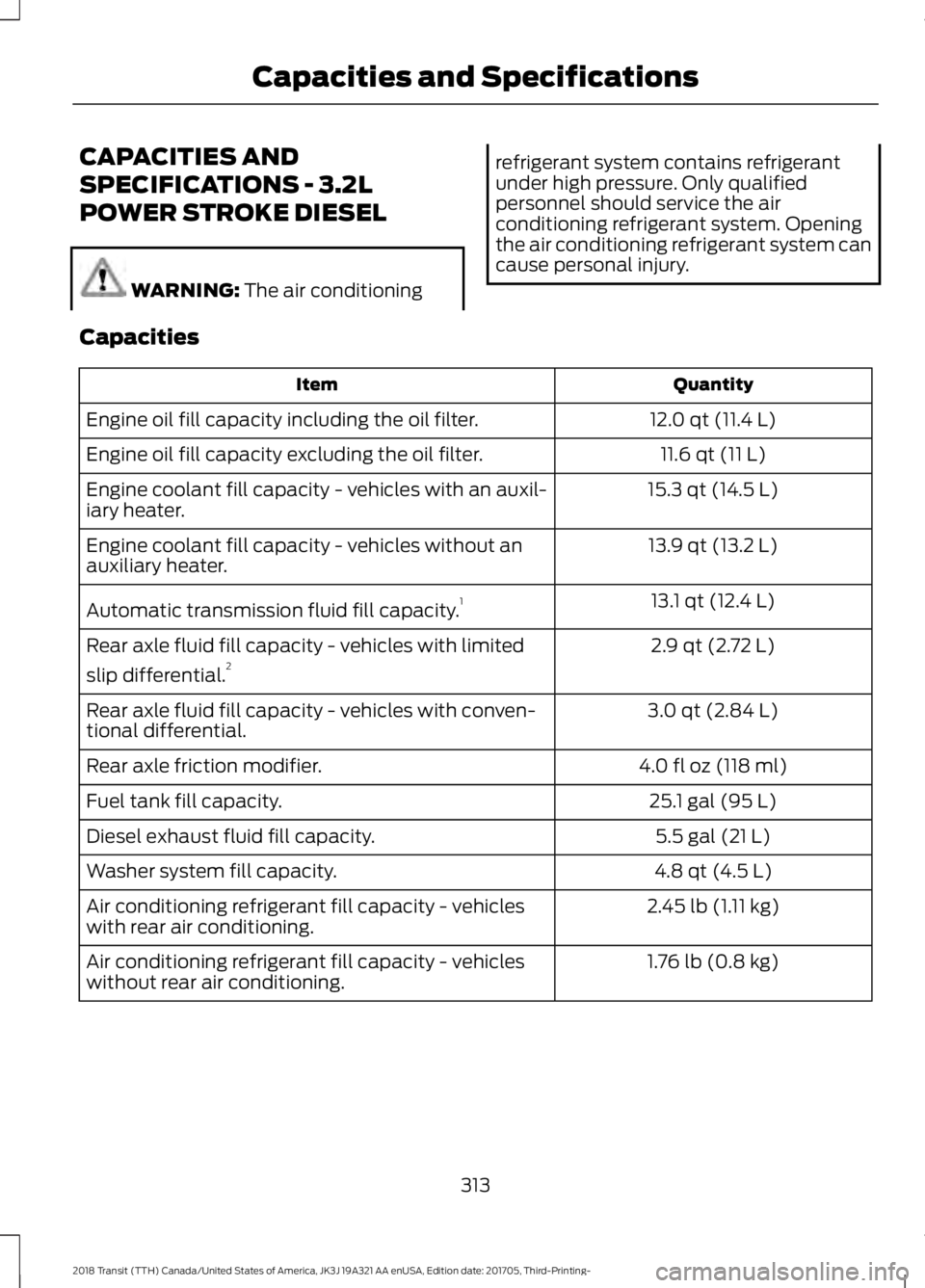
CAPACITIES AND
SPECIFICATIONS - 3.2L
POWER STROKE DIESEL
WARNING: The air conditioning refrigerant system contains refrigerant
under high pressure. Only qualified
personnel should service the air
conditioning refrigerant system. Opening
the air conditioning refrigerant system can
cause personal injury.
Capacities Quantity
Item
12.0 qt (11.4 L)
Engine oil fill capacity including the oil filter.
11.6 qt (11 L)
Engine oil fill capacity excluding the oil filter.
15.3 qt (14.5 L)
Engine coolant fill capacity - vehicles with an auxil-
iary heater.
13.9 qt (13.2 L)
Engine coolant fill capacity - vehicles without an
auxiliary heater.
13.1 qt (12.4 L)
Automatic transmission fluid fill capacity. 1
2.9 qt (2.72 L)
Rear axle fluid fill capacity - vehicles with limited
slip differential. 2
3.0 qt (2.84 L)
Rear axle fluid fill capacity - vehicles with conven-
tional differential.
4.0 fl oz (118 ml)
Rear axle friction modifier.
25.1 gal (95 L)
Fuel tank fill capacity.
5.5 gal (21 L)
Diesel exhaust fluid fill capacity.
4.8 qt (4.5 L)
Washer system fill capacity.
2.45 lb (1.11 kg)
Air conditioning refrigerant fill capacity - vehicles
with rear air conditioning.
1.76 lb (0.8 kg)
Air conditioning refrigerant fill capacity - vehicles
without rear air conditioning.
313
2018 Transit (TTH) Canada/United States of America, JK3J 19A321 AA enUSA, Edition date: 201705, Third-Printing- Capacities and Specifications
Page 319 of 521
Note:
Automatic transmissions that require
MERCON® LV transmission fluid should
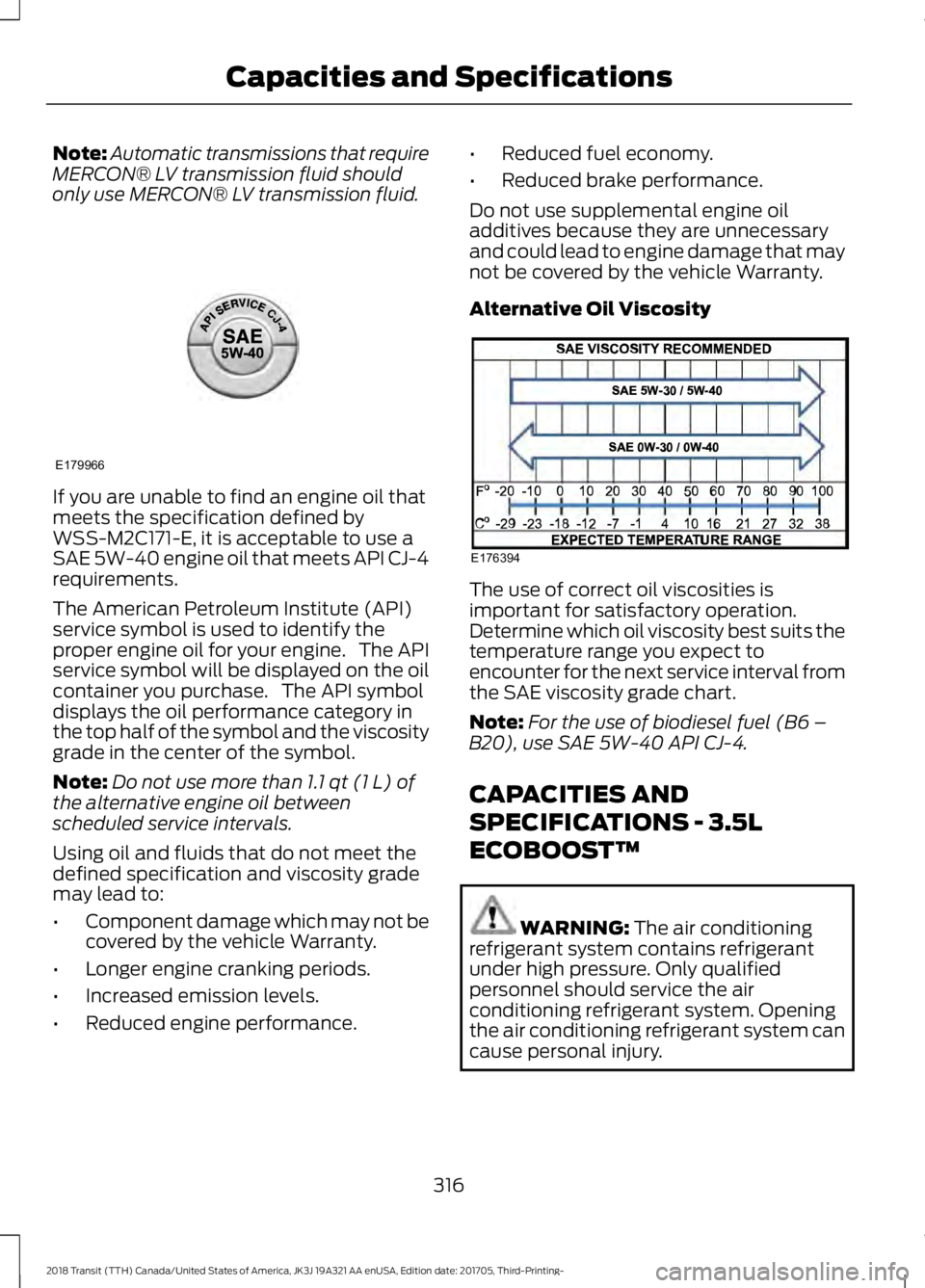
only use MERCON® LV transmission fluid. If you are unable to find an engine oil that
meets the specification defined by
WSS-M2C171-E, it is acceptable to use a
SAE 5W-40 engine oil that meets API CJ-4
requirements.
The American Petroleum Institute (API)
service symbol is used to identify the
proper engine oil for your engine. The API
service symbol will be displayed on the oil
container you purchase. The API symbol
displays the oil performance category in
the top half of the symbol and the viscosity
grade in the center of the symbol.
Note:
Do not use more than 1.1 qt (1 L) of
the alternative engine oil between
scheduled service intervals.
Using oil and fluids that do not meet the
defined specification and viscosity grade
may lead to:
• Component damage which may not be
covered by the vehicle Warranty.
• Longer engine cranking periods.
• Increased emission levels.
• Reduced engine performance. •
Reduced fuel economy.
• Reduced brake performance.
Do not use supplemental engine oil
additives because they are unnecessary
and could lead to engine damage that may
not be covered by the vehicle Warranty.
Alternative Oil Viscosity The use of correct oil viscosities is
important for satisfactory operation.
Determine which oil viscosity best suits the
temperature range you expect to
encounter for the next service interval from
the SAE viscosity grade chart.
Note:
For the use of biodiesel fuel (B6 –
B20), use SAE 5W-40 API CJ-4.
CAPACITIES AND
SPECIFICATIONS - 3.5L
ECOBOOST™ WARNING:
The air conditioning
refrigerant system contains refrigerant
under high pressure. Only qualified
personnel should service the air
conditioning refrigerant system. Opening
the air conditioning refrigerant system can
cause personal injury.
316
2018 Transit (TTH) Canada/United States of America, JK3J 19A321 AA enUSA, Edition date: 201705, Third-Printing- Capacities and SpecificationsE179966 E176394
Page 324 of 521

CAPACITIES AND
SPECIFICATIONS - 3.7L
WARNING: The air conditioning refrigerant system contains refrigerant
under high pressure. Only qualified
personnel should service the air
conditioning refrigerant system. Opening
the air conditioning refrigerant system can
cause personal injury.
Capacities Quantity
Item
6 qt (5.7 L)
Engine oil fill capacity including the oil filter.
5.5 qt (5.2 L)
Engine oil fill capacity excluding the oil filter.
16.4 qt (15.5 L)
Engine coolant fill capacity - vehicles with an auxil-
iary heater.
14.9 qt (14.1 L)
Engine coolant fill capacity - vehicles without an
auxiliary heater.
13.1 qt (12.4 L)
Automatic transmission fluid fill capacity. 1
2.9 qt (2.72 L)
Rear axle fluid fill capacity - vehicles with limited
slip differential. 2
3.0 qt (2.84 L)
Rear axle fluid fill capacity - vehicles with conven-
tional differential.
4.0 fl oz (118 ml)
Rear axle friction modifier.
25.1 gal (95 L)
Fuel tank fill capacity.
4.8 qt (4.5 L)
Washer system fill capacity.
2.45 lb (1.11 kg)
Air conditioning refrigerant fill capacity - vehicles
with rear air conditioning.
1.76 lb (0.8 kg)
Air conditioning refrigerant fill capacity - vehicles
without rear air conditioning.
321
2018 Transit (TTH) Canada/United States of America, JK3J 19A321 AA enUSA, Edition date: 201705, Third-Printing- Capacities and Specifications
Page 371 of 521
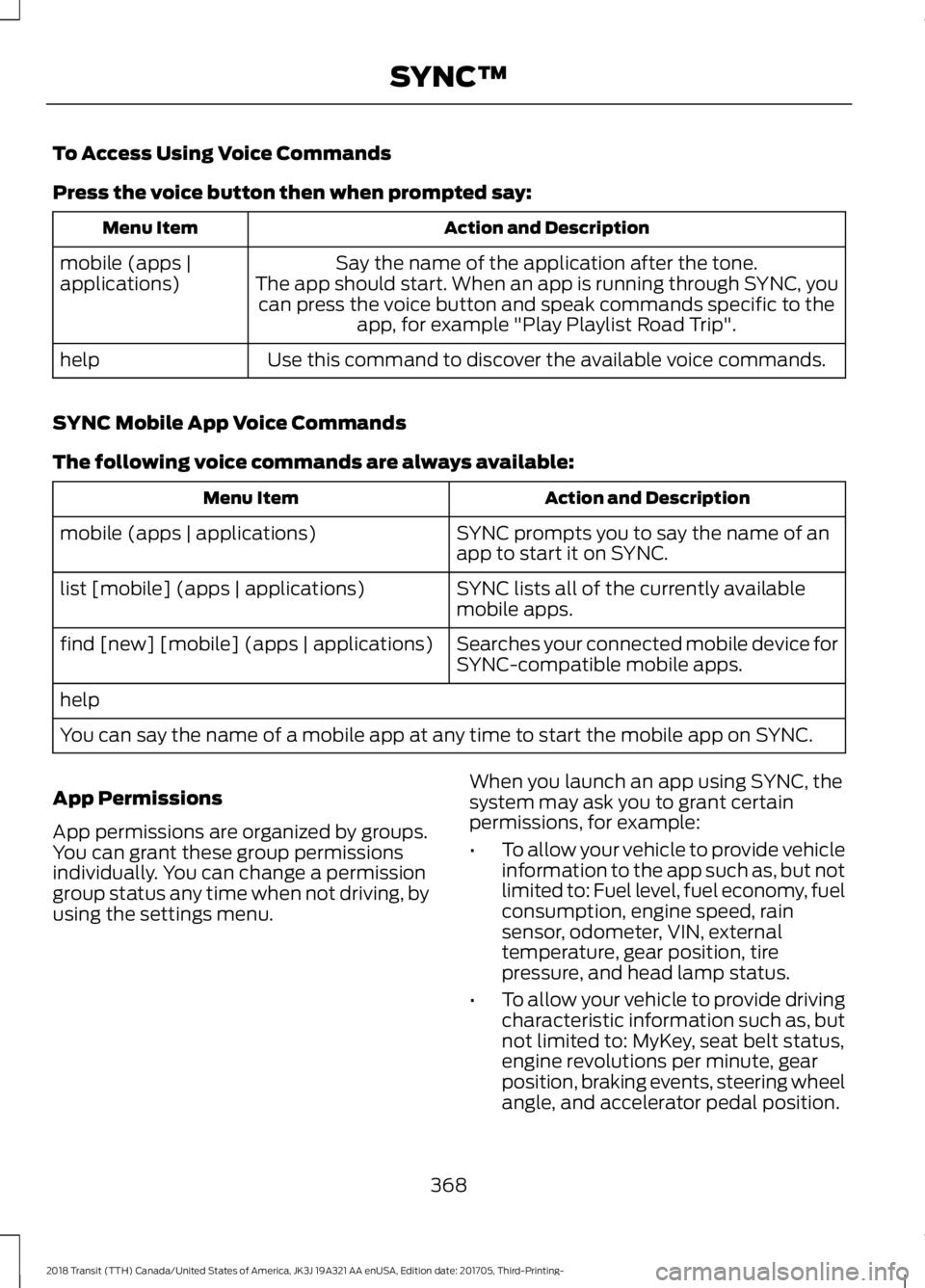
To Access Using Voice Commands
Press the voice button then when prompted say:
Action and Description
Menu Item
Say the name of the application after the tone.
The app should start. When an app is running through SYNC, you can press the voice button and speak commands specific to the app, for example "Play Playlist Road Trip".
mobile (apps |
applications)
Use this command to discover the available voice commands.
help
SYNC Mobile App Voice Commands
The following voice commands are always available: Action and Description
Menu Item
SYNC prompts you to say the name of an
app to start it on SYNC.
mobile (apps | applications)
SYNC lists all of the currently available
mobile apps.
list [mobile] (apps | applications)
Searches your connected mobile device for
SYNC-compatible mobile apps.
find [new] [mobile] (apps | applications)
help
You can say the name of a mobile app at any time to start the mobile app on SYNC.
App Permissions
App permissions are organized by groups.
You can grant these group permissions
individually. You can change a permission
group status any time when not driving, by
using the settings menu. When you launch an app using SYNC, the
system may ask you to grant certain
permissions, for example:
•
To allow your vehicle to provide vehicle
information to the app such as, but not
limited to: Fuel level, fuel economy, fuel
consumption, engine speed, rain
sensor, odometer, VIN, external
temperature, gear position, tire
pressure, and head lamp status.
• To allow your vehicle to provide driving
characteristic information such as, but
not limited to: MyKey, seat belt status,
engine revolutions per minute, gear
position, braking events, steering wheel
angle, and accelerator pedal position.
368
2018 Transit (TTH) Canada/United States of America, JK3J 19A321 AA enUSA, Edition date: 201705, Third-Printing- SYNC™
Page 517 of 521

T
Technical Specifications
See: Capacities and Specifications............305
The Better Business Bureau (BBB) Auto Line Program (U.S. Only).......................203
Tire Care..........................................................269 Glossary of Tire Terminology.......................... 271
Inflating the Tires............................................... 278
Information About Uniform Tire Quality Grades.............................................................. 269
Information Contained on the Tire Sidewall............................................................ 272
Inspecting the Tires and Wheel Valve Stems................................................................. 281
Location of the Tire Label............................... 278
Tire Age.................................................................. 282
Tire and Wheel Alignment............................. 284
Tire Damage......................................................... 281
Tire Pressure Monitoring System.................283
Tire Replacement Requirements.................282
Tire Rotation........................................................ 285
Tire Safety Practices......................................... 283
Tire Wear................................................................ 281
United States Department of Transportation Tire Quality
Grades............................................................... 270
Tire Pressure Monitoring System...........287 Changing Tires With a Tire Pressure
Monitoring System....................................... 289
Tire Pressure Monitoring System Reset Procedure......................................................... 291
Understanding the Tire Pressure Monitoring System.............................................................. 289
Tires See: Wheels and Tires..................................... 268
Tow/Haul.........................................................154
Towing a Trailer.............................................180 Load Placement................................................. 180
Towing Points................................................199
Front Towing Point............................................. 199
Rear Towing Point.............................................. 199
Towing Eye Location........................................ 200
Towing the Vehicle on Four Wheels..........................................................189
Emergency Towing............................................ 189
Recreational Towing......................................... 190
Towing..............................................................180 Traction Control
............................................160
Principle of Operation...................................... 160
Trailer Sway Control.....................................181
Transmission Code Designation.............312
Transmission...................................................151
Transporting the Vehicle
...........................198
Trip Computer................................................102 All Values............................................................... 102
Average Fuel Consumption............................ 102
Digital Speedometer......................................... 102
Distance to Empty............................................. 102
Outside Air Temperature................................. 102
Resetting the Trip Computer.......................... 102
Trip Odometer..................................................... 102
Trip Timer.............................................................. 102
U
Under Hood Overview - 3.2L Power Stroke Diesel
..............................................230
Under Hood Overview - 3.5L Ecoboost™..................................................231
Under Hood Overview - 3.7L....................232
USB Port
..........................................................347
Using Cruise Control...................................168 Switching Cruise Control Off......................... 168
Switching Cruise Control On.......................... 168
Using MyKey With Remote Start Systems..........................................................68
Using Power Running Boards.....................77 Automatic Power Deploy................................... 77
Automatic Power Stow....................................... 77
Bounce-back.......................................................... 78
Enabling and Disabling...................................... 78
Manual Operation................................................ 78
Manual Power Deploy......................................... 77
Resetting the System.......................................... 79
Using Snow Chains
.....................................286
Using Stability Control................................162
Using SYNC™ With Your Media Player.............................................................370
Accessing Your USB Song Library................374
Bluetooth Devices and System Settings............................................................. 376
Connecting Your Digital Media Player to the USB Port........................................................... 370
Media Menu Features....................................... 373
Media Voice Commands.................................. 371
514
2018 Transit (TTH) Canada/United States of America, JK3J 19A321 AA enUSA, Edition date: 201705, Third-Printing- Index
Page 518 of 521

USB 2......................................................................
376
Voice Commands for Audio Sources..........377
Using SYNC™ With Your Phone............353
Accessing Features through the Phone
Menu.................................................................. 358
Accessing Your Phone Settings.................... 361
Bluetooth Devices............................................. 362
Making Calls......................................................... 357
Pairing a Phone for the First Time...............354
Pairing Subsequent Phones.......................... 355
Phone Options during an Active Call..........357
Phone Voice Commands................................ 355
Receiving Calls.................................................... 357
System Settings................................................. 363
Text Messaging................................................... 359
Using Traction Control
...............................160
Switching the System Off............................... 160
System Indicator Lights and Messages......................................................... 160
Using a Switch..................................................... 160
Using the Information Display Controls............................................................ 160
Using Voice Recognition
............................351
Apps........................................................................\
401
Automatic Blower Motor Speed Reduction........................................................ 402
Climate Control.................................................. 398
Entertainment..................................................... 397
General.................................................................. 396
Initiating a Voice Session................................. 351
Navigation........................................................... 400
Phone..................................................................... 399
System Interaction and Feedback..............352
Voice Settings...................................................... 401
Using Winter Tires
.......................................286
Utilizing the Mediation/Arbitration Program (Canada Only)........................204
V
Vehicle Care..................................................260
Vehicle Certification Label........................312
Vehicle Identification Number..................311
Vehicle Storage
............................................266
Battery.................................................................... 267
Body....................................................................... 266
Brakes..................................................................... 267
Cooling system................................................... 267Engine....................................................................
266
Fuel system.......................................................... 267
General.................................................................. 266
Miscellaneous...................................................... 267
Removing Vehicle From Storage.................. 267
Tires........................................................................\
. 267
Ventilation See: Climate Control......................................... 109
VIN See: Vehicle Identification Number..............311
Voice Control
....................................................81
W
Warning Lamps and Indicators
................95
Airbag Warning Lamp........................................ 95
Anti-Lock Brake System Warning Lamp
.................................................................... 95
Battery Charging Condition Warning Lamp
.................................................................... 95
Brake System Warning Lamp.......................... 95
Diesel Warning Lamps....................................... 95
Direction Indicator............................................... 96
Door Ajar................................................................. 96
Engine Coolant Temperature Warning Lamp.................................................................... 96
Engine Warning Lamps..................................... 96
Fasten Seatbelt Warning Lamp...................... 97
Headlamp High Beam Indicator..................... 97
Lamps on Indicator.............................................. 97
Lane Departure Warning Indicator................97
Low Fuel Level Warning Lamp........................ 97
Low Tire Pressure Warning Lamp.................. 97
Low Washer Fluid Level Warning Lamp.................................................................... 97
Message Center Indicator................................. 97
Oil Pressure Warning Lamp.............................. 97
Stability Control and Traction Control Indicator............................................................. 98
Stability Control and Traction Control Off Warning Lamp................................................. 98
Tow/Haul Warning Lamp................................. 98
Washer Fluid Check....................................242
Washers See: Cleaning the Exterior............................... 261
Waxing.............................................................262
Wheel Nuts See: Changing a Road Wheel........................ 292
515
2018 Transit (TTH) Canada/United States of America, JK3J 19A321 AA enUSA, Edition date: 201705, Third-Printing- Index