2018 FORD FOCUS instrument panel
[x] Cancel search: instrument panelPage 7 of 473

Roadside Emergencies
Roadside Assistance..................................188
Hazard Flashers............................................189
Fuel Shutoff...................................................189
Jump Starting the Vehicle.........................190
Post-Crash Alert System...........................192
Customer Assistance
Getting the Services You Need................193
In California (U.S. Only).............................194
The Better Business Bureau (BBB) AutoLine Program (U.S. Only)......................195
Utilizing the Mediation/ArbitrationProgram (Canada Only)........................196
Getting Assistance Outside the U.S. andCanada........................................................196
Ordering Additional Owner'sLiterature......................................................197
Reporting Safety Defects (U.S.Only).............................................................198
Reporting Safety Defects (CanadaOnly).............................................................198
Fuses
Fuse Specification Chart..........................200
Changing a Fuse..........................................209
Maintenance
General Information.....................................211
Opening and Closing the Hood................211
Under Hood Overview - 1.0LEcoBoost™.................................................213
Under Hood Overview - 2.0L....................214
Engine Oil Dipstick - 1.0LEcoBoost™.................................................215
Engine Oil Dipstick - 2.0L...........................215
Engine Oil Check...........................................215
Oil Change Indicator Reset.......................216
Engine Cooling Fan......................................216
Engine Coolant Check.................................217
Automatic Transmission FluidCheck.............................................................221
Brake Fluid Check.........................................221
Clutch Fluid Check - ManualTransmission..............................................221
Washer Fluid Check.....................................222
Changing the 12V Battery..........................222
Checking the Wiper Blades......................223
Changing the Front Wiper Blades.........223
Changing the Rear Wiper Blades...........224
Adjusting the Headlamps.........................225
Removing a Headlamp..............................226
Changing a Bulb...........................................227
Bulb Specification Chart...........................232
Changing the Engine Air Filter.................234
Drive Belt Routing - 1.0LEcoBoost™................................................235
Drive Belt Routing - 2.0L...........................235
Vehicle Care
General Information...................................236
Cleaning Products.......................................236
Cleaning the Exterior...................................237
Waxing.............................................................238
Cleaning the Engine....................................238
Cleaning the Windows and WiperBlades..........................................................239
Cleaning the Interior...................................239
Cleaning the Instrument Panel andInstrument Cluster Lens.......................240
Cleaning Leather Seats.............................240
Repairing Minor Paint Damage...............241
Cleaning the Wheels...................................241
Vehicle Storage.............................................241
Body Styling Kits..........................................243
Wheels and Tires
Tire Care..........................................................244
Using Snow Chains.....................................259
Tire Pressure Monitoring System..........260
42018 Focus (CDH) Canada/United States of America, JM5J 19A321 AA enUSA, Edition date: 201706, Second PrintingTable of Contents
Page 44 of 473
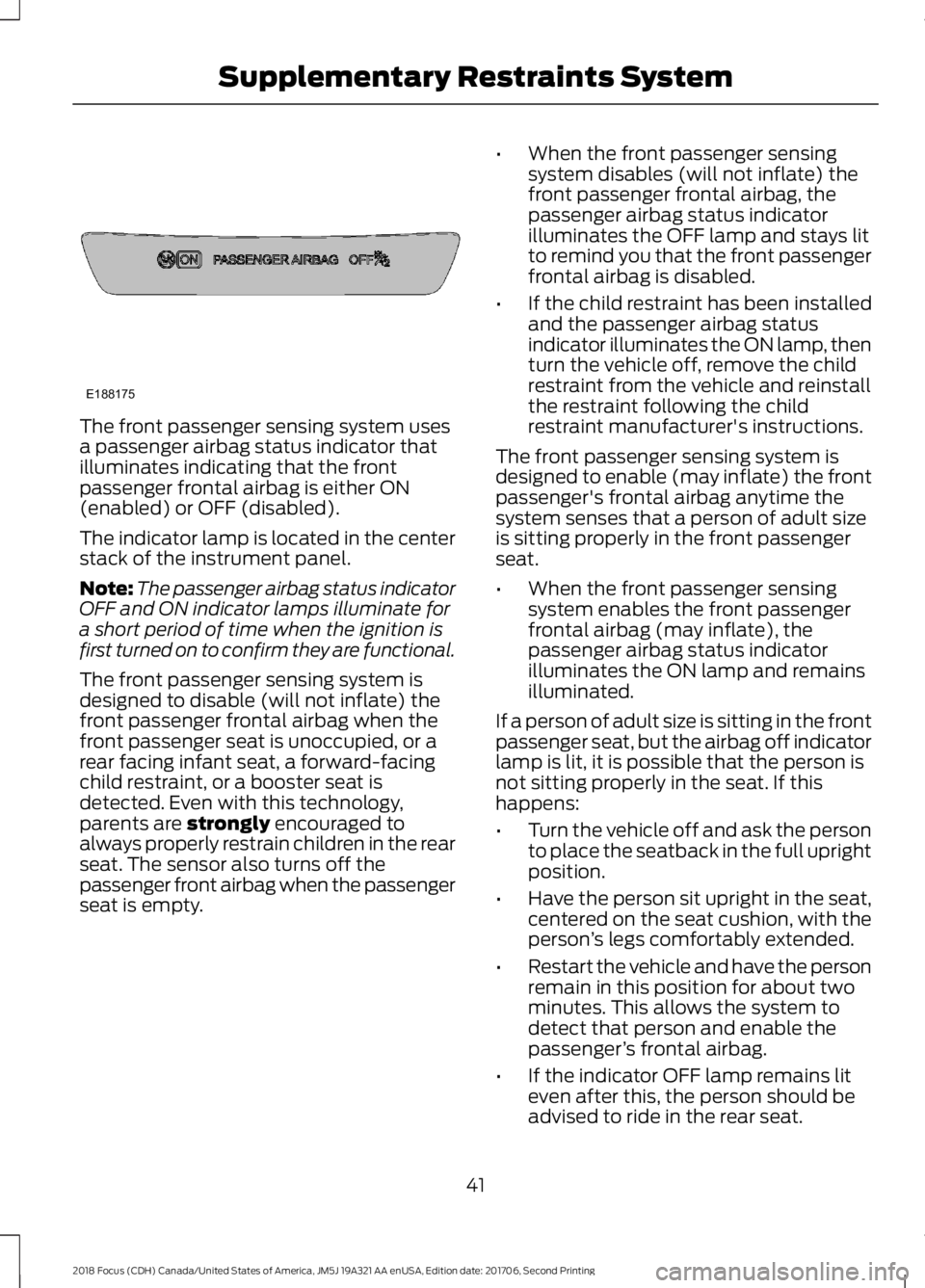
The front passenger sensing system usesa passenger airbag status indicator thatilluminates indicating that the frontpassenger frontal airbag is either ON(enabled) or OFF (disabled).
The indicator lamp is located in the centerstack of the instrument panel.
Note:The passenger airbag status indicatorOFF and ON indicator lamps illuminate fora short period of time when the ignition isfirst turned on to confirm they are functional.
The front passenger sensing system isdesigned to disable (will not inflate) thefront passenger frontal airbag when thefront passenger seat is unoccupied, or arear facing infant seat, a forward-facingchild restraint, or a booster seat isdetected. Even with this technology,parents are strongly encouraged toalways properly restrain children in the rearseat. The sensor also turns off thepassenger front airbag when the passengerseat is empty.
•When the front passenger sensingsystem disables (will not inflate) thefront passenger frontal airbag, thepassenger airbag status indicatorilluminates the OFF lamp and stays litto remind you that the front passengerfrontal airbag is disabled.
•If the child restraint has been installedand the passenger airbag statusindicator illuminates the ON lamp, thenturn the vehicle off, remove the childrestraint from the vehicle and reinstallthe restraint following the childrestraint manufacturer's instructions.
The front passenger sensing system isdesigned to enable (may inflate) the frontpassenger's frontal airbag anytime thesystem senses that a person of adult sizeis sitting properly in the front passengerseat.
•When the front passenger sensingsystem enables the front passengerfrontal airbag (may inflate), thepassenger airbag status indicatorilluminates the ON lamp and remainsilluminated.
If a person of adult size is sitting in the frontpassenger seat, but the airbag off indicatorlamp is lit, it is possible that the person isnot sitting properly in the seat. If thishappens:
•Turn the vehicle off and ask the personto place the seatback in the full uprightposition.
•Have the person sit upright in the seat,centered on the seat cushion, with theperson’s legs comfortably extended.
•Restart the vehicle and have the personremain in this position for about twominutes. This allows the system todetect that person and enable thepassenger’s frontal airbag.
•If the indicator OFF lamp remains liteven after this, the person should beadvised to ride in the rear seat.
412018 Focus (CDH) Canada/United States of America, JM5J 19A321 AA enUSA, Edition date: 201706, Second PrintingSupplementary Restraints SystemE188175
Page 47 of 473
The design and development of the sideairbag system included recommendedtesting procedures that were developedby a group of automotive safety expertsknown as the Side Airbag TechnicalWorking Group. These recommendedtesting procedures help reduce the risk ofinjuries related to the deployment of sideairbags.
DRIVER KNEE AIRBAG
A driver's knee airbag is located under theinstrument panel. During a crash, therestraints control module may activate thedriver's knee airbag based on crash severityand occupant conditions. Under certaincrash and occupant conditions, the driver’sknee airbag may deploy but the driver’sfront airbag may not activate. As with frontand side airbags, it is important to beproperly seated and restrained to reducethe risk of death or serious injury.
Make sure the knee airbag isoperating properly. See CrashSensors and Airbag Indicator(page 45).
SAFETY CANOPY™
WARNINGS
Do not place objects or mountequipment on or near the headlinerat the siderail that may come intocontact with a deploying curtain airbag.Failure to follow these instructions mayincrease the risk of personal injury in theevent of a crash.
Do not lean your head on the door.The curtain airbag could injure youas it deploys from the headliner.
WARNINGS
Do not attempt to service, repair, ormodify the supplementary restraintsystem or associated components.Failure to follow this instruction couldresult in personal injury or death.
All occupants of your vehicle,including the driver, should alwaysproperly wear their seatbelts, evenwhen an airbag supplemental restraintsystem is provided. Failure to properly wearyour seatbelt could seriously increase therisk of injury or death.
To reduce risk of injury, do notobstruct or place objects in thedeployment path of the airbag.
If a supplementary restraint systemcomponent has deployed, it will notfunction again. Have the system andassociated components inspected as soonas possible. Failure to follow thisinstruction could result in personal injuryor death.
The Safety Canopy deploys duringsignificant side crashes or when a certainlikelihood of a rollover event is detectedby the rollover sensor. The Safety Canopyis mounted to the roof side rail sheet metal,behind the headliner, above each row ofseats. In certain sideways crashes orrollover events, the Safety Canopy will beactivated, regardless of which seats areoccupied. The Safety Canopy is designedto inflate between the side window areaand occupants to further enhanceprotection provided in side impact crashesand rollover events.
442018 Focus (CDH) Canada/United States of America, JM5J 19A321 AA enUSA, Edition date: 201706, Second PrintingSupplementary Restraints SystemE67017
Page 48 of 473

The system consists of the following:
•Safety Canopy curtain airbags abovethe trim panels over the front and rearside windows identified by a label orwording on the headliner or roof-pillartrim.
•A flexible headliner which opens abovethe side doors to allow air curtaindeployment
· Crash sensors and monitoringsystem with a readinessindicator. See Crash Sensorsand Airbag Indicator (page 45).
Properly restrain children 12 years old andunder in the rear seats. The Safety Canopywill not interfere with children restrainedusing a properly installed child or boosterseat because it is designed to inflatedownward from the headliner above thedoors along the side window opening.
The design and development of the SafetyCanopy included recommended testingprocedures that were developed by agroup of automotive safety experts knownas the Side Airbag Technical WorkingGroup. These recommended testingprocedures help reduce the risk of injuriesrelated to the deployment of side airbags(including the Safety Canopy).
CRASH SENSORS AND
AIRBAG INDICATOR
WARNING
Modifying or adding equipment tothe front end of your vehicle(including hood, bumper system,frame, front end body structure, tow hooksand hood pins) may affect theperformance of the airbag system,increasing the risk of injury. Do not modifyor add equipment to the front end of yourvehicle.
Your vehicle has a collection of crash andoccupant sensors which provideinformation to the restraints controlmodule which deploys (activates) thefront seatbelt pretensioners, driver airbag,passenger airbag, knee airbag(s), seatmounted side airbags, and the SafetyCanopy. Based on the type of crash, therestraints control module will deploy theappropriate safety devices.
The restraints control module alsomonitors the readiness of the above safetydevices plus the crash and occupantsensors. A warning indicator light in theinstrument cluster indicates the readinessof the safety system. If this warningindicator light is not functioning and thereis another fault within the system, themessage cluster could display an airbagfailure warning. You could hear five tonesthat repeat periodically until you repair theproblem, the warning indicator light couldilluminate or both. Routine maintenanceof the airbag is not required.
A difficulty with the system is indicated byone or more of the following:
The indicator light will notilluminate immediately after theignition is turned on.
452018 Focus (CDH) Canada/United States of America, JM5J 19A321 AA enUSA, Edition date: 201706, Second PrintingSupplementary Restraints SystemE75004 E67017 E67017
Page 57 of 473

1.Press the lock button to lock all thedoors.
2.Press the remote start button twice.The direction indicators flash twice.
The horn sounds if the system fails to start,unless quiet start is on. Quiet start runs theblower fan at a slower speed to reducenoise. You can switch it on or off using theinformation display. See GeneralInformation (page 92).
The power windows do not work duringremote start and the radio does not turnon automatically.
The parking lamps remain on and yourvehicle runs for 5, 10 or 15 minutes,depending on the setting.
Note:If you remote start your vehicle withan intelligent access transmitter, you mustpress the push button ignition switch on theinstrument panel once while applying thebrake pedal before driving your vehicle.
Extending the Engine Running Time
To extend the engine running time durationof your vehicle during remote start, repeatsteps 1 and 2 while the engine is running.If the duration is set to 10 minutes, theduration extends by another 10 minutes.For example, if your vehicle had beenrunning from the first remote start for 5minutes, your vehicle continues to run nowfor a total of 20 minutes. You can extendthe engine running time duration to amaximum of 30 minutes.
Wait at least five seconds before remotestarting after a vehicle shutdown.
Turning Your Vehicle Off After RemoteStarting
Press the button once. Theparking lamps turn off.
You may have to be closer to your vehiclethan when starting due to ground reflectionand the added noise of the running vehicle.
You can turn the remote start system onor off using the information display. SeeGeneral Information (page 92).
REPLACING A LOST KEY OR
REMOTE CONTROL
You can purchase replacement keys orremote controls from an authorized dealer.Authorized dealers can program remotecontrols for your vehicle. See PassiveAnti-Theft System (page 68).
To re-program the passive anti-theftsystem see an authorized dealer.
542018 Focus (CDH) Canada/United States of America, JM5J 19A321 AA enUSA, Edition date: 201706, Second PrintingKeys and Remote ControlsE138625
Page 79 of 473
GENERAL INFORMATION
Condensation in the Exterior FrontLamps and Rear Lamps
Exterior front lamps and rear lamps havevents to accommodate normal changesin air pressure.
Condensation can be a natural by-productof this design. When moist air enters thelamp assembly through the vents, there isa possibility that condensation can occurwhen the temperature is cold. Whennormal condensation occurs, a fine mistcan form on the interior of the lens. Thefine mist eventually clears and exitsthrough the vents during normal operation.
Clearing time may take as long as 48 hoursunder dry weather conditions.
Examples of acceptable condensation are:
•The presence of a fine mist (no streaks,drip marks or large droplets).
•A fine mist covers less than 50% of thelens.
Examples of unacceptable condensationare:
•A water puddle inside the lamp.
•Streaks, drip marks or large dropletspresent on the interior of the lens.
If you see any unacceptable condensation,have your vehicle checked by an authorizeddealer.
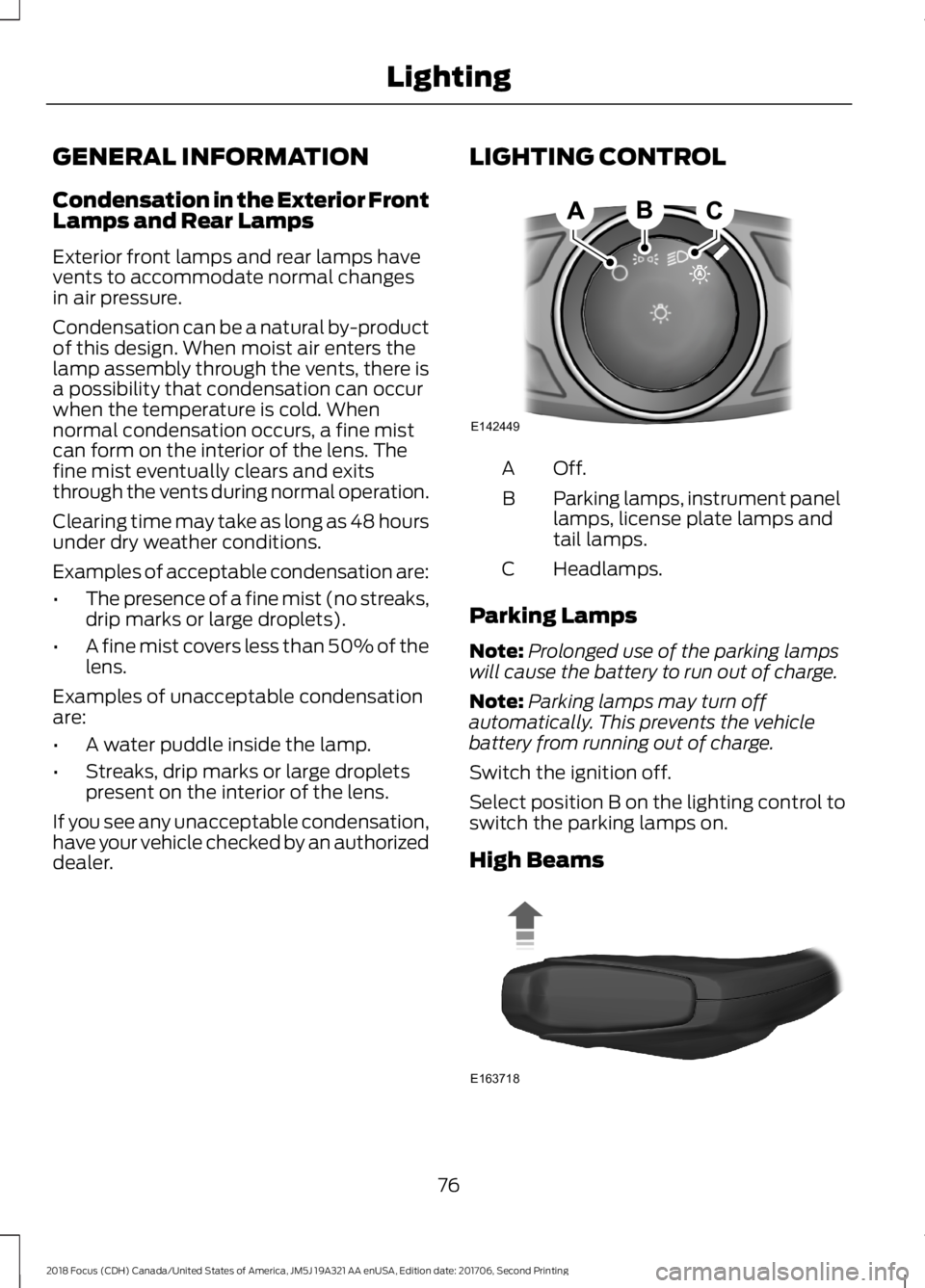
LIGHTING CONTROL
Off.A
Parking lamps, instrument panellamps, license plate lamps andtail lamps.
B
Headlamps.C
Parking Lamps
Note:Prolonged use of the parking lampswill cause the battery to run out of charge.
Note:Parking lamps may turn offautomatically. This prevents the vehiclebattery from running out of charge.
Switch the ignition off.
Select position B on the lighting control toswitch the parking lamps on.
High Beams
762018 Focus (CDH) Canada/United States of America, JM5J 19A321 AA enUSA, Edition date: 201706, Second PrintingLightingE142449 E163718
Page 107 of 473
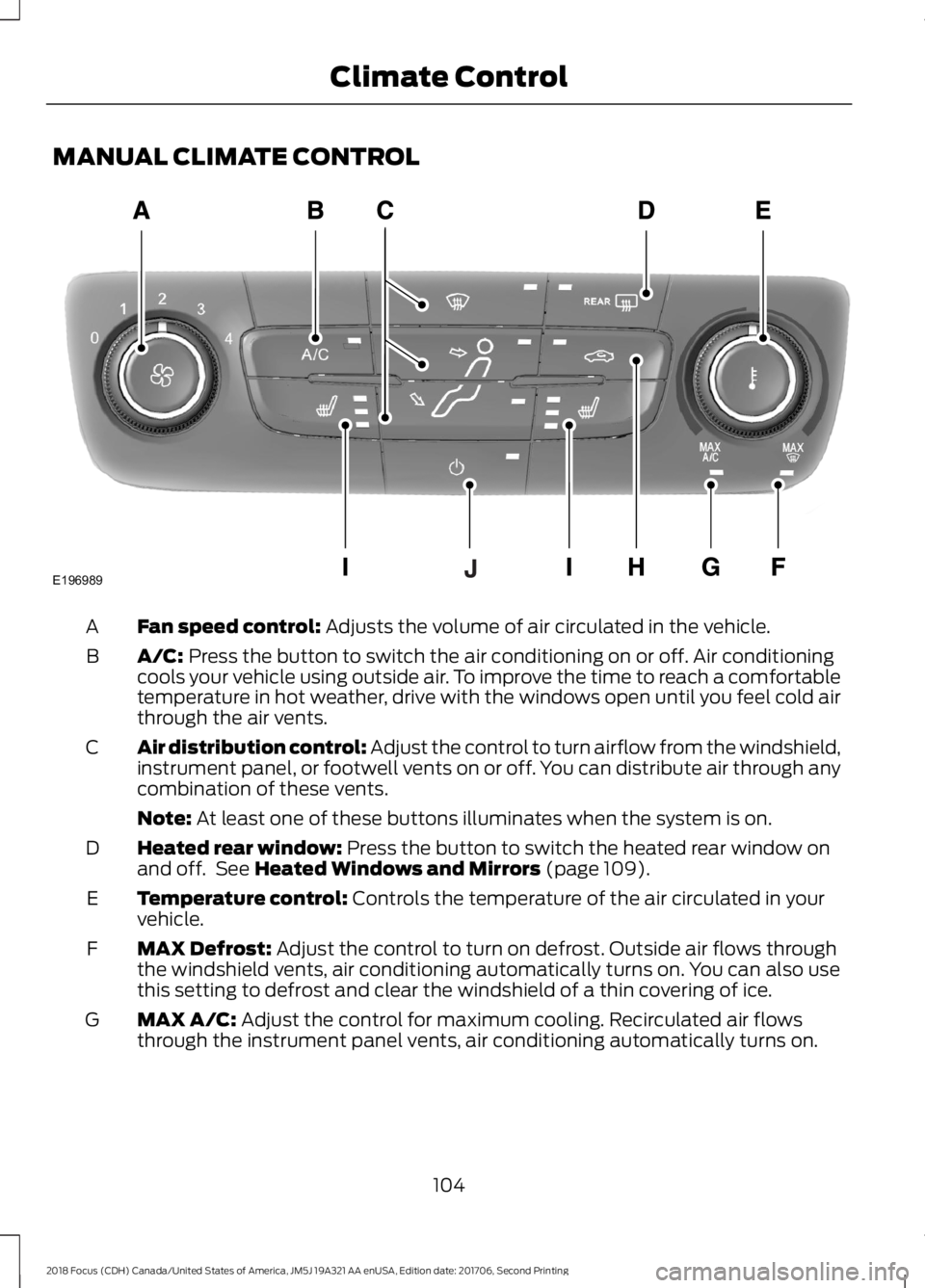
MANUAL CLIMATE CONTROL
Fan speed control: Adjusts the volume of air circulated in the vehicle.A
A/C: Press the button to switch the air conditioning on or off. Air conditioningcools your vehicle using outside air. To improve the time to reach a comfortabletemperature in hot weather, drive with the windows open until you feel cold airthrough the air vents.
B
Air distribution control: Adjust the control to turn airflow from the windshield,instrument panel, or footwell vents on or off. You can distribute air through anycombination of these vents.
C
Note: At least one of these buttons illuminates when the system is on.
Heated rear window: Press the button to switch the heated rear window onand off. See Heated Windows and Mirrors (page 109).D
Temperature control: Controls the temperature of the air circulated in yourvehicle.E
MAX Defrost: Adjust the control to turn on defrost. Outside air flows throughthe windshield vents, air conditioning automatically turns on. You can also usethis setting to defrost and clear the windshield of a thin covering of ice.
F
MAX A/C: Adjust the control for maximum cooling. Recirculated air flowsthrough the instrument panel vents, air conditioning automatically turns on.G
1042018 Focus (CDH) Canada/United States of America, JM5J 19A321 AA enUSA, Edition date: 201706, Second PrintingClimate ControlE196989
Page 108 of 473
Recirculated air: Press the button to switch between outside air andrecirculated air. The air currently in the passenger compartment recirculates.This can reduce the time needed to cool the interior and reduce unwanted odorsfrom entering your vehicle.
H
Heated seats (if equipped): Press the button to switch the heated seats onand off. See Heated Seats (page 116).I
Power: Press the button to switch the system on and off. When the system isoff, it prevents outside air from entering the vehicle.J
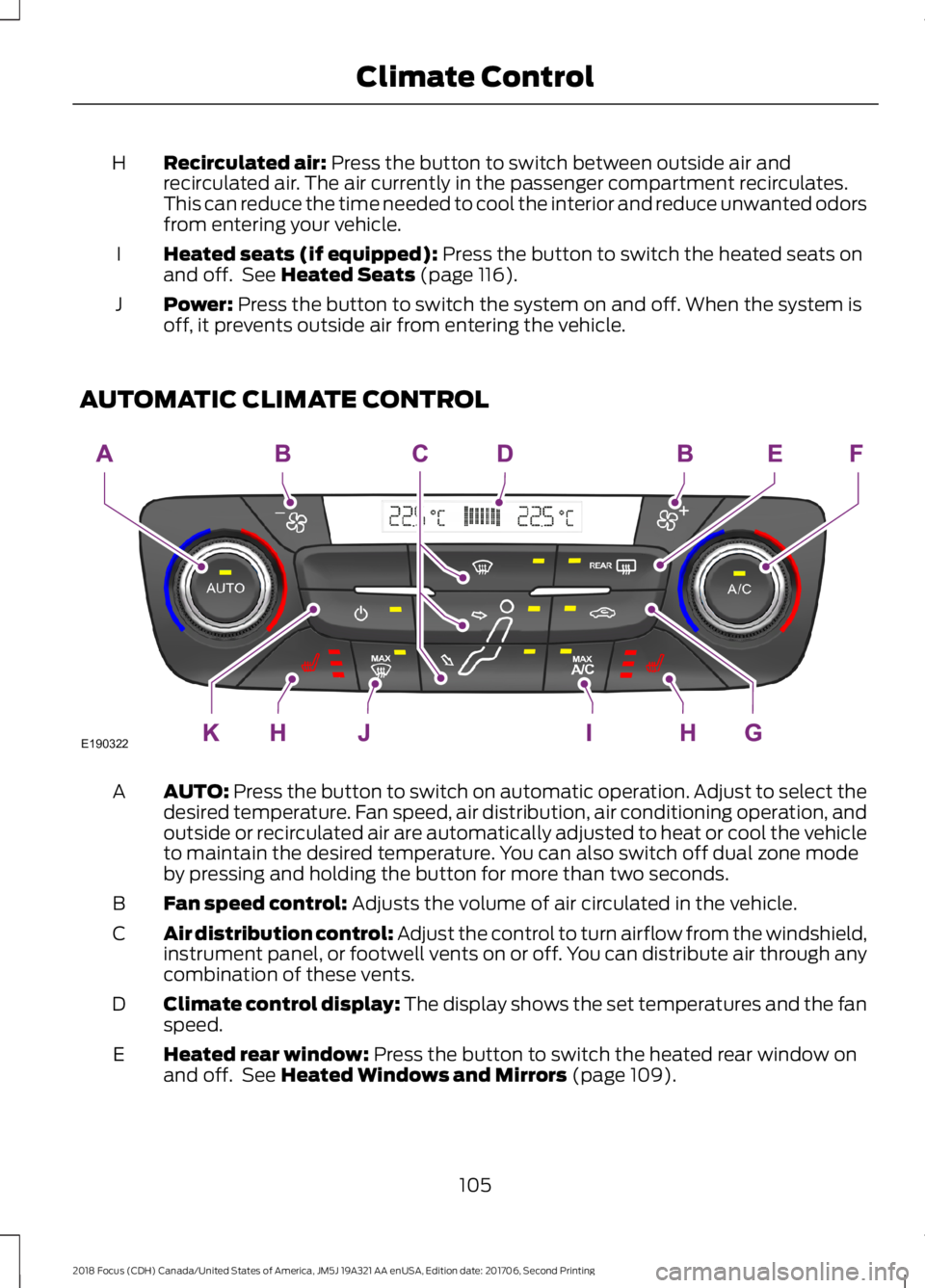
AUTOMATIC CLIMATE CONTROL
AUTO: Press the button to switch on automatic operation. Adjust to select thedesired temperature. Fan speed, air distribution, air conditioning operation, andoutside or recirculated air are automatically adjusted to heat or cool the vehicleto maintain the desired temperature. You can also switch off dual zone modeby pressing and holding the button for more than two seconds.
A
Fan speed control: Adjusts the volume of air circulated in the vehicle.B
Air distribution control: Adjust the control to turn airflow from the windshield,instrument panel, or footwell vents on or off. You can distribute air through anycombination of these vents.
C
Climate control display: The display shows the set temperatures and the fanspeed.D
Heated rear window: Press the button to switch the heated rear window onand off. See Heated Windows and Mirrors (page 109).E
1052018 Focus (CDH) Canada/United States of America, JM5J 19A321 AA enUSA, Edition date: 201706, Second PrintingClimate ControlE190322