Page 197 of 641
EMISSION LAW
WARNING: Do not remove or alter
the original equipment floor covering or
insulation between it and the metal floor
of the vehicle. The floor covering and
insulation protect occupants of the
vehicle from the engine and exhaust
system heat and noise. On vehicles with
no original equipment floor covering
insulation, do not carry passengers in a
manner that permits prolonged skin
contact with the metal floor. Failure to
follow these instructions may result in
fire or personal injury.
U.S. federal laws and certain state laws
prohibit removing or rendering inoperative
emission control system components.
Similar federal or provincial laws may
apply in Canada. We do not approve of any
vehicle modification without first
determining applicable laws. Tampering with emissions
control systems including
related sensors or the Diesel
Exhaust Fluid system can result in reduced
engine power and the illumination of the
service engine soon light. Tampering With a Noise Control
System
Federal laws prohibit the following acts:
•
Removal or rendering inoperative by
any person other than for purposes of
maintenance.
• Repair or replacement of any device or
element of the design incorporated into
a new vehicle for the purpose of noise
control prior to its sale or delivery to
the ultimate purchaser or while it is in
use.
• The use of the vehicle after any person
removes or renders inoperative any
device or element of the design.
The U.S. Environmental Protection Agency
may presume to constitute tampering as
follows:
• Removal of hood blanket, fender apron
absorbers, fender apron barriers,
underbody noise shields or acoustically
absorptive material.
• Tampering or rendering inoperative the
engine speed governor, to allow engine
speed to exceed manufacturer
specifications.
If the engine does not start, runs rough,
experiences a decrease in engine
performance, experiences excess fuel
consumption or produces excessive
exhaust smoke, check for the following:
• A plugged or disconnected air inlet
system hose.
• A plugged engine air filter element.
• Water in the fuel filter and water
separator.
• A clogged fuel filter.
• Contaminated fuel.
• Air in the fuel system, due to loose
connections.
• An open or pinched sensor hose.
• Incorrect engine oil level.
194
F-150 (TFC) Canada/United States of America, enUSA, Edition date: 201709, Fifth-Printing Engine Emission Control
Page 198 of 641

•
Incorrect fuel for climatic conditions.
• Incorrect engine oil viscosity for
climactic conditions.
Note: Some vehicles have a lifetime fuel
filter that is integrated with the fuel tank.
Regular maintenance or replacement is not
needed.
Note: If these checks do not help you
correct the concern, have your vehicle
checked as soon as possible.
Noise Emissions Warranty,
Prohibited Tampering Acts and
Maintenance
On January 1, 1978, Federal regulation
became effective governing the noise
emission on trucks over 10,000 lb
(4,536 kg) Gross Vehicle Weight Rating
(GVWR). The preceding statements
concerning prohibited tampering acts and
maintenance, and the noise warranty
found in the Warranty Guide, are
applicable to complete chassis cabs over
10,000 lb (4,536 kg)
GVWR.
CATALYTIC CONVERTER WARNING:
Do not park, idle or
drive your vehicle on dry grass or other
dry ground cover. The emission system
heats up the engine compartment and
exhaust system, creating the risk of fire. WARNING:
The normal operating
temperature of the exhaust system is
very high. Never work around or attempt
to repair any part of the exhaust system
until it has cooled. Use special care when
working around the catalytic converter.
The catalytic converter heats up to a very
high temperature after only a short
period of engine operation and stays hot
after the engine is switched off. WARNING:
Exhaust leaks may
result in entry of harmful and potentially
lethal fumes into the passenger
compartment. If you smell exhaust
fumes inside your vehicle, have your
vehicle inspected immediately. Do not
drive if you smell exhaust fumes.
Your vehicle has various emission control
components and a catalytic converter that
enables it to comply with applicable
exhaust emission standards.
To make sure that the catalytic converter
and other emission control components
continue to work properly:
• Do not crank the engine for more than
10 seconds at a time.
• Do not run the engine with a spark plug
lead disconnected.
• Do not push-start or tow-start your
vehicle. Use booster cables. See Jump
Starting the Vehicle
(page 323).
• Use only the specified fuel listed.
• Do not switch the ignition off when your
vehicle is moving.
• Avoid running out of fuel.
• Have the items listed in scheduled
maintenance information performed
according to the specified schedule.
Note: Resulting component damage may
not be covered by the vehicle Warranty.
The scheduled maintenance items listed
in scheduled maintenance information are
essential to the life and performance of
your vehicle and to its emissions system.
If you use anything other than Ford,
Motorcraft or Ford-authorized parts for
maintenance replacements or for service
of components affecting emission control,
such non-Ford parts should be equivalent
to genuine Ford Motor Company parts in
performance and durability.
195
F-150 (TFC) Canada/United States of America, enUSA, Edition date: 201709, Fifth-Printing Engine Emission Control
Page 349 of 641
3. Raise the hood until the lift cylinders
hold it open.
4. To close, lower the hood and make sure that it is closed properly and fully
latched.
UNDER HOOD OVERVIEW - 2.7L ECOBOOST™ Windshield washer fluid
reservoir. See Washer Fluid
Check (page 359).
A.
Power distribution box. See
Fuses
(page 335).
B. Battery.
See Changing the 12V
Battery (page 360).
C.
Engine oil filler cap.
See Engine
Oil Check (page 351).
D.
Engine oil dipstick.
See Engine
Oil Dipstick (page 350).
E.
346
F-150 (TFC) Canada/United States of America, enUSA, Edition date: 201709, Fifth-Printing MaintenanceE190266 E249452
Page 350 of 641
Brake fluid reservoir. See Brake
Fluid Check (page 359).
F.
Air filter assembly. See
Changing the Engine Air Filter
(page 370).
G.
Engine coolant reservoir.
See
Engine Coolant Check (page
354).
H.
UNDER HOOD OVERVIEW - 3.0L V6, DIESEL Power distribution box. See
Fuses
(page 335).
A.
Engine oil filler cap. See Engine
Oil Check
(page 351).
B.
Engine oil dipstick. See
Engine
Oil Dipstick (page 350).
C.
Brake fluid reservoir. See
Brake
Fluid Check (page 359).
D. Air filter assembly. See
Changing the Engine Air Filter
(page
370).
E.
Engine coolant reservoir. See
Engine Coolant Check
(page
354).
F.
347
F-150 (TFC) Canada/United States of America, enUSA, Edition date: 201709, Fifth-Printing MaintenanceE247635
Page 351 of 641
Battery. See Changing the 12V
Battery (page 360).
G.
H. Windshield washer fluid
reservoir. See Washer Fluid
Check (page 359).
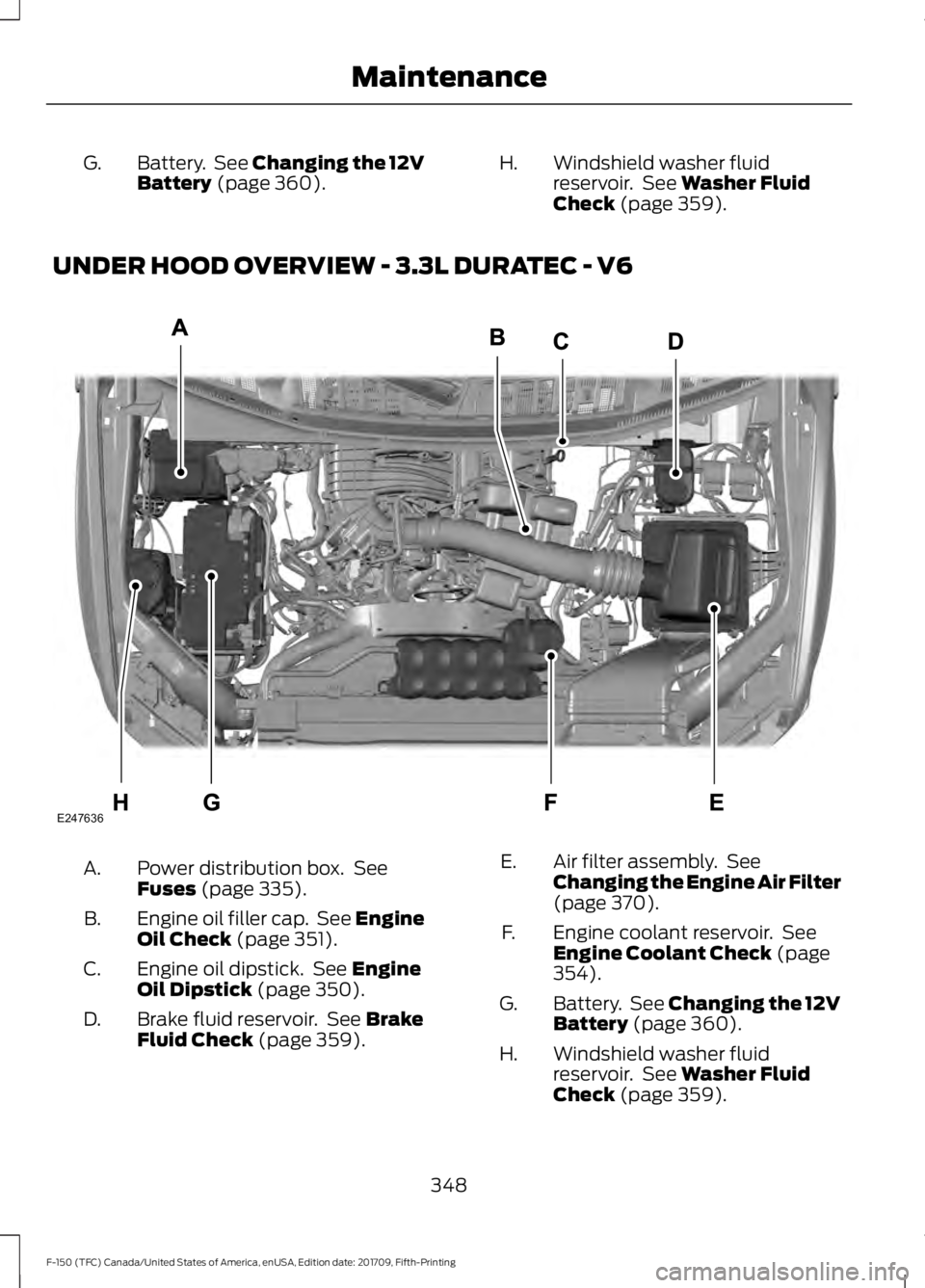
UNDER HOOD OVERVIEW - 3.3L DURATEC - V6 Power distribution box. See
Fuses
(page 335).
A.
Engine oil filler cap. See Engine
Oil Check
(page 351).
B.
Engine oil dipstick. See
Engine
Oil Dipstick (page 350).
C.
Brake fluid reservoir. See
Brake
Fluid Check (page 359).
D. Air filter assembly. See
Changing the Engine Air Filter
(page
370).
E.
Engine coolant reservoir. See
Engine Coolant Check
(page
354).
F.
Battery. See
Changing the 12V
Battery (page 360).
G.
Windshield washer fluid
reservoir. See
Washer Fluid
Check (page 359).
H.
348
F-150 (TFC) Canada/United States of America, enUSA, Edition date: 201709, Fifth-Printing MaintenanceE247636
Page 352 of 641
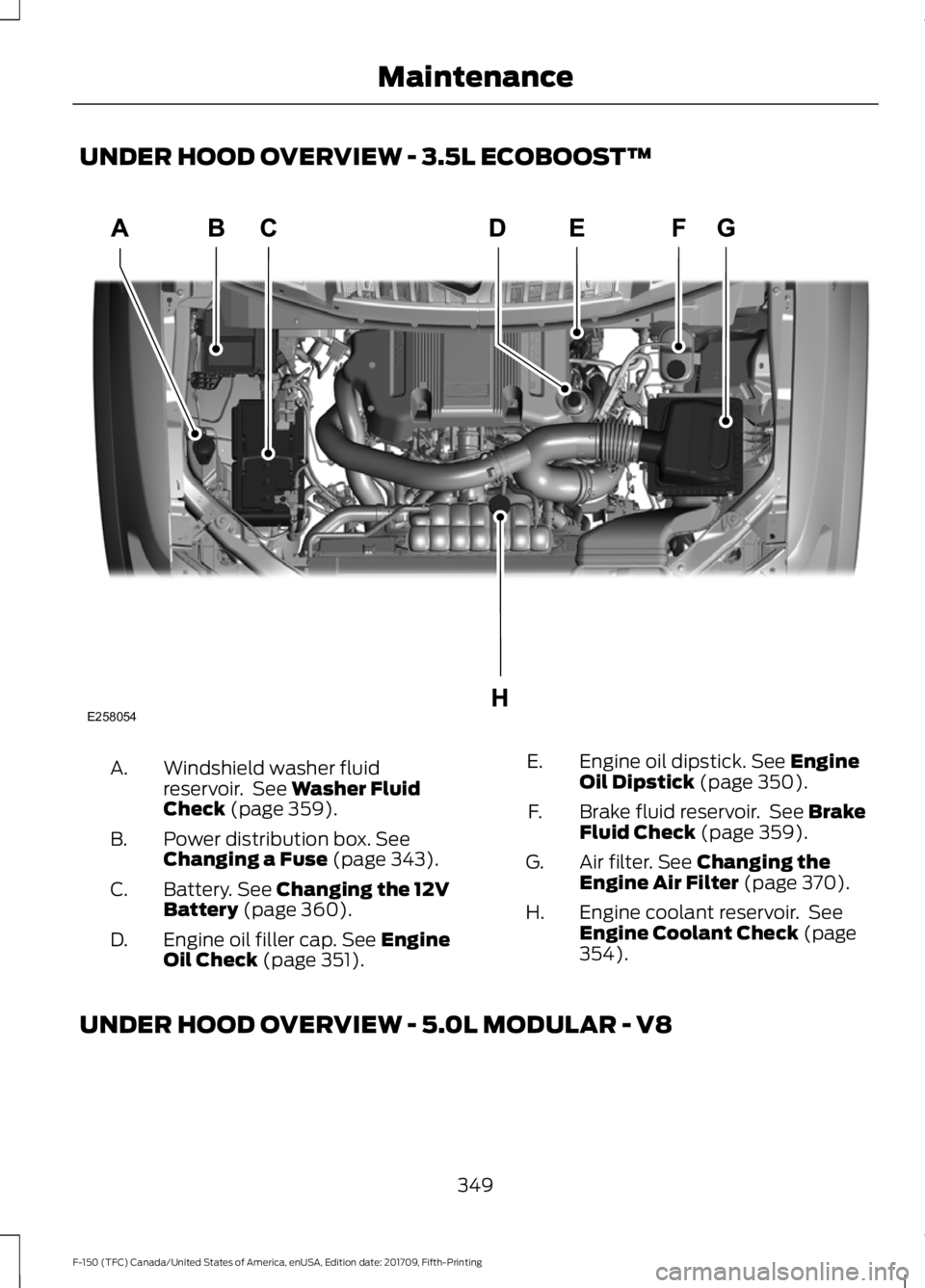
UNDER HOOD OVERVIEW - 3.5L ECOBOOST™
Windshield washer fluid
reservoir. See Washer Fluid
Check (page 359).
A.
Power distribution box.
See
Changing a Fuse (page 343).
B.
Battery.
See Changing the 12V
Battery (page 360).
C.
Engine oil filler cap.
See Engine
Oil Check (page 351).
D. Engine oil dipstick.
See Engine
Oil Dipstick (page 350).
E.
Brake fluid reservoir. See
Brake
Fluid Check (page 359).
F.
Air filter.
See Changing the
Engine Air Filter (page 370).
G.
Engine coolant reservoir. See
Engine Coolant Check
(page
354).
H.
UNDER HOOD OVERVIEW - 5.0L MODULAR - V8
349
F-150 (TFC) Canada/United States of America, enUSA, Edition date: 201709, Fifth-Printing MaintenanceE258054
Page 353 of 641
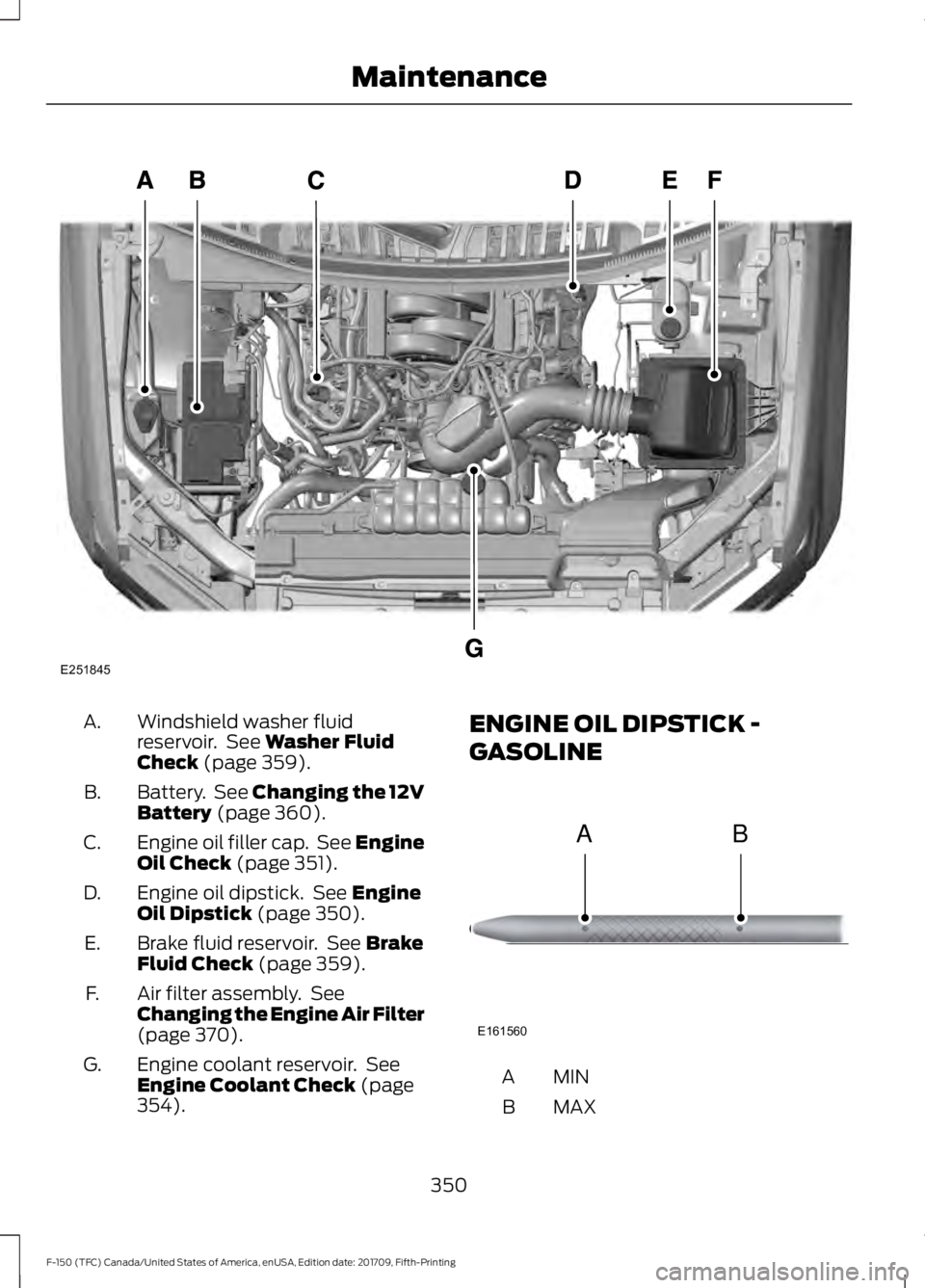
Windshield washer fluid
reservoir. See Washer Fluid
Check (page 359).
A.
Battery. See
Changing the 12V
Battery (page 360).
B.
Engine oil filler cap. See Engine
Oil Check
(page 351).
C.
Engine oil dipstick. See
Engine
Oil Dipstick (page 350).
D.
Brake fluid reservoir. See
Brake
Fluid Check (page 359).
E.
Air filter assembly. See
Changing the Engine Air Filter
(page
370).
F.
Engine coolant reservoir. See
Engine Coolant Check
(page
354).
G. ENGINE OIL DIPSTICK -
GASOLINE
MINA
MAX
B
350
F-150 (TFC) Canada/United States of America, enUSA, Edition date: 201709, Fifth-Printing MaintenanceE251845 E161560
AB
Page 354 of 641
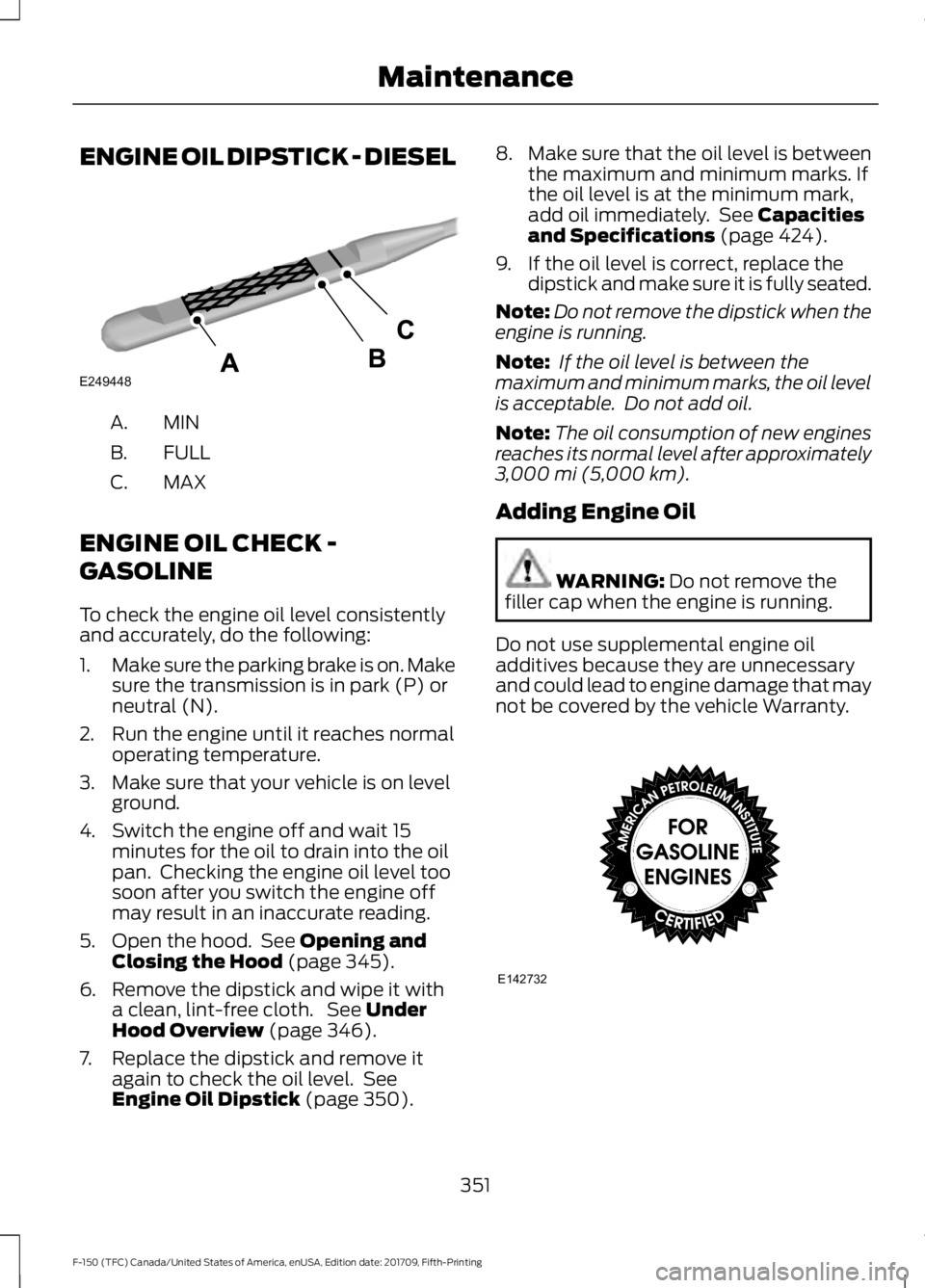
ENGINE OIL DIPSTICK - DIESEL
MINA.
FULL
B.
MAX
C.
ENGINE OIL CHECK -
GASOLINE
To check the engine oil level consistently
and accurately, do the following:
1. Make sure the parking brake is on. Make
sure the transmission is in park (P) or
neutral (N).
2. Run the engine until it reaches normal operating temperature.
3. Make sure that your vehicle is on level ground.
4. Switch the engine off and wait 15 minutes for the oil to drain into the oil
pan. Checking the engine oil level too
soon after you switch the engine off
may result in an inaccurate reading.
5. Open the hood. See Opening and
Closing the Hood (page 345).
6. Remove the dipstick and wipe it with a clean, lint-free cloth. See
Under
Hood Overview (page 346).
7. Replace the dipstick and remove it again to check the oil level. See
Engine Oil Dipstick
(page 350). 8.
Make sure that the oil level is between
the maximum and minimum marks. If
the oil level is at the minimum mark,
add oil immediately. See
Capacities
and Specifications (page 424).
9. If the oil level is correct, replace the dipstick and make sure it is fully seated.
Note: Do not remove the dipstick when the
engine is running.
Note: If the oil level is between the
maximum and minimum marks, the oil level
is acceptable. Do not add oil.
Note: The oil consumption of new engines
reaches its normal level after approximately
3,000 mi (5,000 km)
.
Adding Engine Oil WARNING:
Do not remove the
filler cap when the engine is running.
Do not use supplemental engine oil
additives because they are unnecessary
and could lead to engine damage that may
not be covered by the vehicle Warranty. 351
F-150 (TFC) Canada/United States of America, enUSA, Edition date: 201709, Fifth-Printing MaintenanceE249448 E142732