Page 207 of 641
If you are not able to drive in a manner that
allows effective automatic active
regeneration or you choose to perform
regeneration of the diesel particulate filter
while at idle, then operator commanded
regeneration would need to be performed.
Operator Commanded Regeneration
(If Equipped)
If your vehicle is operated with significant
stationary operation, low speed drive
cycles less than 25 mph (40 km/h), short
drive cycles, a drive time is less than 10 -
15 minutes or the vehicle does not fully
warm up, passive and active regeneration
may not sufficiently clean the diesel
particulate filter system. Operator
commanded regeneration allows you to
manually start regeneration of the diesel
particulate filter at idle to clean the filter.
If you are not sure whether your vehicle has
this feature, contact an authorized dealer.
When to Carry Out Operator Commanded
Regeneration
You can use the operator commanded
regeneration feature when a message
appears in the information display and you
are not able to drive in a manner that
allows effective automatic active
regeneration or if you choose to manually
start the regeneration of the diesel
particulate filter manually while the vehicle
is idle. See
Information Messages (page
125). Operator Commanded Regeneration
Precautions and Safe Exhaust Position WARNING: Do not park or idle your
vehicle over dry leaves, dry grass or other
combustible materials. The regeneration
process creates very high exhaust gas
temperatures and the exhaust will
radiate a considerable amount of heat
during and after regeneration and after
you have switched the engine off. This is
a potential fire hazard. WARNING:
Stay clear of the
exhaust tailpipe during regeneration. Hot
exhaust gases can burn you badly.
Make sure that the louvers located at the
tip of the exhaust are clear of any
obstructions as they are used to introduce
fresh air into the tailpipe to cool the
exhaust gases as they leave the exhaust
system.
Before you start operator commanded
regeneration, do the following:
• Shift into park (P) and apply the
parking brake, on stable, level ground.
• Park your vehicle outside of any
structure.
• Park your vehicle
10– 15 ft (3–5 m)
away from any obstructions and away
from materials that can easily combust
or melt, for example paper, leaves,
petroleum products, fuels, plastics and
other dry organic material.
• Make sure there is a minimum of 1/8
tank of fuel.
• Make sure all fluids are at proper levels.
204
F-150 (TFC) Canada/United States of America, enUSA, Edition date: 201709, Fifth-Printing Engine Emission Control
Page 267 of 641
Note:
The system may not correctly operate
when towing a trailer. For vehicles with an
approved trailer tow module and tow bar,
the system turns off when you attach a
trailer. For vehicles with an aftermarket
trailer tow module or tow bar, we
recommend that you switch the system off
when you attach a trailer.
To permanently switch the system off,
contact an authorized dealer.
STEERING
Electric Power Steering WARNING: The electric power
steering system has diagnostic checks
that continuously monitor the system. If
a fault is detected, a message displays
in the information display. Stop your
vehicle as soon as it is safe to do so.
Switch the ignition off. After at least 10
seconds, switch the ignition on and
watch the information display for a
steering system warning message. If a
steering system warning message
returns, have the system checked by an
authorized dealer. WARNING:
If the system detects
an error, you may not feel a difference in
the steering, however a serious condition
may exist. Obtain immediate service
from an authorized dealer, failure to do
so may result in loss of steering control.
Your vehicle has an electric power steering
system. There is no fluid reservoir. No
maintenance is required.
If your vehicle loses electrical power while
you are driving, electric power steering
assistance is lost. The steering system still
operates and you can steer your vehicle
manually. Manually steering your vehicle
requires more effort. Extreme continuous steering may increase
the effort required for you to steer your
vehicle. This increased effort prevents
overheating and permanent damage to
the steering system. You do not lose the
ability to steer your vehicle manually.
Typical steering and driving maneuvers
allow the system to cool and return to
normal operation.
Steering Tips
If the steering wanders or pulls, check for:
•
Correct tire pressures.
• Uneven tire wear.
• Loose or worn suspension
components.
• Loose or worn steering components.
• Improper vehicle alignment.
Note: A high crown in the road or high
crosswinds may also make the steering
seem to wander or pull.
Adaptive Learning
The electronic power steering system
adaptive learning helps correct road
irregularities and improves overall handling
and steering feel. It communicates with
the brake system to help operate
advanced stability control and accident
avoidance systems. Additionally, whenever
the battery is disconnected or a new
battery installed, you must drive your
vehicle a short distance before the system
relearns the strategy and reactivates all
systems.
264
F-150 (TFC) Canada/United States of America, enUSA, Edition date: 201709, Fifth-Printing Driving Aids
Page 342 of 641
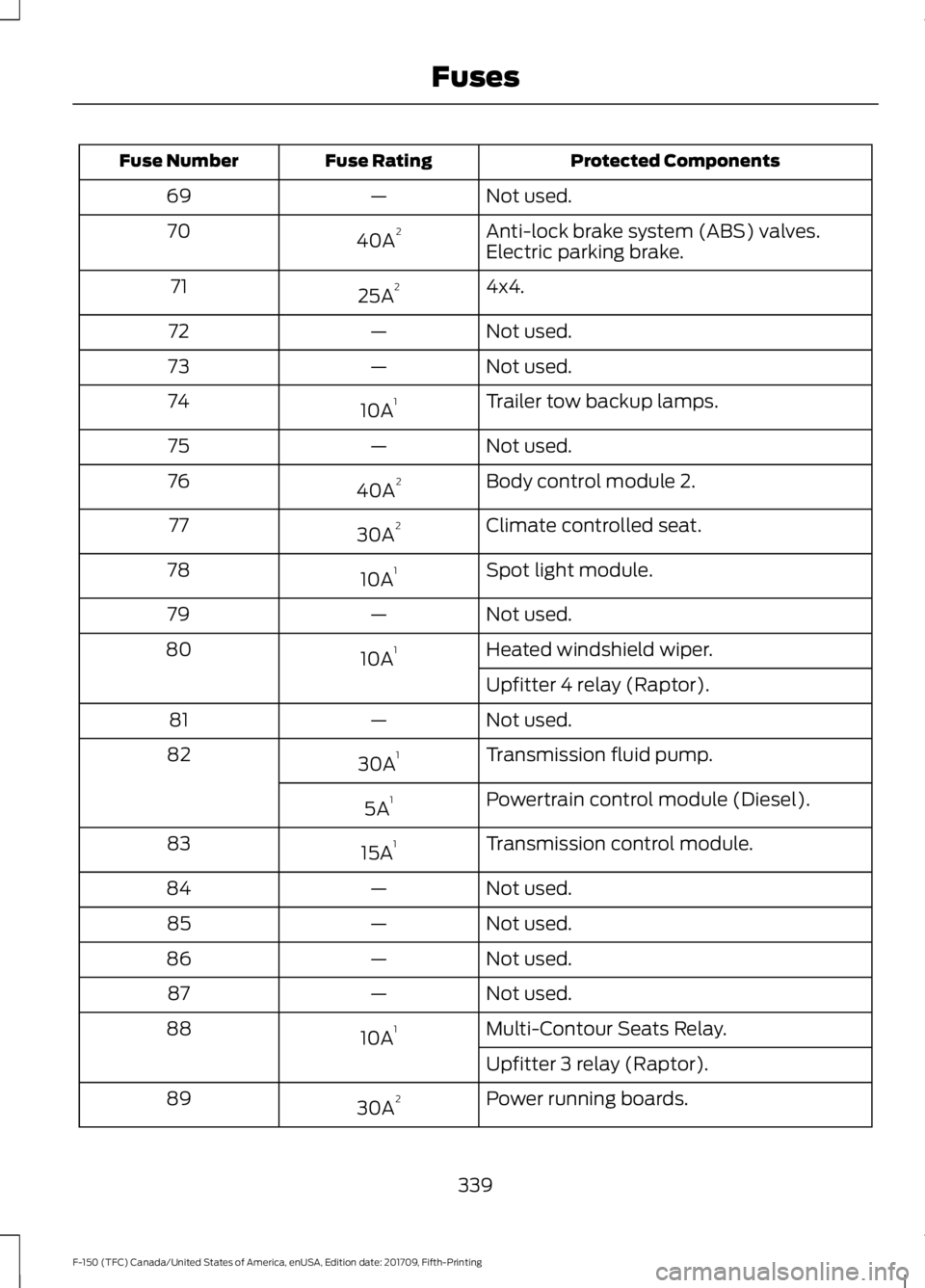
Protected Components
Fuse Rating
Fuse Number
Not used.
—
69
Anti-lock brake system (ABS) valves.
40A 2
70
Electric parking brake.
4x4.
25A 2
71
Not used.
—
72
Not used.
—
73
Trailer tow backup lamps.
10A 1
74
Not used.
—
75
Body control module 2.
40A 2
76
Climate controlled seat.
30A 2
77
Spot light module.
10A 1
78
Not used.
—
79
Heated windshield wiper.
10A 1
80
Upfitter 4 relay (Raptor).
Not used.
—
81
Transmission fluid pump.
30A 1
82
Powertrain control module (Diesel).
5A 1
Transmission control module.
15A 1
83
Not used.
—
84
Not used.
—
85
Not used.
—
86
Not used.
—
87
Multi-Contour Seats Relay.
10A 1
88
Upfitter 3 relay (Raptor).
Power running boards.
30A 2
89
339
F-150 (TFC) Canada/United States of America, enUSA, Edition date: 201709, Fifth-Printing Fuses
Page 348 of 641

GENERAL INFORMATION
Have your vehicle serviced regularly to help
maintain its roadworthiness and resale
value. There is a large network of
authorized dealers that are there to help
you with their professional servicing
expertise. We believe that their specially
trained technicians are best qualified to
service your vehicle properly and expertly.
They are supported by a wide range of
highly specialized tools developed
specifically for servicing your vehicle.
If your vehicle requires professional service,
an authorized dealer can provide the
necessary parts and service. Check your
warranty information to find out which
parts and services are covered.
Use only recommended fuels, lubricants,
fluids and service parts conforming to
specifications. Motorcraft® parts are
designed and built to provide the best
performance in your vehicle.
Precautions
•
Do not work on a hot engine.
• Make sure that nothing gets caught in
moving parts.
• Do not work on a vehicle with the
engine running in an enclosed space,
unless you are sure you have enough
ventilation.
• Keep all open flames and other burning
material (such as cigarettes) away
from the battery and all fuel related
parts.
Working with the Engine Off
1. Set the parking brake and shift the transmission to park (P).
2. Switch off the engine.
3. Block the wheels. Working with the Engine On WARNING: To reduce the risk of
vehicle damage and personal burn
injuries, do not start your engine with the
air cleaner removed and do not remove
it while the engine is running.
1. Set the parking brake and shift the transmission to park (P).
2. Block the wheels.
OPENING AND CLOSING THE
HOOD
1. Inside the vehicle, pull the hood release
handle located under the left hand side
of the instrument panel. 2. Go to the front of your vehicle and
locate the secondary release lever
under the front of the hood near the
center of your vehicle.
345
F-150 (TFC) Canada/United States of America, enUSA, Edition date: 201709, Fifth-Printing MaintenanceE166491
Page 350 of 641
Brake fluid reservoir. See Brake
Fluid Check (page 359).
F.
Air filter assembly. See
Changing the Engine Air Filter
(page 370).
G.
Engine coolant reservoir.
See
Engine Coolant Check (page
354).
H.
UNDER HOOD OVERVIEW - 3.0L V6, DIESEL Power distribution box. See
Fuses
(page 335).
A.
Engine oil filler cap. See Engine
Oil Check
(page 351).
B.
Engine oil dipstick. See
Engine
Oil Dipstick (page 350).
C.
Brake fluid reservoir. See
Brake
Fluid Check (page 359).
D. Air filter assembly. See
Changing the Engine Air Filter
(page
370).
E.
Engine coolant reservoir. See
Engine Coolant Check
(page
354).
F.
347
F-150 (TFC) Canada/United States of America, enUSA, Edition date: 201709, Fifth-Printing MaintenanceE247635
Page 351 of 641
Battery. See Changing the 12V
Battery (page 360).
G.
H. Windshield washer fluid
reservoir. See Washer Fluid
Check (page 359).
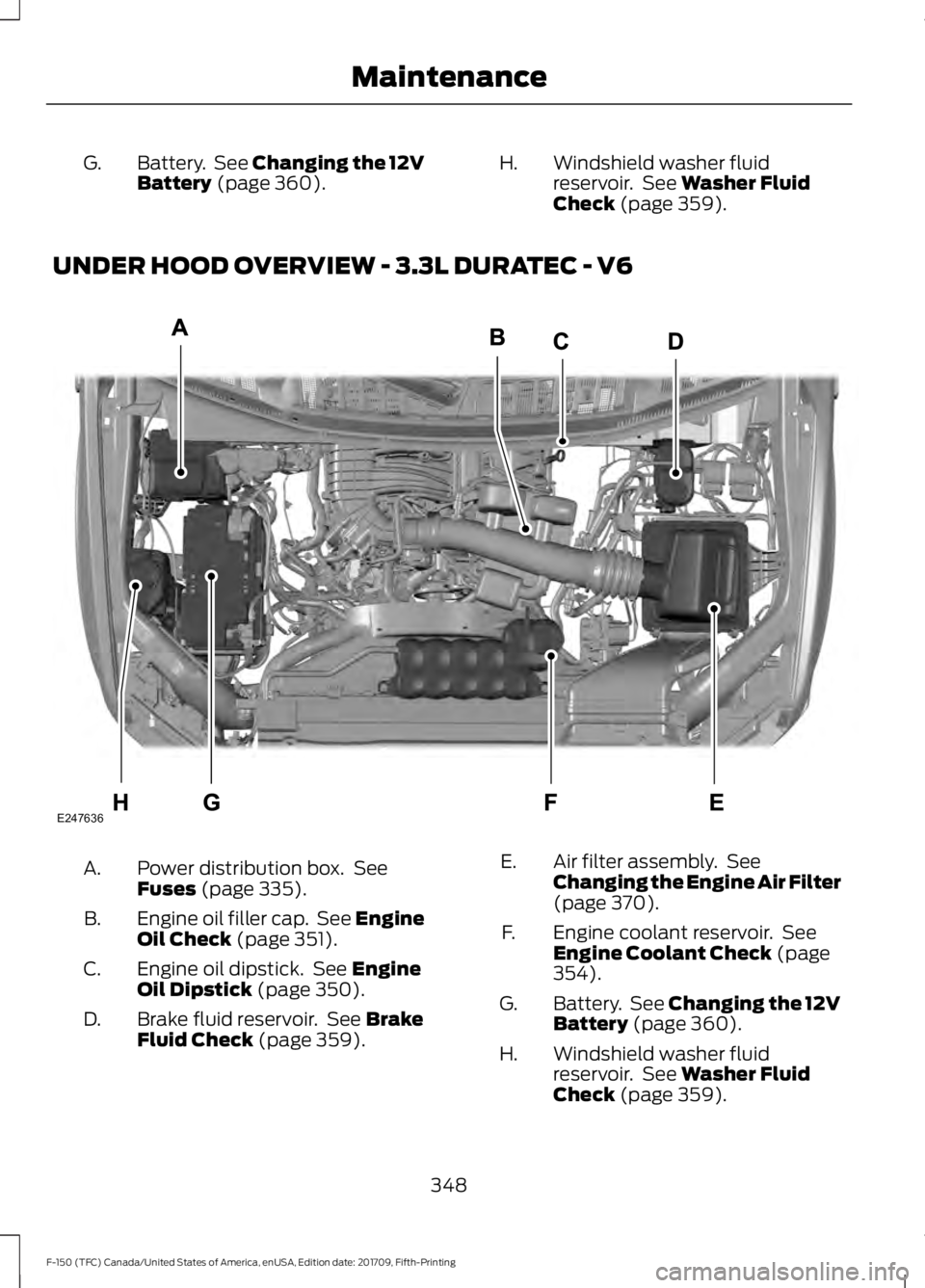
UNDER HOOD OVERVIEW - 3.3L DURATEC - V6 Power distribution box. See
Fuses
(page 335).
A.
Engine oil filler cap. See Engine
Oil Check
(page 351).
B.
Engine oil dipstick. See
Engine
Oil Dipstick (page 350).
C.
Brake fluid reservoir. See
Brake
Fluid Check (page 359).
D. Air filter assembly. See
Changing the Engine Air Filter
(page
370).
E.
Engine coolant reservoir. See
Engine Coolant Check
(page
354).
F.
Battery. See
Changing the 12V
Battery (page 360).
G.
Windshield washer fluid
reservoir. See
Washer Fluid
Check (page 359).
H.
348
F-150 (TFC) Canada/United States of America, enUSA, Edition date: 201709, Fifth-Printing MaintenanceE247636
Page 352 of 641
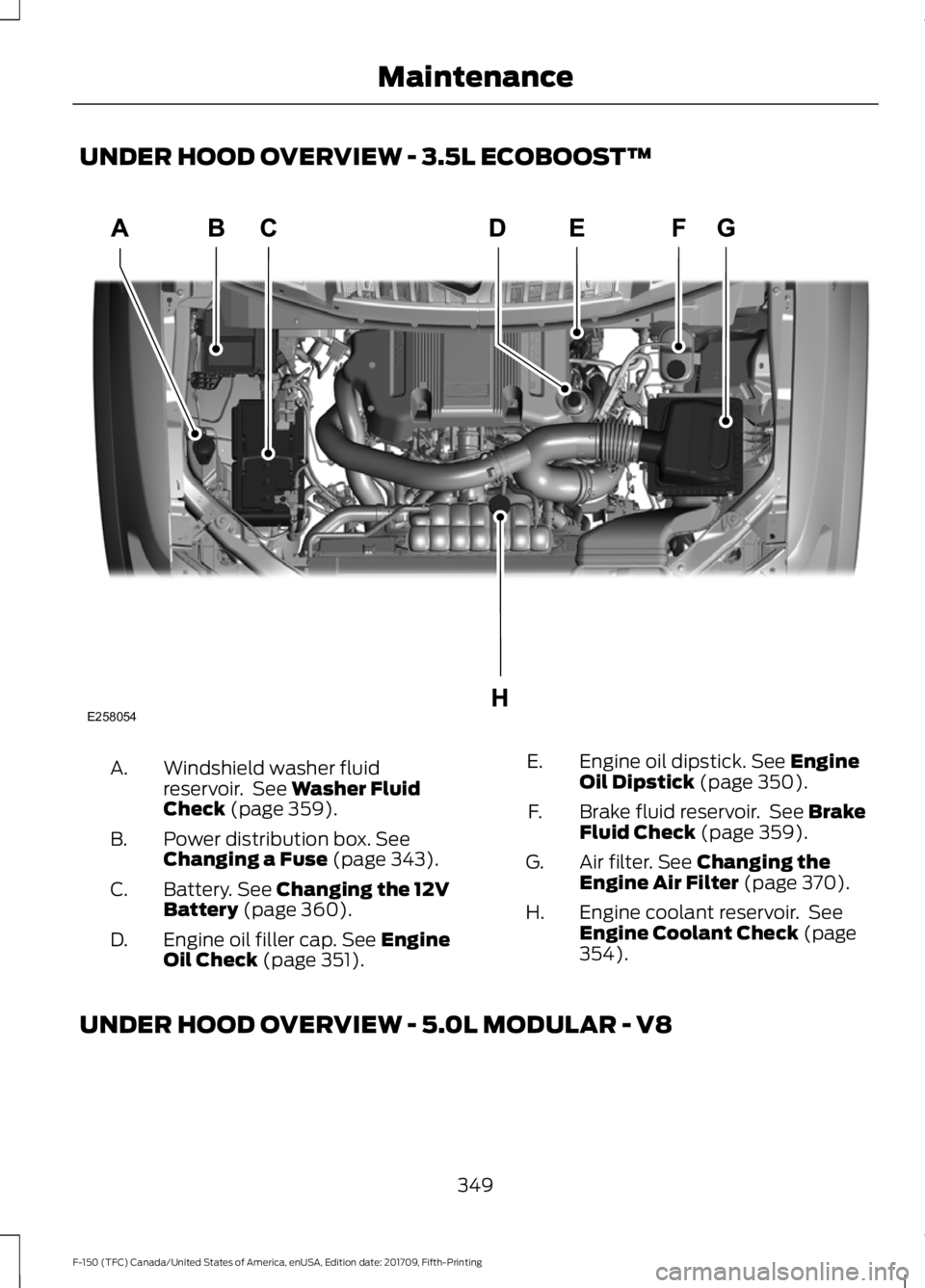
UNDER HOOD OVERVIEW - 3.5L ECOBOOST™
Windshield washer fluid
reservoir. See Washer Fluid
Check (page 359).
A.
Power distribution box.
See
Changing a Fuse (page 343).
B.
Battery.
See Changing the 12V
Battery (page 360).
C.
Engine oil filler cap.
See Engine
Oil Check (page 351).
D. Engine oil dipstick.
See Engine
Oil Dipstick (page 350).
E.
Brake fluid reservoir. See
Brake
Fluid Check (page 359).
F.
Air filter.
See Changing the
Engine Air Filter (page 370).
G.
Engine coolant reservoir. See
Engine Coolant Check
(page
354).
H.
UNDER HOOD OVERVIEW - 5.0L MODULAR - V8
349
F-150 (TFC) Canada/United States of America, enUSA, Edition date: 201709, Fifth-Printing MaintenanceE258054
Page 353 of 641
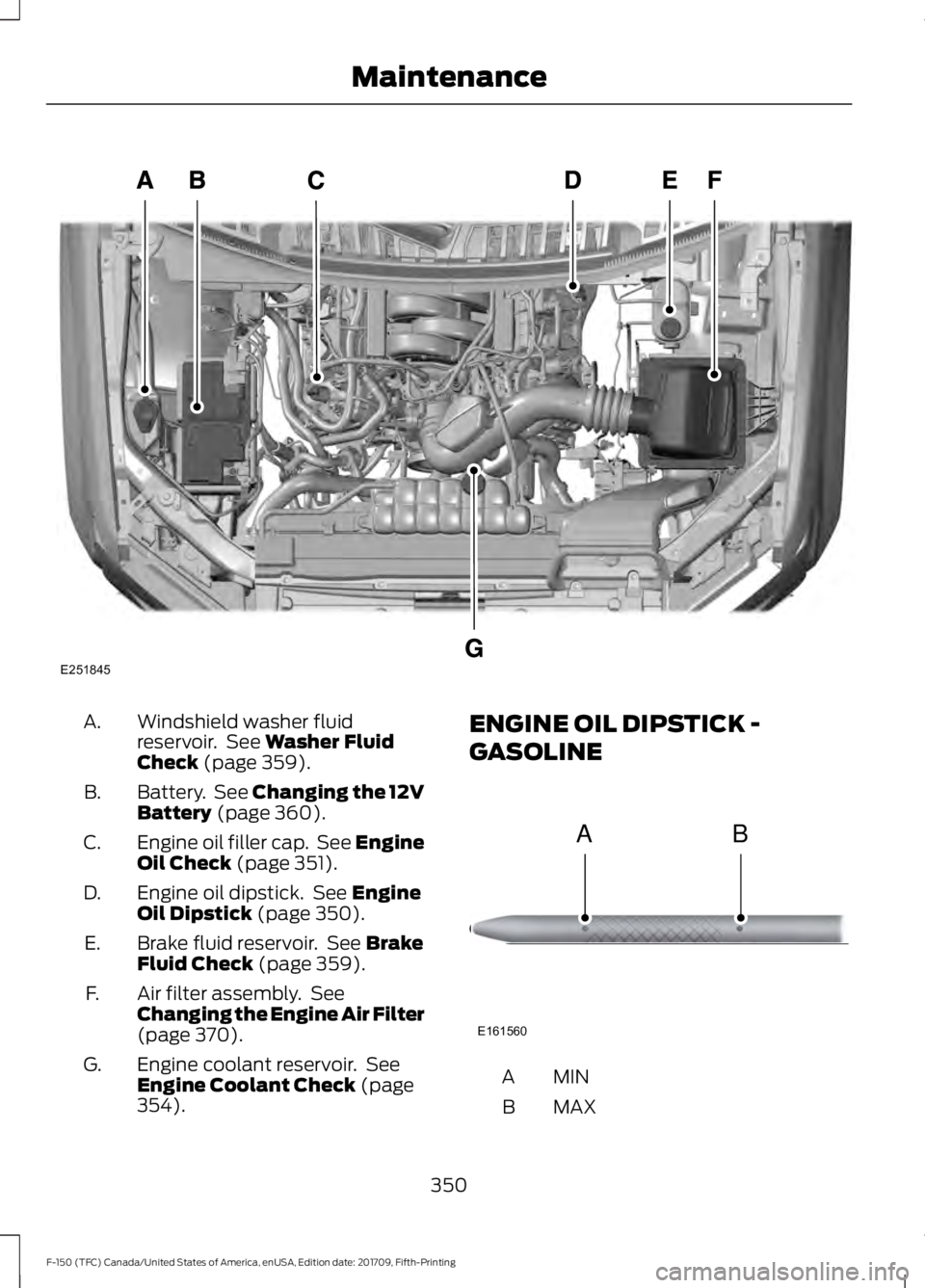
Windshield washer fluid
reservoir. See Washer Fluid
Check (page 359).
A.
Battery. See
Changing the 12V
Battery (page 360).
B.
Engine oil filler cap. See Engine
Oil Check
(page 351).
C.
Engine oil dipstick. See
Engine
Oil Dipstick (page 350).
D.
Brake fluid reservoir. See
Brake
Fluid Check (page 359).
E.
Air filter assembly. See
Changing the Engine Air Filter
(page
370).
F.
Engine coolant reservoir. See
Engine Coolant Check
(page
354).
G. ENGINE OIL DIPSTICK -
GASOLINE
MINA
MAX
B
350
F-150 (TFC) Canada/United States of America, enUSA, Edition date: 201709, Fifth-Printing MaintenanceE251845 E161560
AB