2018 FORD ECOSPORT Intake
[x] Cancel search: IntakePage 102 of 452

PRINCIPLE OF OPERATION
Outside Air
Keep the air intakes in front of thewindshield free from obstruction (such assnow or leaves) to allow the climatecontrol system to function effectively.
Recirculated Air
The air currently in the passengercompartment recirculates. Outside air doesnot enter your vehicle.
Note:Prolonged use of recirculated air maycause the windows to fog up.
Heating
Heating performance depends on thetemperature of the coolant.
General Information on Controllingthe Interior Climate
Close the windows.
Warming the Interior
Direct the air toward your feet. In cold orhumid weather conditions, direct some ofthe air toward the windshield and the doorwindows.
Cooling the Interior
Direct the air toward your face.
Air Conditioning
The system directs condensation to theoutside of your vehicle, which could causea small pool of water to form under yourvehicle. This is normal.
Note:The air conditioning operates onlywhen the temperature is above 39°F (4°C).
Note:When you use air conditioning, yourvehicle uses more fuel.
AIR VENTS
Center Air Vents
Side Air Vents
98EcoSport (CBW) Canada/United States of America, Vehicles Built From: 14-08-2017, GN15-19G219-ZFB enUSA, First PrintingClimate Control
Page 105 of 452

You can adjust the temperature between59.9–85.1°F (15.5–29.5°C) in smallincrements.
When set to low temperatures, the systemswitches to permanent cooling. When setto high temperatures , the system switchesto permanent heating.
HINTS ON CONTROLLING THE
INTERIOR CLIMATE -
VEHICLES WITH: ELECTRONIC
AUTOMATIC TEMPERATURE
CONTROL (EATC)
General Hints
Do not place objects under the front seatsas this may interfere with the airflow to therear seats.
Remove any snow, ice or leaves from theair intake area at the base of thewindshield.
Note:You may feel a small amount of airfrom the footwell air vents regardless of theair distribution setting.
Note:To reduce humidity build-up insideyour vehicle, do not drive with the systemswitched off or with recirculated air alwaysswitched on.
Note:Prolonged use of recirculated air maycause the windows to fog up.
Note: Adjusting the settings when yourvehicle interior is extremely hot or cold isnot necessary. The system automaticallyadjusts to heat or cool the interior to yourselected temperature as quickly as possible.For the system to function efficiently, theinstrument panel and side air vents shouldbe fully open.
Note:When you select automatic modeand the ambient temperature is low and theengine is cold, airflow is directed to thewindshield and side air vents.
Note:When you select automatic modeand the interior and exterior temperaturesare high, the system selects recirculated airto maximize cooling. When the desiredtemperature is reached, recirculated airturns off.
Note:When you switch the system off,outside air is prevented from entering yourvehicle.
Note:When you select maximum defrost,air conditioning turns on and airflow is notdirected to the instrument panel andfootwell air vents.
Quickly Heating the Interior
•Press AUTO.
•Select the highest temperature.
Recommended Settings forHeating
•Press AUTO.
•Select the desired temperature.
Quickly Cooling the Interior
•Press MAX A/C.
Recommended Settings forCooling
•Press AUTO.
•Select the desired temperature.
Defogging the Side Windows inCold Weather
•Select maximum defrost.
101EcoSport (CBW) Canada/United States of America, Vehicles Built From: 14-08-2017, GN15-19G219-ZFB enUSA, First PrintingClimate Control
Page 106 of 452

Maximum Cooling Using theInstrument Panel and Footwell AirVents
•Select the lowest temperature.
•Switch on the air conditioning andrecirculated air.
•Select the highest blower motor speedand then adjust to suit comfort levels.
HINTS ON CONTROLLING THE
INTERIOR CLIMATE -
VEHICLES WITH: ELECTRONIC
MANUAL TEMPERATURE
CONTROL (EMTC)
General Hints
Do not place objects under the front seatsas this may interfere with the airflow to therear seats.
Remove any snow, ice or leaves from theair intake area at the base of thewindshield.
Note:You may feel a small amount of airfrom the footwell air vents regardless of theair distribution setting.
Note:To reduce humidity build-up insideyour vehicle, do not drive with the systemswitched off or with recirculated air alwaysswitched on.
Note:When you switch the system off,outside air is prevented from entering yourvehicle.
Note:To reduce fogging of the windshieldduring humid weather, direct airflow to thewindshield air vents.
Note:Prolonged use of recirculated air maycause the windows to fog up.
Quickly Heating the Interior
•Select the highest blower motor speed.
•Select the highest temperature.
•Direct the airflow to the footwell airvents.
Recommended Settings forHeating
•Select a high blower motor speed.
•Select the desired temperature.
•Direct the airflow to the footwell andwindshield air vents.
Quickly Cooling the Interior
•Select maximum cooling.
Recommended Settings forCooling
•Select the highest blower motor speed.
•Select the desired temperature.
•Direct the airflow to the instrumentpanel air vents.
•Press A/C.
Defogging the Side Windows inCold Weather
•Select maximum defrost.
Maximum Cooling Using theInstrument Panel and Footwell AirVents
•Turn the temperature controlcounterclockwise to the lowest setting.
•Switch on the air conditioning andrecirculated air.
•Select the highest blower motor speedand then adjust to suit comfort levels.
102EcoSport (CBW) Canada/United States of America, Vehicles Built From: 14-08-2017, GN15-19G219-ZFB enUSA, First PrintingClimate Control
Page 187 of 452

3.Remove your foot from the brake pedaland press the START/STOP buttonto switch off the ignition.
4.You can either attempt to start theengine by pressing the brake pedal andthe START/STOP button, or switchon the ignition only by pressing theSTART/STOP button withoutpressing the brake pedal. Both waysre-enable the fuel system.
Note: When you try to restart your vehicleafter a fuel shutoff, the vehicle makes surethat various systems are safe to restart.Once your vehicle determines that thesystems are safe, then the vehicle will allowyou to restart.
Note:In the event that your vehicle doesnot restart after your third attempt, contactan authorized dealer.
JUMP STARTING THE VEHICLE
WARNINGS
Batteries normally produce explosivegases which can cause personalinjury. Therefore, do not allowflames, sparks or lighted substances tocome near the battery. When working nearthe battery, always shield your face andprotect your eyes. Always provide correctventilation.
Keep batteries out of reach ofchildren. Batteries contain sulfuricacid. Avoid contact with skin, eyes orclothing. Shield your eyes when workingnear the battery to protect against possiblesplashing of acid solution. In case of acidcontact with skin or eyes, flushimmediately with water for a minimum of15 minutes and get prompt medicalattention. If acid is swallowed, call aphysician immediately.
Use only adequately sized cables withinsulated clamps.
Do not attempt to push-start yourautomatic transmission vehicle. Automatictransmissions do not have push-startcapability. Attempting to push-start avehicle with an automatic transmissionmay cause transmission damage.
Preparing Your Vehicle
Note:Use only a 12-volt supply to start yourvehicle.
Note:Do not disconnect the battery of thedisabled vehicle as this could damage thevehicle's electrical system.
1.Park the booster vehicle close to thehood of the disabled vehicle makingsure the two vehicles do not touch. Setthe parking brake on both vehicles andstay clear of the engine cooling fan andother moving parts.
2.Check all battery terminals and removeany excessive corrosion before youattach the battery cables. Ensure thatvent caps are tight and level.
3.Turn the heater fan on in both vehiclesto protect from any electrical surges.Turn all other accessories off.
Connecting the Jumper Cables
WARNINGS
Do not use fuel lines, engine valvecovers, windshield wiper arms, theintake manifold, or hood latch asground points.
Use only adequately sized cableswith insulated clamps.
Note:In the illustration, the vehicle on thebottom is used to designate the assisting(boosting) battery.
183EcoSport (CBW) Canada/United States of America, Vehicles Built From: 14-08-2017, GN15-19G219-ZFB enUSA, First PrintingRoadside Emergencies
Page 188 of 452
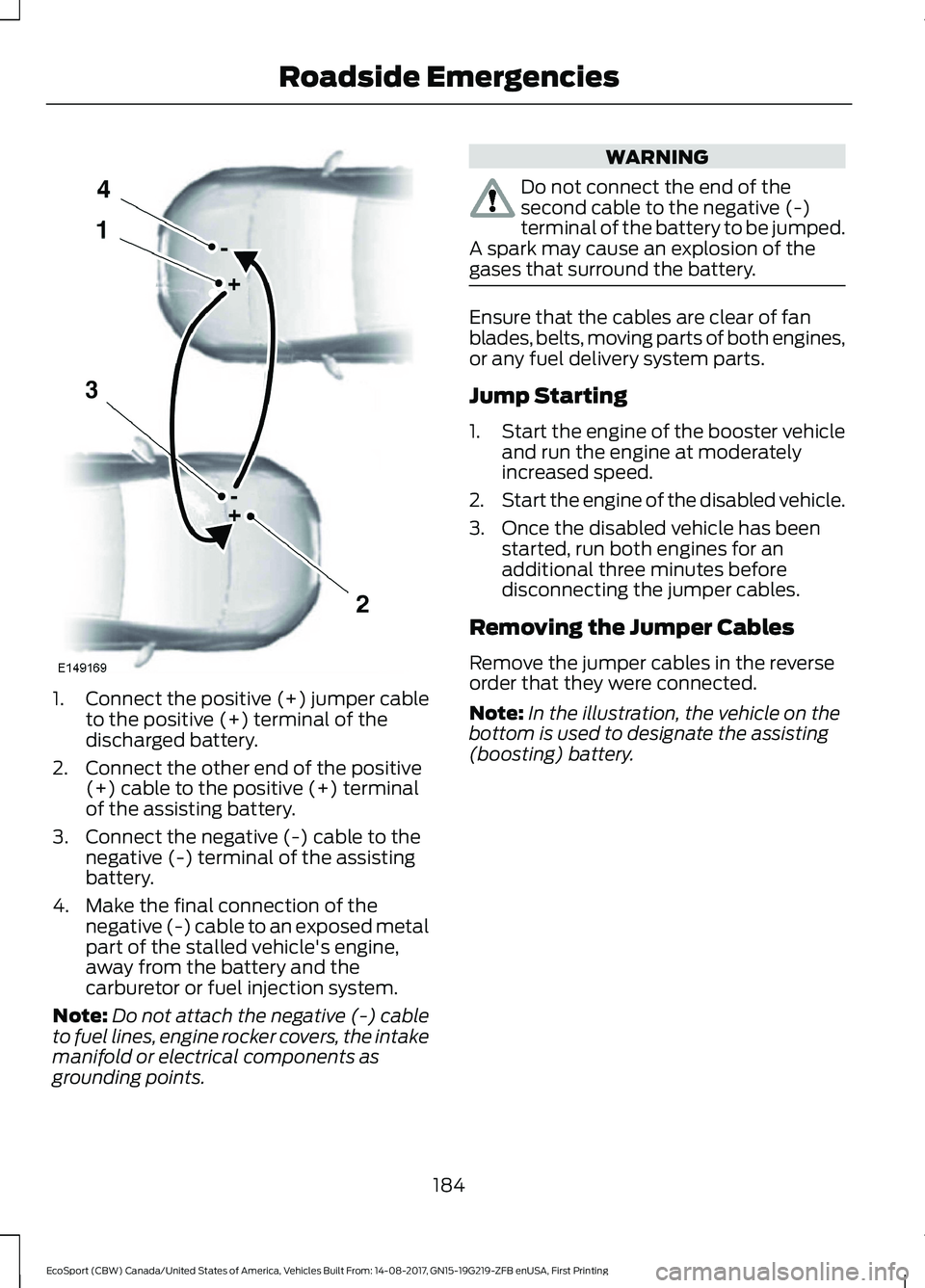
1.Connect the positive (+) jumper cableto the positive (+) terminal of thedischarged battery.
2.Connect the other end of the positive(+) cable to the positive (+) terminalof the assisting battery.
3.Connect the negative (-) cable to thenegative (-) terminal of the assistingbattery.
4.Make the final connection of thenegative (-) cable to an exposed metalpart of the stalled vehicle's engine,away from the battery and thecarburetor or fuel injection system.
Note:Do not attach the negative (-) cableto fuel lines, engine rocker covers, the intakemanifold or electrical components asgrounding points.
WARNING
Do not connect the end of thesecond cable to the negative (-)terminal of the battery to be jumped.A spark may cause an explosion of thegases that surround the battery.
Ensure that the cables are clear of fanblades, belts, moving parts of both engines,or any fuel delivery system parts.
Jump Starting
1.Start the engine of the booster vehicleand run the engine at moderatelyincreased speed.
2.Start the engine of the disabled vehicle.
3.Once the disabled vehicle has beenstarted, run both engines for anadditional three minutes beforedisconnecting the jumper cables.
Removing the Jumper Cables
Remove the jumper cables in the reverseorder that they were connected.
Note:In the illustration, the vehicle on thebottom is used to designate the assisting(boosting) battery.
184EcoSport (CBW) Canada/United States of America, Vehicles Built From: 14-08-2017, GN15-19G219-ZFB enUSA, First PrintingRoadside Emergencies