2018 FORD E-350 child restraint
[x] Cancel search: child restraintPage 34 of 323

DRIVER AND PASSENGER
AIRBAGS (If Equipped)
WARNINGS
Never place your arm over the airbag
module as a deploying airbag can
result in serious arm fractures or
other injuries. Airbags can kill or injure a child in a
child restraint. Never place a
rear-facing child restraint in front of
an active airbag. If you must use a
forward-facing child restraint in the front
seat, move the seat upon which the child
seat is installed all the way back. The driver and front passenger airbags will
deploy during significant frontal and near
frontal crashes.
The driver and passenger front airbag
system consists of:
•
Driver and passenger airbag modules. · Crash sensors and monitoring
system with readiness indicator.
See Crash Sensors and Airbag
Indicator
(page 36). Passenger Airbag On and Off
Switch
(If Equipped) WARNING
Your vehicle may have an airbag
deactivation switch. Before driving,
always look at the switch to make
sure it is in the appropriate position. Failure
to put the switch in the proper position can
increase the risk of serious injury or death
in a crash. Note:
The passenger airbag on and off
switch may be on vehicles with no rear
seats.
Turning the Passenger Airbag Off WARNINGS
If the light does not illuminate when
the passenger airbag switch is off
and you switch the ignition on, have
the passenger airbag switch serviced
immediately by a qualified technician. To avoid switching on the airbag,
always remove the ignition key with
the switch in the off position.
NEVER use a rearward facing child
restraint on a seat protected by an
ACTIVE AIRBAG in front of it, DEATH
or SERIOUS INJURY to the CHILD can
occur. 31
E-Series (TE4) Canada/United States of America, enUSA, Edition date: 201712, Second Printing Supplementary Restraints SystemE151127 E67017
Page 35 of 323

Type 1
Type 2
1. Insert the ignition key into the
passenger airbag on and off switch,
turn the switch to off and hold it in off
while removing the key.
2. When the ignition is turned on and the
passenger airbag switch is in the off
position, the off light illuminates briefly,
momentarily shuts off and then turns
back on. This indicates that the
passenger airbag is deactivated. Turning the Passenger Airbag Back On WARNINGS
The seatbelts for the driver and right
front passenger seating positions are
specifically designed to operate
together with the airbags in certain types
of crashes. When you switch off your
airbag, you not only lose the protection of
the airbag, you also may reduce the
effectiveness of your seatbelt system. If
the passenger does not meet the
requirements stated in the National
Highway Traffic Safety Administration or
Transport Canada deactivation criteria,
switching off the airbag can increase the
risk of serious injury or death in a crash. If your vehicle has rear seats, always
transport children who are 12 and
younger in the rear seat. Always use
seatbelts and child restraints properly. Do
not place a child in a rear facing infant seat
in the front seat unless your vehicle is
equipped with an airbag on and off switch
and the passenger airbag is turned off. This
is because the back of the infant seat is
too close to the inflating airbag and the
risk of a fatal injury to the infant when the
airbag inflates is substantial. If the passenger airbag off light is
illuminated when the passenger
airbag switch is on and the ignition
is on, have the passenger airbag switch
serviced immediately by a qualified
technician. The passenger airbag remains off until you
turn it back on.
32
E-Series (TE4) Canada/United States of America, enUSA, Edition date: 201712, Second Printing Supplementary Restraints SystemE224282 E224283
Page 37 of 323

•
The vehicle has no rear seat.
• The vehicle has a rear seat too small
to accommodate a rear-facing infant
seat.
• The infant has a medical condition
which, according to the infant's
physician, makes it necessary for the
infant to ride in the front so that the
driver can constantly monitor the
child's condition.
2. Child age 1 to 12. A child age 1 to 12 must
ride in the front seat because:
• The vehicle has no rear seat.
• Although children ages 1 to 12 ride in
the rear seat(s) whenever possible,
children ages 1 to 12 sometimes must
ride in the front because no space is
available in the rear seat(s) of the
vehicle.
• The child has a medical condition
which, according to the child's
physician, makes it necessary for the
child to ride in the front seat so that the
driver can constantly monitor the
child's condition.
3. Medical condition. A passenger has a
medical condition which, according to his
or her physician:
• Causes the passenger airbag to pose
a special risk for the passenger.
• Makes the potential harm from the
passenger airbag in a crash greater
than the potential harm from turning
off the airbag and allowing the
passenger, even if belted, to hit the
dashboard or windshield in a crash. Transport Canada Deactivation Criteria
(Canada Only) WARNING
This vehicle has special energy
management seatbelts for the driver
and right front passenger. These
particular seatbelts are specifically
designed to work with airbags to help
reduce the risk of injury in a crash. The
energy management seatbelt gives or
releases additional seatbelt webbing in
some accidents to reduce the
concentration of force on an occupant's
chest and to reduce the risk of certain bone
fractures and injuries to underlying organs.
In a crash, if the airbag is off, this energy
management seatbelt might permit the
passenger wearing the seatbelt to move
forward enough to have a serious or fatal
injury. The more severe the crash, and the
heavier the occupant, the greater the risk.
Make sure the airbag is on for any
passenger who does not qualify under the
National Highway Traffic Safety
Administration deactivation criteria. 1.
Infant: An infant (less than 1 year old)
must ride in the front seat because:
• My vehicle has no rear seat.
• The rear seat in my vehicle cannot
accommodate a rear-facing infant
seat.
• The infant has a medical condition
which, according to the infant's
physician, makes it necessary for the
infant to ride in the front seat so that
the driver can monitor the infant's
condition.
2. Child age 12 or under: A child age 12 or
under must ride in the front seat because:
34
E-Series (TE4) Canada/United States of America, enUSA, Edition date: 201712, Second Printing Supplementary Restraints System
Page 38 of 323
•
My vehicle has no rear seat.
• Although children age 12 and under ride
in the rear seat whenever possible,
children age 12 and under have no
option but to sometimes ride in the
front seat because rear seat space is
insufficient.
• The child has a medical condition that,
according to the child's physician,
makes it necessary for the child to ride
in the front seat so that the driver can
monitor the child's condition.
3. Medical condition: A passenger has a
medical condition that, according to his or
her physician:
• Poses a special risk for the passenger
if the airbag deploys.
• Makes the potential harm from the
passenger airbag deployment greater
than the potential harm from turning
off the airbag and experiencing a crash
without the protection offered by the
airbag.
Proper Driver and Front Passenger
Seating Adjustment WARNING
National Highway Traffic Safety
Administration (NHTSA)
recommends a minimum distance
of at least
10 in (25 cm) between an
occupant’ s chest and the driver airbag
module. To properly position yourself away from
the airbag:
•
Move your seat to the rear as far as you
can while still reaching the pedals
comfortably.
• Recline the seat slightly (one or two
degrees) from the upright position. After all occupants have adjusted their
seats and put on seatbelts, it is very
important that they continue to sit
properly. Properly seated occupants sit
upright, lean against the seat back, and
center themselves on the seat cushion,
with their feet comfortably extended on
the floor. Sitting improperly can increase
the chance of injury in a crash event. For
example, if an occupant slouches, lies
down, turns sideways, sits forward, leans
forward or sideways, or puts one or both
feet up, the chance of injury during a crash
is greatly increased.
Children and Airbags
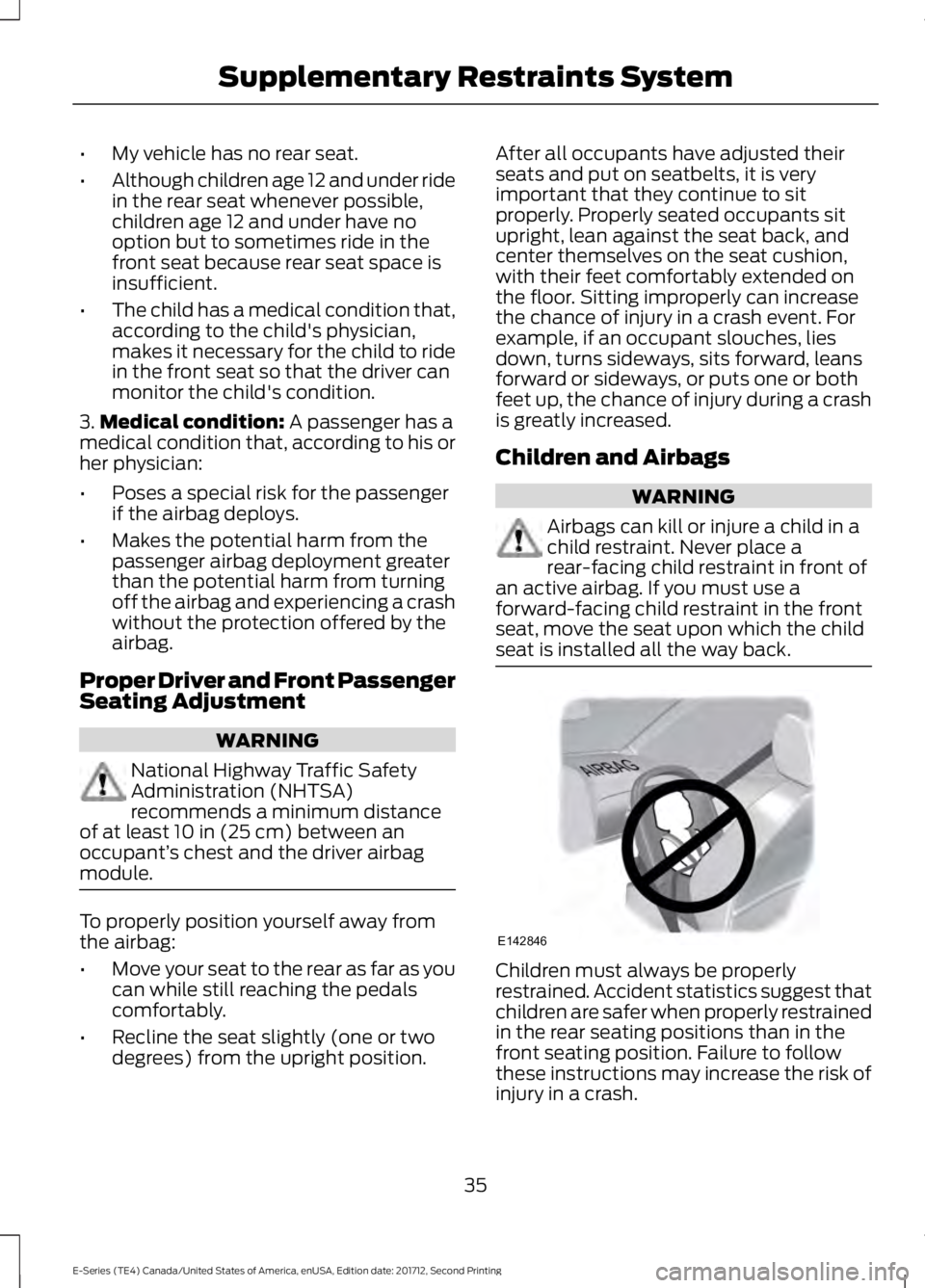
WARNING
Airbags can kill or injure a child in a
child restraint. Never place a
rear-facing child restraint in front of
an active airbag. If you must use a
forward-facing child restraint in the front
seat, move the seat upon which the child
seat is installed all the way back. Children must always be properly
restrained. Accident statistics suggest that
children are safer when properly restrained
in the rear seating positions than in the
front seating position. Failure to follow
these instructions may increase the risk of
injury in a crash.
35
E-Series (TE4) Canada/United States of America, enUSA, Edition date: 201712, Second Printing Supplementary Restraints SystemE142846
Page 169 of 323
GENERAL INFORMATION
Notice to Utility Vehicle, Van and
Truck Owners
WARNINGS
Utility vehicles have a significantly
higher rollover rate than other types
of vehicles. To reduce the risk of
serious injury or death from a rollover or
other crash you must avoid sharp turns and
abrupt maneuvers, drive at safe speeds for
the conditions, keep tires properly inflated,
never overload or improperly load your
vehicle, and make sure every passenger is
properly restrained. In a rollover crash, an unbelted
person is significantly more likely to
die than a person wearing a seat belt.
All occupants must wear seat belts.
Children and infants must use appropriate
restraints to minimize the risk of injury or
ejection. Utility vehicles and trucks handle
differently than passenger cars in the
various driving conditions that are
encountered on streets, highways and
off-road. Utility vehicles and trucks are not
designed for cornering at speeds as high
as passenger cars any more than low-slung
sports cars are designed to perform
satisfactorily under off-road conditions. How Your Vehicle Differs from
Other Vehicles
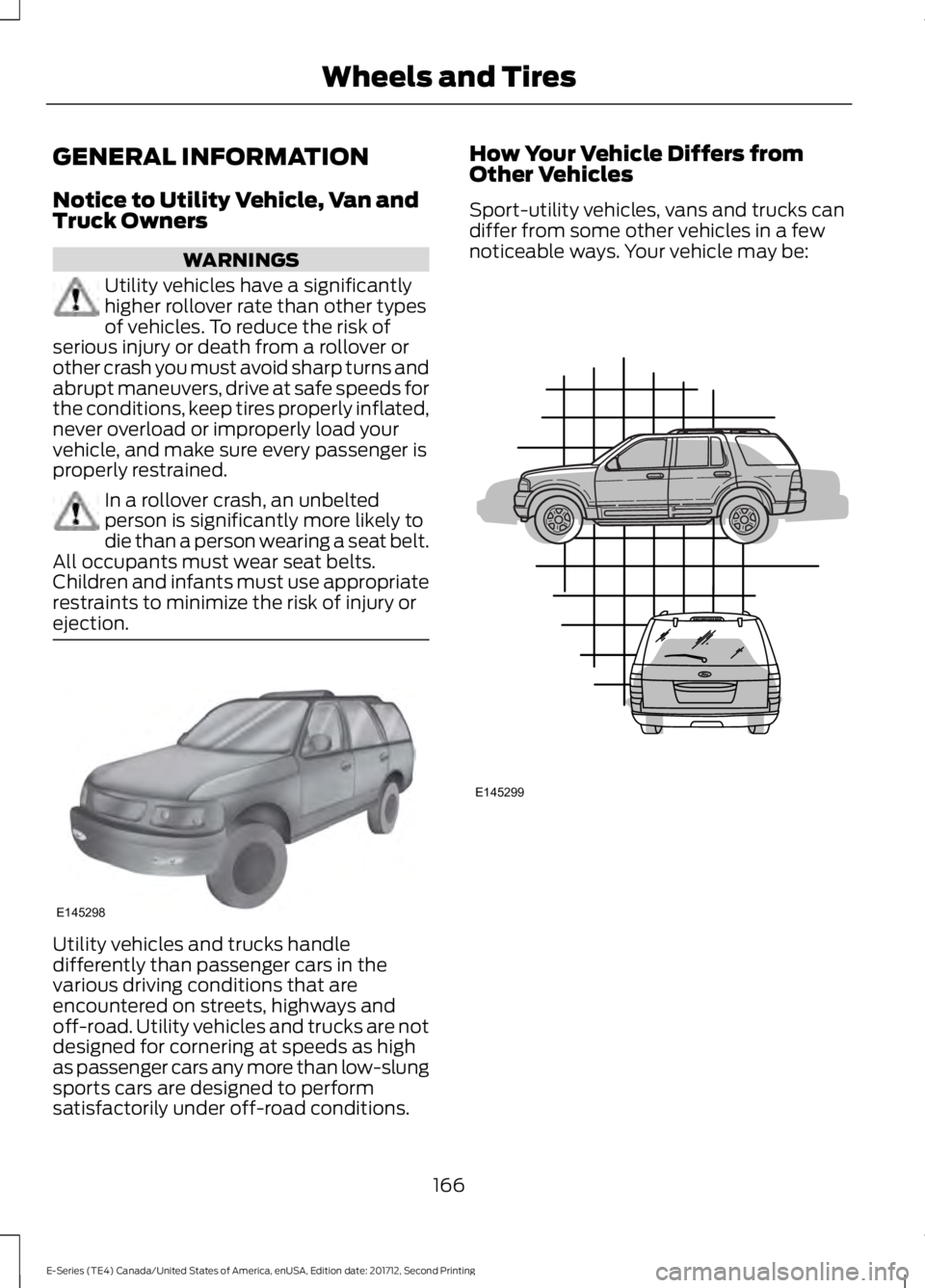
Sport-utility vehicles, vans and trucks can
differ from some other vehicles in a few
noticeable ways. Your vehicle may be:
166
E-Series (TE4) Canada/United States of America, enUSA, Edition date: 201712, Second Printing Wheels and TiresE145298 E145299
Page 317 of 323

Changing a Fuse............................................137
Fuses........................................................................\
137
Changing a Road Wheel............................189 Dissimilar Spare Wheel and Tire Assembly
Information...................................................... 189
Tire Change Procedure.................................... 190
Changing the 12V Battery...........................151 Dual Batteries....................................................... 152
Reconnecting the Battery................................. 151
Changing the Engine Air Filter.................158
Changing the Wiper Blades
......................152
Checking the Wiper Blades.......................152
Child Restraint and Seatbelt Maintenance.................................................28
Child Restraint Positioning
..........................22
Child Safety.......................................................15
General Information............................................. 15
Cleaning Products
........................................159
Materials................................................................ 159
Cleaning the Engine......................................161
Cleaning the Exterior...................................159 Cleaning the Headlamps................................ 160
Exterior Chrome Parts...................................... 160
Exterior Plastic Parts......................................... 160
Stripes or Graphics............................................ 160
Underbody............................................................ 160
Under Hood.......................................................... 160
Cleaning the Instrument Panel and Instrument Cluster Lens
..........................162
Cleaning the Interior....................................162
Cleaning the Wheels
...................................163
Cleaning the Windows and Wiper Blades.............................................................161
Climate Control
..............................................64
Coolant Check See: Engine Coolant Check............................. 142
Crash Sensors and Airbag Indicator........36
Cruise Control
..................................................45
Principle of Operation........................................ 95
Cruise control See: Using Cruise Control................................. 95
Customer Assistance..................................122
D
Data Recording
..................................................7
Event Data Recording........................................... 8
Service Data Recording......................................... 7Daytime Running Lamps............................48
Digital Radio
...................................................213
HD Radio Reception and Station
Troubleshooting............................................. 214
Direction Indicators.......................................48
Doors and Locks.............................................40
Driver and Passenger Airbags.....................31 Children and Airbags........................................... 35
Passenger Airbag On and Off Switch ...........31
Proper Driver and Front Passenger Seating Adjustment........................................................ 35
Driving Aids
......................................................96
Driving Hints....................................................114
Driving Through Water
.................................115
DRL See: Daytime Running Lamps......................... 48
E
Economical Driving.......................................114
Electromagnetic Compatibility
..............288
Emission Law...................................................82
Noise Emissions Warranty, Prohibited
Tampering Acts and Maintenance...........83
Tampering With a Noise Control System................................................................ 82
End User License Agreement.................290 SYNC End User License Agreement
(EULA)............................................................. 290
Engine Block Heater......................................75 Using the Engine Block Heater........................ 75
Engine Coolant Check
.................................142
Adding Coolant.................................................... 143
Coolant Change.................................................. 145
Engine Coolant Temperature Management
................................................... 146
Fail-Safe Cooling................................................ 145
Recycled Coolant............................................... 144
Severe Climates.................................................. 144
Engine Emission Control.............................82
Engine Immobilizer See: Passive Anti-Theft System..................... 43
Engine Oil Check............................................141 Adding Engine Oil................................................ 141
Engine Oil Dipstick
........................................141
Engine Specifications - 6.2L.....................194 Drivebelt Routing................................................ 194
314
E-Series (TE4) Canada/United States of America, enUSA, Edition date: 201712, Second Printing Index
Page 319 of 323

Vehicle Stationary for Extended Periods
During Extreme High Ambient
Temperatures................................................... 66
Hints on Driving With Anti-Lock Brakes.............................................................90
Hood Lock See: Opening and Closing the Hood...........139
I
Ignition Switch.................................................73
In California (U.S. Only)..............................123
Information Displays
.....................................56
General Information............................................ 56
Information Messages
..................................61
Brake System.......................................................... 61
Fuel........................................................................\
..... 61
Maintenance........................................................... 61
Tire........................................................................\
..... 62
Traction Control.................................................... 62
Trailer........................................................................\
63
Transmission.......................................................... 63
Installing Child Restraints
............................16
Child Seats............................................................... 16
Using Lap and Shoulder Belts.......................... 17
Using Tether Straps.............................................. 19
Instrument Cluster
..........................................51
Instrument Lighting Dimmer.....................48
Instrument Panel Overview........................14
Interior Mirror
...................................................50
Automatic Dimming Mirror.............................. 50
Manual Dimming Mirror..................................... 50
Introduction........................................................5
J
Jump Starting the Vehicle..........................119 Connecting the Jumper Cables...................... 119
Jump Starting....................................................... 120
Preparing Your Vehicle....................................... 119
Removing the Jumper Cables........................ 120
K
Keys and Remote Controls.........................37 L
Lighting Control
...............................................47
Headlamp Flasher............................................... 48
High Beams............................................................. 47
Lighting...............................................................47 General Information............................................ 47
Limited Slip Differential..............................89
Load Carrying
...................................................97
Load Limit.........................................................97 Special Loading Instructions for Owners of
Pick-up Trucks and Utility-type
Vehicles.............................................................. 101
Vehicle Loading - with and without a Trailer.................................................................... 97
Locking and Unlocking
................................40
Autolock Feature................................................... 41
Autounlock Feature.............................................. 41
Enabling or Disabling Autolock and Autounlock......................................................... 41
Illuminated Entry................................................... 41
Power Door Locks................................................ 40
Remote Control.................................................... 40
Lug Nuts See: Changing a Road Wheel........................ 189
M
Maintenance..................................................139 General Information.......................................... 139
Manual Climate Control..............................64 Heater Only System............................................ 64
Manual Climate Control.................................... 65
Manual Seats..................................................69 Manual Lumbar ................................................... 69
Moving the Seat Backward and Forward.............................................................. 69
Recline Adjustment............................................ 69
Message Center See: Information Displays................................. 56
Mirrors See: Windows and Mirrors................................ 49
Mobile Communications Equipment
.......12
Motorcraft Parts - 6.2L...............................195
Motorcraft Parts - 6.8L..............................196
316
E-Series (TE4) Canada/United States of America, enUSA, Edition date: 201712, Second Printing Index