Page 482 of 696
CAUTION!
Driving with a hot cooling system could damage your
vehicle. If temperature gauge reads “H”, pull over and
stop the vehicle. Idle the vehicle with the air condi-
tioner turned off until the pointer drops back into the
normal range. If the pointer remains on the “H”, turn
the engine off immediately, and call for service.
MANUAL PARK RELEASE
WARNING!
You should be seated in the driver ’s seat with your foot
firmly placed on the brake pedal to maintain control of
the vehicle before activating the Manual Park Release.
If possible, you should apply the parking brake. Acti-
vating the Manual Park Release will allow your ve-
hicle to roll away if it is not secured or properly
connected to a tow vehicle. Activating the Manual Park
Release on an unsecured vehicle could lead to serious
injury or death for those in or around the vehicle.In order to move the vehicle in cases where the transmis-
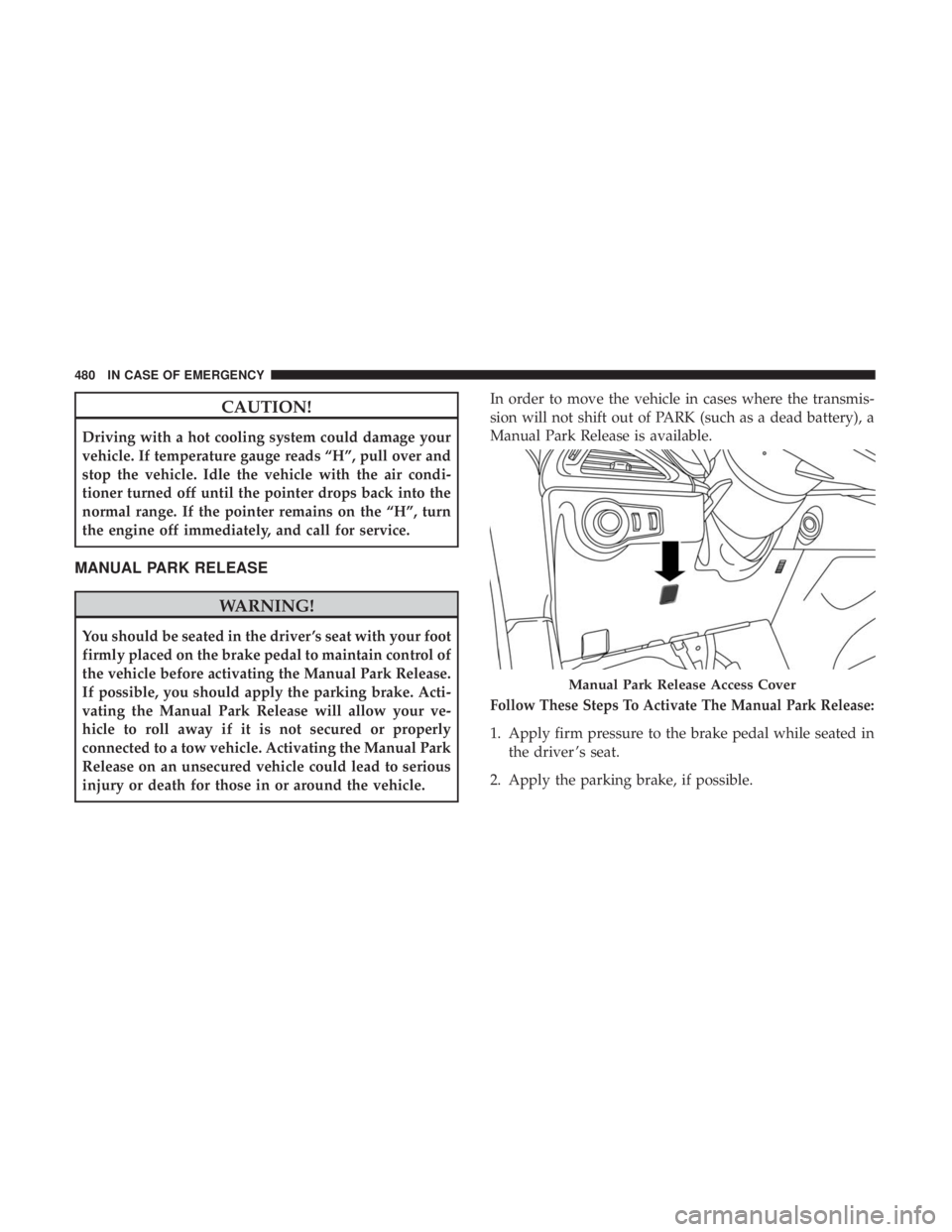
sion will not shift out of PARK (such as a dead battery), a
Manual Park Release is available.
Follow These Steps To Activate The Manual Park Release:
1. Apply firm pressure to the brake pedal while seated in
the driver ’s seat.
2. Apply the parking brake, if possible.
Manual Park Release Access Cover
480 IN CASE OF EMERGENCY
Page 485 of 696
Towing ConditionWheel OFF The Ground ALL MODELS
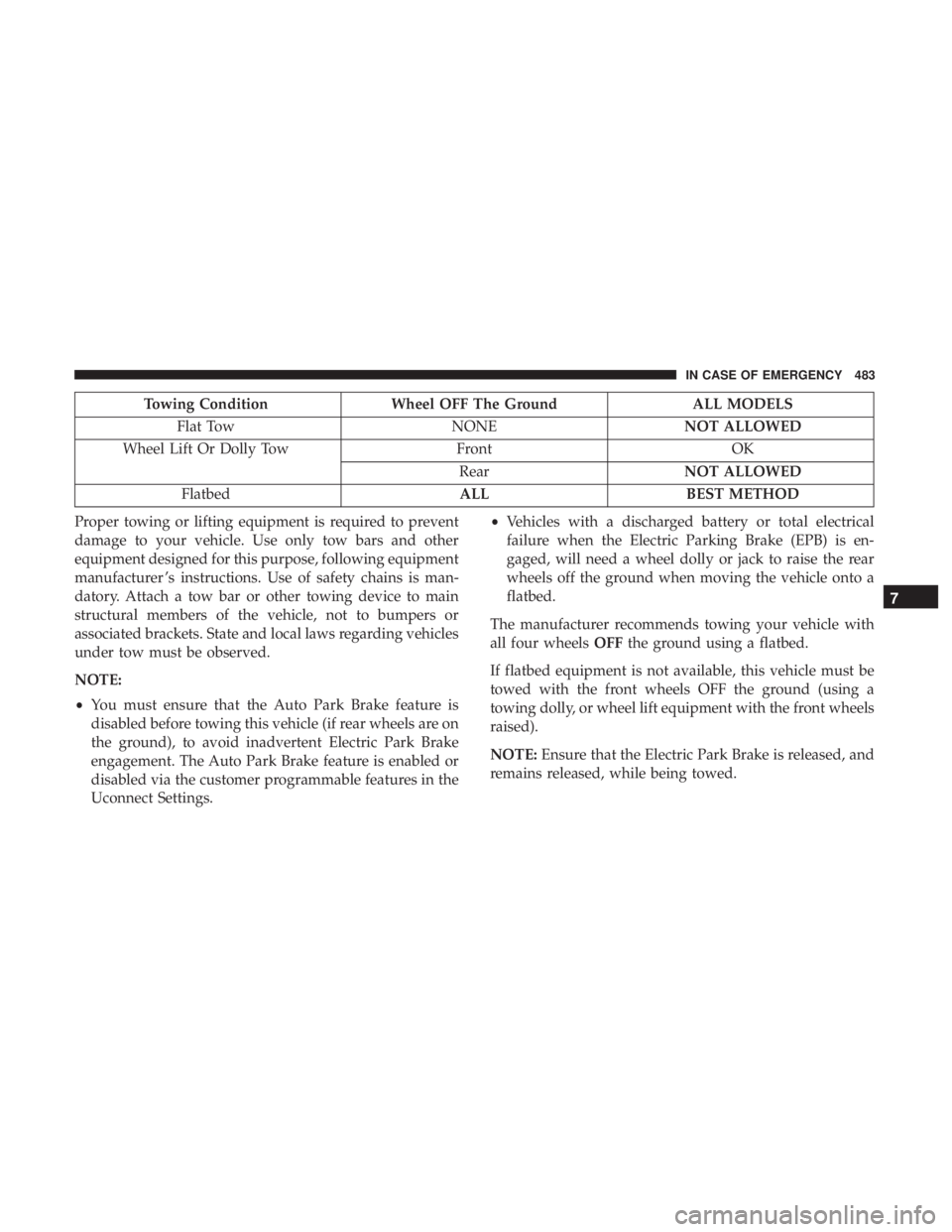
Flat Tow NONENOT ALLOWED
Wheel Lift Or Dolly Tow FrontOK
Rear NOT ALLOWED
Flatbed ALLBEST METHOD
Proper towing or lifting equipment is required to prevent
damage to your vehicle. Use only tow bars and other
equipment designed for this purpose, following equipment
manufacturer ’s instructions. Use of safety chains is man-
datory. Attach a tow bar or other towing device to main
structural members of the vehicle, not to bumpers or
associated brackets. State and local laws regarding vehicles
under tow must be observed.
NOTE:
• You must ensure that the Auto Park Brake feature is
disabled before towing this vehicle (if rear wheels are on
the ground), to avoid inadvertent Electric Park Brake
engagement. The Auto Park Brake feature is enabled or
disabled via the customer programmable features in the
Uconnect Settings. •
Vehicles with a discharged battery or total electrical
failure when the Electric Parking Brake (EPB) is en-
gaged, will need a wheel dolly or jack to raise the rear
wheels off the ground when moving the vehicle onto a
flatbed.
The manufacturer recommends towing your vehicle with
all four wheels OFFthe ground using a flatbed.
If flatbed equipment is not available, this vehicle must be
towed with the front wheels OFF the ground (using a
towing dolly, or wheel lift equipment with the front wheels
raised).
NOTE: Ensure that the Electric Park Brake is released, and
remains released, while being towed.
7
IN CASE OF EMERGENCY 483
Page 487 of 696
CAUTION!(Continued)
•Be applied parallel to the center line of the length of
the vehicle.
• Not be an abrupt acceleration.
If you must use the accessories (wipers, defrosters, etc.)
while being towed, the ignition must be in the ON/RUN
mode, not the ACC mode.
NOTE: The Safehold feature will engage the Electric Park
Brake whenever the driver’s door is opened (if the ignition
is ON, transmission is not in PARK, and brake pedal is
released). If you are towing this vehicle with the ignition in
the ON/RUN mode, you must manually disable the Elec-
tric Park Brake each time the driver’s door is opened, by
pressing the brake pedal and then releasing the EPB.
If the key fob is unavailable, or the vehicle’s battery is
discharged, refer to “Manual Park Release” in this section
for instructions on shifting the transmission out of PARK in
order to move the vehicle.
CAUTION!
• Do not use sling-type equipment when towing. Ve-
hicle damage may occur.
• When securing the vehicle to a flatbed truck, do not
attach to front or rear suspension components. Dam-
age to your vehicle may result from improper towing.
• Ensure that the Electric Park Brake is released, and
remains released, while being towed.
ENHANCED ACCIDENT RESPONSE SYSTEM
(EARS)
This vehicle is equipped with an Enhanced Accident
Response System.
Please refer to “Occupant Restraint Systems” in “Safety”
for further information on the Enhanced Accident Re-
sponse System (EARS) function.
7
IN CASE OF EMERGENCY 485
Page 489 of 696

SERVICING AND MAINTENANCE
CONTENTS
�SCHEDULED SERVICING .................489
▫ Maintenance Plan ..................... .490
▫ Heavy Duty Use Of The Vehicle ............492
� ENGINE COMPARTMENT .................493
▫ 3.6L Engine ..........................493
▫ Checking Oil Level .....................494
▫ Adding Washer Fluid ...................494
▫ Maintenance-Free Battery .................495
� DEALER SERVICE .......................496
▫ Engine Oil .......................... .496
▫ Engine Oil Filter .......................498
▫ Engine Air Cleaner Filter .................498
▫ Accessory Drive Belt Inspection ............499
▫ Air Conditioner Maintenance ..............500▫
Body Lubrication ..................... .503
▫ Windshield Wiper Blades .................504
▫ Exhaust System ........................508
▫ Cooling System ........................510
▫ Brake System ........................ .514
▫ Automatic Transmission ..................516
� RAISING THE VEHICLE ..................517
� TIRES ............................... .517
▫ Tire Safety Information ..................517
▫ Tires — General Information ..............527
▫ Tire Types ............................533
▫ Spare Tires — If Equipped ................534
▫ Wheel And
Wheel Trim Care ..............537
▫ Tire Chains (Traction Devices) .............538
8
Page 492 of 696
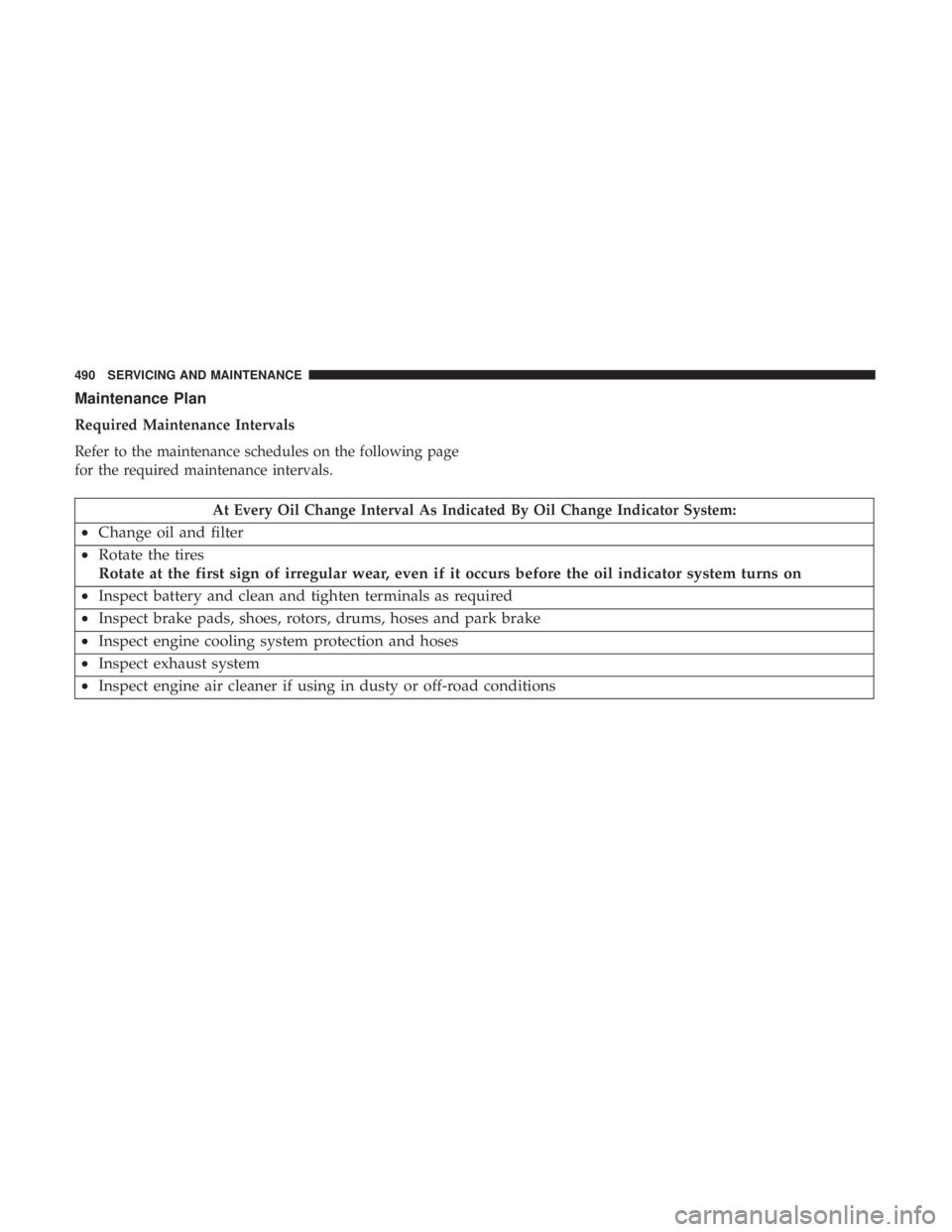
Maintenance Plan
Required Maintenance Intervals
Refer to the maintenance schedules on the following page
for the required maintenance intervals.
At Every Oil Change Interval As Indicated By Oil Change Indicator System:
•Change oil and filter
• Rotate the tires
Rotate at the first sign of irregular wear, even if it occurs before the oil indicator system turns on
• Inspect battery and clean and tighten terminals as required
• Inspect brake pads, shoes, rotors, drums, hoses and park brake
• Inspect engine cooling system protection and hoses
• Inspect exhaust system
• Inspect engine air cleaner if using in dusty or off-road conditions
490 SERVICING AND MAINTENANCE
Page 495 of 696
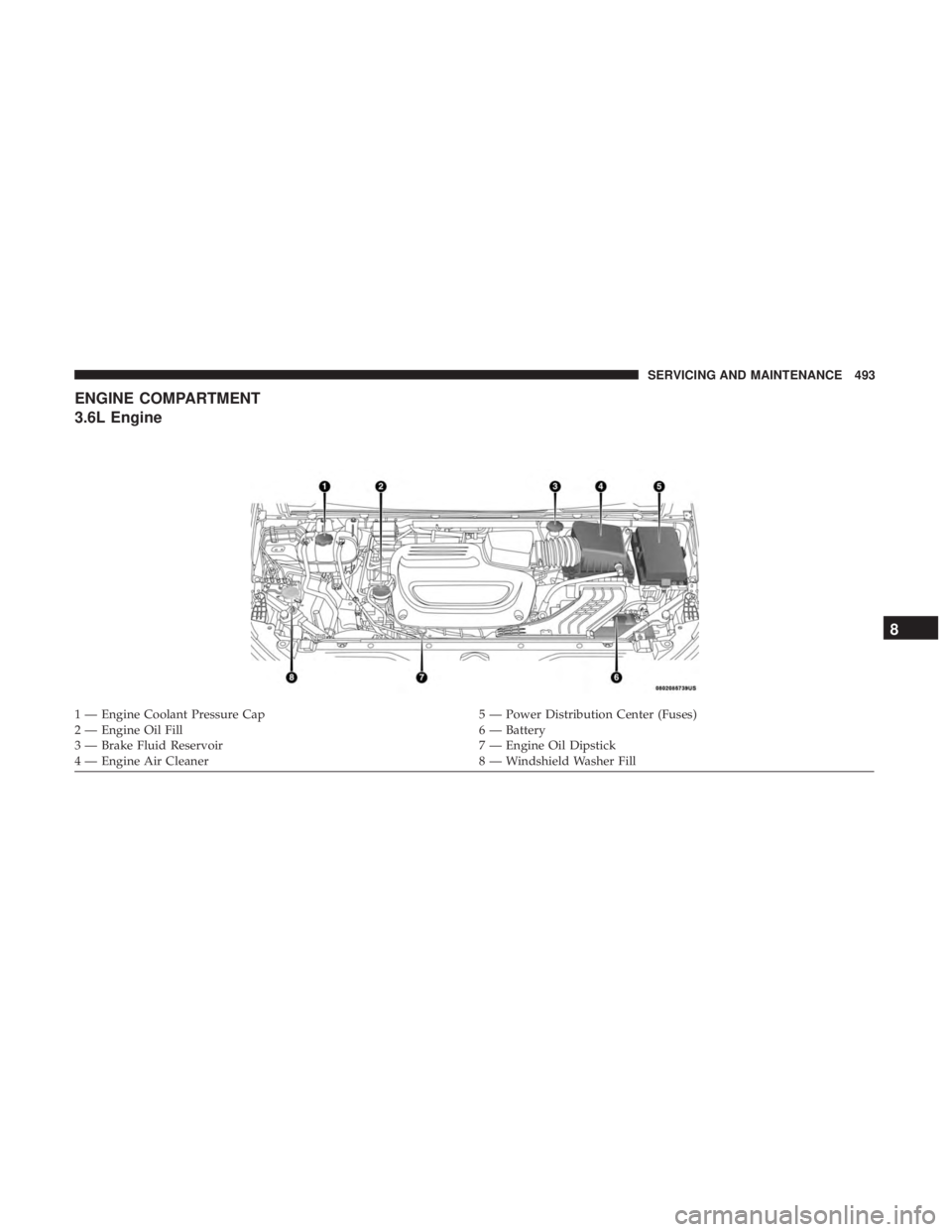
ENGINE COMPARTMENT
3.6L Engine
1 — Engine Coolant Pressure Cap5 — Power Distribution Center (Fuses)
2 — Engine Oil Fill 6 — Battery
3 — Brake Fluid Reservoir 7 — Engine Oil Dipstick
4 — Engine Air Cleaner 8 — Windshield Washer Fill
8
SERVICING AND MAINTENANCE 493
Page 497 of 696
When refilling the washer fluid reservoir, take some
washer fluid, apply it to a cloth or towel, and wipe clean
the wiper blades; this will help blade performance.
To prevent freeze-up of your windshield washer system in
cold weather, select a solution or mixture that meets or
exceeds the temperature range of your climate. This rating
information can be found on most washer fluid containers.
WARNING!
Commercially available windshield washer solvents
are flammable. They could ignite and burn you. Care
must be exercised when filling or working around the
washer solution.
Maintenance-Free Battery
Your vehicle is equipped with a maintenance-free battery.
You will never have to add water, nor is periodic mainte-
nance required.
WARNING!
•Battery fluid is a corrosive acid solution and can
burn or even blind you. Do not allow battery fluid to
(Continued)
WARNING! (Continued)
contact your eyes, skin, or clothing. Do not lean over
a battery when attaching clamps. If acid splashes in
eyes or on skin, flush the area immediately with
large amounts of water. Refer to “Jump Starting
Procedure” in “In Case Of Emergency” for further
information.
• Battery gas is flammable and explosive. Keep flame
or sparks away from the battery. Do not use a booster
battery or any other booster source with an output
greater than 12 Volts. Do not allow cable clamps to
touch each other.
• Battery posts, terminals, and related accessories con-
tain lead and lead compounds. Wash hands after
handling.
CAUTION!
•It is essential when replacing the cables on the
battery that the positive cable is attached to the
positive post and the negative cable is attached to the
negative post. Battery posts are marked positive (+)
and negative (-) and are identified on the battery
(Continued)
8
SERVICING AND MAINTENANCE 495
Page 498 of 696
CAUTION!(Continued)
case. Cable clamps should be tight on the terminal
posts and free of corrosion.
• If a “fast charger” is used while the battery is in the
vehicle, disconnect both vehicle battery cables before
connecting the charger to the battery. Do not use a
“fast charger” to provide starting voltage.
DEALER SERVICE
An authorized dealer has the qualified service personnel,
special tools, and equipment to perform all service opera-
tions in an expert manner. Service Manuals are available
which include detailed service information for your ve-
hicle. Refer to these Service Manuals before attempting any
procedure yourself.
NOTE: Intentional tampering with emissions control sys-
tems may void your warranty and could result in civil
penalties being assessed against you.
WARNING!
You can be badly injured working on or around a
motor vehicle. Only do service work for which you
have the knowledge and the proper equipment. If you
have any doubt about your ability to perform a service
job, take your vehicle to a competent mechanic.
Engine Oil
Change Engine Oil
Refer to “Scheduled Servicing” in this section for the
proper maintenance intervals.
NOTE: Under no circumstances should oil change inter-
vals exceed 10,000 miles (16,000 km), 12 months or 350
hours of engine run time, whichever comes first. The 350
hours of engine run or idle time is generally only a concern
for fleet customers.
Gasoline Engine Oil Selection
For best performance and maximum protection under all
types of operating conditions, the manufacturer only rec-
ommends engine oils that are API Certified and meet the
requirements of FCA Material Standard MS-6395.
496 SERVICING AND MAINTENANCE