Page 173 of 696
WARNING!(Continued)
•Close the lid when not in use and while driving the
vehicle.
• If this outlet is mishandled, it may cause an electric
shock and failure.
CAUTION!
•Many accessories that can be plugged in draw power
from the vehicle’s battery, even when not in use (i.e.,
cellular phones, etc.). Eventually, if plugged in long
enough, the vehicle’s battery will discharge suffi-
ciently to degrade battery life and/or prevent the
engine from starting.
• Accessories that draw higher power (i.e., coolers,
vacuum cleaners, lights, etc.) will degrade the battery
even more quickly. Only use these intermittently and
with greater caution.
• After the use of high power draw accessories, or long
periods of the vehicle not being started (with acces-
sories still plugged in), the vehicle must be driven a
sufficient length of time to allow the generator to
recharge the vehicle’s battery.
Power Inverter — If Equipped
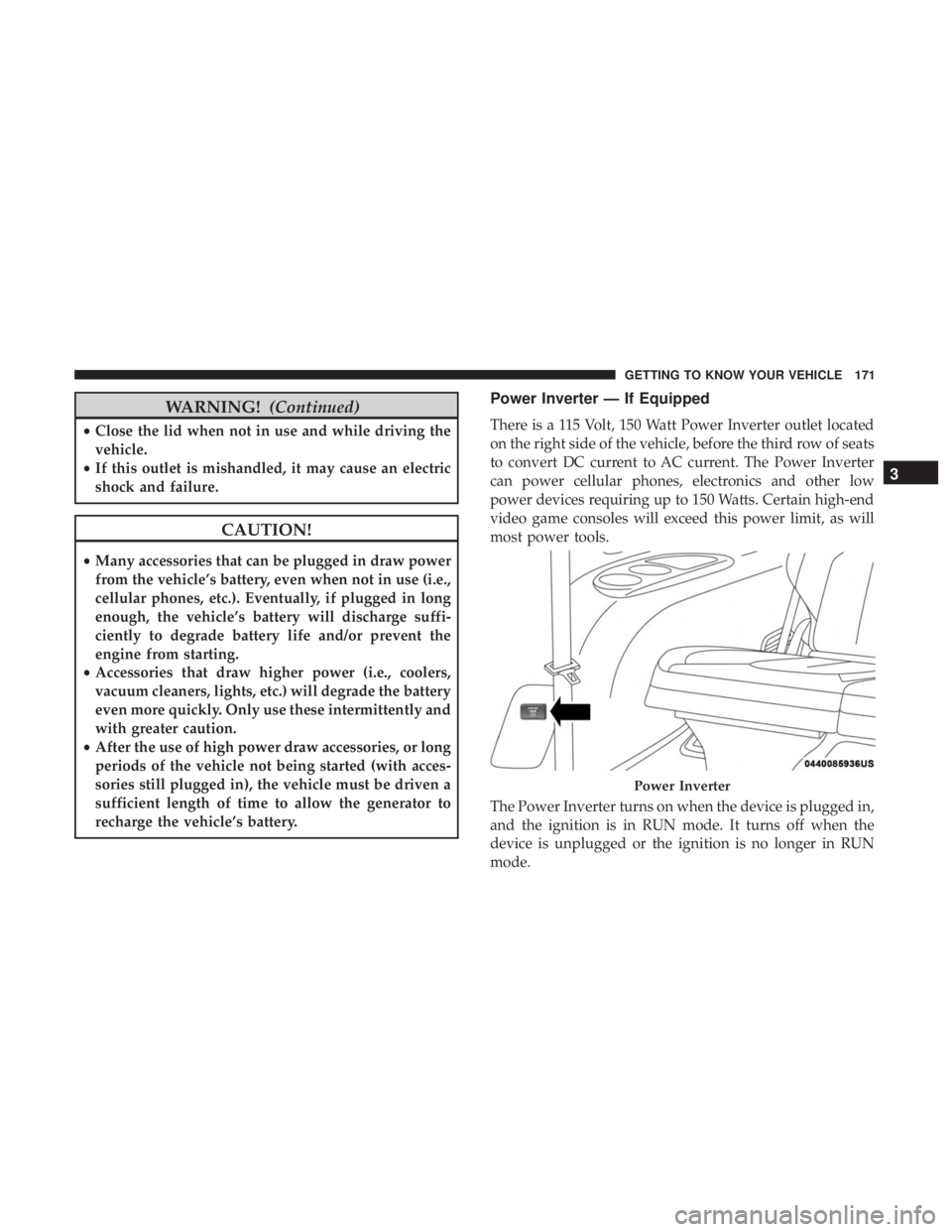
There is a 115 Volt, 150 Watt Power Inverter outlet located
on the right side of the vehicle, before the third row of seats
to convert DC current to AC current. The Power Inverter
can power cellular phones, electronics and other low
power devices requiring up to 150 Watts. Certain high-end
video game consoles will exceed this power limit, as will
most power tools.
The Power Inverter turns on when the device is plugged in,
and the ignition is in RUN mode. It turns off when the
device is unplugged or the ignition is no longer in RUN
mode.
Power Inverter
3
GETTING TO KNOW YOUR VEHICLE 171
Page 249 of 696
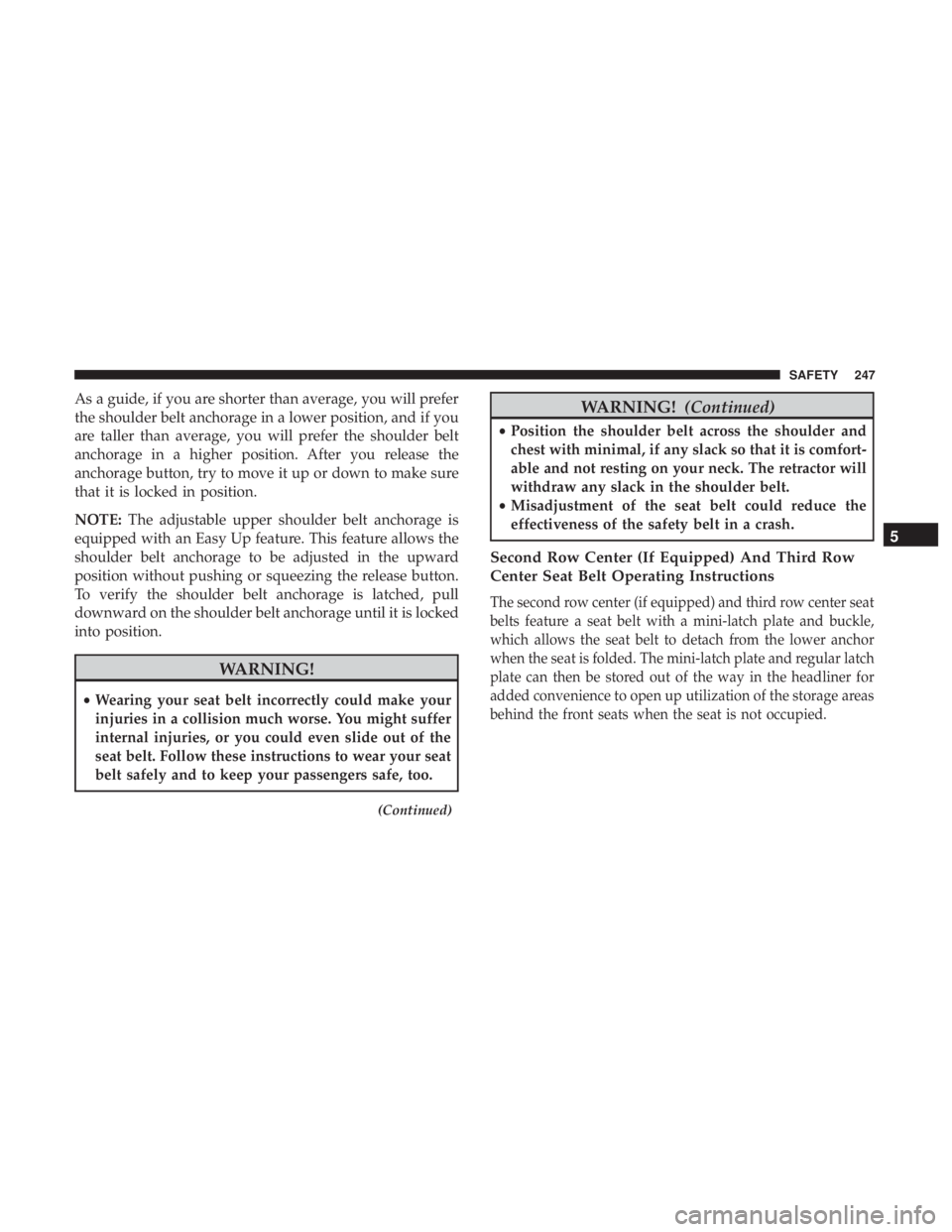
As a guide, if you are shorter than average, you will prefer
the shoulder belt anchorage in a lower position, and if you
are taller than average, you will prefer the shoulder belt
anchorage in a higher position. After you release the
anchorage button, try to move it up or down to make sure
that it is locked in position.
NOTE:The adjustable upper shoulder belt anchorage is
equipped with an Easy Up feature. This feature allows the
shoulder belt anchorage to be adjusted in the upward
position without pushing or squeezing the release button.
To verify the shoulder belt anchorage is latched, pull
downward on the shoulder belt anchorage until it is locked
into position.
WARNING!
• Wearing your seat belt incorrectly could make your
injuries in a collision much worse. You might suffer
internal injuries, or you could even slide out of the
seat belt. Follow these instructions to wear your seat
belt safely and to keep your passengers safe, too.
(Continued)
WARNING! (Continued)
•Position the shoulder belt across the shoulder and
chest with minimal, if any slack so that it is comfort-
able and not resting on your neck. The retractor will
withdraw any slack in the shoulder belt.
• Misadjustment of the seat belt could reduce the
effectiveness of the safety belt in a crash.
Second Row Center (If Equipped) And Third Row
Center Seat Belt Operating Instructions
The second row center (if equipped) and third row center seat
belts feature a seat belt with a mini-latch plate and buckle,
which allows the seat belt to detach from the lower anchor
when the seat is folded. The mini-latch plate and regular latch
plate can then be stored out of the way in the headliner for
added convenience to open up utilization of the storage areas
behind the front seats when the seat is not occupied.
5
SAFETY 247
Page 250 of 696
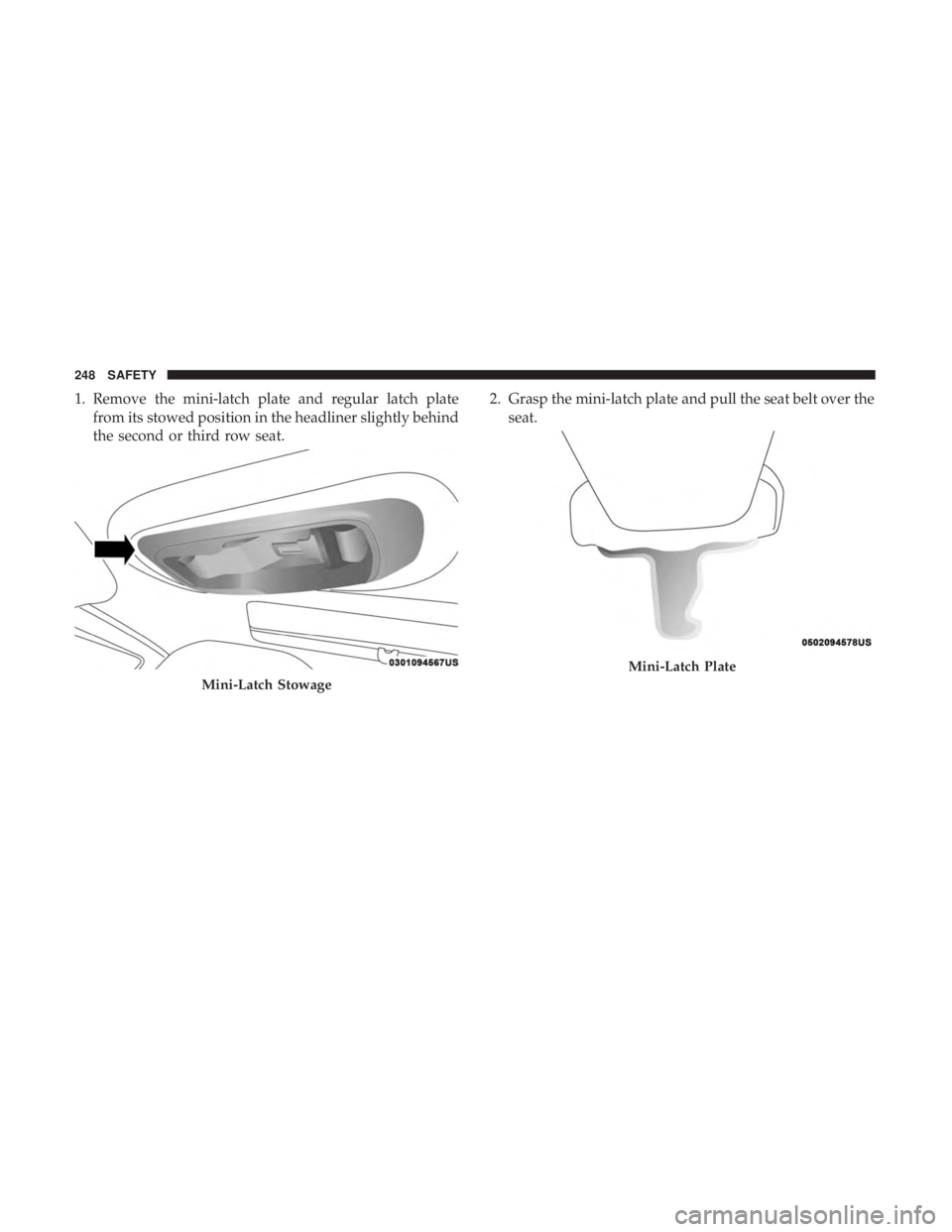
1. Remove the mini-latch plate and regular latch platefrom its stowed position in the headliner slightly behind
the second or third row seat. 2. Grasp the mini-latch plate and pull the seat belt over the
seat.
Mini-Latch Stowage
Mini-Latch Plate
248 SAFETY
Page 258 of 696
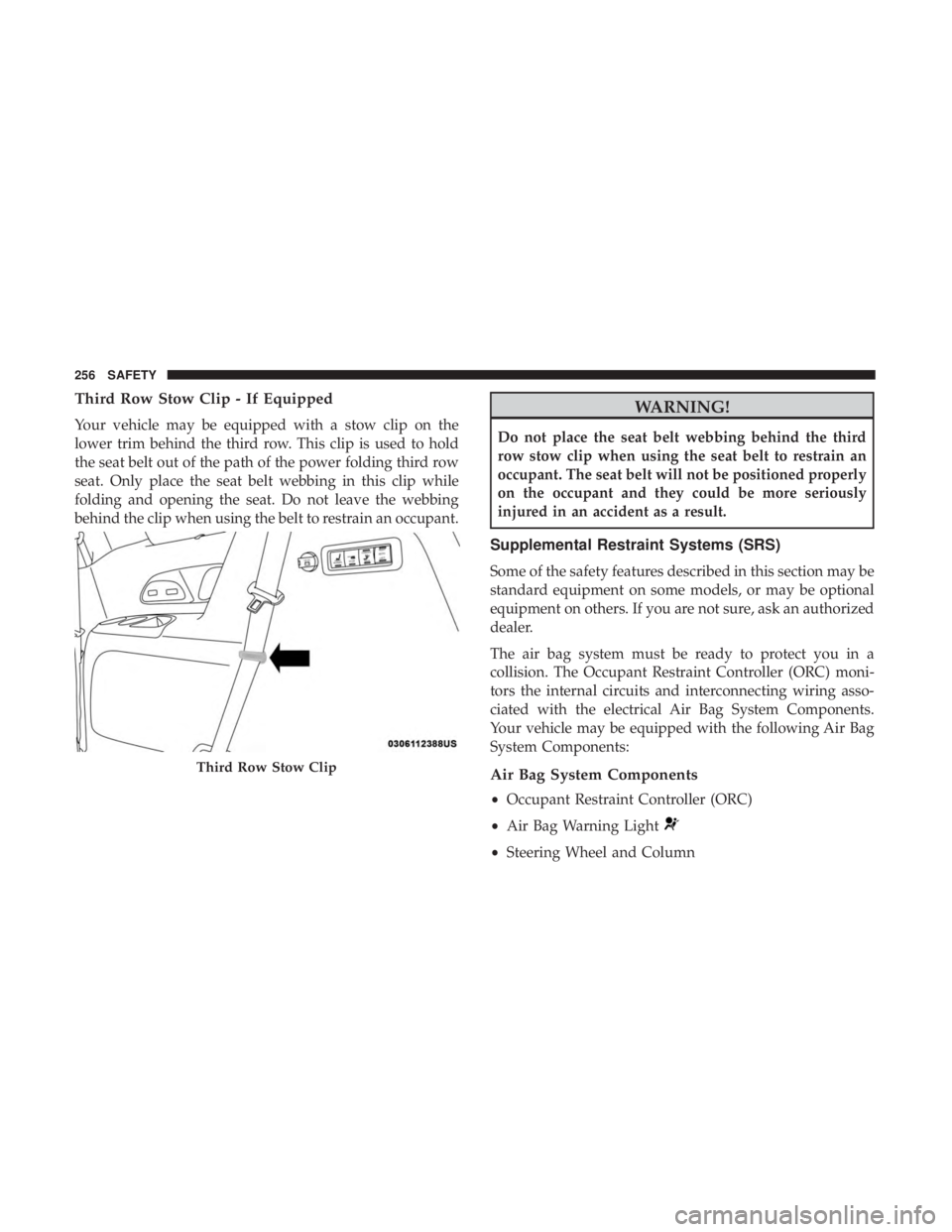
Third Row Stow Clip - If Equipped
Your vehicle may be equipped with a stow clip on the
lower trim behind the third row. This clip is used to hold
the seat belt out of the path of the power folding third row
seat. Only place the seat belt webbing in this clip while
folding and opening the seat. Do not leave the webbing
behind the clip when using the belt to restrain an occupant.
WARNING!
Do not place the seat belt webbing behind the third
row stow clip when using the seat belt to restrain an
occupant. The seat belt will not be positioned properly
on the occupant and they could be more seriously
injured in an accident as a result.
Supplemental Restraint Systems (SRS)
Some of the safety features described in this section may be
standard equipment on some models, or may be optional
equipment on others. If you are not sure, ask an authorized
dealer.
The air bag system must be ready to protect you in a
collision. The Occupant Restraint Controller (ORC) moni-
tors the internal circuits and interconnecting wiring asso-
ciated with the electrical Air Bag System Components.
Your vehicle may be equipped with the following Air Bag
System Components:
Air Bag System Components
•Occupant Restraint Controller (ORC)
• Air Bag Warning Light
•Steering Wheel and Column
Third Row Stow Clip
256 SAFETY
Page 288 of 696
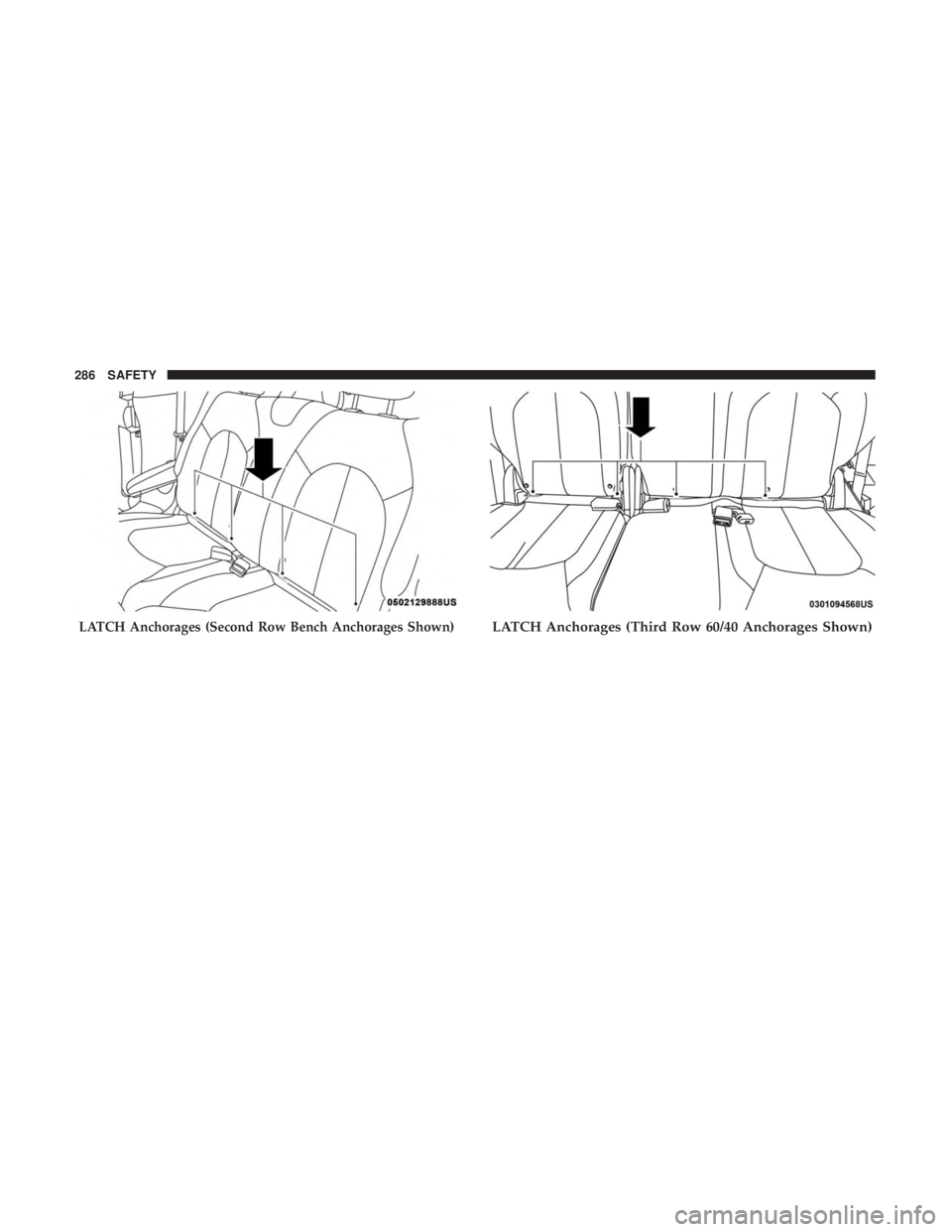
LATCH Anchorages (Second Row Bench Anchorages Shown)LATCH Anchorages (Third Row 60/40 Anchorages Shown)
286 SAFETY
Page 289 of 696
Locating The Upper Tether Anchorages
There are tether strap anchorages located behind
all second row seating positions. The third row
has a tether anchor on the 40% seat for the right
outboard position and in the center of the 60%
seat for either the center or left outboard seating position.
All tether anchorages are located on the back of the seat,
near the floor.
Tether Strap Anchorages
(Second Row Bench Anchorage Shown)
Tether Strap Anchorages
(Second Row 8 Passenger Anchorage Shown)
5
SAFETY 287
Page 290 of 696

LATCH-compatible child restraint systems will be
equipped with a rigid bar or a flexible strap on each side.
Each will have a hook or connector to attach to the lower
anchorage and a way to tighten the connection to the
anchorage. Forward-facing child restraints and some rear-
facing child restraints will also be equipped with a tether
strap. The tether strap will have a hook at the end to attach
to the top tether anchorage and a way to tighten the strap
after it is attached to the anchorage.
Center Seat LATCH
This vehicle has 4 lower LATCH anchorages in the third
row, rear seat. Anchorages A and B are used for the right
outboard position behind the front passenger (1). Anchor-
ages C and D are used for the center seating position (2).
The left outboard position (3) does not have lower anchor-
ages. Do not install a child restraint using anchorages B
and C. This is not a LATCH position in your vehicle.
Tether Strap Anchorages
(Third Row 60/40 Anchorage Shown)
Center Seat LATCH Positions
288 SAFETY
Page 301 of 696

WARNING!(Continued)
•If your vehicle is equipped with a split rear seat,
make sure the tether strap does not slip into the
opening between the seatbacks as you remove slack
in the strap.
Third Row Tether Attachment
The tether anchorage found on the back of the 60% seat in
the third row may be used by either the left outboard or the
center seating position. Only tether one child restraint to
the tether anchorage at a time.
To connect the tether strap hook to the tether anchorage for
either seating position on the 60% third row seat:
1. Route the tether strap to provide the most direct path for
the strap between the anchor and the child seat.
2. If the car seat is in the center, raise the center head restraint and route the tether strap around the inboard
(left) side of the head restraint support posts, as shown
in the diagram. 3. Attach the tether strap hook of the child restraint to the
top tether anchorage as shown in the diagram.
4. Remove slack in the tether strap according to the child restraint manufacturer ’s instructions.
Center Tether Attachment – 3rd Row
5
SAFETY 299