2018 CHEVROLET LOW CAB FORWARD maintenance
[x] Cancel search: maintenancePage 153 of 358

Chevrolet Low Cab Forward Owner Manual (GMNA-Localizing-U.S.-
11254764) - 2018 - crc - 12/5/16
152 Driving and Operating
Cold Weather Starting
If you plan ahead for cold weather,
starting and driving your vehicle
should be no problem. The following
tips will help ensure good starting in
cold weather.
Oil gets thicker as it gets colder,
which slows down the engine
cranking speed. The diesel engine
functions by the heat of
compression (and glow plugs when
cold), rather than through the use of
spark plugs as in a gasoline engine.
So, your engine must crank faster
than a gasoline engine before it will
start.
To be sure the engine can turn fast
enough to start, use SAE 10W-40
viscosity engine oil when prevailing
temperatures drop below 0 °C
(32 °F). See the oil quality and oil
viscosity recommendations. Using
the proper viscosity oil will make
starting easier down to -23 °C
(-10 °F). When prevailing
temperatures drop below -23 °C
(-10 °F), the engine block heater
may be needed for starting. See
Engine Heater0154. Maintenance Items to Aid Cold
Weather Starting
Since the basic principle of diesel
engine ignition is based on
compression, the diesel engine is
somewhat harder to start than a
gasoline engine when the
temperature is below freezing.
To help prevent hard starting
problems, special attention should
be given to following normal
maintenance items:
1. Neglecting to have the fuel filter and water separator
serviced can be one of the
major contributors to hard
starting. If water is permitted to
accumulate in the primary filter,
it will freeze and make starting
the engine impossible.
2. Make sure the fuel tank vent is open.
3. Always refuel at the end of a day's operation. Moisture will
condense in an empty tank;
therefore, the tank should be filled before leaving the vehicle
standing for an extended
period.
Do not use starting aids in the air
intake system. Such aids can cause
immediate engine damage. See
Fuel for Diesel Engines 0206.
Stopping the Engine
When stopping the engine, take the
following steps: 1. Bring the vehicle to a complete stop.
2. Firmly apply the parking brake.
3. Move the selector lever to the P position and make sure that
the shift indicator shows P.
4. Allow the engine to idle for approximately 3 minutes.
5. Turn the engine control switch to the ACC or LOCK position.
Do not shut down the engine
immediately after driving the vehicle.
Otherwise, a seizure or other
failures may result.
Page 160 of 358

Chevrolet Low Cab Forward Owner Manual (GMNA-Localizing-U.S.-
11254764) - 2018 - crc - 12/5/16
Driving and Operating 159
Engine Exhaust
Engine Exhaust Emissions
Caution (Carbon Monoxide)
{Warning
Do not breathe exhaust gas
because it contains carbon
monoxide, which by itself has no
color or odor. Carbon monoxide is
a dangerous gas. It can cause
unconsciousness and can be
lethal.
Do not keep the engine running
for any length of time in a place
that is poorly ventilated. It is
particularly dangerous to run the
engine in a garage or other indoor
place that could easily fill with
exhaust gases because you could
suffer carbon monoxide
poisoning.
Inspect the exhaust pipe from
time to time. If you notice any
defect (for example, a damaged
joint, or a hole or crack caused by(Continued)
Warning (Continued)
corrosion), have checks and
maintenance performed by the
nearest dealer. Continuing to use
the vehicle without having the
defect repaired would be
dangerous because exhaust
gases could get into the cab and
cause carbon monoxide
poisoning.
If at any time you think exhaust
fumes are entering the cab, have
the cause determined and
corrected as soon as possible.
If you must drive under these
conditions, drive only with all
windows fully open. Prevent
carbon monoxide from entering
the cab. The best way is to keep
the engine exhaust system, cab
and cab ventilation system
properly maintained.
We recommend that the exhaust
system and cab be inspected by
a competent technician:(Continued)
Warning (Continued)
.Each time the vehicle has
an oil change.
. Whenever a change is
noticed in the sound of the
exhaust system.
. Whenever the exhaust
system, underbody or cab is
damaged or becomes
corroded.
To allow proper operation of your
vehicle's ventilation system, keep
the air inlet grille clear of snow,
leaves or other obstructions at all
times. Do not park with the
engine running or idle this vehicle
for more than 10 minutes with the
ventilation system control switch
in the OFF position. Even with the
ventilation system on, running the
engine while parked or stopped
for longer periods of time is not
recommended. Entry of carbon
monoxide into the cab is possible
with a poorly repaired, damaged, (Continued)
Page 161 of 358

Chevrolet Low Cab Forward Owner Manual (GMNA-Localizing-U.S.-
11254764) - 2018 - crc - 12/5/16
160 Driving and Operating
Warning (Continued)
or corroded exhaust system or
cab. Do not run the engine in
confined areas (such as garages,
next to a building or near another
stopped vehicles with engine
running) any more than needed to
move the vehicle.
When the vehicle has to be
stopped in an unconfined area
with the engine running for any
more than a few minutes, take the
following steps:. Adjust the heating or cooling
system to force outside air
into the cab.
. With temperature and outlet
selector knob in any
position:
. Set the air selector lever to
the fresh air position.
. Set the fan speed control
knob to the maximum speed
position.
(Continued)
Warning (Continued)
.Keep the exhaust tailpipe
area clear of snow and
other material to help
reduce the buildup of
exhaust gases under the
vehicle.
This is particularly important when
parked in blizzard conditions. You
and others could be seriously
injured.
See Climate Control Systems 0115
and Maintenance Schedule 0303.
Running the Vehicle
While Parked
Caution
To reduce the chance of personal
injury and/or vehicle damage due
to engine overheating, never
leave the engine idling without an
alert driver present. If the engine
(Continued)
Caution (Continued)
should overheat, as indicated by
the engine coolant temperature
gauge, immediate action is
required to correct the condition.
Continued operation of the
engine, even for a short time, may
result in a fire. Do not engage the
exhaust brake while the engine is
idling as this may cause engine
overheating.
Avoid Unnecessary Idling of the
Diesel Engine
If the engine idles too long, the
engine coolant temperature will fall
below the operating range. Low
engine operating temperature
causes several conditions that are
harmful to engine operation and life.
Incomplete combustion of fuel in an
engine that is not fully warmed-up
causes crankcase dilution and
forms lacquer and gummy deposits
on valves, pistons, and rings. It also
causes rapid accumulation of
sludge within the engine.
Page 162 of 358

Chevrolet Low Cab Forward Owner Manual (GMNA-Localizing-U.S.-
11254764) - 2018 - crc - 12/5/16
Driving and Operating 161
Diesel Particulate
Filter
Diesel Particulate Filter (DPF)
The DPF purifies diesel exhaust
gases of particulate matter (PM). PM
is filtered from the exhaust gas and
collected in the DPF. When PM is
collected to the predetermined level
by the engine control module, the
DPF automatically burns the PM in
a process called regeneration.
Regeneration may not be completed
under certain driving conditions.
If this occurs, the Driver Information
Center (DIC) will provide prompts to
properly complete DPF
regeneration.
The following sections will provide
details on DPF regeneration. Follow
the steps carefully to keep the DPF
in good working order. SeeDriver
Information Center (DIC) 082,
Recommended Fluids and
Lubricants 0326, and Engine Oil
0 223.
{Warning
Exhaust parts and gases become
very hot when the DPF is being
regenerated.
Parking over flammable items
could allow them to touch hot
exhaust parts under your vehicle
and cause them to ignite. Do not
park over papers, leaves, grass
or other things that can burn. You
and others could be seriously
injured.
This content is to restore the
function of the DPF and it is not a
malfunction. However, the check
engine malfunction indicator light
and reduced engine power indicator
light may come on and the power
output may be limited if driving or
power take-off (PTO) operation is
continued for a long time with the
regeneration required warning light
or selectable (switch) regeneration
required warning light (amber/
red) on. This is to prevent the DPF from
being damaged. When operating
PTO during parking, check to
ensure that the regeneration
required warning light or selectable
(switch) regeneration required
warning light (amber/red) on the DIC
is not on.
Engine oil that supports DPF (low
ash oil) is recommended. Use of low
ash oil extends the maintenance
interval of the DPF filter.
Do not modify the DPF or exhaust
pipe. Changing the alignment,
length or diameter of the exhaust
pipe would adversely affect the
exhaust system's exhaust emission
reduction function. If any
modification is necessary to install a
component to the rear of the
vehicle, consult your dealer.
Although the DPF filter automatically
undergoes regeneration (burning of
the accumulated PM) when a
certain amount of PM has
accumulated, driving conditions can
prevent completion of regeneration.
Page 202 of 358
Chevrolet Low Cab Forward Owner Manual (GMNA-Localizing-U.S.-
11254764) - 2018 - crc - 12/5/16
Driving and Operating 201
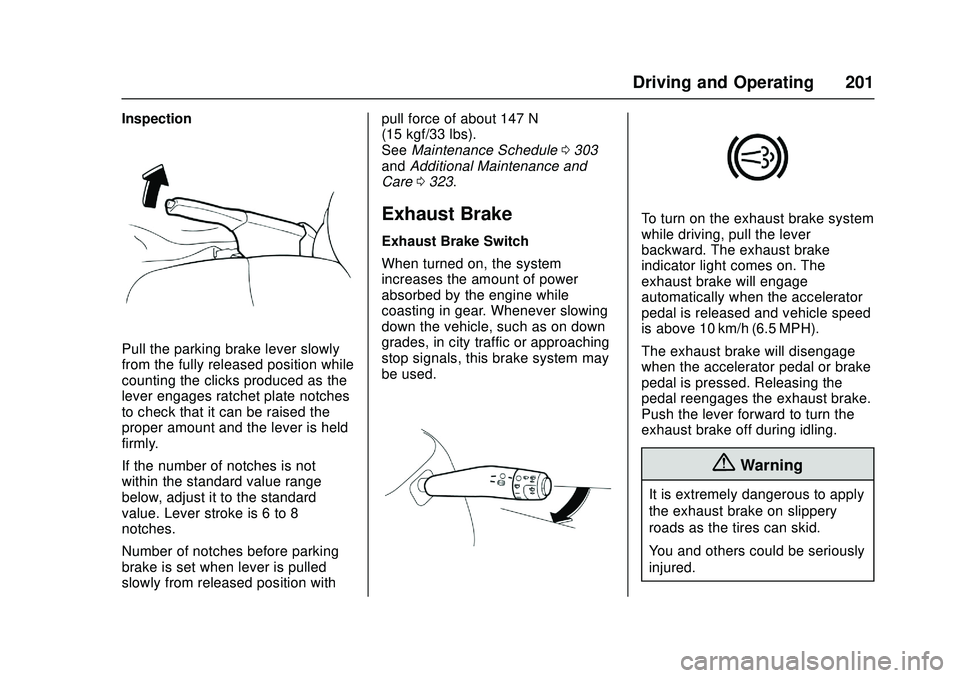
Inspection
Pull the parking brake lever slowly
from the fully released position while
counting the clicks produced as the
lever engages ratchet plate notches
to check that it can be raised the
proper amount and the lever is held
firmly.
If the number of notches is not
within the standard value range
below, adjust it to the standard
value. Lever stroke is 6 to 8
notches.
Number of notches before parking
brake is set when lever is pulled
slowly from released position withpull force of about 147 N
(15 kgf/33 lbs).
See
Maintenance Schedule 0303
and Additional Maintenance and
Care 0323.
Exhaust Brake
Exhaust Brake Switch
When turned on, the system
increases the amount of power
absorbed by the engine while
coasting in gear. Whenever slowing
down the vehicle, such as on down
grades, in city traffic or approaching
stop signals, this brake system may
be used.
To turn on the exhaust brake system
while driving, pull the lever
backward. The exhaust brake
indicator light comes on. The
exhaust brake will engage
automatically when the accelerator
pedal is released and vehicle speed
is above 10 km/h (6.5 MPH).
The exhaust brake will disengage
when the accelerator pedal or brake
pedal is pressed. Releasing the
pedal reengages the exhaust brake.
Push the lever forward to turn the
exhaust brake off during idling.
{Warning
It is extremely dangerous to apply
the exhaust brake on slippery
roads as the tires can skid.
You and others could be seriously
injured.
Page 219 of 358

Chevrolet Low Cab Forward Owner Manual (GMNA-Localizing-U.S.-
11254764) - 2018 - crc - 12/5/16
218 Vehicle Care
General Information
Your authorized dealer has trained
technicians and genuine parts to
service your vehicle properly. For
expert advice and quality service,
see your authorized dealer.
California Proposition
65 Warning
Most motor vehicles, including this
one, as well as many of its service
parts and fluids, contain and/or emit
chemicals known to the State of
California to cause cancer and birth
defects or other reproductive harm.
Engine exhaust, many parts and
systems (including some inside the
vehicle), many fluids and some
component wear by-products
contain and/or emit these
chemicals.
California Perchlorate
Materials Requirements
Certain types of automotive
applications, such as airbag
initiators, seat belt pretensioners,
and lithium batteries contained inremote keyless transmitters, may
contain perchlorate materials.
Special handling may be necessary.
For additional information, see
www.dtsc.ca.gov/hazardouswaste/
perchlorate.
Accessories and
Modifications
Factory-Approved Accessories
Your dealer can furnish a wide
range of comfort, convenience, and
safety accessories, especially
designed for you and your new
truck. They can install all of the
safety accessories you will need to
comply with local, state and D.O.T.
regulations and advise you how to
comply with these regulations.
Be sure to ask your authorized
dealer about the accessories.
Vehicle Checks
Doing Your Own
Service Work
Precautions for Checking and
Adjustments
Your authorized dealer has trained
technicians and genuine parts to
service your vehicle properly. For
expert advice and quality service,
see your authorized dealer.
{Warning
To help avoid personal injury, take
care when doing any
maintenance or making any
check or repair. Follow
manufacturer's instructions for all
materials used during service and
maintenance of this vehicle.
If used or handled improperly,
they may be hazardous. Improper
or incomplete service can also
affect the vehicle and result in
personal injury, or damage to the
(Continued)
Page 220 of 358

Chevrolet Low Cab Forward Owner Manual (GMNA-Localizing-U.S.-
11254764) - 2018 - crc - 12/5/16
Vehicle Care 219
Warning (Continued)
vehicle or its equipment. If you
have any questions about
carrying out some service, have
the work done by a skilled
technician.
To prevent personal injury, keep
hands, tools and clothing clear of
the engine cooling fan when the
engine is running.
The engine, exhaust pipe and
radiator will be hot immediately
after the vehicle is driven. Be
careful around these parts to
prevent burns. Perform all checks
when the engine is cold.
Do not perform work near an
open flame or other heat sources.
Do not let the engine run in poorly
ventilated garages or sheds. This
could cause carbon monoxide
poisoning.(Continued)
Warning (Continued)
Performing maintenance work on
a truck or chassis can be
dangerous. In trying to do some
jobs, you can be seriously injured.
Do your own maintenance work
only if you have the required
know-how and the proper tools
and equipment for the job. If you
have any doubts, contact your
dealer.
You and others could be seriously
injured.
Pull firmly on the parking brake
lever and move the selector lever to
"P" and make sure the shift indicator
displays "P".
Make sure to turn off the engine and
remove the key from the engine
control switch before performing any
checks.
Select a place with a solid and level
surface to perform the checking and
maintenance work. Make sure to chock the wheels. It would be very
dangerous if the vehicle started
to move.
When performing work on the
electrical system, begin by turning
the engine control switch to the
"LOCK" position, wait at least
3 minutes, and then disconnect the
negative cable from the negative
terminal on battery. If the negative
cable is disconnected within
3 minutes, the engine control
module may malfunction.
When working on the fuel line or
fuel filter, remove the fuel tank filler
cap. The fuel system is under
pressure and the fuel will overspill
unless the pressure is relieved,
possibly leading to combustion or
a fire.
Do not make engine adjustments
yourself. Be sure to consult your
dealer.
Use only appropriate tools.
Oils, brake fluid and engine coolant
have lubrication, cooling and rust
prevention functions. If these liquids
deteriorate through loss or
Page 221 of 358

Chevrolet Low Cab Forward Owner Manual (GMNA-Localizing-U.S.-
11254764) - 2018 - crc - 12/5/16
220 Vehicle Care
contamination, it will cause a
decline in the performance of the
parts and such problems as seizure
or malfunctioning. Replenish or
change these liquids when
performing the checks (daily and
periodic checks) as required by the
relevant regulations or in
accordance with the Maintenance
Schedule (when either the specified
driving distance or period of time,
whichever comes first, has expired).
Confirm that all systems and
components are normal after
performing the work.
Do not leave the removed parts or
tools in the engine compartment.
They could damage the equipment if
caught in the belts or other moving
components.
Dirty water, dirt and other impurities
seriously impair the effectiveness of
the oil, grease and fluids, and
damage the parts. Exercise all due
caution to prevent waste or other
refuse from coming in contact with
parts or materials that have been
removed when changing or
replenishing them.Do not step on the engine or climb
onto it. You could cause an engine
failure by, for example, damaging
the cylinder head cover or various
connectors.
Electric Welding
Careless electric welding of vehicle
parts can cause welding current to
flow back through the vehicle’s
ground circuit and damage electrical
and electronic parts so that they do
not function normally. Whenever
electric welding is necessary,
consult your dealer.
Cab Tilting
Before Tilting the Cab (Single Cab
Model)
{Warning
To help avoid personal injury and
property damage:
(Continued)
Warning (Continued)
.Park the vehicle on level
ground and check that there
is enough space in front of
and above the cab.
. Set the parking brake firmly
and block the front wheels.
. Move the selector lever in
the "P" position.
. Secure loose articles in
the cab.
. Stop the engine.
. Close the cab door.
. Keep the area surrounding
the cab clear.
You and others could be seriously
injured.
Tilting the Cab 1. Check that all personnel are clear of the cab.
2. Read the label on the rear of the cab.